Work record
I Have a Dream
1963 · Postwar Contemporary · Oratory · English
Abstract
Background. Spring protests in Birmingham and Kennedy's June proposal of a civil rights bill set the stage for a mass rally in the capital. Unions, churches, and the main civil rights organizations brought marchers by bus and train from across the country.
Content. King begins by measuring the century since emancipation and pictures the nation's charters as an IOU left unpaid. He presses for immediate action, cautions the movement to stay nonviolent and open to white allies, and catalogs grievances that forbid contentment. His second half imagines a reconciled South, Isaiah's leveled valleys, and freedom echoing from peaks in every region.
Form. A reasoned, metaphor-driven first half gives way to repetition and call-and-response cadence. Prophetic texts and a patriotic hymn supply the climax, and a spiritual supplies the last words.
Themes. Equal citizenship under the American creed, the duty of nonviolent discipline, hope grounded in biblical promise, and brotherhood across color lines, offered as the fulfillment of the nation's own first principles.
Significance. Broadcast nationally as it happened, the address helped build support for the 1964 Civil Rights Act. Its improvised refrain is now among the most recognized passages of twentieth-century rhetoric, recited annually on the holiday bearing King's name, while copyright in the text remains with his estate.
Key figures
- Martin Luther King Jr.: Baptist minister and SCLC president, final featured speaker of the day
- A. Philip Randolph: Veteran labor leader who chaired the march
- Bayard Rustin: Deputy director who organized the logistics of the march
- Mahalia Jackson: Gospel singer reported to have urged King to speak of the dream
- Abraham Lincoln: Signer of the Emancipation Proclamation, whose memorial framed the speech

Summary
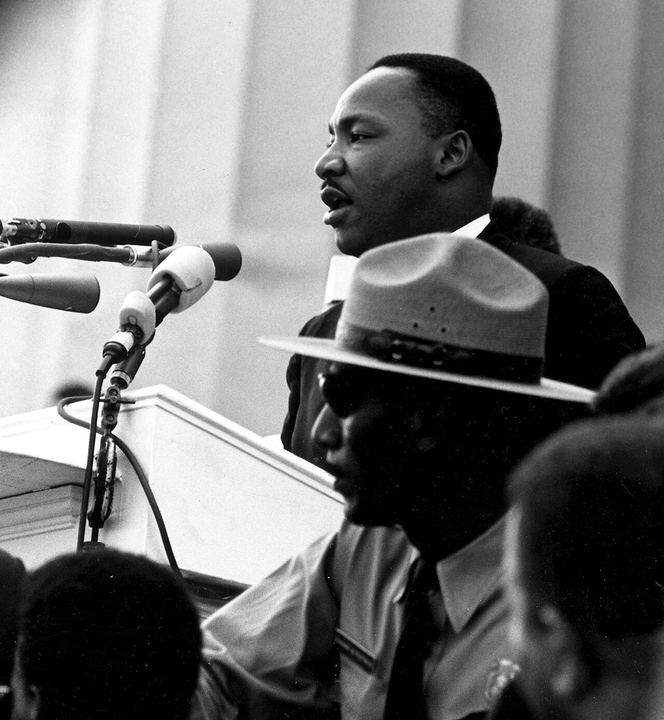
Martin Luther King Jr. gave this address on 28 August 1963 from the steps of the Lincoln Memorial, near the end of the March on Washington for Jobs and Freedom. The march, led by A. Philip Randolph and organized chiefly by Bayard Rustin, drew roughly a quarter of a million people to the Mall to press for civil rights legislation then before Congress and for economic opportunity. It was the centennial year of the Emancipation Proclamation, and King began by echoing the archaic count of years in Lincoln's Gettysburg Address while standing in Lincoln's shadow. The first half is an argument built on a financial metaphor. The founders, King says, signed a promissory note in the Declaration and the Constitution guaranteeing every American the rights of life, liberty, and the pursuit of happiness; for Black citizens the nation has handed back a check that bounced. He will not accept that the nation's reserves of justice have run dry, and he insists that the moment is urgent, rejecting gradualism. He then warns his own followers: the struggle must be carried on with dignity and discipline, without bitterness or physical violence, and without distrust of the many white Americans who had joined the march. He lists the conditions under which they cannot be satisfied, from police brutality to the denial of the vote in Mississippi, and closes the section with Amos's words on justice rolling down like waters. The second half, partly extemporized, turns to vision. In a series of sentences beginning with the title phrase King imagines the nation living out the creed of human equality, the children of former slaves and former slaveholders at one table in Georgia, his own four children judged by their character, and Black and white children in Alabama joining hands. He quotes Isaiah's prophecy of every valley exalted. The speech ends with a second refrain on letting freedom ring from hills and mountains across the country, from New Hampshire to Mississippi, and with the words of an old spiritual. The speech was carried live on television, and within a year the Civil Rights Act of 1964 had passed. It is now among the most widely recognized speeches in American history.
Virtues in this work
- Justice: King demands that the nation pay the debt of equal citizenship promised in the Declaration and the Constitution.
- Hope: He will not concede that the nation has nothing left to pay in justice, and he closes with a vision of reconciliation grounded in Isaiah's prophecy.
- Charity: He warns his followers against bitterness and hatred and welcomes the white marchers as allies whose destiny is tied to their own.
- Fortitude: He honors the veterans of suffering and jail and sends the marchers back to Mississippi and Alabama to continue the struggle.
Plot or Argument
- Opening: a hundred years after emancipation
King recalls the Emancipation Proclamation, issued a century before by the president whose memorial stands behind him, and contrasts its promise with the continued segregation and poverty of Black Americans in 1963.
- The bad check and the urgency of the moment
The founding documents are pictured as a promissory note owed to every citizen, and the nation as a debtor who has defaulted. King refuses to accept that justice is bankrupt, demands payment now, and warns that there will be no rest until citizenship rights are granted.
- Counsel to the movement and the conditions of satisfaction
King turns to his followers, urging nonviolence, discipline, and continued fellowship with white allies. He answers those who ask when the movement will be satisfied with a list of specific grievances, ending in the prophet Amos, and sends the marchers home to the South with hope.
- The dream refrain
Departing from his prepared text, King describes his dream in a series of parallel sentences: the nation true to its creed, brotherhood in Georgia, justice in Mississippi, his children judged by character, children joining hands in Alabama, and Isaiah's vision of the glory of the Lord revealed.
- Let freedom ring and the closing spiritual
Quoting the patriotic hymn America, King calls for freedom to ring from mountains in every region, including Stone Mountain in Georgia and Lookout Mountain in Tennessee, and closes by imagining all God's children singing an old spiritual of deliverance.
Key claims
The main steps of the argument, in order, and how they fit together.
- A century after emancipation, Black Americans are still held back by segregation, discrimination and poverty.How it is supported: The contrast with the Emancipation Proclamation's centennial, given at Lincoln's memorial.
- The Declaration and the Constitution are a promissory note guaranteeing life, liberty and the pursuit of happiness to every citizen.How it is supported: An extended financial metaphor about the founders' promise.
- The nation has defaulted on that note for its Black citizens, yet its reserves of justice are not exhausted.How it is supported: The image of a check returned for insufficient funds.
- The moment is urgent, and gradualism cannot be accepted while citizenship rights are still denied.How it is supported: An appeal to the urgency of the present and a warning against delay.
- The struggle must be carried on with dignity and discipline, without bitterness or physical violence.How it is supported: Direct counsel to his own followers.
- Many white Americans share the cause, so the movement must not distrust all white people.How it is supported: The presence of white marchers at the rally.
- The movement cannot be satisfied while police brutality, segregation and denial of the vote continue.How it is supported: A list of specific grievances closing with the prophet Amos on justice.
- In faith he hopes the nation will one day live out its creed as a reconciled brotherhood across color lines.How it is supported: Isaiah's vision, a patriotic hymn and a closing spiritual of deliverance.
Argument map
Supported by
- 3The nation has defaulted on that note for its Black citizens, yet its reserves of justice are not exhausted.
which rests on
- 1A century after emancipation, Black Americans are still held back by segregation, discrimination and poverty.
- 2The Declaration and the Constitution are a promissory note guaranteeing life, liberty and the pursuit of happiness to every citizen.
- 4The moment is urgent, and gradualism cannot be accepted while citizenship rights are still denied.
which rests on
- 7The movement cannot be satisfied while police brutality, segregation and denial of the vote continue.
- 5The struggle must be carried on with dignity and discipline, without bitterness or physical violence.
which rests on
- 6Many white Americans share the cause, so the movement must not distrust all white people.
- 8In faith he hopes the nation will one day live out its creed as a reconciled brotherhood across color lines.
Therefore
Plain-language summaries of the author's argument, not quotations.
Lessons
Holding a nation to its own promise
King does not ask America to adopt new principles; he asks it to honor the ones it already professes in the Declaration and the Constitution. The promissory-note metaphor frames civil rights as a debt owed under the nation's founding creed, which makes his appeal one of fidelity rather than revolution.
- Why does King describe the Declaration and the Constitution as a promissory note?
- What is gained by appealing to a nation's own founding words rather than to a new theory?
- Where else in history have reformers called a people back to principles it already claimed?
Righteous urgency without hatred
In one stretch of the speech King both insists that justice cannot wait and warns his followers against bitterness and physical force. He asks for a movement that is impatient with wrong yet charitable toward people, including the white Americans who had come to march.
- What does King tell his own followers they must not do, and why?
- How can someone be urgent about injustice without becoming bitter toward those responsible?
- Why does King mention the white marchers present that day?
Prophetic vision in the language of Scripture
The second half of the speech is shaped like a sermon. Its refrain, its quotation of Amos and Isaiah, and its closing spiritual draw on the Black church tradition in which King was trained, and they present racial reconciliation as part of God's purpose rather than only a political program.
- Which biblical prophets does King quote, and what does each passage add?
- How does the repeated title phrase change the speech from argument to vision?
- Can a political speech rightly use the language of prophecy? What are its strengths and risks?
Context
By 1963 the civil rights movement had won court victories and mounted campaigns across the South, and the spring demonstrations in Birmingham, Alabama, met with police dogs and fire hoses, had moved national opinion. In June President Kennedy proposed a civil rights bill, and leaders of the major organizations, along with labor and church groups, planned a march on Washington to support it and to demand jobs. A. Philip Randolph, who had proposed such a march as early as 1941, chaired it, and Bayard Rustin organized it.
Composition
King worked on a prepared text with advisers in the days before the march. He had used the dream theme in earlier speeches, including a June 1963 address in Detroit. At the Memorial he followed his text through the first half, then departed from it; the gospel singer Mahalia Jackson is widely reported to have called out to him to tell the crowd about the dream. King registered copyright in the speech shortly afterward, and in 1999 a federal appeals court ruled that its public delivery had not placed it in the public domain; his estate holds the rights.
Reception
The three major television networks covered the march, and the speech reached a national audience. The Civil Rights Act was signed in July 1964 and the Voting Rights Act in August 1965. The speech has since become a fixture of American schooling and public commemoration; the spot where King stood is marked on the Memorial steps.
Comparisons
- gettysburg-address
King opens with a deliberate echo of Lincoln's archaic count of years and speaks at Lincoln's memorial, carrying the Gettysburg proposition of equality and new birth of freedom into the 1960s.
- sermons-and-letter-from-birmingham-jail
The Letter from Birmingham Jail, written in April 1963, makes at length the arguments the speech compresses: the urgency of the present, the failure of gradualism, and the scriptural and natural-law case for justice.
- the-founding-documents
King calls the Declaration and the Constitution a promissory note and quotes the Declaration's self-evident truth as the creed the nation must live out.
- narrative-and-fourth-of-july
Frederick Douglass's 1852 Fourth of July oration also measured the nation against the Declaration and appealed to its founding principles while describing the condition of Black Americans.
Quotes
Frequently cited
“they will not be judged by the color of their skin but by the content of their character”
Frequently cited
“Free at last! Free at last! Thank God Almighty, we are free at last!”
For Students
A reading companion for classical Christian high school students. See the student guide.
Reading Guide
Watch for
- The opening echo of the Gettysburg Address and the setting at the Lincoln Memorial in the centennial year of emancipation.
- The extended financial metaphor of the first half, in which the nation is a debtor and civil rights an unpaid obligation.
- The turn to King's own followers, where he warns against bitterness and physical force.
- The shift from prepared text to the dream refrain, with each sentence naming a place: Georgia, Mississippi, Alabama.
- The closing roll call of mountains, from New Hampshire to Stone Mountain and Lookout Mountain, ending in the spiritual.
Key terms and names
- March on Washington for Jobs and Freedom
- The demonstration of 28 August 1963 at which King spoke, organized to support civil rights legislation and economic opportunity.
- Emancipation Proclamation
- Lincoln's 1863 order declaring slaves in the rebelling states free; King opens by noting that a century has passed since it.
- Promissory note
- A written promise to pay; King's image for the guarantees of the Declaration and the Constitution, which he says the nation has not honored.
- Gradualism
- The view that civil rights should come slowly; King rejects it, insisting that the moment is urgent.
- Soul force
- King's phrase for the moral power of nonviolent resistance, which he sets against physical force.
- Spiritual
- A religious folk song from the tradition of enslaved African Americans; King closes with the words of one about final freedom.
Seminar Questions
- Comprehension What event does King recall at the opening, and why was 1963 a fitting year to recall it?
- Comprehension According to King's metaphor, what has the nation promised, and how has it failed to pay?
- Interpretation Why does King, in the middle of a speech demanding justice, stop to warn his own followers about how they must struggle?
- Interpretation How does the speech change when King begins the dream refrain? Compare its language and rhythm with the first half.
- Interpretation Why does King name specific places, such as the red hills of Georgia and Stone Mountain, instead of speaking only of the nation as a whole?
- Big Question What does it mean to judge a person by character, and why is that standard both simple and demanding?
- Big Question Can a nation's founding words bind later generations to live up to them? Where does that obligation come from?
Faith Connections
- Amos 5:24 (Scripture)
King quotes the prophet's call for justice to roll down like waters and righteousness like a mighty stream, ending the first half of the speech on the demand of a God who cares about how the poor are treated.
- Isaiah 40:4-5 (Scripture)
The prophecy that every valley shall be exalted and the glory of the Lord revealed to all flesh becomes the final dream, placing reconciliation within God's promise rather than human effort alone.
- Galatians 3:28 (Scripture)
Paul's teaching that in Christ there is neither Jew nor Greek, slave nor free, stands behind King's picture of all God's children joining hands.
- Augustine, On Free Choice of the Will I (Church Fathers)
In the Letter from Birmingham Jail that spring, King cited Augustine's teaching that an unjust law is no law at all; the speech's appeal to a higher justice above local custom rests on that tradition.
Logic and Rhetoric
Central argument: The nation's founding documents promised the rights of life, liberty, and the pursuit of happiness to all its citizens; a century after emancipation that promise remains unpaid to Black Americans; justice cannot wait, yet it must be pursued without hatred or violence; therefore the nation must honor its creed now, and the movement will press on in faith until the vision of a reconciled people is realized.
Rhetorical device: Anaphora. The title phrase begins each sentence of the dream refrain, and the call to let freedom ring begins each line of the closing roll of mountains, building the speech to its final quotation.
Debate: Resolved: King's appeal to the founding documents was more persuasive than an appeal to new principles would have been.
Writing Prompts
Essay: King's speech moves from argument in its first half to vision in its second. Analyze how the promissory-note metaphor and the dream refrain work together, and explain why the speech needs both.
Comparison with The Gettysburg Address: King opens his speech with an echo of the Gettysburg Address and delivers it at Lincoln's memorial. Compare how Lincoln and King each interpret the proposition that all men are created equal and what each asks of the living.
Creative Prompts
- Classroom
Watch or listen to a recording of the speech and mark the point where King leaves his prepared text; discuss how his delivery, pace, and the crowd's response change from that moment.
- Essay
Trace the financial metaphor of the first half (note, check, bank, vaults) and explain why King chose the language of debt and payment to describe the claims of Black Americans.
- Fiction
Write the day of the march from the point of view of a teenager who rode a chartered bus from the South to Washington and stood near the Reflecting Pool.
Further Reading
- A Testament of Hope: The Essential Writings and Speeches of Martin Luther King, Jr., Martin Luther King Jr., ed. James M. Washington
Authorized collection that includes the speech.
- Parting the Waters: America in the King Years, 1954-63, Taylor Branch
Pulitzer Prize-winning narrative ending with the year of the march.
- The Dream: Martin Luther King, Jr., and the Speech That Inspired a Nation, Drew D. Hansen
Close study of the speech's composition, sources, and delivery.
- Strength to Love, Martin Luther King Jr.
King's 1963 collection of sermons, showing the preaching from which the speech's style grew.
Verification notes
Date, place, organizers, and the speech's outline are well documented. Crowd estimates vary; roughly a quarter of a million is the common figure. The speech is under copyright held by the King estate, so this record quotes only the two standard lines named for it and otherwise paraphrases. The order of the dream sentences is given from standard published texts; the call from Mahalia Jackson is reported by witnesses and repeated in most accounts.
- Speech text is under copyright; check quotations against an authorized edition before publication.