Work record
Hans Brinker, or the Silver Skates
1865 · 19th Century · Novel · English
Abstract
Background. A widowed New York writer who had not yet seen the Netherlands, Dodge set out to join a domestic tale with a book of travels, drawing on Dutch histories and friends. James O'Kane issued it with pictures by Darley and Nast.
Plot. Near Broek a poor family endures a father whose mind has been clouded since a flood-time fall, a vanished store of savings and a silver watch entrusted to the mother. While the son pleads with Holland's foremost surgeon, a band of wealthier boys tours the canals to The Hague, meeting museums, a thief and a famous legend of the dike. An operation restores Raff, his recovered memory leads to the hidden money and to the surgeon's missing son, and a race on the river decides the coveted prize.
Form. Chapters alternate between the cottage and the excursion, so that Dutch history, art and customs are woven through the family story.
Themes. Self-sacrifice, fidelity under hardship, kindness across class, providence in suffering, and the healer's calling.
Significance. Translated widely and honored in France, it fixed for generations of readers the picture of Holland as a land of skaters, windmills and watchful dikes, and gave the world its best-known version of the little Haarlem hero.
Main characters
- Hans Brinker: Diligent peasant boy who seeks a surgeon for his father
- Gretel Brinker: His nimble younger sister, a goose girl
- Raff Brinker: Dike laborer left senseless by a fall during a flood
- Dame Brinker: Resolute mother who nurses Raff and guards a mysterious watch
- Dr. Boekman: Gruff celebrated surgeon mourning a son who vanished
- Peter van Holp: Leader of the boys' skating expedition
- Ben Dobbs: English visitor who sees Holland with fresh eyes
- Hilda van Gleck: Generous burgomaster's daughter who befriends the Brinkers
- Annie Bouman: Playful friend who becomes Hans's wife

Summary
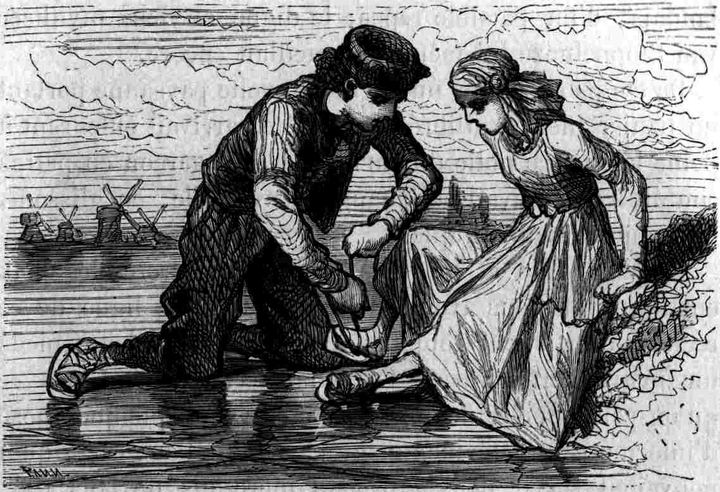
On a cold December morning in Holland, fifteen-year-old Hans Brinker and his twelve-year-old sister Gretel skate on the canal near the village of Broek on wooden runners Hans has carved himself. Their family is very poor. Ten years earlier their father, Raff Brinker, a brave worker on the dikes, fell while fighting a flood and struck his head; he recovered from the fever but not from the injury, and now sits dull and confused, not knowing his own wife and children, and sometimes becomes dangerous. On the night before his fall he gave his wife Meitje a silver watch to keep until he asked for it, and the family's savings of a thousand guilders vanished the same day. Dame Brinker refuses to sell the watch, however hungry they become. A grand skating race is announced for the twentieth of December, Mevrouw van Gleck's birthday, with a pair of silver skates as the prize. The kind rich girl Hilda van Gleck gives Hans money and orders a carved wooden chain from him, and the peasant girl Annie Bouman befriends him. On his way to buy real skates, Hans meets the famous and gruff surgeon Dr. Boekman and offers him the money to examine his father. Much of the book then follows a group of boys led by Peter van Holp, with Jacob Poot and his English cousin Ben Dobbs, on a skating journey from Broek through Amsterdam, Haarlem and Leyden to The Hague, seeing churches, paintings, windmills and museums. Along the way Hans returns Peter's lost purse, Peter catches a robber at their inn in Leyden, and Ben hears the story of the little boy who held his finger in a leaking dike all night to save Haarlem. When Raff grows worse, Dr. Boekman operates to relieve pressure on his brain. Raff wakes knowing his family and thinking only a night has passed. He remembers burying the money by a willow tree; after a vain search, Hans finds the pot by the stump of the old tree, which had been cut down. Raff also remembers that the watch was given him by a frightened young man who believed he had killed someone and fled Holland. The initials on it prove the youth to be Laurens, Dr. Boekman's lost son, who had mistakenly prepared a poison but never administered it. At the race Gretel wins the girls' silver skates; Hans gives his own strap to Peter, who wins the boys' prize. The maker's name on Gretel's skate case, Thomas Higgs of Birmingham, leads to Laurens, who returns to his father. Dr. Boekman offers to train Hans as a surgeon, and the last chapter tells how he grows up to be the famous Dr. Brinker and marries Annie. The book was published in New York by James O'Kane in 1865.
Virtues in this work
- Charity: Hans gives his skate strap to Peter just before the race, giving up his own chance at the silver skates.
- Fortitude: Dame Brinker nurses her injured husband for ten years and keeps the family alive by spinning, knitting and gardening.
- Industry: Hans carves, studies, rides the towing horses and finds work to support his family, and later studies hard to become a surgeon.
- Faith: Before consenting to the operation, Dame Brinker prays, and after Raff wakes the family kneels and reads a chapter from the Bible.
- Honor: Hans returns Peter's lost purse of sixty guilders and refuses a reward.
Plot or Argument
- Chapters 1-7: The Brinker cottage
Hans and Gretel skate on homemade runners; the race for the silver skates is announced; Hilda van Gleck orders a chain from Hans; the mystery of the watch and the lost guilders is told; Hans meets Dr. Boekman on the ice.
- Chapters 8-11: Saint Nicholas and Amsterdam
Jacob Poot's English cousin Ben arrives; the children keep the Feast of Saint Nicholas; the boys set out on their journey and see the sights of Amsterdam.
- Chapters 12-18: To Haarlem
Peter loses the boys' purse and Hans returns it, telling of his father's attack on his mother; Peter promises to find Dr. Boekman; at Haarlem the boys see the great organ, and Ben hears the tale of the boy who saved the town by stopping a leak in the dike.
- Chapters 19-30: Leyden, The Hague and home
Jacob tires and the plan changes; Peter catches a robber at the inn in Leyden; the boys visit Peter's married sister in The Hague and the Palace in the Wood, then skate home.
- Chapters 31-37: The operation and the awakening
Dr. Boekman operates on Raff while Gretel runs outside and falls asleep in the snow, where Hilda finds her and makes her walk to keep warm; Raff wakes after ten years and asks for a chapter from the Bible.
- Chapters 38-43: The guilders and the watch
Raff tells where he buried the money; Hans finds it beside the old willow stump; Raff remembers the young man with the watch, and Dr. Boekman recognizes his son's initials.
- Chapters 44-48: The race and broad sunshine
Gretel wins the silver skates and Hans gives Peter his strap; Gretel's skate case leads to Thomas Higgs, who is Laurens Boekman; Dr. Boekman takes Hans as his student, and the Conclusion tells what became of everyone.
Characters
- Hans Brinker, hero
A poor, hardworking fifteen-year-old who carves, studies, cares for his family and seeks a cure for his father.
- Gretel Brinker, Hans's sister
A quick, shy twelve-year-old goose girl who wins the girls' silver skates.
- Raff Brinker, father
A dike worker injured in a flood ten years before the story, restored by surgery.
- Dame Brinker (Meitje), mother
A strong, sharp-tongued and faithful wife who keeps the family going and guards the watch.
- Dr. Boekman, surgeon
Holland's most famous surgeon, gruff outside and kind within, grieving for his lost son.
- Laurens Boekman (Thomas Higgs), the doctor's son
The young man who fled Holland believing he had caused a death and lives as a manufacturer in Birmingham.
- Hilda van Gleck, burgomaster's daughter
A rich and generous girl who befriends the Brinkers and plans the race.
- Annie Bouman, peasant girl
A cheerful friend of Hans who sells his skates for him and later marries him.
- Peter van Holp, captain of the skating party
A good-hearted leader who carries Hans's message to Dr. Boekman and wins the boys' race.
- Ben Dobbs, English cousin
Jacob Poot's English cousin, through whose eyes the reader sees Holland.
- Jacob Poot, skater
A fat, sleepy, good-natured boy whose tiredness changes the boys' route.
- Rychie Korbes and Carl Schummel, proud children
Wealthy schoolmates who sneer at the Brinkers' poverty.
Lessons
Putting others first
Hans offers his skate money to Dr. Boekman for his father's sake, later lets Annie sell his new skates to help the family, and in the race gives his strap to Peter. Each time he chooses someone else's good over his own wish. Dodge shows that this kind of giving is not weakness: it wins Hans the trust of Peter and of Dr. Boekman.
- Why does Hans give Peter his strap even though he might have won?
- What does Hans offer Dr. Boekman when he meets him on the ice?
- Is it ever hard for you to let someone else have the prize?
Faithfulness in hard times
For ten years Dame Brinker cares for a husband who does not know her and refuses to sell the watch he trusted to her, even when the family is near starvation. Her faithfulness is rewarded when Raff wakes and the watch brings Dr. Boekman his son. Keeping a promise can matter long after it seems to make sense.
- Why will Dame Brinker not sell the watch?
- How does the watch help bring Laurens home?
Rich and poor
Rychie and Carl look down on Gretel as a goose girl, while Hilda and Peter treat the Brinkers as friends. At the race, Gretel's win shows that worth does not depend on money. The Conclusion tells what became of the proud and the kind.
- How does Hilda treat Hans and Gretel differently from Rychie?
- What happens to Carl Schummel when he grows up, and why does the author tell us?
- Why do you think Gretel wins the race?
A whole country holding back the sea
Dodge describes how Holland lives below the level of the sea, protected by dikes that need constant watching. Raff was hurt defending a dike, and the story of the boy of Haarlem shows a child giving everything to stop a leak. Lambert says the boy stands for the spirit of the whole country.
- What is a dike, and why is it so important in Holland?
- What does the boy of Haarlem do, and what does it cost him?
- What does Lambert mean when he says a million fingers are ready to stop a leak?
Context
The story is set in the Netherlands about twenty years before the 1873 Letter from Holland printed with later editions, when canals froze hard enough for long-distance skating and much of the country lay below sea level behind dikes. Dodge filled the boys' journey with Dutch history, including the siege of Leyden in 1574 and the painters of Haarlem, and with customs such as the Feast of Saint Nicholas on 5-6 December. In her preface she says that the descriptions of Dutch places and customs were given with scrupulous care and that the story of Raff Brinker is founded on fact.
Composition
Dodge wrote the book in New York as a young widow, before she had visited Holland, drawing on histories of the Dutch Republic and on Dutch friends who checked her descriptions. It was published by James O'Kane in New York in 1865 with illustrations by F. O. C. Darley and Thomas Nast. Her Letter from Holland, dated Amsterdam, 30 July 1873, records her first visit and her pleasure at finding a Dutch translation of the book.
Reception
The book became one of the most popular American children's novels of the nineteenth century, was translated into many languages, and received an award from the French Academy. Its story of the boy who saves Haarlem by stopping a leak in the dike became so well known abroad that the Dutch later raised statues to the legendary boy, though the tale was not Dodge's invention and is not Dutch history.
Comparisons
- heidi
Both books, written a few years apart, carry readers to a European country through a poor child's devotion to family, and both include a doctor who becomes a friend of the household.
- little-women
Published three years later, Little Women also shows a household holding together through poverty and a father's absence, with a mother as its steady centre.
- little-lord-fauntleroy
Both stories set a good-hearted child among rich and proud people and let kindness soften a gruff old man: Dr. Boekman here, the Earl there.
- the-railway-children
In both books children of a struggling household help bring a lost father home, and an old gentleman of standing becomes their friend.
- pollyanna
Both books turn on an injury and a hoped-for cure; Pollyanna's cheerfulness and Hans's quiet hard work are two ways of meeting trouble.
Quotes
Frequently cited
“Say what God tells thee, Mother”
“we must be nearer starvation than this before we turn faithless to the father!”
“I am no beggar, mynheer”
“Not a leak can show itself anywhere either in its politics, honor, or public safety, that a million fingers are not ready to stop it, at any cost.”
“you have called me your friend. Take this strap--quick!”
“It is an ugly business, boy, this surgery”
“It calls for wisdom, too, and a reverence for God’s work.”
For Students
A reading companion for classical Christian high school students. See the student guide.
Reading Guide
Watch for
- What Hans plans to do with his skate money when he meets Dr. Boekman on the ice.
- The story of the boy of Haarlem who holds his finger in the leaking dike all night.
- Where Gretel goes during her father's operation, and who finds her there.
- The old willow stump behind the cottage and what is buried beside it.
- What Hans does when Peter's skate strap breaks just before the race.
Key terms and names
- Dike
- A great wall of earth that keeps the sea and rivers from flooding the low land of Holland; Raff was hurt working on one.
- Mynheer
- The Dutch word for sir or mister, which Hans uses for Dr. Boekman and Peter.
- Guilder
- A Dutch coin; the Brinkers lost a thousand of them.
- Meester
- What the Brinkers call Dr. Boekman, meaning master or doctor.
- Burgomaster
- The mayor of a Dutch town; Hilda van Gleck is a burgomaster's daughter.
- Saint Nicholas
- The children's saint whose feast the Dutch children keep in December in the book.
Seminar Questions
- Comprehension What happened to Hans and Gretel's father ten years before the story begins?
- Comprehension Where had Raff Brinker hidden the thousand guilders, and how did Hans finally find them?
- Comprehension Who wins the silver skates?
- Interpretation Dr. Boekman looks cross and frightening. How does Hans know he is kind?
- Interpretation Why do you think the author tells the story of the boy who held back the sea right in the middle of the boys' trip?
- Interpretation Hans could have won the race. Did he lose anything when he gave Peter his strap?
- Big Question What makes someone truly rich?
Faith Connections
- Philippians 2:3-4 (Scripture)
Paul tells believers to look also on the things of others. Hans does this when he gives Peter his strap and when he thinks first of his father's cure.
- James 1:5 (Scripture)
If any lack wisdom, let him ask of God. When Dame Brinker must decide about the operation, Hans tells her to say what God tells her, and she prays before she answers.
- Ruth 1:16 (Scripture)
Ruth's whither thou goest, I will go matches Dame Brinker's ten years of faithful care for a husband who did not know her.
- Luke 10:25-37 and the Christian tradition of the physician (Great Conversation)
The Good Samaritan binds wounds out of mercy; Hans's wish to become a surgeon who cures the sick and crippled stands in this long Christian line of healing as service.
Logic and Rhetoric
Central argument: The Brinkers are poor and burdened, yet they stay honest, hardworking and faithful to each other and to God. Their faithfulness opens doors: the watch they refuse to sell brings Dr. Boekman his son, and Hans's honesty and unselfishness win him friends and a calling. Therefore patient goodness in hard times is rewarded, not always with prizes, but with restored families and useful lives.
Rhetorical device: story within a story. In Chapter 18 the tale of the boy who holds back the sea at Haarlem is read in an English schoolroom while Ben hears it in Holland, and it echoes Raff's own injury fighting the flood.
Debate: Resolved: that Hans was right to give Peter his skate strap instead of racing himself.
Memory Work
Say what God tells thee, Mother
It calls for wisdom, too, and a reverence for God’s work.
Writing Prompts
Essay: Choose two times in the book when Hans gives up something he wants. Explain what he gives up, why he does it, and what good comes of it.
Comparison with Heidi: Heidi and Gretel are both poor girls whom richer children help. Compare how each girl shows courage and how each one helps her family.
Medical Lens
The novel's plot rests on a head injury and its surgical cure. Raff Brinker falls on the dikes, has a fever, and is left for ten years with a dulled mind, childlike behaviour, outbursts of violence and, near the crisis, constant pressing of his hands to his head; Dr. Boekman diagnoses pressure on the brain and operates in the cottage, with an assistant, an earthen basin of water and a case of instruments, after recalling a colleague's removal of a dark sac under the skull in a similar case. The book does not name the procedure; a reader of the period would recognize trephining, and a modern reader may think of a chronic subdural collection, but that is a retrospective guess. Raff's awakening with his memory stopped at the day of the accident, asking about the baby and calling his fifteen-year-old son little Hans, is vividly drawn. The book also shows informed consent of a sort: the surgeon explains to Hans that the operation may kill, and the mother decides. Dr. Boekman's son flees after mistakenly preparing a deadly poison for a patient, a dispensing error caught before it was given. Dame Brinker's years of nursing, Dr. Boekman's warning against noise and food after surgery, and his prescription of peace and cheerfulness are period details of home care. Hans's vocation, and his answer that surgery calls for a reverence for God's work, give the book a lasting appeal to future physicians.
- Chapter 5, Shadows in the Home
Dame Brinker tells how Raff was brought home from the flooded dike with his head bruised and cut, and how the fever passed but the dullness grew.
- Chapter 14, Hans
Hans tells Peter how his father held his mother to the fire and afterward slept in a fever with his hands pressed to his head.
- Chapter 32, The Crisis
Dr. Boekman discusses the case with his assistant Vollenhoven, explains the risk to Hans, obtains the mother's consent and begins the operation.
- Chapter 34, The Awakening
Raff wakes believing he is still on the dike in the flood, recognizes his wife, and asks after the baby.
- Chapter 43, A Discovery
Dr. Boekman explains that his son prepared the wrong medicine, a deadly poison, which was never given.
- Chapter 47, Broad Sunshine
Hans praises surgery as the grandest thing on earth and Dr. Boekman offers to train him as his successor.
Listen to the book
Public-domain audiobook from LibriVox, read by Mark F. Smith. Recording: Hans Brinker or The Silver Skates on LibriVox (Internet Archive).
LibriVox recordings are volunteer readings released into the public domain. The reading may follow a different edition from the text in this library.
Creative Prompts
- Classroom
Trace the boys' skating route on a map of Holland, from Broek to Amsterdam, Haarlem, Leyden and The Hague, and have each student report on one sight they saw.
- Fiction
Write the night of the operation from Gretel's point of view, crouching in the snow outside the cottage.
- Dialogue
Write the first conversation between Laurens Boekman and his father after ten years apart.
Further Reading
- The Rise of the Dutch Republic, John Lothrop Motley
- Heidi, Johanna Spyri
- Little Women, Louisa May Alcott
Verification notes
Plot details, ages, place names and chapter titles follow the attached Project Gutenberg text (#764), which includes Dodge's preface and her 1873 Letter from Holland. Chapter numbers are counted from the table of contents. Publication by James O'Kane in 1865, the Darley and Nast illustrations and the French Academy award were checked against the Wikipedia article on the novel. That Dodge wrote before visiting Holland is stated in many accounts and fits the 1873 letter. The identification of Raff's condition with a modern diagnosis is interpretive. All quotes were found in the attached text.
- Confirm the name and year of the French Academy award (often given as the Montyon Prize).
- Confirm which histories Dodge used; Motley's Rise of the Dutch Republic (1856) is commonly named.