Work record
The Dream of the Rood
c. 700-750 (Ruthwell Cross); Vercelli Book c. 975 · Medieval · Poetry · Old English
Abstract
Background. Composed by an unknown English poet, the work survives complete in a single Italian-held manuscript, while fragments of its crucifixion passage were cut in runes on a Northumbrian stone cross long before. Its world is early English Christianity, devoted to relics of the true cross.
Content. A narrator describes a midnight vision of a gleaming, gem-studded tree that also runs with blood. The tree speaks: felled in a forest, it was raised on a hill, where a warrior-Christ mounted it eagerly. Forbidden to bend, it endured nails and mockery, mourned with all creation, was buried, and was later recovered and gilded. It then charges the visionary to preach its message and warns of judgment. Waking, the narrator vows devotion and longs to be carried to the heavenly banquet; the closing lines recall Christ's descent into hell.
Themes. Loyalty is reimagined as obedience to a Lord who chooses death. Shame turns into honor, so the gallows now gleams like treasure. Lonely exile on earth gives way to hope of the saints' fellowship.
Form. Most lines belong to the speaking cross, framed by the dreamer's account, and the verse uses the stressed, alliterating half-lines of Germanic poetry.
Significance. Students of Old English treat it as a central text, and it is the oldest English dream vision. It shows how converts fused heroic ideals with the theology of the Passion.
Main characters
- The Dreamer: Sinful, friendless narrator who sees the vision and is sent to proclaim it
- The Rood: The cross itself, speaking as a loyal servant made to bear its Lord's death
- Christ: The young Hero who mounts the cross willingly and later harrows hell

Summary
The Dream of the Rood is the oldest dream-vision poem in English and one of the great devotional poems of the early Middle Ages. A sleepless narrator, at midnight while others rest, sees a vast tree rising into the sky, wrapped in light and set with gold and jewels. As he gazes, the splendor flickers: at one moment the tree is adorned with treasure, at the next it is wet with blood from its right side. Aware of his own sins, the dreamer lies watching until the tree begins to speak. The cross then tells its own story. It was cut down at the edge of a forest, carried by enemies to a hill, and set up as a gallows for criminals. Christ appears not as a passive victim but as a young warrior who strips himself and eagerly climbs onto the cross to save mankind. The tree, which could have struck down its foes, must instead stand firm and obey its Lord: it is pierced with the same dark nails, mocked alongside him, and drenched with his blood. Darkness covers the earth and all creation weeps. Friends take down the body, lay it in a tomb, and sing a lament at evening. The crosses are then felled and buried, until the Lord's thanes find this one and adorn it with gold and silver. In its final address, the cross explains that the instrument of the worst torment has become the way of life, honored as Mary was honored above women. It commands the dreamer to tell the vision to others and describes Christ's return at the day of judgment. The dreamer wakes to a new resolve: he prays to the cross, admits he has few powerful friends left on earth, and longs for the day the rood will bring him to the heavenly feast. The poem closes with Christ's harrowing of hell, leading a host of freed souls home in triumph. The poem's power lies in its fusion of Germanic heroic loyalty with Christian theology of the Passion. It has been read as a meditation on the true cross, linked to liturgy for the feasts of the Cross and to the relic culture of the period.
Virtues in this work
- Fortitude: The cross stands fast through nails, mockery, and blood because its Lord commands it, and Christ climbs the gallows boldly before many witnesses.
- Faith: The dreamer ends by directing all his hope to the rood, trusting that it will carry him to the feast of the saints.
- Humility: The tree, once a criminal's gallows, accepts its humiliation in obedience before it is exalted, and the dreamer confesses himself stained with sins.
Plot or Argument
- The vision of the jeweled tree (lines 1-27)
The dreamer introduces the best of dreams, seen at midnight. A radiant tree towers into the air, covered with gold and five gems at the crossbeam, watched by angels and all creation. Its appearance alternates between glory and blood, and the sinful dreamer watches in fear until the wood begins to speak.
- The cross recounts the crucifixion (lines 28-56)
Speaking in the first person, the tree recalls being hewn down and set on a hill by enemies. The young Hero, Almighty God, strips himself and mounts it boldly to redeem mankind. The cross trembles but dare not bend or fall; it is pierced with nails, mocked with its Lord, and wet with his blood as darkness covers the land and creation mourns the King.
- Deposition, burial, and recovery (lines 57-77)
Followers take down the weary body and lay it in a tomb carved from bright stone, singing a lament at evening. The crosses are felled and buried in a deep pit, but friends of the Lord later find this cross and adorn it with gold and silver, a reference to the legend of the finding of the true cross.
- The exaltation and the commission (lines 78-121)
The cross now towers in honor and can heal those who reverence it; once the most hated punishment, it has become the right way of life, honored by God as Mary was honored above all women. It charges the dreamer to tell this vision to men, recounting Christ's death, resurrection, ascension, and coming judgment, when no one need fear who bears the cross in his breast.
- The dreamer's response and the harrowing of hell (lines 122-156)
Alone, the dreamer prays to the cross with a joyful heart. His friends have departed for heaven, and he hopes the rood will fetch him to the feast of the saints. The poem ends by recalling Christ's victorious return from hell with a band of rescued spirits, entering the kingdom to the joy of the angels.
Characters
- The Dreamer, Narrator and visionary
A man stained with sin and short of powerful friends, who receives the vision at midnight and is commissioned to proclaim it.
- The Rood (the Cross), Speaker of the central narrative
The tree that became the cross; it speaks like a loyal retainer forced to take part in its lord's death, and is afterward honored and adorned.
- Christ, The young Hero and Lord
Portrayed as a bold warrior-king who strips for battle and mounts the cross willingly, then rises, ascends, and harrows hell.
Lessons
Christ as the willing young Hero
The poet does not show Christ dragged to execution; he hastens with great courage and climbs the gallows to free mankind. In a warrior culture, this is how the poem makes the Passion legible as victory rather than defeat. The cross, not Christ, bears the visible suffering.
- Why might an Anglo-Saxon audience respond to a Christ who strips himself for battle more readily than to a passive sufferer?
- How does assigning the pain to the cross change the way the reader sees Christ's death?
- Does the heroic portrayal lose anything that the Gospel accounts of Gethsemane keep?
Obedience that costs everything
The cross repeatedly says that it dared not bend or break, though it could have felled its foes. Its loyalty to the Lord means taking part in his death. The poem thus pictures a faithful thane whose obedience requires him to stand still while his lord is slain.
- Why is standing firm harder for the cross than fighting would have been?
- Where else in literature does loyalty require someone to do nothing?
- What does the cross's obedience suggest about the Christian disciple's role?
The instrument of shame becomes a sign of glory
The poem's governing paradox is the transformation of a criminal's gallows into a jeweled beacon. The shifting vision of gold and blood at the opening teaches the reader to see both at once, much as Paul glories in the cross.
- Why does the dreamer see the tree alternately covered in jewels and in blood?
- How does the comparison between the cross and Mary help explain its new honor?
- Can suffering be transformed rather than simply ended? Where does the poem show this?
Context
The poem comes out of early English Christianity, which grew from the Roman mission to Kent (597) and the Irish mission to Northumbria. Veneration of the cross was strong in this period: relics of the true cross circulated in the West, and the feasts of the Finding and Exaltation of the Cross were observed. The poem draws on the vocabulary of Germanic heroic verse, with Christ as a lord and the cross and disciples as his retainers.
Composition
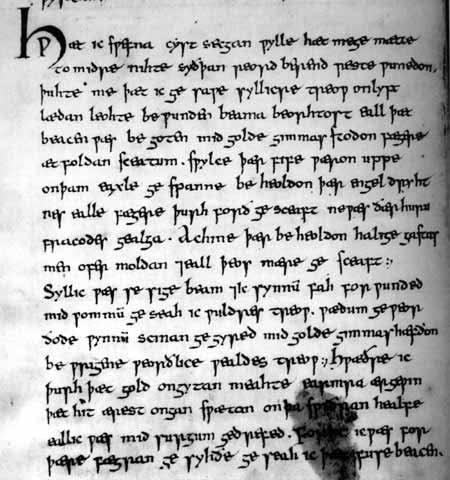
Lines corresponding to the crucifixion section were carved in runes on the Ruthwell Cross in Dumfriesshire, usually dated to the eighth century. The complete poem survives only in the Vercelli Book, a late tenth-century manuscript of Old English prose and verse kept in the cathedral library at Vercelli in northern Italy. The early eleventh-century Brussels reliquary cross carries a related inscription. The modern title is editorial.
Reception
The poem was little known until the Vercelli Book was studied in the nineteenth century. It is now a standard text in Old English courses and anthologies and has been widely translated. The Ruthwell Cross, damaged in the seventeenth century and later reassembled, stands inside Ruthwell church.
Comparisons
- caedmons-hymn
Both are early English Christian poems that recast the vocabulary of heroic verse for sacred subjects; Cædmon praises the Creator as guardian of the kingdom, while the Rood presents the Redeemer as a young warrior.
- beowulf
The cross speaks like a loyal thane, and Christ resembles a heroic lord; reading it beside Beowulf's account of lord-retainer bonds shows how the poet turned that ethic toward the Passion.
- journey-of-the-magi
Both poems tell the life of Christ through an eyewitness voice that is not a Gospel narrator: Eliot's aged Magus at the Nativity and the speaking tree at the crucifixion.
- the-bible
The cross's account follows the Passion narratives, including the darkness over the land (Matthew 27:45), the piercing of the side (John 19:34), and the burial in a rock-hewn tomb.
Quotes
Frequently cited
“Almighty God was He, Strong and stern of mind; He stied on the gallows high, Bold in sight of many, for man He would redeem.”
Frequently cited
“A rood was I upreared; I raised the mighty King, The Lord of Heaven; I durst not bend me.”
Frequently cited
“There wept all creation, Bewailed the King's death; Christ was on the cross.”
“Methought I saw a wondrous wood Tower aloft with light bewound, Brightest of trees;”
“Death tasted He there; yet the Lord arose With His mickle might for help to men.”
“Who bears in his breast the best of beacons;”
“May the Lord be my friend, Who here on earth suffered before On the gallows-tree for the sins of man!”
For Students
A reading companion for classical Christian high school students. See the student guide.
Reading Guide
Watch for
- The flickering vision in lines 13-23, where the tree is jeweled one moment and blood-soaked the next.
- The moment in line 28 when the dreamer stops narrating and the tree takes over in the first person.
- Christ stripping himself and climbing the cross in lines 39-41, presented as a warrior's eager deed.
- The cross's repeated insistence that it dared not bend, fall, or harm the men who nailed it.
- The final turn to the harrowing of hell in lines 147-156, which ends the poem in triumph instead of grief.
Key terms and names
- Rood
- Old English word for a pole or cross; in the poem it is the cross of the crucifixion, which names itself in line 44.
- Prosopopoeia
- Giving a voice to an object; most of this poem is spoken by the tree that became the cross.
- Dream vision
- A poem framed as a dream that reveals spiritual truth; here the dreamer sees the cross at midnight while others sleep.
- Thane
- A retainer bound in loyalty to a lord; the cross and the disciples behave like thanes, and the Lord's thanes later rescue the buried cross.
- Harrowing of hell
- Christ's descent to free the righteous dead; the poem's last lines show him returning with a band of spirits.
- Ruthwell Cross
- A carved stone cross in Dumfriesshire with runic lines matching part of the crucifixion section, evidence the poem's matter was known centuries before the Vercelli copy.
Seminar Questions
- Comprehension What does the dreamer see in the first section, and how does the appearance of the tree change as he watches?
- Comprehension According to the cross, what happened to it after Christ's body was taken down and buried?
- Interpretation Why does the poet let the cross, rather than Christ or a disciple, tell the story of the crucifixion?
- Interpretation The cross says it could have felled all its foes but stood fast. What kind of courage does this describe, and how does it differ from Christ's courage in the same scene?
- Interpretation How does the dreamer change between the opening, where he is stained with sins, and the close, where he prays with a joyful heart?
- Big Question Is it right to honor the instrument of a death, as the poem honors the cross, and what distinguishes such honor from idolatry?
- Big Question Can heroic ideals like loyalty and courage be fully taken up into Christian faith, or does the Gospel transform them into something different?
Faith Connections
- Galatians 6:14 (Scripture)
Paul's refusal to glory except in the cross of Christ is the paradox the poem stages, in which the gallows becomes a jeweled beacon.
- Philippians 2:5-11 (Scripture)
The hymn of Christ's self-emptying obedience unto death and his exaltation parallels the poem's movement from crucifixion to the cross towering in honor.
- Venantius Fortunatus, Vexilla Regis and Pange lingua (Church Fathers)
These sixth-century Latin hymns to the cross, written for a relic of the true cross, also praise the tree as noble and adorned with royal purple, a close cousin of the Rood-poet's vision.
- 1 Peter 3:18-20 (Scripture)
The reference to Christ preaching to the spirits in prison underlies the tradition of the harrowing of hell with which the poem ends.
Logic and Rhetoric
Central argument: The cross was the most shameful means of death; but Christ willingly died on it to redeem mankind and rose victorious; therefore the cross is now the sign of glory and the way of life, and whoever bears it in the heart need not fear judgment.
Rhetorical device: Prosopopoeia. From line 28 the tree speaks in its own voice, as in lines 44-45 where it says it was upreared and dared not bend.
Debate: Resolved: The Dream of the Rood's heroic portrait of Christ illuminates the Gospel accounts more than it alters them.
Memory Work
There wept all creation, Bewailed the King's death; Christ was on the cross.
A rood was I upreared; I raised the mighty King, The Lord of Heaven; I durst not bend me.
Writing Prompts
Essay: Analyze how the poet uses the language of lord, thane, and battle to present the crucifixion, and argue whether that language adds to or obscures the Gospel account.
Comparison with Beowulf: Compare the cross's loyalty to its Lord in The Dream of the Rood with Wiglaf's loyalty to Beowulf in the dragon fight. What does each poem think a faithful retainer owes his lord at the hour of death?
Creative Prompts
- Poetry
Write a short poem in the voice of another object present at the Passion (a nail, the spear, the stone of the tomb), keeping the Rood-poet's device of an object that must obey.
- Classroom
Compare a photograph of the Ruthwell Cross with the crucifixion section of Garnett's translation (roughly lines 39-64); have students identify which parts of the poem were carved in stone and discuss why those lines were chosen.
- Essay
Explain how the poem's opening alternation between gold and blood prepares the reader for the cross's later claim that the worst torment has become the way of life.
Further Reading
- The Dream of the Rood, Michael Swanton (ed.)
Standard student edition of the Old English text with introduction and notes.
- A Guide to Old English, Bruce Mitchell and Fred C. Robinson
Grammar and reader that includes the poem in Old English.
- Ritual and the Rood: Liturgical Images and the Old English Poems of the Dream of the Rood Tradition, Éamonn Ó Carragáin
Study of the Ruthwell Cross and the poem in their liturgical setting.
Verification notes
The manuscript facts (Vercelli Book, late tenth century; Ruthwell Cross runes related to lines of the crucifixion section) are well established. The Ruthwell Cross date is usually given as eighth century but remains debated, and the relation between the runic lines and the Vercelli poem is a matter of scholarly argument. Line numbers follow Garnett's line-for-line translation, which tracks the Old English lineation closely. Quotations are from Garnett's translation as stored, with his archaisms (sty, stied, mickle) kept.
No verification flags recorded.