Work record
Magna Carta
1215 · Medieval · Political Theory · Latin
Abstract
Background. After losing Normandy in 1204 and the battle of Bouvines in 1214, John faced rebel lords who seized London in May 1215. Talks mediated by Langton produced a sealed grant meant to restore peace.
Content. The opening clause frees the church and extends the grant to every freeman. Most provisions fix feudal payments, protect heirs and widows, curb sheriffs and forest officials, and safeguard towns and traders. Clause 12 ties extraordinary levies to the realm's counsel; clauses 39 and 40 forbid punishment without judgment by peers or the law of the land and promise unbought, prompt justice.
Enforcement. A committee of twenty-five lords could distrain the crown's castles and estates if John broke faith. Mutual oaths and a general pardon for offences committed during the quarrel close the document.
Afterlife. Rome quashed it within ten weeks and war resumed. Shortened reissues under Henry III, especially the 1225 version confirmed by Edward I in 1297, became statute; Coke and the Stuart-era Parliaments revived it, and American framers drew on its language of due process.
Translation. The library reproduces the 1915 English rendering prepared by White and Notestein for American students of English history. Clause numbers follow the modern editorial convention, since the sealed Latin parchments run on without any divisions.
Key figures
- King John: Angevin king who granted the charter to end a rebellion
- Stephen Langton: Archbishop of Canterbury and mediator, first of the named advisers
- Pope Innocent III: Overlord of England after 1213 who voided the charter
- William Marshal: Earl of Pembroke, later regent who reissued it
- Pandulf: Papal envoy named among the witnesses

Summary
Magna Carta, the "Great Charter," is the grant of liberties that King John of England sealed in the meadow of Runnymede, on the Thames between Windsor and Staines, on 15 June 1215. It was written in Latin and issued as a royal charter, but it was really a peace treaty: a large group of barons, angered by John's heavy taxation, his arbitrary fines and seizures, and his costly failed wars in France, had renounced their allegiance and taken London in May 1215. Archbishop Stephen Langton helped mediate the settlement. The text runs as one continuous document; the familiar division into 63 clauses was added by later editors. The charter opens with John's greeting to his officials and a list of the bishops and lords who advised him. Clause 1 grants that the English church shall be free, including freedom of church elections. Many of the following clauses regulate the feudal dues a lord could demand: the relief an heir paid to inherit (2-3), the conduct of guardians of underage heirs (4-6), and the rights of widows, who are not to be forced to remarry (7-8). Clause 12 forbids scutage or aid without the common counsel of the kingdom, except in three customary cases, and clause 14 explains how that counsel is to be summoned. Other clauses protect the liberties of London and other towns (13), require fines to fit the offence (20-22), limit the king's purveyors and sheriffs (23-33), set one standard of weights and measures (35), and allow merchants to travel safely (41). The best-remembered clauses are 39 and 40. No freeman is to be imprisoned, deprived of his lands, exiled or destroyed except by the lawful judgment of his peers or by the law of the land, and the king promises not to sell, deny or delay justice. Clause 45 requires royal officers who know the law. Clauses 47-53 deal with the royal forests and with wrongs done by John and his brother Richard. Clause 61, the security clause, sets up a council of twenty-five barons empowered to seize the king's castles and lands if he breaks the charter; clauses 62-63 pardon the quarrel and bind both sides by oath. The peace failed within weeks. At John's request Pope Innocent III declared the charter void on 24 August 1215, and the First Barons' War followed. After John died in October 1216, the regents of the boy-king Henry III reissued a revised charter in 1216 and 1217, and Henry issued the definitive text in 1225; Edward I confirmed it in 1297. Seventeenth-century lawyers such as Sir Edward Coke appealed to it against the Stuart kings, and American revolutionaries and constitution-makers treated it as an ancestor of due process and trial by jury. The library text is the English translation by Albert Beebe White and Wallace Notestein, published in Source Problems in English History (1915).
Virtues in this work
- Justice: Clauses 39 and 40 promise that no freeman will be punished without lawful judgment and that justice will be neither sold nor delayed.
- Prudence: The barons and Langton build practical safeguards such as the forty days' notice of clause 14 and the council of twenty-five in clause 61.
- Piety: John makes his grant first to God and begins by confirming the freedom of the English church in clause 1.
Plot or Argument
- Preamble
John greets his archbishops, bishops, earls, barons and officials and states that he grants the charter for the honour of God and the reform of the realm, on the advice of Archbishop Stephen Langton, other bishops, the papal envoy Pandulf, William Marshal and other named lords.
- The freedom of the church (clause 1)
The English church is to be free, with her rights entire and her liberties inviolate, including the freedom of elections John had already granted. The same clause grants the liberties that follow to all freemen of the kingdom and their heirs for ever.
- Feudal dues, wardship and widows (clauses 2-11)
Fixed reliefs for heirs, rules against guardians wasting an heir's land, marriage of heirs without disparagement, widows' dower and freedom not to remarry, and limits on the seizure of land for debt.
- Common counsel and the towns (clauses 12-16)
No scutage or aid beyond the three customary cases without the common counsel of the kingdom; clause 14 lays out how archbishops, bishops, abbots, earls and greater barons are to be summoned with forty days' notice. London and other towns keep their ancient liberties.
- Courts, fines and royal officers (clauses 17-38)
Common pleas are to be held in a fixed place; assizes are to be heard in the counties; fines must match the offence and be assessed by honest neighbours; sheriffs, constables and purveyors may not take corn, horses, carts or wood without payment or consent; weights and measures are standardized.
- Lawful judgment and justice (clauses 39-40)
No freeman may be taken, imprisoned, disseised, exiled or destroyed except by the lawful judgment of his peers or the law of the land, and justice is not to be sold, refused or delayed.
- Merchants, travel, officers and forests (clauses 41-51)
Merchants may come and go safely; free subjects may leave and return; only men who know the law are to be made justices and sheriffs; recently created royal forests are to be disafforested and evil forest customs investigated by juries of twelve knights.
- Redress of past wrongs (clauses 52-59)
John promises to restore lands, castles and rights taken without lawful judgment, to return hostages and charters, to dismiss named foreign officers and mercenaries, and to deal justly with the Welsh and with King Alexander of Scotland.
- Security and peace (clauses 60-63)
The liberties are to be observed by lords toward their own men as well. Clause 61 creates the council of twenty-five barons who may distrain the king if he breaks the charter. Clause 62 pardons the ill-will of the quarrel, and clause 63 repeats the grant and records the oath and the date at Runnymede.
Characters
- King John, grantor
King of England (1199-1216) who sealed the charter under pressure from rebel barons and soon sought its annulment.
- Stephen Langton, mediator
Archbishop of Canterbury named first among John's advisers in the preamble and a mediator between king and barons.
- Pope Innocent III, papal overlord
Named in clause 1 as confirming church elections; he declared the charter void in August 1215.
- William Marshal, royal adviser
Earl of Pembroke, named in the preamble; as regent for Henry III he reissued the charter in 1216 and 1217.
- Pandulf, papal envoy
Subdeacon of the papal household named in the preamble and in clause 62.
- The twenty-five barons, guarantors
Council chosen by the barons under clause 61 to enforce the charter against the king.
Lessons
The king under the law
Clauses 39 and 40 bind the king himself: he may not move against a freeman except by lawful judgment or the law of the land, and he may not sell or delay justice. The charter's lasting fame rests on this idea that even the highest ruler acts within settled law.
- What actions does clause 39 forbid the king to take against a freeman?
- Why might clause 40 single out selling and delaying justice?
- How does clause 45's demand for officers who know the law support clauses 39 and 40?
Consent to taxation
Clause 12 limits the king's power to raise scutage and aids to three customary cases unless the common counsel of the kingdom agrees, and clause 14 says who must be summoned. The barons were protecting their own purses, but later generations read these clauses as an early form of the principle that taxes need consent.
- What three occasions for an aid does clause 12 allow without common counsel?
- Who is summoned under clause 14, and who is left out?
- Why would later readers find more in clause 12 than the barons may have intended?
A charter as a peace treaty
Many clauses fix particular grievances, from fishweirs on the Thames to named foreign officers, and clause 61 gives twenty-five barons power to enforce the terms. Reading these clauses shows that the charter was a practical settlement made in a crisis, not an abstract declaration of rights.
- Which clauses deal with problems specific to 1215 rather than lasting principles?
- How does the security clause (61) try to make the king keep his word?
- Why do you think the peace broke down within a few months?
Liberty in layers
The charter grants liberties to the church, to freemen, to London and the towns, to merchants and to widows, and clause 60 asks lords to treat their own men by the same customs. Medieval liberty was a set of particular rights belonging to particular people and bodies.
- List three different groups that receive liberties in the charter.
- What does clause 60 ask of the barons themselves?
Context
Angevin kings had built a powerful system of royal justice and taxation in England. King John, who lost Normandy to Philip II of France in 1204, raised money for his attempts to recover it through scutages, heavy reliefs and arbitrary fines. His quarrel with Pope Innocent III over the election of Stephen Langton to Canterbury ended in 1213 when he submitted and made England a papal fief. After his defeat at Bouvines in 1214, many barons rebelled, took London in May 1215, and forced him to negotiate.
Composition
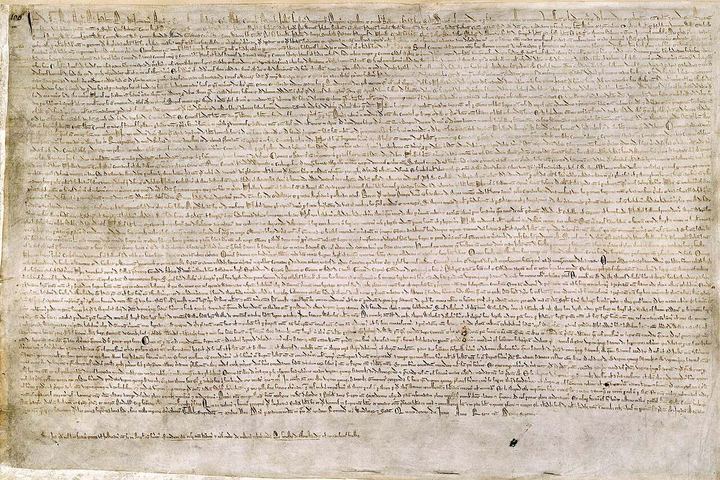
The barons' demands survive in a draft called the Articles of the Barons. The agreed charter was dated 15 June 1215 at Runnymede and sealed copies were sent out to the counties; four original 1215 exemplifications survive, two in the British Library and one each at Lincoln and Salisbury. The text is continuous Latin; numbering into 63 clauses came from later editors. This library uses the English translation printed in White and Notestein's Source Problems in English History (1915).
Reception
Innocent III annulled the charter on 24 August 1215 and civil war followed. Revised versions were issued in 1216, 1217 (alongside a separate Charter of the Forest) and 1225, when Henry III's charter became the standard text; Edward I's 1297 confirmation entered the statute roll, and a few of its chapters, including the substance of clauses 39 and 40, remain law in England. In the seventeenth century Sir Edward Coke and Parliament invoked the charter against the Stuart kings, and it shaped the vocabulary of due process and the law of the land in American colonies' charters, state constitutions and the Fifth Amendment.
Comparisons
- the-founding-documents
The Fifth Amendment's promise that no one be deprived of life, liberty or property without due process of law descends from clause 39's lawful judgment of peers and law of the land.
- commentaries-on-the-laws-of-england
Blackstone treats the Great Charter as a foundation of the absolute rights of Englishmen in Book I and himself edited the text of the charters in 1759.
- articles-of-confederation
Both documents limit a central authority by written terms: the barons bind a king with a council of twenty-five, while the American states bind their Congress by requiring nine states for major acts and unanimity for amendment.
- ivanhoe
Scott's novel portrays Prince John as a scheming regent under Richard I, giving students a fictional picture of the ruler who later sealed the charter.
- the-merry-adventures-of-robin-hood
Pyle's outlaw tales set forest law and greedy sheriffs at the centre, the same grievances the charter's forest and sheriff clauses (44-48) try to correct.
Quotes
Frequently cited
“No freeman shall be taken or imprisoned or disseised or exiled or in anyway destroyed, nor will we go upon him nor send upon him, except by the lawful judgment of his peers or by the law of the land.”
Frequently cited
“To no one will we sell, to no one will we refuse or delay, right or justice.”
“the English church shall be free, and shall have her rights entire, and her liberties inviolate”
“No scutage nor aid shall be imposed on our kingdom, unless by common counsel of our kingdom”
“We will appoint as justices, constables, sheriffs, or bailiffs only such as know the law of the realm and mean to observe it well.”
For Students
A reading companion for classical Christian high school students. See the student guide.
Reading Guide
Watch for
- The long list of advisers in the preamble, from Archbishop Stephen Langton to William Marshal, and why John names them.
- Clause 1 granting liberties first to the church and then to all freemen and their heirs for ever.
- Clauses 12 and 14 on scutage, aids and the common counsel of the kingdom.
- Clauses 39 and 40 on lawful judgment of peers, the law of the land, and justice not sold or delayed.
- Clause 61, where twenty-five barons are given power to enforce the charter against the king.
Key terms and names
- Freeman
- A person not bound as an unfree villein; clause 39 protects freemen, which in 1215 excluded much of the rural population.
- Scutage
- Shield money paid to the king in place of military service; clause 12 limits it without common counsel.
- Disseise
- To put someone out of possession of land or rights; clause 39 forbids it without lawful judgment.
- Amercement
- A money penalty for an offence; clause 20 requires it to match the offence and be assessed by honest neighbours.
- Relief
- The payment an heir owed the lord to take up an inheritance; clause 2 fixes the amounts.
- Runnymede
- The meadow on the Thames between Windsor and Staines named in clause 63 as the place where the charter was given.
- Law of the land
- The settled customs and laws of the realm, set beside judgment by peers in clause 39 as the only grounds for action against a freeman.
Seminar Questions
- Comprehension Who is named in the preamble as advising King John, and what reasons does he give for granting the charter?
- Comprehension According to clauses 39 and 40, what may the king not do, and on what grounds alone may he act against a freeman?
- Comprehension What power does clause 61 give the twenty-five barons if the king breaks the charter?
- Interpretation Why does the charter begin with the freedom of the English church before it reaches the barons' grievances?
- Interpretation Clause 12 protects the barons from new taxes. Is it fair for later readers to treat it as a principle of consent for the whole people?
- Interpretation What does clause 45, requiring officers who know the law, suggest about how John had governed?
- Big Question Can a promise extracted from a ruler under threat of force create lasting law, as Magna Carta eventually did?
Faith Connections
- Deuteronomy 17:18-20 (Scripture)
Israel's king is to copy the law and read it all his days, so that his heart be not lifted up above his brethren; the charter likewise sets the king beneath settled law.
- Deuteronomy 16:19 (Scripture)
Judges are forbidden to wrest judgment or take gifts, a close parallel to clause 40's promise not to sell or delay justice.
- Augustine, City of God IV.4 (Church Fathers)
Augustine asks what kingdoms are without justice but great robberies; the barons' complaints of arbitrary fines and seizures turn on the same distinction between rule and plunder.
- Thomas Aquinas, Summa Theologiae I-II, q. 90 (Great Conversation)
Aquinas defines law as an ordinance of reason for the common good made by whoever has care of the community, a definition against which the charter's limits on royal will can be read.
Logic and Rhetoric
Central argument: Because the king rules a realm with ancient customs and liberties, and because arbitrary seizures and fines have broken the peace, the king must bind himself and his heirs to act only by lawful judgment and the law of the land, and accept a council able to enforce that promise.
Rhetorical device: anaphora and parallelism. Clause 40 repeats to no one before each verb, building a compact triple promise against selling, refusing or delaying justice (quote 4).
Debate: Resolved: that clause 61's council of twenty-five barons was a wise means of making the king keep the charter.
Memory Work
No freeman shall be taken or imprisoned or disseised or exiled or in anyway destroyed, nor will we go upon him nor send upon him, except by the lawful judgment of his peers or by the law of the land.
To no one will we sell, to no one will we refuse or delay, right or justice.
Writing Prompts
Essay: Using clauses 12, 39, 40 and 61, explain how Magna Carta tries to limit the power of King John, and judge which method was most likely to last.
Comparison with The Founding Documents: Compare clause 39 of Magna Carta with the Fifth and Sixth Amendments of the Bill of Rights: what protections carry over, and what has been added?
Medical Lens
The charter is a legal and political settlement with no medical content. Its guarantees concern property, courts, taxation and the church.
Creative Prompts
- Dialogue
Write a conversation at Runnymede in June 1215 between Archbishop Langton, King John and a rebel baron, each arguing about clause 61's council of twenty-five.
- Classroom
Sort a printed list of the 63 clauses into groups (church, feudal dues, courts, towns and merchants, forests, past wrongs, security) and decide which groups still matter today.
- Essay
Explain how clauses 39 and 40, written to protect barons from King John, came to be read as protections for everyone.
- Fiction
Tell the story of a sheriff's clerk in 1215 who must carry a sealed copy of the charter to his county and read it aloud.
Further Reading
- Magna Carta, J. C. Holt
The standard scholarly study of the charter, its making and its afterlife.
- Magna Carta, David Carpenter
A new translation with a detailed commentary on each clause, published for the 800th anniversary.
- 1215: The Year of Magna Carta, Danny Danziger and John Gillingham
A readable account of England in the year of the charter.
- Commentaries on the Laws of England, William Blackstone
Book I treats the charter as a foundation of English liberties.
Verification notes
All five quotations were found by Grep in content/texts/magna-carta.txt (White and Notestein translation) and are cited by the conventional clause numbers printed in that file. The 1215 date, Innocent III's annulment of 24 August 1215, the reissues of 1216, 1217 and 1225, the 1297 confirmation and the four surviving exemplifications were checked against general reference sources. Langton's exact role in drafting is debated by historians and is stated cautiously. Clause groupings in plotOrArgument are approximate thematic divisions of a continuous text.
- Confirm the clause ranges used for the forest and redress sections (roughly 44-48 and 52-59) against a numbered Latin edition before citing them by number.
- Confirm which chapters of the 1297 statute remain in force in England at the date of publication.