Work record
Commentaries on the Laws of England
1765-1769 · 18th Century · Political Theory · English
Abstract
Background. Common law had long been learned by apprenticeship in London. Blackstone brought it into the university curriculum, first privately and then from a newly endowed chair, and turned his lectures into a book for readers outside the profession.
Scope. The full work covers persons, property, civil wrongs and crimes. This selection contains only the introductory lectures and the first volume, on persons and the public and private relations among them.
Content. The Introduction justifies legal education, sets English law beneath natural and revealed law, explains custom, statute and equity, and maps the realms under English jurisdiction. Book I proceeds from individual rights to the constitution of the legislature and the crown, then to magistrates, clergy, soldiers and subjects, and finally to the household relations and to corporate bodies.
Method. Each topic is divided into numbered heads, traced historically through statutes and reports, and justified by reason, so that a sprawling body of precedent appears as an ordered system. Latin and Law French terms are explained in plain English for the lay student.
Significance. The volumes became the standard introduction to law in Britain and especially America, where lawyers and judges of the revolutionary and early republican generations learned their common law from Blackstone, and courts there still consult it today.
Key figures
- William Blackstone: Oxford's first professor of English law, lecturing to future gentlemen and lawyers
- Charles Viner: Legal abridger whose legacy endowed the lectureship
- Sir Edward Coke: Jacobean jurist whose Institutes supply many authorities
- Sir Matthew Hale: Restoration chief justice quoted on Parliament as the highest court
- John Locke: Philosopher praised on liberty but resisted on the people's right of removal
- Montesquieu: French jurist cited on the balance and fragility of English liberty

Summary
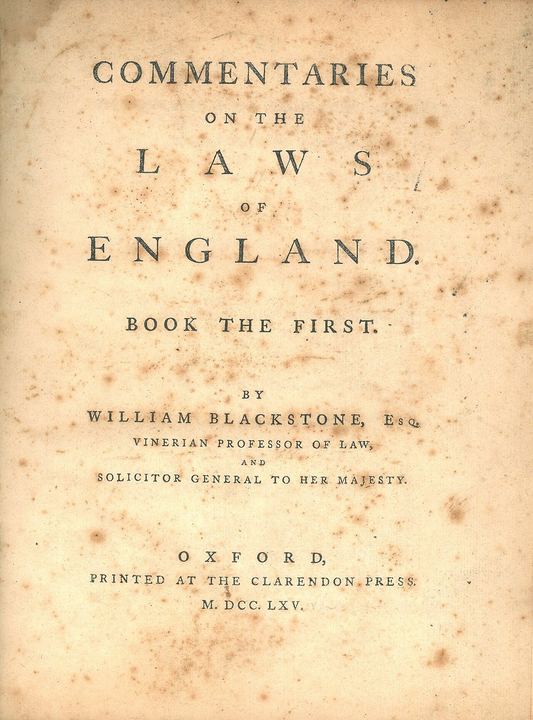
Sir William Blackstone's Commentaries on the Laws of England, published at Oxford by the Clarendon Press in four volumes between 1765 and 1769, grew out of the lectures he gave at Oxford from 1753 and as first Vinerian Professor from 1758. It was the first full account of English law written for educated readers rather than for practising lawyers, arranged as a reasoned system instead of a collection of cases. Volume I treats the Rights of Persons, II the Rights of Things (property), III Private Wrongs (civil remedies and procedure) and IV Public Wrongs (crimes). The library text is a selection: the Introduction and Book I from the first edition of 1765. Books II to IV are not included. The Introduction has four sections. The first, Blackstone's inaugural Vinerian lecture of 25 October 1758, argues that every English gentleman, as juror, magistrate, legislator or landowner, ought to know the laws of his country, and that the universities should teach them. The second, on the nature of laws in general, describes law as a rule of action prescribed by a superior: the law of nature, coeval with mankind and dictated by God, and the revealed law of Scripture are the foundations, and no human law should contradict them. The third distinguishes the unwritten common law, known through the decisions of courts and the customs of the realm, from statute law, and describes how equity and the civil and canon laws fit in. The fourth surveys the countries subject to English law: Wales, Scotland after the Union, Ireland, the islands, and the American plantations, which he classes as conquered or ceded lands where the common law did not automatically apply. Book I begins with the absolute rights of individuals: personal security (life, limbs, body, health and reputation), personal liberty, and private property, protected by auxiliary rights such as Parliament, limits on the royal prerogative, access to the courts, petition, and arms for defence. Chapter 2 describes Parliament, whose power Blackstone calls so great that what it does no authority upon earth can undo. Chapters 3 to 8 treat the king: his title, family, councils, duties, prerogative (the king can do no wrong, and never dies) and revenue, which includes the custody of idiots and lunatics. Chapters 9 to 13 describe magistrates, aliens and natives, the clergy, the civil state of nobility and commons, and the army and navy. The private relations follow: master and servant, husband and wife (the doctrine of coverture, by which husband and wife are one person in law), parent and child, and guardian and ward. The final chapter treats corporations. The Commentaries were reprinted in Philadelphia in 1771 to 1772 and became the chief textbook of law in the young United States, read by the founding generation and by later students including Abraham Lincoln.
Virtues in this work
- Justice: Book I, ch. 1 makes the protection of each person's security, liberty and property the principal aim of society.
- Prudence: Blackstone defends following precedent because accumulated judgments are wiser than any single judge's private opinion.
- Piety: Introduction §2 roots every human law in the law of nature dictated by God and in revealed Scripture.
- Charity: Chapter 8 casts the crown as trustee for lunatics, preserving their estates for their use should they recover.
Plot or Argument
- Introduction §1: why gentlemen should study the law
Blackstone's opening lecture regrets that English law has been left to the Inns of Court while the universities taught only Roman law. Every gentleman may serve as juror, justice of the peace, member of Parliament or peer, and needs to know the law he administers; landowners, clergy and physicians also benefit. He describes Charles Viner's benefaction and the statutes of the new professorship.
- Introduction §2: law of nature, revelation and human law
Law is a rule of action prescribed by a superior. God has laid down the law of nature, which commands each person to pursue true happiness and is known by reason; because reason is corrupt, God has also given the revealed law of Scripture. On these two foundations depend all human laws, which may regulate things indifferent but may not contradict natural or divine law. Blackstone then discusses the law of nations and the nature of municipal law, sovereignty, and the forms of government.
- Introduction §3: the common law, statutes and equity
English law is divided into the unwritten law, general customs known through the records and reports of the courts and the writings of judges, together with particular customs and the civil and canon laws received in certain courts, and the written law of statutes. Precedents are to be followed unless clearly contrary to reason or divine law. Blackstone gives rules for interpreting statutes and describes equity as the correction of law where it is deficient by reason of its universality.
- Introduction §4: the countries subject to the laws of England
Wales was united with England under Henry VIII; Scotland keeps its own laws under the Union of 1707; Ireland has its own parliament but is bound by English acts that name it; the Isle of Man and the Channel Islands have their own customs. Settlers in an uninhabited land carry English law with them, but conquered or ceded countries keep their own laws until the king alters them, and Blackstone places the American plantations in this second class, so the common law has no authority there except as their own legislatures adopt it.
- Book I, ch. 1: the absolute rights of individuals
The principal aim of society is to protect individuals in the enjoyment of their absolute rights, which in England are three: personal security, personal liberty, and private property. They are guarded by five auxiliary rights: the constitution and powers of Parliament, limits on the king's prerogative, the right to apply to the courts, the right to petition, and the right to have arms for defence. Blackstone traces these rights through Magna Carta, the Petition of Right, the Habeas Corpus Act, the Bill of Rights and the Act of Settlement.
- Book I, ch. 2: Parliament and its supreme power
Blackstone describes the King, Lords and Commons, their customs, immunities and procedure, and the passage of bills. The power of Parliament is transcendent and absolute and can change even the constitution itself. Against Locke's view that the people retain a supreme power to remove a legislature that betrays its trust, he argues that no existing system of law can adopt such a principle, since it would dissolve all government.
- Book I, ch. 3–8: the king, his prerogative and his revenue
The crown is hereditary but its descent may be altered by Parliament, as in 1688 and the Act of Settlement. The king's councils, his coronation duties and his prerogative follow: he is sovereign, perfect in the legal sense that he can do no wrong, and perpetual, since the king never dies. Chapter 8 lists the ordinary and extraordinary revenues of the crown, ending with the custody of idiots and lunatics and the procedure for finding a person non compos mentis.
- Book I, ch. 9–13: magistrates, subjects, clergy and armed forces
Blackstone describes sheriffs, coroners, justices of the peace, constables and surveyors of highways; the allegiance of natural-born subjects, denizens and aliens; the ranks and duties of the clergy; the civil state of nobility and commoners; and the law of the army and navy, with his preference for a militia over a standing army in time of peace.
- Book I, ch. 14–17: the private relations of persons
Four private relations complete the law of persons: master and servant, including apprentices and labourers; husband and wife, in which the wife's legal existence is incorporated in her husband's during marriage under the doctrine of coverture; parent and child, including the duties of maintenance, protection and education; and guardian and ward, with the ages at which an infant may act in law.
- Book I, ch. 18: corporations
Artificial persons, sole or aggregate, ecclesiastical or lay, are created by the king's charter or by Parliament so that rights may be kept in perpetual succession. Blackstone explains their powers, their visitation, and how they may be dissolved.
Characters
- Charles Viner, benefactor
Author of a vast abridgment of English law whose bequest founded the Oxford professorship Blackstone first held.
- Sir Edward Coke, authority
Jacobean judge and author of the Institutes, cited throughout as the great authority on the common law.
- Sir Matthew Hale, authority
Seventeenth-century chief justice, cited often as an authority; scholars regard his Analysis of the Law as a model for Blackstone's arrangement of persons, things and wrongs.
- John Locke, interlocutor
Cited with approval on liberty and law in Book I, ch. 1, but answered in ch. 2 on the people's power to remove a legislature.
- Montesquieu, authority cited
Called the president Montesquieu, quoted on the English constitution and its possible decline.
- King John, historical figure
The king who granted Magna Carta, the first of the great charters Blackstone lists as declarations of English rights.
Lessons
Human law rests on natural and revealed law
Blackstone begins his account of English law with God. The law of nature, dictated by God and binding everywhere, and the revealed law of Scripture are the two foundations; human laws regulate matters left indifferent and must not contradict them. Positive law, on this view, is a servant of a higher order.
- What reason does Blackstone give for why God added revelation to the law of nature?
- What kinds of questions does he say human laws may decide for themselves?
- What should a judge do, on Blackstone's view, if a statute contradicted the law of nature? Does he give a clear answer?
Three absolute rights of every Englishman
Book I, ch. 1 names personal security, personal liberty and private property as the absolute rights that society exists to protect. Blackstone shows that these rights would be words only without auxiliary rights: Parliament, limits on the crown, the courts, petition and arms. Rights need institutions to guard them.
- What does the right of personal security include, according to Blackstone?
- Why does he list auxiliary rights after the absolute ones?
- Which of the five auxiliary rights reappear in the American Bill of Rights?
Law as an inheritance of precedent
The common law is not a code enacted at a single time but a body of customs known through the decisions of judges, who are bound to follow precedent unless it is clearly absurd or unjust. Blackstone presents this as a source of stability and of liberty, since no single ruler can remake the law at will.
- How does Blackstone say the general customs of the realm are known?
- Why does he think judges should follow earlier decisions?
- What are the advantages and the dangers of law that grows by precedent rather than by legislation?
Every gentleman should know the law
In his opening lecture Blackstone argues that knowledge of law belongs to liberal education, because jurors, magistrates, legislators and landowners all exercise legal power. A free people that does not understand its laws cannot keep them.
- Which offices does Blackstone list that require knowledge of the law?
- Why does he think universities rather than only the Inns of Court should teach English law?
- Should every citizen today study the laws of the country? What would such study include?
The law as guardian of those who cannot guard themselves
Chapter 8's account of idiots and lunatics shows the crown acting as trustee for people unable to manage their affairs, preserving their property for them and forbidding the next heir to be the keeper of a lunatic, since he would gain by the person's death. Blackstone presents this protective duty as part of the king's office as general conservator of his people.
- How does the law treat an idiot differently from a lunatic, and why?
- Why may the next heir not be the committee of a lunatic's person?
- What does this chapter suggest about the purposes of royal power?
Context
Before Blackstone, English law was taught at the Inns of Court through apprenticeship and the reading of cases and statutes, while the universities taught Roman and canon law. The law itself was scattered across centuries of year books, reports, abridgments and Law French terminology. Blackstone wrote in the reign of George III, after the Seven Years' War had enlarged the British empire, and in a decade when the relationship between Parliament and the American colonies was being disputed. His account of parliamentary sovereignty and of the American plantations as conquered or ceded lands bore directly on that dispute.
Composition
Blackstone began private lectures on English law at Oxford in 1753. Charles Viner, who died in 1756, left money to found a professorship, and Blackstone was elected the first Vinerian Professor in 1758, opening with the lecture that became Introduction §1 on 25 October 1758. Unauthorized notes of the lectures circulated, and he prepared the Commentaries for print: Book I appeared in November 1765, Book II in 1766, Book III in 1768 and Book IV in 1769, all from the Clarendon Press. He revised the work through eight editions in his lifetime, sometimes altering passages after controversy. The library text gives the Introduction and Book I of the first edition of 1765 only.
Reception
The Commentaries were an immediate success in England and America. Robert Bell published an American edition in Philadelphia in 1771–1772, and Edmund Burke remarked in his speech on conciliation with America (1775) that nearly as many copies had been sold in America as in England. Jeremy Bentham attacked Blackstone's natural-law framework and his complacency toward English institutions in A Fragment on Government (1776). In the United States the work became the basic text of legal education; St. George Tucker published an annotated American edition in 1803, Hamilton cites Blackstone in Federalist 84, and Abraham Lincoln is recorded as having read the Commentaries in his early study of law. American courts still cite it as evidence of the common law at the time of the founding.
Comparisons
- magna-carta
Blackstone edited the Great Charter and the Charter of the Forest (1759), and in Book I, ch. 1 he places Magna Carta first in the line of declarations of the rights of Englishmen, reading clauses 39–40 as the root of personal liberty and due process.
- the-founding-documents
The Declaration's appeal to unalienable rights, the Constitution's provisions on habeas corpus and the Bill of Rights' guarantees of petition and arms all correspond to the absolute and auxiliary rights set out in Book I, ch. 1.
- second-treatise-of-government
Blackstone quotes Locke approvingly that where there is no law there is no freedom, but in Book I, ch. 2 he declines Locke's doctrine that the people may remove a legislature that breaks its trust, as inconsistent with any existing form of government.
- the-spirit-of-the-laws
Blackstone cites the president Montesquieu on the English constitution and his prediction that England would lose its liberty when the legislature became more corrupt than the executive, and his account of balanced King, Lords and Commons owes much to Book XI.
- the-federalist-papers
In Federalist 84 Hamilton quotes the judicious Blackstone on habeas corpus and arbitrary imprisonment to show that the Constitution already protects the liberties a bill of rights would list.
- articles-of-confederation
The Articles left each state its own courts and laws, so the received common law that Blackstone described remained the working law of the states, a situation the later federal judiciary inherited.
Quotes
“law of nature, being co-eval with mankind and dictated by God himself, is of course superior in obligation to any other.”
“the principal aim of society is to protect individuals in the enjoyment of those absolute rights, which were vested in them by the immutable laws of nature”
“THE right of personal security consists in a person's legal and uninterrupted enjoyment of his life, his limbs, his body, his health, and his reputation.”
“LIFE is the immediate gift of God, a right inherent by nature in every individual”
“this spirit of liberty is so deeply implanted in our constitution, and rooted even in our very soil”
“THE third absolute right, inherent in every Englishman, is that of property; which consists in the free use, enjoyment, and disposal of all his acquisitions, without any control or diminution, save only by the laws of the land.”
“the king himself can do no wrong; since it would be a great weakness and absurdity in any system of positive law, to define any possible wrong, without any possible redress.”
“A lunatic is indeed properly one that hath lucid intervals; sometimes enjoying his senses, and sometimes not, and that frequently depending upon the change of the moon.”
For Students
A reading companion for classical Christian high school students. See the student guide.
Reading Guide
Watch for
- The opening lecture of Introduction §1, where Blackstone argues that jurors, magistrates and legislators all need to know the law, and what that says about his audience.
- The ladder of laws in Introduction §2: law of nature, revealed law, law of nations, municipal law, and the claim that no human law may contradict the first two.
- The three absolute rights and five auxiliary rights in Book I, ch. 1, and the historical documents Blackstone cites for each.
- The contrast in Book I, ch. 2 between the omnipotence of Parliament and Locke's doctrine that the people may remove a faithless legislature.
- The distinction in Book I, ch. 8 between idiots and lunatics, and the safeguards the law places around those who cannot manage their affairs.
Key terms and names
- Common law
- The unwritten law of England, consisting of general customs known through the records of the courts and the decisions of judges, as opposed to statute law enacted by Parliament.
- Law of nature
- In Introduction §2, the will of God for human conduct, discoverable by reason and binding in all countries and at all times, superior in obligation to any human law.
- Absolute rights
- The rights that belong to individuals as such, apart from any social relation; in England, personal security, personal liberty and private property.
- Auxiliary rights
- The subordinate rights that protect the absolute ones: the powers of Parliament, limits on the prerogative, access to courts, petition, and arms for defence.
- Prerogative
- The special powers and pre-eminence that the law gives the king over all other persons, described in Book I, ch. 7 as including sovereignty, legal perfection and perpetuity.
- Non compos mentis
- The legal term in Book I, ch. 8 for a person who once had understanding but has lost the use of reason; the crown acts only as trustee of such a person's estate.
- Coverture
- The common-law doctrine described in Book I, ch. 15 by which husband and wife are one person in law and the wife's legal existence is incorporated into her husband's during marriage.
- Vinerian Professor
- The Oxford chair of English law founded under Charles Viner's will, which Blackstone was the first to hold, beginning in 1758.
Seminar Questions
- Comprehension What are the two foundations on which, according to Introduction §2, all human laws depend?
- Comprehension What three absolute rights does Blackstone name in Book I, ch. 1, and what does each include?
- Comprehension How does the law treat an idiot and a lunatic differently in Book I, ch. 8?
- Interpretation Blackstone says human laws may not contradict the law of nature, yet in Book I, ch. 2 he calls the power of Parliament absolute. How might these two claims be reconciled?
- Interpretation Why does Blackstone argue that the maxim the king can do no wrong protects the subject rather than placing the king above the law?
- Interpretation Why does Blackstone think the next heir should never be the keeper of a lunatic's person? What does this show about how the law reasons about motives?
- Big Question Are our rights given by God and nature, granted by government, or inherited from our ancestors? Which view does Blackstone hold, and does he hold only one?
- Big Question Is law better made by judges following precedent or by legislatures enacting statutes?
Faith Connections
- Romans 2:14-15 (Scripture)
Paul says the Gentiles, who have not the law, do by nature the things contained in the law, which is written in their hearts. Blackstone's law of nature, known by reason and binding in all countries, draws on this classic text of natural law.
- Genesis 2:7 (Scripture)
God breathed into man the breath of life. Blackstone's statement that life is the immediate gift of God, a right inherent by nature, grounds the first absolute right in creation.
- Thomas Aquinas, Summa Theologiae I-II, q. 95, a. 2 (Great Conversation)
Aquinas teaches that every human law has the nature of law only so far as it is derived from the law of nature. Blackstone's claim in Introduction §2 that no human law should contradict natural or revealed law stands in this tradition.
- Richard Hooker, Of the Laws of Ecclesiastical Polity, Book I (Great Conversation)
Hooker's ordered account of eternal, natural, divine and human law is the English model for Blackstone's ladder of laws in the second section of the Introduction.
Logic and Rhetoric
Central argument: God has established a law of nature, known by reason, and a revealed law, and all human laws depend on these. The principal aim of human society is to protect individuals in the natural rights of personal security, personal liberty and property. English law, built up through custom, precedent, statute and great charters such as Magna Carta, protects these rights better than other systems by means of Parliament, limits on the crown, open courts and the right of petition. Therefore English law deserves to be studied as a rational system by every citizen who will exercise legal power.
Rhetorical device: divisio (methodical division). Blackstone divides every subject into numbered heads, three absolute rights, five auxiliary rights, eighteen branches of revenue, so that the reader always knows where he stands in the system; Book I, ch. 1 is the clearest example.
Debate: Resolved: That a law contrary to the law of nature is no true law and does not bind.
Memory Work
THE right of personal security consists in a person's legal and uninterrupted enjoyment of his life, his limbs, his body, his health, and his reputation.
LIFE is the immediate gift of God, a right inherent by nature in every individual
Writing Prompts
Essay: Blackstone grounds human law in the law of nature and revelation, yet calls the power of Parliament transcendent and absolute. Using Introduction §2 and Book I, ch. 2, explain how he understands the relation between divine law and parliamentary sovereignty, and argue whether his position is consistent.
Comparison with Second Treatise of Government: Locke and Blackstone both hold that government exists to protect natural rights. Compare their accounts of those rights and of what happens when a legislature abuses its power, and argue which is the sounder guide for a free people.
Medical Lens
Book I is a primary source for the eighteenth-century law of insanity and incapacity. Chapter 8 distinguishes the idiot, without understanding from birth, whose lands the crown takes into ward for life, from the lunatic or person non compos mentis, who has lost reason by disease, grief or accident and whose estate the crown holds only as trustee in case of recovery. Blackstone notes the old association of lunacy with lucid intervals and the moon, includes under non compos mentis persons under frenzies and those who lose their intellects by disease, and treats a person born deaf, dumb and blind as legally like an idiot because the senses supply the mind with ideas, an echo of Lockean psychology. The Lord Chancellor's commission to inquire into a person's state of mind, decided by a jury, and the appointment of a committee of the person, but never the next heir, are early procedural safeguards in incapacity law. Chapter 1 defines personal security to include health, and states that the law protects life from quickening, so that killing a quick child by potion or blows was by ancient law homicide and in Blackstone's day a heinous misdemeanour. These are legal categories of 1765, not clinical diagnoses.
- Book I, ch. 1
Personal security defined to include health; life protected from the time an infant can stir in the womb; harms to health and limbs as injuries to the person.
- Book I, ch. 8 (eighteenth branch of the king's ordinary revenue)
Idiots and natural fools distinguished from lunatics; the writ de idiota inquirendo and the jury test of a person's understanding.
- Book I, ch. 8
Non compos mentis caused by disease, grief or accident; lucid intervals; persons under frenzies or losing intellect by disease; the crown as trustee for their recovery.
- Book I, ch. 8
The Lord Chancellor's commission of lunacy and the rule that the next heir may not be committee of the person.
Creative Prompts
- Classroom
Make a chart of the three absolute rights and five auxiliary rights in Book I, ch. 1, and beside each write the clause of the United States Constitution or Bill of Rights that corresponds to it.
- Dialogue
Write a conversation in 1774 between a Virginia lawyer reading his Philadelphia edition of Blackstone and a London barrister about whether Parliament may tax the colonies, drawing on Introduction §4 and Book I, ch. 2.
- Essay
Blackstone says every gentleman ought to know the laws of his country. Write the opening lecture of a course in law for high school students, modelled on Introduction §1.
Further Reading
- The Great Charter and Charter of the Forest, William Blackstone
Blackstone's 1759 edition of the medieval charters.
- A Fragment on Government, Jeremy Bentham
The famous 1776 attack on the Commentaries.
- Blackstone and His Commentaries: Biography, Law, History, Wilfrid Prest (ed.)
- William Blackstone: Law and Letters in the Eighteenth Century, Wilfrid Prest
- The Mysterious Science of the Law, Daniel J. Boorstin
A study of the Commentaries as an Enlightenment work.
Verification notes
The library text is a selection: the Introduction (four sections) and Book I (Of the Rights of Persons) from the first edition of 1765. Books II–IV (Rights of Things, Private Wrongs, Public Wrongs) are not included, and nothing in this record quotes them. All eight quotations were found by search in the stored text (content/texts/commentaries-on-the-laws-of-england.txt) and copied exactly; where a quotation starts a paragraph, its capitalized first word reproduces the edition's typography. Chapter and section locators follow the text's headings. Dates of Blackstone's career, the Vinerian chair and the four volumes are standard.
- The wording of Blackstone's later-edition revision of the sentence on slaves landing in England (usually described as adding that the master's right to service may still continue) and the edition in which it first appeared.
- Burke's remark in the 1775 conciliation speech about sales of the Commentaries in America, and the dates of Robert Bell's Philadelphia edition (1771–1772).
- The account of Lincoln's first reading of the Commentaries, which rests on later reminiscence.