Work record
The Faerie Queene, Book I
1590 · Renaissance Early Modern · Epic · English (Early Modern)
Abstract
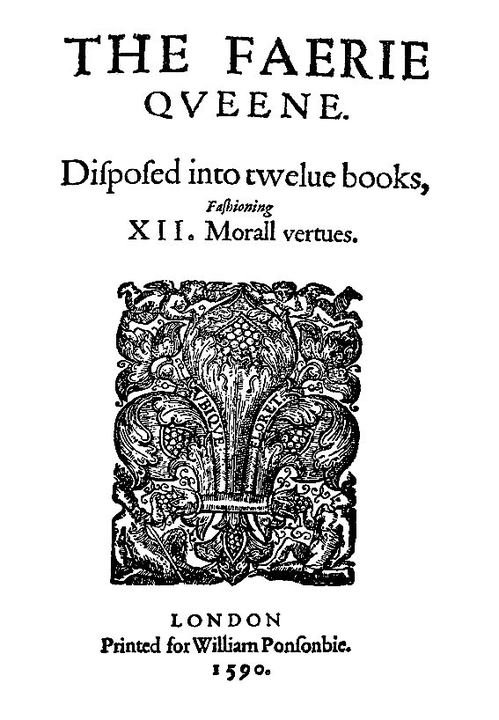
Background. Spenser planned twelve books, each centred on a knight of one virtue, and explained the scheme to Raleigh in a prefatory letter. Book I, devoted to Holiness, appeared with Books II and III in 1590; the library copy is Wauchope's annotated 1903 classroom edition.
Narrative. Sent by Gloriana to deliver Una's besieged parents, the red-crossed champion conquers Error but is tricked by Archimago into deserting his lady. Paired with Duessa, he sees Pride's palace, drinks from a weakening spring, and lies starving in Orgoglio's dungeon until Arthur breaks it open. After Una saves him from Despair's dagger, Coelia's household disciplines and heals him, Contemplation names him England's patron saint, and a three-day combat ends with the dragon dead.
Form. Nine-line stanzas close on a lengthened alexandrine; spelling and vocabulary are archaized in homage to Chaucer. Each canto opens with a four-line argument, and a letter and sonnet to Raleigh and a dedication to the Queen frame the book.
Themes. Deception and discernment, pride against humility, sin pictured as sickness and captivity, and victory credited to grace rather than prowess.
Significance. Book I is the most self-contained legend in the poem and the usual doorway into it. Its stanza passed to Byron, Keats and Shelley, and its pilgrimage-allegory shaped Milton and Bunyan.
Main characters
- The Redcrosse Knight: Untried champion of Holiness, revealed as Saint George
- Una: Veiled princess figuring the one true faith
- Duessa: Two-faced witch posing as Fidessa
- Archimago: Deceiving enchanter in a hermit's habit
- Prince Arthur: Magnificence, rescuer of the captive knight
- Orgoglio: Swollen giant who jails Redcrosse
- Despair: Cave-dwelling sophist who urges self-murder
- Lucifera: Queen presiding over the parade of deadly sins
- Contemplation: Hermit who shows the heavenly Jerusalem

Summary
Book I of The Faerie Queene, the Legend of the Knight of the Red Cross, or of Holiness, tells how a young, untried knight wins his spurs by freeing a kingdom from a dragon and, on the way, learns how easily a Christian soul is deceived. Gloriana, the Faerie Queene, has sent the Redcrosse Knight, who bears a bloody cross on breast and shield, to help the lady Una, whose royal parents are besieged in their brazen castle by a monstrous dragon. Una rides a white ass beside him, veiled and leading a milk-white lamb, with a dwarf behind. In Canto I a storm drives them into the Wandering Wood, where Redcrosse strangles the serpent-woman Error and her brood; that night the enchanter Archimago, posing as a hermit, sends false dreams and a sprite in Una's likeness to persuade the knight that his lady is wanton. Redcrosse abandons her, kills the Saracen Sansfoy, and takes up with his companion Duessa, a witch who calls herself Fidessa; he hears the tree Fradubio tell how Duessa trapped him. Alone, Una is guarded by a lion, deceived by Archimago in Redcrosse's armor, and seized by the Saracen Sansloy, then rescued by satyrs who try to worship her and by the wild knight Satyrane. Redcrosse, meanwhile, visits Lucifera's House of Pride, sees the procession of the Seven Deadly Sins, and fights Sansjoy, whom Night carries down to Aesculapius in hell to be healed. Warned by the dwarf of the dungeon full of Pride's victims, he flees, but resting unarmed by an enchanted fountain he is captured by the giant Orgoglio, and Duessa mounts a seven-headed beast. Prince Arthur, the knight of Magnificence, answers Una's plea, kills Orgoglio, frees the wasted Redcrosse, and strips Duessa to reveal her hideous form. In Canto IX the weakened knight meets Despair in his cave and is nearly argued into suicide until Una snatches the knife away. She brings him to the House of Holiness, where Dame Coelia and her daughters Fidelia, Speranza and Charissa teach him; the physician Patience, Penance and Repentance cure his soul; and the hermit Contemplation shows him the New Jerusalem and tells him he is Saint George of England. In Cantos XI and XII Redcrosse fights the dragon for three days, revived by the Well of Life and the balm of the Tree of Life, and kills it. Una's parents celebrate, Archimago and a letter from Duessa fail to stop the betrothal, and Redcrosse leaves to serve the Faerie Queene six more years before the marriage. The first three books were published in London in 1590 by William Ponsonby with a letter to Sir Walter Raleigh explaining the plan; Books IV to VI followed in 1596. The library text is Book I alone, in George Armstrong Wauchope's 1903 Macmillan school edition, with his introduction, notes and canto summaries.
Virtues in this work
- Faith: Una keeps faith with Redcrosse through his desertion and goes in search of help to free him from Orgoglio.
- Humility: Redcrosse is humbled in the House of Holiness by Penance and Repentance before he is fit to face the dragon.
- Hope: Una snatches the knife from Redcrosse in the Cave of Despair and reminds him that he shares in heavenly mercy.
- Fortitude: Redcrosse fights the dragon for three days, rising each morning after being struck down.
- Charity: Charissa and the seven beadsmen in Canto X teach the knight works of mercy to the poor, the prisoner, the sick and the dead.
Plot or Argument
- Letter to Raleigh and Proem
Spenser explains his continued allegory: twelve books, each a knight embodying a private virtue, with Arthur as Magnificence seeking Gloriana; the poet then invokes the Muse and Queen Elizabeth.
- Canto I: Error and Archimago
Redcrosse kills Error in the Wandering Wood; Archimago's false dreams and a counterfeit Una drive the knight to suspect his lady.
- Cantos II-III: Duessa and Una alone
Redcrosse kills Sansfoy and takes up with Duessa, ignoring the warning of the tree Fradubio; Una is guarded by a lion, which Sansloy kills before carrying her off.
- Cantos IV-V: The House of Pride
At Lucifera's palace the Seven Deadly Sins parade; Redcrosse fights Sansjoy, Night bears Sansjoy to Aesculapius, and the knight flees past the dungeon of the proud.
- Cantos VI-VIII: Satyrs, Orgoglio and Arthur
Satyrs and Satyrane protect Una; Redcrosse, unarmed by a draining fountain, is cast into Orgoglio's dungeon; Prince Arthur kills the giant, frees the knight and unmasks Duessa.
- Canto IX: Arthur's love and Despair
Arthur tells of his vision of the Faerie Queene; Despair nearly persuades Redcrosse to stab himself until Una reminds him of grace.
- Canto X: The House of Holiness
Faith, Hope and Charity instruct the knight; Patience and Penance heal his conscience; seven beadsmen practice works of mercy; Contemplation shows the heavenly city and names him Saint George.
- Cantos XI-XII: The dragon and the betrothal
A three-day battle, renewed by the Well of Life and the Tree of Life, ends with the dragon's death; Una is unveiled at the feast, Duessa's claim is exposed, and Archimago is bound.
Characters
- The Redcrosse Knight, hero; Holiness; Saint George
A brave but inexperienced knight who must learn humility and dependence on grace before he can slay the dragon.
- Una, the lady; Truth
A king's daughter, steadfast and veiled, whose single name marks the one true faith.
- Duessa, witch; Falsehood
A double-dealing enchantress who calls herself Fidessa and draws Redcrosse into pride and captivity.
- Archimago, enchanter; false holiness
A shape-shifting sorcerer disguised as a hermit who divides Redcrosse from Una.
- Prince Arthur, Magnificence
The young Arthur, seeking Gloriana, who rescues Redcrosse from Orgoglio by grace-like intervention.
- Lucifera, queen of the House of Pride
A dazzling usurping queen whose palace rests on a sandy foundation.
- Orgoglio, giant; carnal pride
A huge earth-born giant who imprisons the knight in his dungeon.
- Despair, tempter
A ragged figure in a cave who persuades guilty men to kill themselves.
- Sansfoy, Sansjoy and Sansloy, Saracen brothers
Faithless, joyless and lawless knights who attack Redcrosse and Una.
- Sir Satyrane, wild-born knight
Son of a satyr, he learns truth from Una and defends her against Sansloy.
- Coelia and her daughters, House of Holiness
Coelia with Fidelia, Speranza and Charissa, who teach and heal the knight.
- Contemplation, hermit
An aged seer who shows Redcrosse the New Jerusalem and reveals his destiny.
Lessons
Holiness is learned through falling
Redcrosse is a saint in the making, not a finished one. He is fooled by Archimago, seduced by Duessa, and imprisoned by Orgoglio before he can slay the dragon. Spenser shows holiness as a path of repentance and growth rather than a quality the hero simply has at the start.
- Why does Redcrosse believe the false Una so quickly in Canto I?
- What makes him vulnerable to Orgoglio in Canto VII?
- Why must the House of Holiness come before the dragon fight rather than after it?
Truth is one; falsehood is double
Una's name means one, and Duessa's suggests two. Duessa wears borrowed beauty and a false name, Fidessa, while Una is veiled but unchanging. The allegory teaches readers to judge by fruits and constancy, not by first appearances.
- How does Duessa disguise her true nature, and how is she finally exposed in Canto VIII?
- Why is Una veiled for most of the book and unveiled only at the end?
Answering despair
In Canto IX Despair turns half-truths about sin and justice into an argument for suicide, and Redcrosse has no reply. Una answers with grace: the knight has a part in heavenly mercy, and justice is not the last word. The scene is a careful study of how despair reasons and how hope breaks its logic.
- Which of Despair's claims are true, and where does his argument go wrong?
- Why can Redcrosse not answer him alone?
- How does Una's reply change the terms of the argument?
Strength belongs to God
The opening of Canto X tells the reader not to credit the knight's victory to his own skill. Arthur's rescue, the Well of Life and the balm of the Tree of Life all show that Redcrosse wins only when he is renewed from outside himself.
- What heals Redcrosse at the end of each day of the dragon fight?
- How does Arthur's rescue in Canto VIII prepare for this teaching?
Context
Spenser wrote for the court of Elizabeth I, whom the poem honors as Gloriana and, in other aspects, as Una. Book I's allegory works on several levels at once: the moral life of the Christian soul, the history of the English church as Spenser's Protestant generation saw it, with Una as true religion and Duessa as the Roman church, and the national legend of Saint George. The poem joins the Italian romance epic of Ariosto and Tasso to Arthurian matter, medieval allegory and the Book of Revelation.
Composition
Spenser worked on the poem through the 1580s, largely in Ireland, and dated the explanatory letter to Sir Walter Raleigh 23 January 1589 (old style, that is 1590). Books I-III were printed in London by William Ponsonby in 1590, and Books IV-VI in 1596; the fragmentary Mutabilitie Cantos appeared in 1609. Of the twelve books planned, six were completed. He invented the nine-line Spenserian stanza, eight pentameters closed by an alexandrine rhyming ababbcbcc, and used deliberately old-fashioned spelling and diction. The library text is Wauchope's 1903 school edition of Book I.
Reception
Spenser was praised in his lifetime as the leading English poet and was later called the poets' poet. Milton named him a better teacher than Aquinas, and his stanza was revived by Thomson, Byron in Childe Harold's Pilgrimage, Keats in The Eve of St. Agnes, and Shelley. Book I, with its self-contained story, has long been the part most read in schools and the usual introduction to the poem.
Comparisons
- the-pilgrims-progress
Bunyan's Christian, like Redcrosse, falls into a giant's dungeon (Giant Despair in Doubting Castle) and must reach the Celestial City; Bunyan's plain prose allegory makes a useful contrast with Spenser's courtly romance.
- le-morte-darthur
Malory gives the Arthurian knights their quests and failures; Spenser borrows Prince Arthur from that tradition but makes him a figure of heavenly grace who rescues the fallen knight.
- paradise-lost
Milton, who admired Spenser, also sets pride and disobedience against grace; Lucifera's palace anticipates Pandaemonium, and both poems end with fallen humanity sent out on a hopeful journey.
- the-divine-comedy
Dante's pilgrim must be led through hell and purgation before seeing heaven; Redcrosse is purged in the House of Holiness before Contemplation shows him the New Jerusalem.
- sir-gawain-and-the-green-knight
Both medieval and Renaissance poems test a knight's faith and honesty through enchantment and a lady's deception, with a hero who is humbled rather than simply triumphant.
- the-anatomy-of-melancholy
Burton's treatise devotes a long section to religious melancholy and despair; Spenser's Cave of Despair is a poetic portrait of the same spiritual condition.
Quotes
Frequently cited
“Fierce warres and faithfull loves shall moralize my song.”
Frequently cited
“Vertue gives her selfe light, through darkenesse for to wade.”
Frequently cited
“And made a sunshine in the shadie place”
Frequently cited
“Is not short paine well borne, that brings long ease, And layes the soule to sleepe in quiet grave? Sleepe after toyle, port after stormie seas, Ease after warre, death after life does greatly please.”
“The deare remembrance of his dying Lord, For whose sweete sake that glorious badge he wore, And dead as living ever him ador'd”
“Ay me, how many perils doe enfold The righteous man, to make him daily fall, Were not that heavenly grace doth him uphold, And stedfast truth acquite him out of all.”
“If any strength we have, it is to ill, But all the good is Gods, both power and eke will.”
“In that disease of grieved conscience, And well could cure the same; his name was Patience.”
For Students
A reading companion for classical Christian high school students. See the student guide.
Reading Guide
Watch for
- The short verse argument at the head of each canto, which tells you what happens before you read it.
- Every time Redcrosse is separated from Una, and what happens to him while they are apart.
- Names that tell you what a figure is: Una, Duessa, Sansfoy, Sansjoy, Sansloy, Orgoglio, Speranza.
- The parallel between Lucifera's House of Pride in Canto IV and Coelia's House of Holiness in Canto X.
- What restores Redcrosse at the end of each of the three days of the dragon fight in Canto XI.
Key terms and names
- Allegory
- A story in which characters and places stand for ideas; Spenser calls his poem a continued allegory, or dark conceit.
- Spenserian stanza
- Spenser's nine-line stanza: eight lines of iambic pentameter and a final twelve-syllable alexandrine, rhymed ababbcbcc.
- Gloriana
- The Faerie Queene who sends Redcrosse on his quest; she stands for glory and for Queen Elizabeth.
- Saracen
- The romance word for a pagan knight; the three Saracen brothers embody faithlessness, joylessness and lawlessness.
- Leech
- An old word for a physician; the leech Patience cures the knight's diseased conscience in Canto X.
- Well of Life and Tree of Life
- The spring and tree that revive Redcrosse during the dragon fight, drawn from Genesis and Revelation and often read as baptism and the Lord's Supper.
Seminar Questions
- Comprehension How does Archimago separate Redcrosse from Una in Cantos I and II?
- Comprehension Who rescues Redcrosse from Orgoglio's dungeon, and what happens to Duessa afterward?
- Comprehension What does Contemplation reveal to Redcrosse about his birth and his future?
- Interpretation Why is the House of Pride beautiful on the outside and built on sand?
- Interpretation Despair's arguments in Canto IX use true statements about sin and judgment. Where exactly does his reasoning fail, and how does Una expose it?
- Interpretation Why does Spenser keep Una veiled until the betrothal feast in Canto XII?
- Big Question Can a person become holy by his own effort, or must holiness be received?
- Big Question How can someone tell true teaching from a convincing imitation?
Faith Connections
- Ephesians 6:11-17 (Scripture)
The Letter to Raleigh says Redcrosse's armor is the armor of a Christian man described by Saint Paul, so the whole quest is a picture of spiritual warfare.
- Revelation 12 and 17 (Scripture)
The great red dragon and the woman seated on a scarlet many-headed beast lie behind Spenser's dragon and Duessa's mount in Canto VII.
- 1 Corinthians 13:13 (Scripture)
Faith, hope and charity become Fidelia, Speranza and Charissa, the daughters of Coelia who teach the knight in Canto X.
- Augustine, Confessions VIII (Church Fathers)
Augustine describes being unable to free his own will until grace intervenes; Redcrosse's helplessness before Despair and Orgoglio dramatizes the same teaching.
Logic and Rhetoric
Central argument: Redcrosse is brave and well armed, yet he falls whenever he trusts appearances or his own strength. He is restored only by Una's truth, Arthur's rescue, the discipline of the House of Holiness and the Well and Tree of Life. Therefore holiness is not native strength but a gift received through repentance and grace, which then makes true heroism possible.
Rhetorical device: isocolon and parallelism. Despair's line in Canto IX, stanza 40, sets matched pairs (sleep after toil, port after stormy seas, ease after war, death after life) so that suicide sounds like natural rest; the balance is what makes the temptation persuasive.
Debate: Resolved: that Redcrosse is more to blame for leaving Una than Archimago is for deceiving him.
Memory Work
If any strength we have, it is to ill, But all the good is Gods, both power and eke will.
Vertue gives her selfe light, through darkenesse for to wade.
Writing Prompts
Essay: Trace Redcrosse's movement from the House of Pride to the House of Holiness and argue what Spenser believes a person must lose before he can become holy.
Comparison with The Pilgrim's Progress: Compare Spenser's Cave of Despair with Bunyan's Doubting Castle. Argue which allegory better shows how despair is defeated, and why.
Medical Lens
Book I treats sin and despair in the language of disease and cure, which makes it a useful document for the Renaissance overlap of spiritual and medical care. The Cave of Despair (Canto IX) is one of the most influential English portraits of suicidal persuasion, written when despair was treated by divines as a spiritual crisis and by physicians as a form of melancholy; Burton's Anatomy of Melancholy later joins the two traditions. In Canto X a leech named Patience treats the knight's grieved conscience with salves, medicines, words and a strict diet, while fasting is used to abate proud humours, a picture of soul care borrowing humoral therapeutics. Canto V sends the wounded Sansjoy to Aesculapius in the underworld, recalling the classical god of medicine and the myth of his punishment for raising Hippolytus. Redcrosse's wasted body after Orgoglio's dungeon (Canto VIII) shows the period's ready link between spiritual captivity and bodily decline. These are allegorical uses of medicine, not clinical descriptions.
- Book I, Canto V, stanzas 17 and 36-44
Leeches wash Sansjoy's wounds with wine and oil; Night carries him to Aesculapius in hell, whose story of healing Hippolytus is told.
- Book I, Canto VIII, stanzas 40-41
Redcrosse is brought out of the dungeon pale, wasted and too weak to stand.
- Book I, Canto IX, stanzas 28-54
Trevisan's flight, the cave of Despair, the argument for suicide, and Una's rescue of the knight as he raises the knife.
- Book I, Canto X, stanzas 23-29
Coelia summons the leech Patience for a soul-diseased knight; diet, salves, Penance, Remorse and Repentance complete the cure.
Listen to the book
Public-domain audiobook from LibriVox, read by Various volunteers. Recording: Faerie Queene Book 1 on LibriVox (Internet Archive).
LibriVox recordings are volunteer readings released into the public domain. The reading may follow a different edition from the text in this library.
Creative Prompts
- Classroom
Make an allegory chart for Book I: list each figure Redcrosse meets (Error, Archimago, Duessa, Lucifera, Orgoglio, Despair, Contemplation) with what it stands for and the canto where it appears.
- Poetry
Write one Spenserian stanza (ababbcbcc, eight pentameters and a closing alexandrine) describing a temptation you know well as a figure met on a road.
- Dialogue
Rewrite the debate in the Cave of Despair in modern prose, giving Redcrosse the answers Una supplies.
- Essay
Why does Spenser make Prince Arthur, not Redcrosse, defeat Orgoglio? Argue what the rescue teaches about grace.
Further Reading
- The Allegory of Love, C. S. Lewis
Its final chapter is a classic study of The Faerie Queene.
- Spenser's Images of Life, C. S. Lewis
- The Anatomy of Melancholy, Robert Burton
Its section on religious melancholy and despair is the natural companion to Canto IX.
- Orlando Furioso, Ludovico Ariosto
The Italian romance epic Spenser set out to rival.
Verification notes
Plot, structure and publication facts are standard. Canto and stanza locators for the quotes follow the Wauchope text attached to the library; the Canto V, VIII and IX stanza ranges in the medical passages are approximate. The church-historical reading of Una and Duessa is the traditional one and is stated here as Spenser's evident intention, not as the poem's only sense. Quotes were checked by exact search against the attached text.
- Stanza ranges given in medicalLens.passages are approximate.