Work record
Essays on Education in a Republic
1786-1798 · 18th Century · Essays · English
Abstract
Background. Independence left Pennsylvanians, English and German speakers of many churches, without a shared plan for teaching their young. A signer trained in Edinburgh medicine, who believed bodily causes shape character, set out over five years to supply one.
Content. A statewide ladder rises from township schools through four colleges to a university. Republican schooling is grounded in the Gospel and in patriotic duty. Classical tongues are postponed in favour of English, modern languages and sciences; school games become gardening and handicrafts; whipping is renounced; girls study bookkeeping, history and song; and children learn to read from Scripture.
Method. Rush argues by numbered propositions and objections answered, and by examples from Sparta, Scotland, Moravian Bethlehem and his own consulting room. Three pieces are letters to friends, one an address to an academy's visitors, and the whole ends with a plea to Belknap.
Key Concepts. Usefulness as the test of learning; physical causes acting on morals; citizens shaped to fit the machinery of self-government; mothers as their sons' first instructors in liberty; Scripture as the mainstay of a free state.
Significance. These pieces remain among the fullest founding-era statements on schooling. They anticipate debates over public funding, the classics, discipline, women's learning and religion in the classroom that would continue in American education for generations.
Key figures
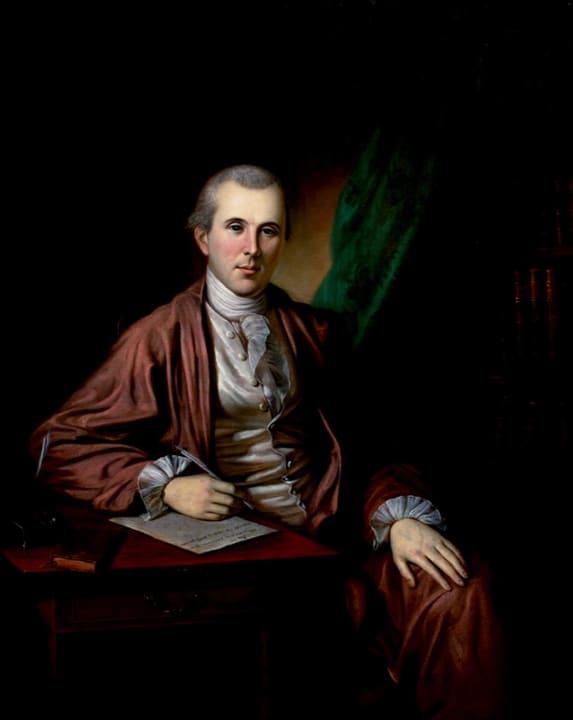
- Benjamin Rush: Philadelphia physician, signer and school reformer writing in his own voice
- James Muir: Head of the Alexandria academy who welcomed the essay on the classics
- George Clymer: Fellow signer who asked Rush about school amusements and discipline
- Jeremy Belknap: Boston clergyman and historian, recipient of the Bible letter

Summary
Essays on Education in a Republic gathers the six essays on schooling that open Benjamin Rush's Essays, Literary, Moral and Philosophical, published in Philadelphia in 1798. Rush, a physician and signer of the Declaration of Independence, wrote them between 1786 and 1791 to ask what kind of education a free people needs once it has made itself a republic. The library text follows the 1798 printing, with the long s modernized and Rush's footnotes omitted. The first essay, A Plan for Establishing Public Schools in Pennsylvania (1786), lists the benefits of learning to religion, liberty, law, manners, agriculture and manufactures, then proposes one state university in Philadelphia, four colleges (Philadelphia, Carlisle, Lancaster for German citizens, and later Pittsburgh) and free schools in every township, all tied into one system. Rush answers those who would object to paying for other people's children by arguing that schools will cost less than jails, pillories and gallows. The second essay, Of the Mode of Education Proper in a Republic, makes religion, and specifically the religion of the New Testament, the foundation of republican education, since there can be no liberty without virtue and no virtue without religion. A citizen must be taught that he belongs to his country, and Rush goes so far as to say that education can make men into republican machines fitted to the great machine of government. He recommends a temperate diet, manual work, vocal music, the study of English, French and German, history, commerce, chemistry and law, and the education of women in the principles of liberty. The third essay, Observations upon the Study of the Latin and Greek Languages, argues that four or five years spent on dead languages delay the knowledge of things, and proposes teaching them last, and only for reading. It is followed by a letter of 1791 from James Muir, principal of the academy at Alexandria, Virginia, and Rush's answer. The fourth essay, addressed to George Clymer in 1790, proposes gardening, mechanical arts and agriculture as school amusements, forbids gunning, objects to crowding children into close rooms, and argues at length that corporal punishment is never necessary in schools. The fifth, Thoughts upon Female Education, delivered at the Young Ladies' Academy of Philadelphia on July 28, 1787, outlines a course of English, handwriting, bookkeeping, geography, history, vocal music, dancing and daily Bible reading suited to American women who would manage households and teach their sons the principles of liberty. The last, A Defence of the Use of the Bible as a School Book, written to the Reverend Jeremy Belknap of Boston and dated March 10, 1791, argues from the nature of the mind, from Deuteronomy 6 and from history that children should learn to read from the Bible, and calls the Bible the surest support of republican government.
Virtues in this work
- Piety: Rush makes the religion of the New Testament the foundation of republican education and defends daily Bible reading in schools.
- Prudence: The Plan weighs the cost of schools against the cost of jails and gallows and fits each subject to the student's future work.
- Charity: In the letter to Clymer Rush pleads the cause of children beaten in school, arguing that they should be governed by reason, hope and love.
- Industry: He would turn school amusements into gardening, farming and the mechanical arts so that play prepares children for useful work.
Plot or Argument
- A Plan for Establishing Public Schools in Pennsylvania (1786)
Learning is friendly to religion, liberty, just laws, manners, agriculture and manufactures. Rush proposes a state university, four colleges and free township schools teaching reading and writing in English and German, so that the whole state is joined by one system of education. The expense will be repaid by lower taxes, better farming and fewer crimes, since the cost of trying and punishing criminals already exceeds what schools would cost.
- Of the Mode of Education Proper in a Republic
Independence has created new duties, so Americans should be educated at home and in a common system. The only foundation of a useful education in a republic is religion, the religion of the New Testament, because every precept of the Gospel favours humility and equality. The pupil must be taught that he is public property, owing his country service, while avoiding party rage and loving all mankind. Rush recommends physical discipline, vocal music, English and modern languages, eloquence, history, commerce, chemistry and law, and urges that women be taught the principles of liberty and government.
- Observations upon the Study of the Latin and Greek Languages
Rush states propositions: education prepares youth for usefulness here and happiness hereafter; the knowledge of things precedes the knowledge of words; four or five years of Latin and Greek crowd out useful learning and discourage many boys. He answers the usual arguments for the classics, proposes a course of study in which English, French, German, mathematics, history and natural science come first, and suggests replacing moral philosophy with lectures on the evidences and precepts of Christianity.
- Letter from James Muir and Rush's answer (1791)
Muir, head of the academy at Alexandria, reports that his students prefer useful to ornamental studies. Rush replies that if the dead languages must be taught, they should be taught only for reading, late in a boy's schooling, after history and geography, and he quotes Franklin's estimate that reading a language takes half the labour of writing it.
- Thoughts upon the Amusements and Punishments Proper for Schools (1790)
Addressed to George Clymer, the essay proposes that school amusements prepare children for their future work: gardening, farming and the mechanical arts. Rush excludes gunning, warns against long sitting and crowded rooms as causes of disease, and gives eleven reasons why corporal punishment is never necessary in schools, answering the appeal to the biblical rod by reading it as a figure for punishment of any kind.
- Thoughts upon Female Education (1787)
Spoken to the visitors of the Young Ladies' Academy of Philadelphia, the essay argues that American women marry early, manage property, teach their children and need education fitted to those duties. Rush recommends English grammar, a clear hand, bookkeeping, geography, history, vocal music, dancing, poetry and moral essays rather than novels, and daily instruction in the Christian religion, and closes by urging the students to prove that the cultivation of reason in women serves private and public happiness.
- A Defence of the Use of the Bible as a School Book (1791)
Writing to Jeremy Belknap, Rush argues from the constitution of the mind (memory opens first, children are drawn to religious truths, habits formed early last), from the command of Deuteronomy 6 and the history of the Jews and of Protestant nations, and from the agreement of Scripture with philosophy. He answers objections about reverence, unsuitable passages and the division into verses, and concludes that teaching children the Bible is the surest means of perpetuating republican government.
Characters
- James Muir, correspondent
Presbyterian minister and principal of the academy at Alexandria, Virginia, whose letter of July 29, 1791 approves Rush's views on the classics.
- George Clymer, addressee
Philadelphia merchant and fellow signer of the Declaration, to whom the essay on amusements and punishments is addressed.
- Jeremy Belknap, addressee
Congregational minister and historian of New Hampshire, to whom the defence of the Bible as a school book is written.
- Benjamin Franklin, authority cited
Quoted in Rush's answer to Muir for dividing the labour of learning a language into reading, speaking and writing.
Lessons
Religion, virtue and liberty as a chain
Rush's central claim is that a republic cannot survive without virtuous citizens, and that virtue cannot be formed without religion. He therefore places the New Testament at the foundation of schooling and, in his letter to Belknap, the Bible at the centre of the classroom. For Rush, Christian teaching and republican government support each other because the Gospel teaches humility, self-denial and brotherly kindness.
- What reasons does the Mode of Education essay give for saying a Christian cannot fail of being a republican?
- Why does Rush prefer the Bible itself to extracts or catechisms as a school book?
- Is Rush's chain from religion to virtue to liberty persuasive? Which link seems strongest, and which most open to question?
Education for usefulness
Rush judges every subject by whether it prepares young people to serve their families, their professions and their country. That standard leads him to favour English, modern languages, history, commerce, chemistry and law, and to argue that Latin and Greek should come late and be learned for reading. His view sparked replies in his own day, and the debate he joined continues wherever schools weigh the classics.
- What does Rush mean by saying the knowledge of things precedes the knowledge of words?
- Which of the usual arguments for Latin and Greek does Rush answer, and which does he leave untouched?
- How would a defender of classical education answer Rush's case? Use specific claims from his essay.
Governing children by reason rather than the rod
In the letter to Clymer, Rush argues that children old enough for school can be moved by moral and rational motives, that beating confuses ignorance with wrongdoing, and that fear weakens both body and mind. He would govern schools by order, shame, confinement and the withholding of treats in dress, food or amusement instead, and he reads the biblical rod as a figure for correction of any kind.
- Which of Rush's eleven reasons against corporal punishment draw on his experience as a physician?
- How does Rush answer those who appeal to Scripture in favour of the rod?
- Rush calls the schoolmaster the only despot left in free countries. How does that image connect his argument about schools to his politics?
Educating women for a republic
Rush argues that American women, who marry young, manage property and give children their first instruction, need an education fitted to those responsibilities, including the principles of liberty and government. He presents this as a new kind of schooling, different from the ornamental accomplishments then fashionable in Britain, and he praises the woman of Proverbs 31 as his model.
- What four or five circumstances of American life does Rush say require a distinct education for women?
- Why does Rush prefer history, travels and moral essays to novels and instrumental music?
- How does Rush connect the education of mothers to the future of the republic?
Context
After independence, American leaders debated how to form citizens for a republic. Several states wrote education into their constitutions, and men such as Jefferson, Noah Webster and Rush published plans for public schooling. Pennsylvania, with its English, German, Scots-Irish and other communities and its many churches, raised in a sharp form the question of how one system of education could unite a diverse people. Rush, a Presbyterian-reared physician who had studied in Edinburgh, drew on the Scottish universities, the Swiss and German examples he admired, and his own medical ideas about the influence of physical causes on the mind and morals.
Composition
The Plan for public schools and the essay on the mode of education first appeared together in Philadelphia in 1786. Thoughts upon Female Education was delivered at the Young Ladies' Academy on July 28, 1787, and printed at the request of its visitors. The essay on Latin and Greek appeared first in a magazine to which Muir's letter refers as the Museum; the letter to Clymer is dated August 20, 1790, Rush's answer to Muir August 24, 1791, and the letter to Belknap March 10, 1791. Rush gathered all six at the head of Essays, Literary, Moral and Philosophical (Philadelphia: Thomas and Samuel F. Bradford, 1798).
Reception
Rush's attack on the classical languages drew published replies in Philadelphia, which he mentions in his answer to Muir, and classical learning remained central to American colleges for decades. Pennsylvania did not adopt a general system of free schools until 1834, though Rush's hopes for colleges at Carlisle and Lancaster were realized in Dickinson College (1783) and Franklin College (1787), both of which he helped found. His Thoughts upon Female Education became one of the best-known early American statements on the subject; historians have since used the phrase republican motherhood for the ideal it expresses. Readers continue to discuss his remark about republican machines and his proposals for the Bible in schools, some reading them as a programme of civic and Christian formation and others as an early expression of state-directed education.
Comparisons
- medical-inquiries-and-observations-upon-diseases-of-the-mind
Rush's 1812 treatise on mental illness develops the conviction behind his educational essays that physical causes act on the mind and the moral faculty, the same idea that leads him in 1786 to prescribe diet, exercise, sleep and solitude for students.
- narrative-of-yellow-fever-1793
Richard Allen and Absalom Jones describe the nursing and burial work Black Philadelphians undertook at Rush's request in the epidemic of 1793, two years after his Bible essay; read together they show Rush as physician and civic organizer in the same city where his school plans were addressed.
- the-republic
Plato's guardians are educated in music and gymnastic for the sake of the city; Rush likewise joins vocal music and bodily discipline to moral instruction, and his claim that a pupil is public property echoes the ancient subordination of the citizen to the city, though Rush grounds his scheme in the Gospel rather than in philosophy.
- jefferson-selected-writings
Jefferson's plans for Virginia, from the Bill for the More General Diffusion of Knowledge of 1779 to the University of Virginia, share Rush's aim of a statewide system from township schools to a university, but Jefferson kept religious instruction out of the university's curriculum while Rush placed it at the foundation.
- franklin-autobiography-and-poor-richard
Franklin, whom Rush quotes in his answer to Muir, had proposed in 1749 an English-centred, practical academy for Philadelphia; Rush's preference for useful over ornamental learning continues that local tradition.
Quotes
“Freedom can exist only in the society of knowledge.”
“the only foundation for a useful education in a republic is to be laid in Religion. Without this there can be no virtue, and without virtue there can be no liberty, and liberty is the object and life of all republican governments.”
“I consider it is possible to convert men into republican machines.”
“The knowledge of things always preceeds the knowledge of words.”
“The rod is yet the principal instrument of governing them, and a school-master remains the only despot now known in free countries.”
“A kind rebuke, like fresh air in a fainting fit, is calculated to act upon a young mind with more effect, than stimulants of the greatest power”
“The equal share that every citizen has in the liberty, and the possible share he may have in the government of our country, make it necessary that our ladies should be qualified to a certain degree by a peculiar and suitable education, to concur in instructing their sons in the principles of liberty and government.”
“We profess to be republicans, and yet we neglect the only means of establishing and perpetuating our republican forms of government, that is, the universal education of our youth in the principles of christianity, by means of the bible”
For Students
A reading companion for classical Christian high school students. See the student guide.
Reading Guide
Watch for
- The Plan's ladder of institutions, from township free schools to four colleges to one university, and Rush's answer to the bachelor who objects to the school tax.
- The paragraph in the Mode of Education essay that lists the pupil's paired duties: love family but prefer country, love popularity but despise it when it conflicts with judgment.
- The numbered propositions that open the Observations on Latin and Greek, and the boy who tells his mother that two Latin lessons a day are trouble enough.
- The eleven numbered reasons against corporal punishment in the letter to Clymer, and the reading of the biblical rod that follows them.
- The contrast with the woman of Proverbs 31 near the end of Thoughts upon Female Education.
Key terms and names
- Republican education
- Rush's name for schooling designed to form citizens of a self-governing state: religious, patriotic, practically trained and united by one system.
- Republican machines
- Rush's image in the Mode of Education essay for citizens fitted by education to their parts in the machine of government, so that the wills of the people produce regularity rather than discord.
- Free schools
- Township or district schools supported by public taxes, in which children learn to read and write English and German and to use figures.
- Dead languages
- Latin and Greek, which Rush would postpone to age fourteen or fifteen and teach for reading only, rather than make the first business of school.
- Corporal punishment
- Beating, boxing ears and similar correction, which Rush argues is never necessary in schools for children past four or five years of age.
- Young Ladies' Academy
- The Philadelphia school for girls whose visitors heard Rush's address on female education in July 1787.
Seminar Questions
- Comprehension What schools and colleges does the Plan of 1786 propose, and where would they be?
- Comprehension What subjects does Thoughts upon Female Education recommend, and which does Rush leave out or limit?
- Comprehension Name three of Rush's reasons against corporal punishment in the letter to Clymer.
- Interpretation Rush says a pupil must be taught that he is public property, yet also that he must not defraud his creditors or neglect his family. How does he balance duty to country with private duties?
- Interpretation What does Rush mean by converting men into republican machines? Does the rest of the Mode of Education essay soften or sharpen the phrase?
- Interpretation How does Rush's training as a physician shape his arguments about diet, crowded schoolrooms, punishment and singing?
- Big Question Should a free society aim to make its citizens alike in principles, as Rush hoped, or to leave them as different as their families and churches make them?
- Big Question Rush argues that the knowledge of things comes before the knowledge of words. Is the study of an ancient language a study of words only, or also of things?
Faith Connections
- Deuteronomy 6:6-9 (Scripture)
Rush quotes this passage in the Bible essay as an implied command of God to teach Scripture to children at home and by the way, and builds his second argument for the Bible as a school book upon it.
- Proverbs 31:10-31 (Scripture)
Near the end of Thoughts upon Female Education Rush contrasts the fashionable woman with the woman of Proverbs, who opens her mouth with wisdom and whose children rise up and call her blessed, as the model for an American education of women.
- Proverbs 13:24 (Scripture)
The verse on sparing the rod is the kind of text Rush's opponents cited in favour of corporal punishment; his letter to Clymer answers that the rod in the Old Testament is a figure for correction of any kind, an interpretation students can test against the passage.
- Augustine, Confessions I.9-14 (Great Conversation)
Augustine remembers being beaten as a boy for neglecting his lessons and hating Greek while loving Latin stories; his account touches both of Rush's targets, the rod and the early drill in ancient languages, from the side of the child.
Logic and Rhetoric
Central argument: A republic depends on the virtue and knowledge of its citizens. Virtue cannot be formed without religion, and the religion of the New Testament teaches the humility, self-denial and kindness a republic needs. Knowledge is useful only when it prepares citizens for their actual duties. Therefore the state should establish a connected system of schools teaching Christianity through the Bible, useful modern subjects before the dead languages, and the principles of liberty to women as well as men, governed by reason rather than by the rod.
Rhetorical device: antithesis. The Mode of Education essay sets each duty against its limit: the pupil must love private life but decline no public station, love popularity but despise it when it conflicts with his judgment, avoid neutrality but shun party rage. Rush's closing contrast in the female education essay (the one is admired abroad, the other honoured at home) uses the same balanced form.
Debate: Resolved: That Latin and Greek should be taught late, and for reading only, as Rush proposed.
Memory Work
Freedom can exist only in the society of knowledge.
the only foundation for a useful education in a republic is to be laid in Religion. Without this there can be no virtue, and without virtue there can be no liberty, and liberty is the object and life of all republican governments.
Writing Prompts
Essay: Rush wanted to make Pennsylvanians more homogeneous through one system of education and also to form free citizens who would think for themselves. Using the Plan and the Mode of Education essay, explain how he reconciles uniformity with liberty, and evaluate whether the reconciliation succeeds.
Comparison with The Republic: Both Plato and Rush design education for the sake of the city and join music, bodily training and moral formation. Compare Plato's education of the guardians with Rush's Mode of Education essay, paying attention to the place each gives to religion and to the family.
Medical Lens
These are a physician's essays, and Rush's medicine runs through them. In the same year as the school Plan he delivered An Enquiry into the Influence of Physical Causes upon the Moral Faculty (1786), and the Mode of Education essay applies that idea to students: a temperate diet of broths, milk and vegetables, no spirituous liquors, manual work, moderate sleep, silence, solitude and cleanliness are prescribed because physical causes act on intellect and morals. The letter to Clymer reflects the miasmatic thinking of the period when it blames morbid effluvia from crowded schoolrooms for fevers, and its case against corporal punishment draws on clinical memory (a schoolmate said to have died after a whipping, injuries to the brain from blows to the head) and on the language of excitability and stimulants that Rush shared with the Edinburgh school of William Cullen and John Brown. Thoughts upon Female Education claims that singing strengthens the lungs against consumption, citing the rarity of the disease among Pennsylvania Germans and the observations of the academy's music master. The Bible essay points to the memory of the aged and to Sir John Pringle, physician to the Queen, who studied Scripture at the end of his life. These are period theories and anecdotes; any modern reading of them, for instance of fear and stress in learning, should be offered as interpretation rather than as Rush's meaning. His later Medical Inquiries and Observations upon the Diseases of the Mind (1812) develops the same mind-body convictions at length.
- Of the Mode of Education Proper in a Republic
Physical discipline for students: diet, abstinence from spirits, manual labour, sleep, silence, solitude and cleanliness, and the claim that these physical causes act on intellect and morals.
- Thoughts upon the Amusements and Punishments Proper for Schools, on gunning and on school rooms
Gunning exposes boys to fevers and accidents; long sitting deforms the body; crowding children into one room breeds fevers from morbid effluvia, which Rush says he has seen in many hundred cases.
- Thoughts upon the Amusements and Punishments Proper for Schools, reasons 4, 9 and 10 against corporal punishment
Injuries to body and intellect from beating, a schoolmate's reported death after a whipping, fear debilitating the mind, and the analogy between dosing a remedy to a patient's excitability and fitting discipline to a child's temper.
- Thoughts upon Female Education, branch V (vocal music)
Singing as protection for the lungs against consumption, with the example of the Pennsylvania Germans and cases reported by the academy's music master.
- A Defence of the Use of the Bible as a School Book, argument VIII
The memory of old age recovering early learning, and Sir John Pringle's turn to Scripture at the close of his life.
Creative Prompts
- Classroom
Hold a mock meeting of the Pennsylvania legislature in 1786. One group presents Rush's Plan, another raises the objections he anticipates (cost, taxing the childless, German-language schools), and the class votes.
- Dialogue
Write a conversation between Rush and a Latin master at a Philadelphia grammar school in 1791, each using arguments from the Observations and from Rush's answer to Muir.
- Essay
Rush wanted schools to form republican citizens and Christian believers at once. Choose two of the six essays and explain how he joins the two aims, then evaluate whether they ever pull in different directions in his own argument.
Further Reading
- Essays on Education in the Early Republic, Frederick Rudolph (ed.)
Collects Rush's Plan with essays by Noah Webster, Samuel Harrison Smith and others.
- Letters of Benjamin Rush, L. H. Butterfield (ed.)
- The Autobiography of Benjamin Rush, George W. Corner (ed.)
- Rush: Revolution, Madness, and the Visionary Doctor Who Became a Founding Father, Stephen Fried
- Women of the Republic: Intellect and Ideology in Revolutionary America, Linda K. Kerber
The study that made republican motherhood a common term, with discussion of Rush's essay on female education.
Verification notes
Essay titles, addressees and the dates of the Clymer letter (August 20, 1790), Muir's letter (July 29, 1791), Rush's answer (August 24, 1791), the Belknap letter (March 10, 1791) and the Young Ladies' Academy address (July 28, 1787) are taken from the stored 1798 text. The library text follows the Text Creation Partnership transcription with the long s modernized and footnotes omitted. All eight quotations were found by search in content/texts/rush-essays-on-education-in-a-republic.txt and copied exactly, keeping the 1798 spelling (preceeds) and lower-case christianity and bible. Biographical facts in authorBio and the founding dates of Dickinson and Franklin Colleges are standard.
- The first periodical printing of the essay on Latin and Greek (usually given as the American Museum, 1789).
- The 1786 pamphlet title and printer of the Plan with the Mode of Education essay (often cited as A Plan for the Establishment of Public Schools and the Diffusion of Knowledge in Pennsylvania, Philadelphia: Thomas Dobson).