Work record
O Captain! My Captain!
1865 · 19th Century · Poetry · English
Abstract
Background. Whitman composed this lament in the months after John Wilkes Booth killed the president at Ford's Theatre, while the poet still worked as a federal clerk in Washington. A free-verse companion, When Lilacs Last in the Dooryard Bloom'd, answered the same loss.
Content. A crewman brings the vessel into harbour amid pealing bells, waving flags and garlands, yet his attention never leaves the bloodied figure stretched on the planks. He pleads with the commander to get up and receive the acclaim, supports his head, and half persuades himself that he is dreaming. In the last stanza he registers silence, pallor and the stopped heart, then paces alone while the coast rejoices.
Form. Long rhyming lines carry the noise of triumph; clipped, progressively indented lines carry the sorrow, a visual staircase that narrows toward the repeated close.
Themes. Triumph shadowed by loss, the president as father of a household-nation, and loyalty kept through mourning. The nautical conceit lets the Union's survival and its leader's death appear in one picture, so that neither the harbour crowd nor the solitary mourner is wrong.
Significance. Uncharacteristic of a poet famous for unrhymed long lines, it nevertheless became the most recited thing he wrote, a standard of American classrooms, and one of the defining literary memorials of Lincoln.
Main characters
- The speaker: Grieving sailor who addresses his captain as father
- The Captain: Dead commander of the ship, figuring Abraham Lincoln

Summary
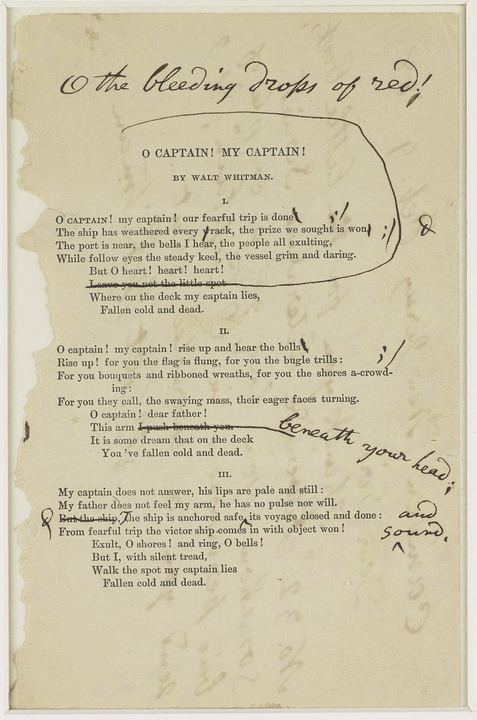
O Captain! My Captain! is Walt Whitman's elegy for Abraham Lincoln, who was shot at Ford's Theatre on Good Friday, 14 April 1865, and died the next morning, days after Lee's surrender at Appomattox had all but ended the Civil War. It was first printed in the Saturday Press on 4 November 1865, appeared in Sequel to Drum-Taps, and was finally placed in the Memories of President Lincoln cluster of Leaves of Grass. The poem never names Lincoln. It is built on a single extended metaphor: the nation is a ship returning from a fearful voyage, the war is the storm it has weathered, the preserved Union is the prize, and the president is the captain who has brought it home. The speaker is a young sailor who calls the captain father. Each of the three eight-line stanzas sets four long, rhymed lines of public celebration against four short, indented lines of private grief, all ending on the same refrain about the captain fallen cold and dead. In the first stanza bells ring and crowds exult at the port, while the sailor sees blood on the deck. In the second he begs the captain to rise and hear the bugles and see the wreaths and the swaying crowd meant for him; holding his arm beneath the captain's head, he calls it some dream. In the third he accepts the truth: the lips are pale, there is no pulse, and the ship is anchored safe while he walks the deck with mournful tread. The final stanza keeps the two worlds apart, telling the shores to exult while the speaker mourns. Unusually for Whitman, the poem uses regular rhyme, a refrain and a ballad-like beat, and it quickly became his most popular poem, recited in schools for generations. Whitman often read it at the close of his lectures on Lincoln's death, though he is reported to have grown weary of its fame. Its companion, When Lilacs Last in the Dooryard Bloom'd, mourns the same death in free verse.
Virtues in this work
- Piety: The sailor honours his captain as dear father and stays beside his body when everyone else is celebrating.
- Fortitude: In the last stanza he faces the plain fact of death and walks the deck with mournful tread rather than fleeing it.
- Friendship: The poem gives the crowd its joy and the captain his grief, honouring both the shared victory and the bond with the fallen leader.
Plot or Argument
- Stanza 1: Homecoming and the fallen captain
The ship has weathered the storm and won its prize; bells ring and crowds watch from the port, but the sailor's eyes go to the bleeding drops on the deck where the captain lies.
- Stanza 2: The plea to rise
The sailor urges the captain to rise for the flag, bugle, wreaths and crowds that are all for him, cradles his head, calls him dear father, and tries to believe his death is a dream.
- Stanza 3: Acceptance and mourning
The captain does not answer and has no pulse; the ship is anchored safe with its object won. The sailor bids the shores exult and the bells ring while he alone walks the deck in mourning.
Characters
- The speaker, a sailor on the ship
A devoted crewman who calls the captain father and moves from disbelief to grief.
- The Captain, the ship's fallen commander
The figure of Abraham Lincoln, dead on deck at the moment of victory.
- The people on the shore, the welcoming crowd
The exulting nation, unaware that the captain has fallen.
Lessons
Victory and grief at the same hour
Each stanza sets the crowd's celebration beside the speaker's private loss, and the poem never lets one cancel the other. The Union is saved and the captain is dead; Whitman teaches that a people can rightly rejoice and mourn in the same moment.
- What do the people on shore see that the speaker does not, and what does he see that they do not?
- Why does the poem end with Exult O shores rather than with the speaker's grief alone?
- Can a victory be complete when its leader is lost?
A leader as father
In the second and third stanzas the sailor calls the captain dear father and my father. The metaphor makes a national leader a protector and head of a household, and shows how deeply many Americans felt Lincoln's death as a personal bereavement.
- Why does the speaker shift from Captain to father?
- What duties does a good captain share with a good father?
- What does it mean for a citizen to feel a leader's death as family grief?
The comfort of form
Whitman, the great poet of free verse, chose rhyme, refrain and a steady beat for this elegy. The fixed form gives a shaken nation something to hold and repeat, much as a hymn does at a funeral.
- How does the refrain Fallen cold and dead change in force from stanza to stanza?
- Why might a poet choose a traditional form for public mourning?
- Compare this poem's sound with any passage of Song of Myself. What is gained and lost?
Context
Lincoln was shot by John Wilkes Booth on 14 April 1865 and died on 15 April, less than a week after Lee surrendered at Appomattox. His funeral train carried his body through the great Northern cities to Springfield, Illinois, and the nation's mourning was unprecedented. Whitman, then a clerk in Washington and a long-time visitor to the wounded in its military hospitals, wrote two elegies for him: the free-verse When Lilacs Last in the Dooryard Bloom'd and this short rhymed poem.
Composition
The poem was first published in the New York Saturday Press on 4 November 1865 and was included in Sequel to Drum-Taps (1865-66). Whitman revised its punctuation and wording over the years and placed it in the cluster Memories of President Lincoln in later editions of Leaves of Grass, including the deathbed edition of 1891-92 that is the stored text.
Reception
It became the most widely anthologized and recited of Whitman's poems in his lifetime, and he often closed his public lectures on the death of Lincoln, given from 1879, by reading it. Critics have sometimes ranked it below Lilacs because of its conventional form, but its refrain made it a schoolroom staple, and a twentieth-century film about a teacher of poetry brought its opening words to a new generation.
Comparisons
- gettysburg-address
Lincoln at Gettysburg asked the living to finish the work for which soldiers died; Whitman's sailor stands where that work is done and its leader has fallen.
- lincoln-second-inaugural-address
Delivered six weeks before the assassination, Lincoln's address looks toward binding up the nation's wounds, the safe harbour Whitman's ship reaches without its captain.
- in-flanders-fields
Both are short rhymed elegies with a refrain from wartime that became schoolroom recitation pieces; McCrae's dead speak to the living, while Whitman's living speaker cannot rouse the dead.
- elegy-written-in-a-country-churchyard
Gray mourns the unremembered poor in a quiet churchyard; Whitman mourns the most public death of his century amid bells and crowds.
Quotes
Frequently cited
“O Captain! my Captain! our fearful trip is done, The ship has weather’d every rack, the prize we sought is won,”
Frequently cited
“Exult O shores, and ring O bells! But I with mournful tread, Walk the deck my Captain lies, Fallen cold and dead.”
“But O heart! heart! heart! O the bleeding drops of red, Where on the deck my Captain lies, Fallen cold and dead.”
“Here Captain! dear father! This arm beneath your head! It is some dream that on the deck, You’ve fallen cold and dead.”
“My Captain does not answer, his lips are pale and still, My father does not feel my arm, he has no pulse nor will,”
For Students
A reading companion for classical Christian high school students. See the student guide.
Reading Guide
Watch for
- The ship-of-state metaphor in lines 1-4: the fearful trip, the weathered rack, the prize won, the steady keel.
- The sudden turn at But O heart! heart! heart! in line 5, where the indented short lines begin.
- The shift from Captain to dear father in line 13 and my father in line 18.
- The physical signs of death in stanza 3: pale lips, no pulse, an arm the captain cannot feel.
- How the refrain Fallen cold and dead closes each stanza but is heard differently each time.
Key terms and names
- Elegy
- A poem of mourning for the dead; this one mourns Lincoln without naming him.
- Extended metaphor
- A comparison carried through a whole poem; here the United States is a ship, the Civil War its voyage and Lincoln its captain.
- Refrain
- A repeated line or phrase; each stanza ends with the captain fallen cold and dead.
- Rack
- A storm or wind-driven cloud; the ship has weather'd every rack, meaning it has come through every storm of the war.
- Memories of President Lincoln
- The section of Leaves of Grass in which Whitman gathered his four poems on Lincoln's death.
Seminar Questions
- Comprehension What do the ship, the voyage, the prize and the captain each stand for?
- Comprehension What is happening on the shore while the speaker kneels on the deck?
- Interpretation Why does the speaker call the captain father in stanzas 2 and 3 but not in stanza 1?
- Interpretation How does the contrast between long and short lines in each stanza mirror the contrast between public and private feeling?
- Interpretation Why does Whitman never name Lincoln in the poem?
- Interpretation In stanza 3 the speaker tells the shores to exult. Is this bitterness, generosity or acceptance?
- Big Question What do citizens owe to a leader who dies in their service, and how should a nation remember him?
Faith Connections
- 2 Samuel 1:17-27 (Scripture)
David's lament for Saul and Jonathan, with its refrain how are the mighty fallen, is the great biblical elegy for a fallen leader, and like Whitman's poem it mourns in the hour of national crisis.
- Deuteronomy 34:1-8 (Scripture)
Moses sees the promised land from Nebo but dies before Israel enters it, and the people mourn him thirty days; many preachers in April 1865 drew this parallel to Lincoln, who saw the war's end but not the peace.
- Psalm 107:23-30 (Scripture)
The psalm's sailors cry to the Lord in the storm and are brought to their desired haven; Whitman's ship reaches its haven too, but at the cost of its captain.
Logic and Rhetoric
Central argument: The voyage has succeeded and the people rightly celebrate; but the captain who brought the ship home lies dead on the deck. Since his death cannot be undone, the speaker lets the nation rejoice while he keeps faith with the captain through mourning. Victory and loss must therefore be held together.
Rhetorical device: apostrophe. The speaker addresses the dead captain directly (O Captain! my Captain! and Here Captain! dear father!) and, in the last stanza, the shores and bells themselves (Exult O shores, and ring O bells!).
Debate: Resolved: that Whitman's rhymed elegy honours Lincoln better than a free-verse poem could.
Memory Work
O Captain! my Captain! our fearful trip is done, The ship has weather’d every rack, the prize we sought is won,
Exult O shores, and ring O bells! But I with mournful tread, Walk the deck my Captain lies, Fallen cold and dead.
Writing Prompts
Essay: Trace the ship metaphor through all three stanzas and argue what it allows Whitman to say about Lincoln and the Civil War that a direct statement could not.
Comparison with The Gettysburg Address: Lincoln at Gettysburg spoke of the honored dead and the unfinished work; Whitman wrote of Lincoln as the honored dead after the work was finished. Compare how each text asks the living to respond to sacrifice.
Medical Lens
The poem is a compact study of acute bereavement: the speaker moves from shock and denial (it is some dream) to recognition of death by its bodily signs, the pale lips and the absent pulse, and ends in a solitary mourning that the public celebration cannot reach. Readers sometimes compare this sequence with later stage models of grief, but such a reading is interpretive. The bedside details may owe something to Whitman's years among the dying in Washington's Civil War hospitals, which he described in Specimen Days and The Wound-Dresser.
- Stanza 2, lines 13-16
The speaker cradles the captain's head and tries to treat the death as a dream.
- Stanza 3, lines 17-18
Death is confirmed by pale, still lips and the absence of a pulse.
Listen to the book
Public-domain audiobook from LibriVox, read by Various volunteers. Recording: O Captain! My Captain! on LibriVox (Internet Archive).
LibriVox recordings are volunteer readings released into the public domain. The reading may follow a different edition from the text in this library.
Creative Prompts
- Classroom
Mark every word in the poem that belongs to the ship metaphor (trip, rack, keel, deck, anchor'd) and every word that belongs to celebration or mourning; then chart how the balance shifts across the three stanzas.
- Poetry
Write a short elegy for a public figure using Whitman's design: four long lines of the crowd's view followed by four short lines of a single mourner's view, with a refrain.
- Essay
Read O Captain! My Captain! beside When Lilacs Last in the Dooryard Bloom'd and argue which form, rhymed refrain or free verse, better serves national grief.
Further Reading
- Specimen Days, Walt Whitman
- Walt Whitman's America: A Cultural Biography, David S. Reynolds
- Walt Whitman: The Song of Himself, Jerome Loving
Verification notes
Text follows the deathbed edition of Leaves of Grass as stored; the 1865 Saturday Press version differs in punctuation and some wording. Line numbers count the 24 lines of the stored text, eight per stanza. Whitman's weariness with the poem's popularity is reported by contemporaries rather than stated in his published writing, so it is given as reported. All quotes are found verbatim in the stored text.
No verification flags recorded.