Work record
The Adventures of Sherlock Holmes
1892 (stories 1891-92) · 19th Century · Short Stories · English
Abstract
Background. Two earlier novels about Holmes had sold modestly when Doyle, then setting up a London eye practice, offered a popular monthly a series of stand-alone tales with a continuing hero. The idea transformed both the magazine and his career.
Content. Cases range from royal blackmail and a bank tunnel to a bride who vanishes after the ceremony, a gem swallowed by a goose, and a snake sent through a ventilator. Clients include a pawnbroker, a typist, a hydraulic engineer, a banker, and a governess. Holmes is outwitted once by a woman, fails once to protect a client from a secret society, and twice spares a culprit.
Structure. Most tales follow one pattern: a visitor's narrative at Baker Street, Holmes's opening deductions, a journey or vigil, and a closing explanation, often with a confession.
Themes. Observation against assumption, respectable disguises hiding greed or cruelty, guardians who prey on daughters and wards for their money, and private justice tempered by mercy.
Significance. Paget's drawings and the magazine format made Holmes an international figure, and the collection fixed the conventions of the short detective story for decades of later writers. Because author and narrator were both medical men, the tales also preserve a vivid picture of Victorian practice, from a surgery near Paddington to an East End opium den.
Main characters
- Sherlock Holmes: Private consulting detective who reasons from minute traces
- Dr. John H. Watson: Doctor, friend, and narrator of every case
- Irene Adler: Singer who defeats Holmes and wins his lasting respect
- Inspector Lestrade: Scotland Yard officer in two of the cases
- Dr. Grimesby Roylott: Brutal stepfather and physician at Stoke Moran
- John Clay: Aristocratic thief behind a fake society of redheads
- Neville St. Clair: Suburban gentleman leading a secret life as a beggar
- Violet Hunter: Resourceful governess hired for a sinister masquerade

Summary
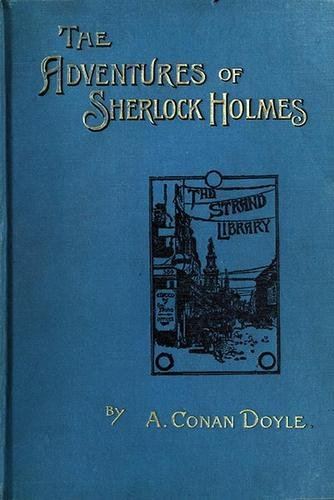
The Adventures of Sherlock Holmes collects the first twelve short stories about the consulting detective of 221B Baker Street, each narrated by his friend Dr. John Watson. In A Scandal in Bohemia the King of Bohemia hires Holmes to recover a compromising photograph from the singer Irene Adler; Holmes, disguised first as a groom and then as a clergyman, tricks her into revealing its hiding place, but she sees through him and escapes with her new husband, leaving Holmes the admiring loser. The Red-Headed League sends a London pawnbroker, Jabez Wilson, to copy the encyclopaedia for a strange society of red-haired men while his assistant, the criminal John Clay, tunnels from his cellar toward a bank vault. In A Case of Identity a typist's vanished fiancé proves to be her own stepfather in disguise. The Boscombe Valley Mystery clears a young man of his father's murder and uncovers an old Australian gold-robbery and years of blackmail. The Five Orange Pips is a failure: a young client, warned by a secret society's sign, is murdered before Holmes can act. In The Man with the Twisted Lip Watson finds Holmes in an East End opium den, searching for a missing gentleman who turns out to have lived a double life as a scarred professional beggar. The Blue Carbuncle follows a stolen jewel into a Christmas goose, and Holmes lets the frightened thief go. In The Speckled Band a young woman fears the stepfather whose house killed her sister; Holmes and Watson keep watch in the dark bedroom, discover the ventilator, the dummy bell-rope, and a deadly Indian snake, and the doctor dies by his own weapon. A hydraulic engineer loses his thumb escaping from coiners in The Engineer's Thumb; an aristocrat's American bride vanishes from her wedding breakfast in The Noble Bachelor; a banker's son is wrongly accused of breaking a royal pledge in The Beryl Coronet; and in The Copper Beeches a governess is paid to cut her hair, wear an electric-blue dress, and sit with her back to the window, until she discovers that her employer's daughter is imprisoned upstairs. The stories appeared monthly in The Strand Magazine from July 1891 to June 1892, with Sidney Paget's illustrations, and were collected by George Newnes in October 1892. They set the pattern of the modern detective story: a client's narrative in the Baker Street sitting room, close observation of trifles, an expedition, and a final explanation of how the clues fit.
Virtues in this work
- Prudence: Holmes refuses to name the meaning of the King's note until he has data, and his patience in the dark vault and the bedroom at Stoke Moran saves lives.
- Friendship: Watson leaves his practice and his home at a word from Holmes in later cases, and in The Speckled Band brings his revolver to share the danger of the night watch.
- Justice: Holmes clears James McCarthy and Arthur Holder, both wrongly accused, and exposes James Windibank's heartless trick on his stepdaughter.
- Fortitude: Violet Hunter stays at the Copper Beeches despite her fear, explores the locked wing, and helps Holmes rescue Alice Rucastle.
Plot or Argument
- A Scandal in Bohemia
The masked King of Bohemia needs a photograph back from Irene Adler before his royal marriage. Holmes stands witness at her wedding in disguise, fakes a fire with Watson's smoke-rocket to learn where she keeps it, and finds the next morning that she has fled, leaving her own portrait and a letter. Holmes asks for that photograph as his only reward.
- The Red-Headed League; A Case of Identity
Jabez Wilson is paid four pounds a week to copy the Encyclopaedia Britannica while his assistant digs a tunnel to the City and Suburban Bank; Holmes waits in the vault and catches John Clay. Mary Sutherland's fiancé Hosmer Angel disappears at the church door, and Holmes proves by the typewritten letters that he is her stepfather, James Windibank, protecting her income.
- The Boscombe Valley Mystery; The Five Orange Pips
In Herefordshire young James McCarthy is charged with killing his father; Holmes reads the ground, the dying man's last words, and the ash of an Indian cigar, and the dying landowner John Turner confesses to being Black Jack of Ballarat, blackmailed for decades. John Openshaw brings the story of his uncle's death after receiving five orange pips marked K. K. K., is killed on his way home, and Holmes's revenge is lost when the killers' ship goes down at sea.
- The Man with the Twisted Lip
Watson fetches an addicted acquaintance from the Bar of Gold opium den and finds Holmes there in disguise. Mrs. St. Clair saw her husband at an upper window in Upper Swandam Lane, yet only the deformed beggar Hugh Boone is found; Holmes washes Boone's face with a sponge in his cell and reveals Neville St. Clair, who had earned more by begging than by honest work.
- The Blue Carbuncle
A battered hat and a Christmas goose lead Holmes to the Countess of Morcar's stolen gem, hidden in the bird's crop by the hotel attendant James Ryder. Holmes lets the terrified Ryder go, saying it is the season of forgiveness.
- The Speckled Band
Helen Stoner fears for her life at Stoke Moran, where her twin sister Julia died crying out about a speckled band. Holmes notes a ventilator into the stepfather's room, a bell-rope that rings nothing, and a saucer of milk; in the dark he lashes at a swamp adder, which turns and kills Dr. Grimesby Roylott.
- The Engineer's Thumb; The Noble Bachelor
Victor Hatherley arrives at Watson's surgery with his thumb hacked off, having been hired by Colonel Lysander Stark to repair a press supposedly used for fuller's-earth but really for coining; the house burns and the gang escapes. Lord St. Simon's bride Hatty Doran vanishes from the wedding breakfast because her first husband, Francis Hay Moulton, thought killed in the West, has come back.
- The Beryl Coronet; The Copper Beeches
The banker Alexander Holder finds his son Arthur holding the damaged coronet pledged by an exalted client; Holmes shows that the boy was shielding his cousin Mary, who has run off with Sir George Burnwell. Violet Hunter takes a strange post at the Copper Beeches, near Winchester; Holmes reveals that Jephro Rucastle is keeping his daughter Alice locked away from her suitor and using the governess to impersonate her, and Rucastle is mauled by his own mastiff.
Characters
- Sherlock Holmes, detective
Consulting detective of Baker Street, a master of observation, disguise, chemistry, and the violin, restless when he has no problem to solve.
- Dr. John H. Watson, narrator
Holmes's friend and chronicler, a doctor who shares the Baker Street rooms in the earliest case and in most others has married and set up in general practice.
- Irene Adler, adversary
The opera singer who outwits Holmes in A Scandal in Bohemia; afterward he calls her the woman.
- Inspector Lestrade, police detective
Scotland Yard man who works the Boscombe Valley and Noble Bachelor cases and is generally a step behind.
- Dr. Grimesby Roylott, villain
Violent physician of Stoke Moran, formerly in practice in Calcutta, who plans to kill his stepdaughters for their money.
- John Clay, villain
Clever, well-born criminal behind the Red-Headed League who tunnels toward a bank's gold.
- Neville St. Clair, missing man
Respectable suburban gentleman secretly earning his living as the beggar Hugh Boone.
- Violet Hunter, client
Brave, sensible governess at the Copper Beeches who keeps her nerve and investigates her own employer.
- Helen Stoner, client
Young woman of Stoke Moran, prematurely grey with fear, whose sister died before her wedding.
Lessons
Seeing and observing
In the first story Holmes tells Watson that he has climbed the stairs to their rooms hundreds of times without knowing there are seventeen steps. Across the collection Holmes reads a man's trade from his hands, a stranger's history from his hat, and a crime from a bell-rope that rings nothing. Attention is a discipline that can be practised.
- What does Holmes learn about Henry Baker from his old hat in The Blue Carbuncle?
- Why does Watson not notice what Holmes notices, when they are looking at the same things?
- What is one thing you see every day but have never really observed?
Facts first, then theories
Holmes warns that a detective who theorizes too early begins to bend the facts to fit. In The Beryl Coronet everyone, including the boy's own father, decides Arthur Holder is guilty because he was found holding the coronet; Holmes reads the footprints in the snow and finds the truth was the opposite.
- Why does Alexander Holder believe his son is a thief?
- Which clues in the snow change the picture?
- When have you decided something too quickly before you had all the facts?
Justice and mercy are not always the same as the law
Holmes sometimes lets a guilty person go: the dying John Turner in Boscombe Valley, and James Ryder at Christmas in The Blue Carbuncle. He also admits failure in The Five Orange Pips and is beaten fairly by Irene Adler. The stories ask when mercy serves justice better than prosecution.
- Why does Holmes release James Ryder? Do you agree with him?
- How is the case of John Turner different from Ryder's?
- Is it right for a private detective, rather than a court, to decide who is punished?
Respectable masks
Many villains in these stories wear respectable faces: a stepfather pretending to be a suitor, a doctor and landowner who is a murderer, a country gentleman who keeps his daughter prisoner, a baronet's son who is a thief. Doyle has Holmes say that the quiet countryside can hide as much sin as any London alley.
- Which villain surprised you most, and why?
- Why might crimes stay hidden more easily in a lonely country house than in a crowded city?
- What does Neville St. Clair's double life suggest about the difference between how people look and who they are?
Context
The stories are set in the late Victorian London of gaslight, hansom cabs, telegrams, the Underground, and a new mass-reading public. Scotland Yard's detective branch was still young, and newspapers fed public appetite for crime. Holmes brings the method of the laboratory and the clinic to detection: he analyses ash and inks, consults his index of cuttings, and reasons from signs as a physician reads symptoms. The world of the stories also reaches across the empire and beyond, with clients and villains returned from Australia, India, and the American West.
Composition
After two Holmes novels, A Study in Scarlet (1887) and The Sign of Four (1890), had made little stir, Doyle proposed a series of complete short stories with a continuing hero to The Strand Magazine. A Scandal in Bohemia appeared in July 1891, and the twelve stories ran monthly until The Copper Beeches in June 1892, each illustrated by Sidney Paget, whose drawings fixed Holmes's appearance. George Newnes published them as a book on 14 October 1892.
Reception
The series made The Strand's fortune and Holmes the most famous detective in fiction; the self-contained detective story built around a recurring hero became a staple of magazines. Doyle continued with The Memoirs of Sherlock Holmes, killed Holmes off in 1893, and revived him in The Hound of the Baskervilles (1901-02). The deerstalker, the pipe, and the phrase about seeing and observing passed into common culture, and generations of writers, including Chesterton, Christie, and Sayers, worked in the form these stories defined.
Comparisons
- the-hound-of-the-baskervilles
The Hound stretches the method of the Adventures to novel length and brings back the country-house menace of The Speckled Band and The Copper Beeches, with a legend in place of a snake.
- the-innocence-of-father-brown
Chesterton's priest solves crimes by understanding the sinner from within rather than by reading ash and footprints; reading the two together sets Holmes's scientific observation beside Brown's moral insight.
- the-strange-case-of-dr-jekyll-and-mr-hyde
Neville St. Clair's double life as Hugh Boone and Stevenson's respectable doctor with a hidden self are both late Victorian London stories about a gentleman who lives a second, disguised life.
- a-christmas-carol
The Blue Carbuncle is Doyle's Christmas story: a goose, a poor family man, and Holmes's decision that the season calls for forgiveness, in the tradition Dickens made popular.
Quotes
Frequently cited
“You see, but you do not observe.”
Frequently cited
“It is a capital mistake to theorise before one has data. Insensibly one begins to twist facts to suit theories, instead of theories to suit facts.”
Frequently cited
“I suppose that I am commuting a felony, but it is just possible that I am saving a soul.”
Frequently cited
“When a doctor does go wrong he is the first of criminals. He has nerve and he has knowledge.”
Frequently cited
“the lowest and vilest alleys in London do not present a more dreadful record of sin than does the smiling and beautiful countryside.”
“alternating from week to week between cocaine and ambition, the drowsiness of the drug, and the fierce energy of his own keen nature.”
“life is infinitely stranger than anything which the mind of man could invent.”
“He found, as so many more have done, that the practice is easier to attain than to get rid of”
For Students
A reading companion for classical Christian high school students. See the student guide.
Reading Guide
Watch for
- The opening scene of each story in the Baker Street sitting room, and what Holmes deduces about the visitor before a word is said.
- Holmes's disguises: the groom and the clergyman in A Scandal in Bohemia, and the old man in the opium den in The Man with the Twisted Lip.
- The three strange details of the bedroom at Stoke Moran: the ventilator, the bell-rope, and the bed clamped to the floor.
- The cases Holmes does not win, such as Irene Adler's escape and the death of John Openshaw.
- How each story ends: with an arrest, a pardon, a confession, or a wedding.
Key terms and names
- Deduction
- Holmes's name for reasoning from small observed facts, such as a tan line or a worn sleeve, to firm conclusions about a person or event.
- Consulting detective
- Holmes's own invented profession: a private expert whom both the police and private clients come to for advice.
- Baker Street
- The London street where Holmes lodges at number 221B, and where most of the cases begin.
- Scotland Yard
- Headquarters of the London police; Inspector Lestrade and Inspector Bradstreet come from there.
- Opium den
- A hidden room where people paid to smoke opium, like the Bar of Gold in The Man with the Twisted Lip.
- Carbuncle
- A deep-red precious stone; the famous one in this book is unusually blue.
- Swamp adder
- The venomous snake that Holmes calls the deadliest in India, used as a weapon in The Speckled Band.
Seminar Questions
- Comprehension How does Irene Adler discover that the clergyman she helped is really Sherlock Holmes?
- Comprehension Why does the Red-Headed League pay Jabez Wilson to copy the encyclopaedia?
- Comprehension What clues in Julia Stoner's room lead Holmes to the solution of The Speckled Band?
- Interpretation Watson tells the stories, not Holmes. How would the stories change if Holmes told them himself?
- Interpretation Why does Holmes keep Irene Adler's photograph instead of the king's emerald ring?
- Interpretation Many of the villains are respectable men: a stepfather, a doctor, a landowner, a country gentleman. What is Doyle suggesting about appearances?
- Big Question Is it ever right to let a guilty person go free, as Holmes does with James Ryder?
- Big Question Is careful reasoning enough to find the truth about people, or does it take something more?
Faith Connections
- Numbers 32:23 (Scripture)
Be sure your sin will find you out. In story after story, a hidden crime is found out through a small trace: a typewritten letter, footprints in snow, a bell-rope that does not ring.
- Proverbs 25:2 (Scripture)
It is the glory of God to conceal a thing, but the honour of kings is to search out a matter. Holmes's delight in searching out hidden things is a picture of the honour the proverb gives to patient inquiry.
- Luke 6:36-37 (Scripture)
Be merciful, as your Father is merciful. Holmes's decision to let the trembling James Ryder go at Christmas raises the question of when mercy can save a person whom punishment would harden.
- G. K. Chesterton, A Defence of Detective Stories (1901) (Great Conversation)
Chesterton argued that the detective story is the first popular form to find poetry in modern city life, with the detective as a knight-errant of civilization. Holmes's London of fog, cabs, and lit windows is the city he had in mind.
Logic and Rhetoric
Central argument: Every action leaves traces, and the trained observer who gathers facts before forming theories can read those traces truly. Since crime is an action, crime can be solved by observation and reasoning rather than by guesswork or confession. Holmes's successes demonstrate the method; his rare failures, as with Irene Adler, show its limits when the other mind is as quick as his own.
Rhetorical device: delayed explanation. In The Red-Headed League Holmes taps the pavement outside the pawnshop and examines the assistant's trouser knees, but Watson and the reader learn why only after the arrest in the bank vault, when Holmes explains the chain of reasoning.
Debate: Resolved: that Irene Adler, not Holmes, was in the right in A Scandal in Bohemia.
Memory Work
You see, but you do not observe.
It is a capital mistake to theorise before one has data. Insensibly one begins to twist facts to suit theories, instead of theories to suit facts.
Writing Prompts
Essay: Choose two stories in which Holmes reads a person from small details, such as the hat in The Blue Carbuncle and the client in The Red-Headed League. Explain his reasoning step by step and judge whether each deduction is certain or only likely.
Comparison with The Innocence of Father Brown: Compare how Holmes and Father Brown solve crimes. Which detective understands criminals better, and why?
Medical Lens
Written by a practising physician and narrated by a general practitioner, the Adventures are steeped in late Victorian medicine. Holmes's method openly imitates clinical diagnosis: the reading of a stranger's history from his hands, gait, or clothes descends from the bedside teaching of Doyle's Edinburgh teacher Joseph Bell. The collection is also an early fictional record of recreational drug use in a respectable class. Watson mentions Holmes's cocaine in the first paragraph of the first story, at a time when cocaine was a new and legal stimulant sold by chemists; The Man with the Twisted Lip opens with a careful picture of opium dependence, from a habit begun in imitation of De Quincey's Confessions to the yellow, pasty face and pin-point pupils of the user, and then descends into an East End opium den. The Speckled Band offers the physician-poisoner, and Holmes compares Roylott with the real poisoners William Palmer and Edward Pritchard, both medical men hanged for murder; the plot turns on a venom that Holmes says no chemical test could detect, a period anxiety about undetectable poisons. Watson treats a traumatic amputation of the thumb in The Engineer's Thumb, and the Copper Beeches turns on a young woman's six weeks of brain fever under pressure from her father, a common nineteenth-century diagnosis for illness brought on by emotional strain whose modern equivalent is uncertain. The dying John Turner's diabetes is mentioned as a death sentence, as it was before insulin. Readers should keep in mind that Holmes's habits are described, not prescribed, and that Watson himself disapproves of them in later stories.
- A Scandal in Bohemia, opening
Watson describes Holmes, alone in Baker Street, alternating between bouts of cocaine and bursts of work on crime.
- The Man with the Twisted Lip, opening
Isa Whitney's opium habit, begun after reading De Quincey, with the physical signs of the user; Watson then enters the Bar of Gold opium den in Upper Swandam Lane to bring him home and finds Holmes there in disguise.
- The Man with the Twisted Lip
The beggar Hugh Boone's scarred, drawn-up lip, which proves to be greasepaint and disguise worn by Neville St. Clair to draw alms.
- The Adventure of the Speckled Band
Dr. Grimesby Roylott, a physician who once practised in Calcutta, uses a trained swamp adder through a ventilator; Holmes reflects on doctors who become murderers and on poisons that escape chemical detection.
- The Adventure of the Engineer's Thumb
Victor Hatherley comes to Watson's surgery near Paddington with his thumb cut off by a cleaver; Watson cleans and dresses the wound while the patient tells his story.
- The Boscombe Valley Mystery
John Turner, dying of long-standing diabetes, confesses to the killing and is spared the trial he would not live to finish.
- The Adventure of the Copper Beeches
Mrs. Toller explains that Alice Rucastle, harried by her father to sign away her rights, fell ill with brain fever for six weeks and had her hair cut off.
Listen to the book
Public-domain audiobook from LibriVox, read by Ruth Golding. Recording: Adventures of Sherlock Holmes (version 2) on LibriVox (Internet Archive).
LibriVox recordings are volunteer readings released into the public domain. The reading may follow a different edition from the text in this library.
Creative Prompts
- Classroom
Play the hat game from The Blue Carbuncle: bring an old coat, bag, or shoe, and have students list what they can deduce about its owner, then argue which deductions are certain and which are guesses.
- Fiction
Retell A Scandal in Bohemia from Irene Adler's point of view, from the moment she sees the clergyman fall in the street to the letter she leaves for Holmes.
- Essay
Holmes lets two guilty people go free in this collection. Using The Boscombe Valley Mystery and The Blue Carbuncle, argue whether he was right.
- Adaptation
Turn The Speckled Band into a radio play for three voices, using sound effects for the whistle, the bell-rope, and the metallic clang in the dark.
Further Reading
- The Memoirs of Sherlock Holmes, Arthur Conan Doyle
The second collection, ending with The Final Problem.
- A Study in Scarlet, Arthur Conan Doyle
The first Holmes novel, in which Watson meets Holmes.
- Memories and Adventures, Arthur Conan Doyle
Doyle's own autobiography, with his account of Joseph Bell and the Strand stories.
- Teller of Tales: The Life of Arthur Conan Doyle, Daniel Stashower
Verification notes
Serial and book dates checked at https://en.wikipedia.org/wiki/The_Adventures_of_Sherlock_Holmes: twelve monthly issues of The Strand Magazine from July 1891 to June 1892, illustrated by Sidney Paget; book published by George Newnes on 14 October 1892. The library text is Project Gutenberg #1661, which uses the London spelling theorise and printed italics as underscores; for that reason the famous opening sentence about the woman was not used as a quote. Doyle's brief work as an eye specialist in London in 1891 and his Vienna study are standard biographical facts not separately checked. Holmes's comparison of Roylott with Palmer and Pritchard is in the text; the identifications of those two men with the hanged physician-poisoners William Palmer (1856) and Edward William Pritchard (1865) are standard annotations. All quotations were checked by exact search against content/texts/the-adventures-of-sherlock-holmes.txt.
No verification flags recorded.