Work record
The Hound of the Baskervilles
1902 (serialized 1901-02) · Early 20th Century · Novel · English
Abstract
Background. Eight years after sending his detective over a Swiss waterfall, Doyle heard a Devon folk tale from a journalist friend, explored the moor with him, and built a long mystery around it, dating the events to the years before the hero's apparent death.
Plot. A doctor brings Holmes an old family curse and a fresh death at the end of a yew walk. The heir comes home from Canada, warnings and thefts follow him through London, and Watson escorts him to Devon. Lights in windows, a fugitive killer, a lonely stranger on the hills, and a neighbour's 'sister' who begs the heir to leave all thicken the puzzle until Holmes emerges from hiding, recognizes an ancestor's face in a painting, and stakes out the fog-bound path where the glowing beast attacks.
Form. Doyle shifts from Watson's usual retrospective narration into dated letters and diary entries, so the reader shares his partial knowledge before the closing chapter reorders every clue.
Themes. Superstition tested by reason, greed for inheritance, heredity and resemblance, the menace of wild country, and loyalty under fear.
Significance. Its success led directly to Holmes's revival in the stories of 1903 onward. Repeatedly filmed, it fixed the image of Dartmoor as a landscape of mist and danger and is often called the strongest of Doyle's four novels about the detective.
Main characters
- Sherlock Holmes: Detective who works the case in secret from a moorland hut
- Dr. John H. Watson: Narrator and bodyguard whose reports form the book's middle
- Sir Henry Baskerville: Canadian-raised heir marked as the next victim
- Dr. James Mortimer: Moorland surgeon and phrenology enthusiast who consults Holmes
- Jack Stapleton: Butterfly collector concealing a claim to the estate
- Beryl Stapleton: Wife posing as his sister, coerced into silence
- The Barrymores: Hall servants sheltering a fugitive relative
- Selden: Convict from Princetown hiding among the rocks
- Laura Lyons: Typist of Coombe Tracey drawn into the fatal appointment

Summary
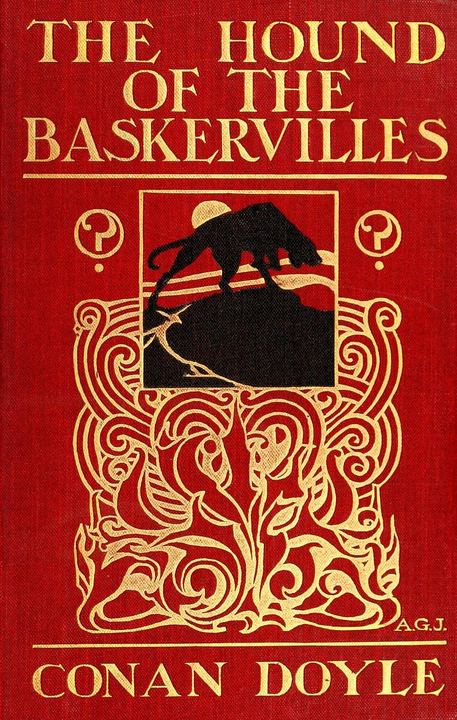
The Hound of the Baskervilles brings Sherlock Holmes and Dr. Watson to Dartmoor to investigate a family curse. It opens in Baker Street with a walking stick left by a visitor, from which Holmes deduces a young country doctor with a curly-haired spaniel. The owner, Dr. James Mortimer, reads them an eighteenth-century manuscript: the wicked Sir Hugo Baskerville, chasing a kidnapped girl across the moor, was torn apart by a huge spectral hound, and the family has suffered sudden deaths ever since. Mortimer then reports that Sir Charles Baskerville, a kindly man with a weak heart who lived in dread of the legend, has been found dead at the end of the yew alley at Baskerville Hall, his face distorted with terror, and near the body were the footprints of a gigantic hound. The heir, Sir Henry, arrives from Canada and in London receives a warning pasted from words cut out of The Times, loses first a new boot and then an old one from his hotel, and is shadowed by a bearded man in a cab. Holmes, claiming to be kept in town, sends Watson to Devonshire to guard him. Watson's reports describe the bleak moor and its people: the butler Barrymore and his wife, secretly feeding her brother Selden, an escaped convict; the naturalist Jack Stapleton and his beautiful 'sister' Beryl, who tries to warn Sir Henry away; the litigious old Frankland with his telescope; and a mysterious man living in a prehistoric stone hut. That man proves to be Holmes, who has been on the moor in secret all along. Selden falls to his death over a rock while wearing Sir Henry's cast-off clothes, and a family portrait of Hugo reveals to Holmes that Stapleton is a Baskerville, the son of Sir Charles's disgraced younger brother, plotting to inherit. Beryl is in fact Stapleton's wife, and he used Mrs. Laura Lyons to lure Sir Charles to the moor gate. Using Sir Henry as bait, Holmes, Watson and Inspector Lestrade wait in the fog outside Stapleton's house, Merripit House; a huge dog smeared with phosphorus bursts out and attacks the baronet, and Holmes shoots it dead. Stapleton flees into the Grimpen Mire and is never seen again. The novel was serialized in The Strand Magazine from August 1901 to April 1902 with Sidney Paget's illustrations and published as a book by George Newnes in 1902. Doyle set it before Holmes's supposed death at the Reichenbach Falls, and it remains the best-known Holmes story.
Virtues in this work
- Fortitude: Watson goes out alone at night to follow Barrymore's light and to confront the man in the stone hut with his revolver ready.
- Friendship: Watson stays at Sir Henry's side on the moor as Holmes asked, and Holmes later admits how much his friend's reports and loyalty mattered.
- Prudence: Holmes refuses to accept the legend or to strike too early, waiting until the night at Merripit House to catch Stapleton in the act.
- Charity: Mrs. Barrymore risks her place to feed her escaped brother because, she says, he is still the boy she nursed.
Plot or Argument
- Chapters 1-3: The stick, the legend, and the footprints
Watson tries Holmes's method on a forgotten walking stick and gets most of it wrong; Holmes corrects him and identifies Dr. Mortimer before he appears. Mortimer reads the 1742 manuscript of Hugo Baskerville and the hound, then the newspaper account of Sir Charles's death, and finally his private fact: footprints of a gigantic hound beside the body. Holmes spends a day in thought and takes the case.
- Chapters 4-5: Sir Henry in London
Sir Henry Baskerville receives an anonymous warning made of words cut from The Times leader, and boots go missing from his hotel. Holmes and Watson follow him and spot a bearded man in a cab, who escapes and, as the cabman later reports, gave his name as Sherlock Holmes. Every thread Holmes pulls breaks, and he sends Watson to Devonshire with Sir Henry and Mortimer.
- Chapters 6-7: Baskerville Hall and Merripit House
The party reaches the gloomy Hall as warders hunt the escaped murderer Selden on the moor. Watson meets Stapleton, who shows him the great Grimpen Mire swallowing a pony and hears a long, low moan across the moor. Beryl Stapleton, mistaking Watson for Sir Henry, urges him to go back to London.
- Chapters 8-10: Watson's reports and diary
Watson writes to Holmes about Stapleton's angry interruption of Sir Henry's courtship of Beryl, and about Barrymore signalling with a candle at night. He and Sir Henry learn that the light is for Mrs. Barrymore's convict brother, chase Selden in vain, and see a tall figure on a tor. From Barrymore they learn that Sir Charles had an appointment at the moor gate with a woman whose initials were L. L.
- Chapters 11-12: The man on the tor and death on the moor
Watson questions Laura Lyons at Coombe Tracey, then tracks the stranger to a stone hut and finds it is Holmes. As they talk, a scream rings over the moor; they find a body in Sir Henry's tweed suit, but it is Selden, who has fallen from a ledge fleeing the hound. Stapleton arrives and studies their faces.
- Chapters 13-14: The trap is sprung
Holmes sees Stapleton's face in the portrait of Hugo Baskerville and confronts Laura Lyons with proof that Stapleton is married. Sir Henry dines at Merripit House and walks home across the moor in rising fog; the hound, glowing with phosphorus, leaps on him, and Holmes kills it. Beryl is found bound in an upstairs room, and Stapleton is lost in the Grimpen Mire, where only Sir Henry's old boot and the hound's hiding place are found.
- Chapter 15: A retrospection
Months later in Baker Street, Holmes explains everything to Watson: Stapleton's real name and South American past, his use of his wife and of Laura Lyons, the stolen boot used to give the hound Sir Henry's scent, and why Holmes kept even Watson in the dark. Sir Henry and Dr. Mortimer leave on a long voyage to restore Sir Henry's nerves.
Characters
- Sherlock Holmes, detective
Consulting detective who seems to stay in London but secretly camps in a stone hut on the moor to watch the case unfold.
- Dr. John H. Watson, narrator
Holmes's friend, sent to guard Sir Henry; most of the middle of the book is told through his letters and diary from Dartmoor.
- Sir Henry Baskerville, heir
Frank, brave young heir, recently farming in Canada, who comes to claim the Hall and falls in love with Beryl Stapleton.
- Dr. James Mortimer, client
Absent-minded country surgeon and amateur anthropologist, friend of Sir Charles, who brings the case to Holmes.
- Jack Stapleton, villain
Mild-seeming naturalist with a butterfly net who is really a Baskerville, plotting to kill his way to the estate.
- Beryl Stapleton, wife of the villain
Costa Rican-born woman passed off as Stapleton's sister, who tries in secret to warn Sir Henry.
- Barrymore and Mrs. Barrymore, servants
Butler and housekeeper at the Hall whose suspicious behaviour hides only their loyalty to her brother Selden.
- Selden, escaped convict
Murderer on the run from Princetown prison, fed by his sister, who dies on the moor in Sir Henry's old clothes.
- Laura Lyons, witness
Frankland's deserted daughter in Coombe Tracey, whom Stapleton used to draw Sir Charles to the moor gate.
- Mr. Frankland, neighbour
Quarrelsome old man of Lafter Hall who goes to law with everyone and watches the moor through a telescope.
Lessons
A legend explained is a legend defeated
The hound seems supernatural from the first manuscript to the night of the fog, and even Mortimer, a man of science, half believes it. Holmes refuses to accept a ghost before he has ruled out every natural cause, and the creature turns out to be a real dog painted with phosphorus by a real man. The novel shows that fear thrives on what is only hinted at, as the old manuscript itself admits.
- Why does Dr. Mortimer hide the footprints from the inquest?
- Which clues show Holmes that a human hand is behind the hound?
- Why is something half seen often more frightening than something seen clearly?
Watson alone
For most of the book Holmes is absent, and Watson must observe, report, and act by himself. He makes mistakes, but his letters are honest and his courage in following the light on the moor and stalking the man on the tor is real. Holmes later admits that Watson's reports were essential, even though he kept Watson in the dark.
- What does Watson get right on Dartmoor, and what does he get wrong?
- Was Holmes fair to Watson in hiding on the moor without telling him?
- What is it like to be trusted with a hard job when the expert is not there to help?
The past in the blood?
Holmes recognizes Stapleton in the portrait of the wicked Hugo and calls him a throwback, both physical and spiritual. Dr. Mortimer writes papers on atavism and covets Holmes's skull. The book plays with the late Victorian idea that character is inherited, but Stapleton still chooses every step of his plot, and Sir Henry, of the same blood, is honest and kind.
- What does Holmes see when Sir Henry's candle lights up the portrait of Hugo?
- How are Sir Henry and Stapleton alike, and how are they different?
- Can a family's sins be passed down, or does each person choose good or evil for himself?
Hidden kindness and hidden cruelty
Many people on the moor are not what they seem. The sinister Barrymores are only protecting a brother; the friendly naturalist is a murderer; the 'sister' is a wife who has been beaten and bound. Doyle uses the fog and the bog to picture a world where appearances mislead, and only patient attention sorts the true from the false.
- Why does Watson suspect Barrymore at first?
- What clues about Stapleton could a careful reader have noticed early?
- How should we judge people whose actions look suspicious before we know their reasons?
Context
Dartmoor in Devon was, around 1900, a wild upland of granite tors, bogs, Bronze Age hut circles, tin-mining remains, and the convict prison at Princetown, whose escaped prisoners occasionally roamed the moor. West Country folklore told of black spectral dogs and of a wicked squire hunted by hounds. The story also belongs to an age fascinated by science: Mortimer's papers on atavism, his interest in skull measurement, and his admiration for the French police scientist Alphonse Bertillon reflect the criminal anthropology and heredity theories much discussed at the end of the nineteenth century.
Composition
Doyle had killed Holmes in 1893. In 1901, after a holiday in Norfolk where his friend Bertram Fletcher Robinson told him a West Country legend, the two toured Dartmoor together, and Doyle wrote a thriller in which Holmes proved necessary. He solved the problem of Holmes's death by setting the story earlier. The book is dedicated to Robinson for the legend and help with details. It ran in The Strand Magazine in nine monthly parts from August 1901 to April 1902, illustrated by Sidney Paget, and George Newnes published the book in 1902.
Reception
The serial raised The Strand's circulation sharply, and the demand it revealed helped persuade Doyle to bring Holmes back permanently in The Empty House (1903). The novel has been filmed and adapted more often than any other Holmes story and is commonly named the finest of the four Holmes novels; its atmosphere of fog, moor, and mire set a pattern for Gothic detective fiction.
Comparisons
- the-adventures-of-sherlock-holmes
The short-story collection that made Holmes famous; The Speckled Band's lonely country house, trained animal, and greedy relative are the seed of the Hound's plot, expanded here to novel length.
- the-innocence-of-father-brown
Chesterton's priest also faces crimes dressed up as the supernatural, but where Holmes defeats the legend with physical evidence, Father Brown reads the human heart and insists that reason and faith are allies.
- the-strange-case-of-dr-jekyll-and-mr-hyde
Both books test late Victorian science against the uncanny and ask whether evil is inherited or chosen; Stevenson keeps the horror within one man, while Doyle traces a family's wickedness through a portrait.
- dracula
Published five years earlier, Stoker's novel is told through letters and diaries much as Watson's Dartmoor chapters are, and also pits modern doctors against an ancient terror.
- the-thirty-nine-steps
Buchan's hero, like Sir Henry, is a newcomer from overseas hunted across lonely British moorland, and both books turn wild landscape into a stage for suspense.
Quotes
Frequently cited
“It may be that you are not yourself luminous, but you are a conductor of light.”
Frequently cited
“forbear from crossing the moor in those dark hours when the powers of evil are exalted.”
Frequently cited
“Mr. Holmes, they were the footprints of a gigantic hound!”
Frequently cited
“The world is full of obvious things which nobody by any chance ever observes.”
Frequently cited
“Never in the delirious dream of a disordered brain could anything more savage, more appalling, more hellish be conceived than that dark form and savage face which broke upon us out of the wall of fog.”
“Sir Charles’s nervous system was strained to the breaking point.”
“A false step yonder means death to man or beast.”
“it is an interesting instance of a throwback, which appears to be both physical and spiritual.”
For Students
A reading companion for classical Christian high school students. See the student guide.
Reading Guide
Watch for
- What Holmes deduces from Dr. Mortimer's walking stick, and how much of Watson's guess was wrong.
- The two missing boots in the London hotel, a new brown one and an old black one, and why a thief would want an old boot.
- Every time someone tries to warn Sir Henry away from Dartmoor.
- The light in the window at night, the man on the tor, and the moaning cry across the moor.
- The family portraits in the hall of Baskerville Hall.
Key terms and names
- Moor
- A wide, open upland of heather, rock, and bog with few trees or houses; Dartmoor in Devon is the setting of the story.
- Tor
- A rocky hilltop rising out of the moor, where Watson sees a tall figure standing against the moon.
- Mire
- A deep, soft bog that can swallow a person or animal; the great Grimpen Mire hides Stapleton's secret.
- Baronet
- A British title passed from father to son, ranking just below a baron; Sir Henry inherits it with the Hall.
- Heir
- The person who receives an estate or title when its owner dies; Stapleton wants to become the heir by murder.
- Inquest
- An official inquiry into a sudden death; the inquest on Sir Charles finds that he died of heart failure.
- Phosphorus
- A chemical that glows in the dark; Stapleton paints the hound's muzzle with it to make it look like a demon.
Seminar Questions
- Comprehension What does the old Baskerville manuscript say happened to Hugo Baskerville?
- Comprehension Why does Holmes send Watson to Dartmoor instead of going himself?
- Comprehension Whom is Barrymore signalling to with a candle, and why?
- Interpretation Why does Doyle keep Holmes out of the story for so many chapters, and what does the book gain from Watson's letters and diary?
- Interpretation How does the moor itself, with its fog, tors, and mire, become a kind of character in the book?
- Interpretation Holmes calls Stapleton a throwback to Hugo. Is Stapleton wicked because of his family, or because of his own choices?
- Big Question Is it reasonable to look first for a natural explanation of something that seems supernatural, and are there limits to that rule?
- Big Question Was Holmes right to use Sir Henry as bait to catch the murderer?
Faith Connections
- Exodus 20:5-6 (Scripture)
The Baskerville manuscript itself appeals to Holy Writ, hoping Providence will not punish the innocent beyond the third or fourth generation. The commandment sets that warning beside God's mercy to thousands, which the honest heir Sir Henry receives.
- Ezekiel 18:20 (Scripture)
The son shall not bear the iniquity of the father. Sir Henry and Stapleton share Hugo's blood, but each is judged by what he does, which answers the fear that a family curse decides a person's fate.
- 1 John 4:18 (Scripture)
Perfect love casts out fear. Sir Charles is destroyed by dread, while Watson's loyalty to his friend and charge keeps him going out onto the moor at night.
- G. K. Chesterton, The Blue Cross and The Oracle of the Dog (Great Conversation)
Chesterton's Father Brown also sees through crimes disguised as the uncanny, but he insists that true reason and true faith work together; reading him beside Holmes shows two ways of refusing superstition.
Logic and Rhetoric
Central argument: Every apparent marvel in the case, the curse, the footprints, the cry on the moor, and the glowing beast, can be traced to a human cause if one gathers facts patiently and refuses to accept a supernatural explanation until natural ones are exhausted. Because the facts point to a man who gains by the deaths, the legend must be a tool of greed, and the way to defeat it is to catch the man in the act.
Rhetorical device: chapter-ending cliffhanger. Chapter 2 builds through a legend and a dry newspaper report and then ends on Mortimer's whispered line about the footprints of a gigantic hound, so the serial reader had to wait a month for the next number.
Debate: Resolved: that Dr. Mortimer was right to keep the hound's footprints out of the inquest.
Memory Work
The world is full of obvious things which nobody by any chance ever observes.
Mr. Holmes, they were the footprints of a gigantic hound!
Writing Prompts
Essay: Trace three clues that point to Stapleton before Holmes reveals him, such as the warning made from The Times, the stolen old boot, and Stapleton's reaction to Selden's body, and explain how each fits the solution.
Comparison with The Adventures of Sherlock Holmes: Compare The Hound of the Baskervilles with The Speckled Band. How does each use a frightening animal, a lonely house, and a greedy relative, and which mystery is better constructed?
Medical Lens
Two medical men carry the case: Watson, the narrator, and Dr. James Mortimer, M.R.C.S., a former house-surgeon at Charing Cross Hospital now in country practice and serving as parish medical officer. Mortimer's listed publications, an essay asking whether disease is a reversion and papers on atavism and on whether humanity progresses, place him in the late nineteenth-century debate over heredity, degeneration, and criminal anthropology, and his wish to measure Holmes's skull belongs to the same craniometric fashion. The plot turns on that idea: Holmes reads Stapleton's descent in a family portrait and calls him a throwback. The death of Sir Charles is the novel's medical puzzle. The inquest accepts cardiac death in a man with long-standing heart disease, breathlessness, and attacks of nervous depression, and Mortimer had advised a change of scene in London because chronic dread of the legend was harming his health; Holmes concludes that Stapleton meant the hound to frighten a man with a weak heart to death. The book thus offers a Victorian picture of fright as a cause of sudden cardiac death, a reading that should be held as the period's understanding rather than a diagnosis. After the final night Sir Henry falls into delirium with high fever, attributed to shattered nerves, and recovers only after a long voyage in Mortimer's care, the standard prescription of a sea voyage for nervous collapse. Selden is described as a man of brutal appearance, again in the period's physiognomic language.
- Chapter 1
Watson reads Dr. Mortimer's entry in the Medical Directory: Charing Cross house-surgeon, prize essay on whether disease is a reversion, papers on atavism in the Lancet and on progress in the Journal of Psychology.
- Chapter 1
Mortimer admires Holmes's long skull and supra-orbital development and asks to run his finger along his parietal fissure.
- Chapter 2
The newspaper account of the inquest: Sir Charles's heart disease, changes of colour, breathlessness and nervous depression, facial distortion explained as usual in death from cardiac exhaustion, and a post-mortem confirming organic disease.
- Chapter 2
Mortimer describes Sir Charles's mounting dread of the legend and his medical advice to spend months in London for distraction.
- Chapter 13
Holmes uncovers Stapleton's face in the portrait of Hugo Baskerville and speaks of a physical and spiritual throwback.
- Chapter 14
After the hound's attack Sir Henry is revived with brandy; that night the shock brings on a delirious high fever, and Mortimer later takes him round the world to recover.
Listen to the book
Public-domain audiobook from LibriVox, read by Richard Reiman. Recording: Hound of the Baskervilles (Version 6) on LibriVox (Internet Archive).
LibriVox recordings are volunteer readings released into the public domain. The reading may follow a different edition from the text in this library.
Creative Prompts
- Classroom
Play the walking-stick game from Chapter 1: bring in an old umbrella, bag, or shoe, and have students list what Watson would conclude and what Holmes would conclude about its owner.
- Fiction
Write the letter Beryl Stapleton would have sent to Sir Henry if she had dared to tell him everything before the dinner at Merripit House.
- Essay
Holmes is absent for about a third of the book. Argue whether the novel is stronger or weaker for leaving Watson on his own.
- Adaptation
Turn Chapter 14 into a radio scene for four voices, using only sound to show the fog rolling in, the footsteps on the path, and the hound's attack.
Further Reading
- A Study in Scarlet, Arthur Conan Doyle
The first Holmes novel, in which Watson and Holmes meet.
- The Return of Sherlock Holmes, Arthur Conan Doyle
The stories that brought Holmes back from Reichenbach after the Hound's success.
- Memories and Adventures, Arthur Conan Doyle
Doyle's autobiography, with his own account of the Holmes stories.
- Teller of Tales: The Life of Arthur Conan Doyle, Daniel Stashower
Verification notes
Serial run (The Strand Magazine, August 1901 to April 1902, illustrated by Sidney Paget), book publication by George Newnes in 1902, the Dartmoor tour with Bertram Fletcher Robinson, and the story's setting before The Final Problem are standard facts of the Doyle bibliography; they match the manifest date and the dedication to Robinson printed in the library text. The approximate setting of 1889 is inferred from the date 1884 on Mortimer's stick and Holmes's remark that he left the hospital five years ago. The claim that the serial raised The Strand's circulation is widely reported but not separately checked. All quotations were checked by exact search against content/texts/the-hound-of-the-baskervilles.txt (Project Gutenberg #2852), which uses curly apostrophes.
- Exact day of the 1902 Newnes book publication (usually given as 25 March 1902).
- Number of monthly Strand instalments (nine, August 1901 to April 1902) against a bibliography.