Work record
The Real Mother Goose
1916 · Early 20th Century · Poetry · English
Abstract
Background. English nursery verse lived for generations in oral use, ballad fragments and street cries before the London firm of John Newbery gathered it in the eighteenth century under the name Mother Goose. Rand McNally of Chicago issued this 1916 collection with plates by Blanche Fisher Wright, choosing the familiar traditional wording over softened retellings.
Content. Rhymes by the hundred appear without a story line: Humpty Dumpty, Jack and Jill, Bo-Peep, Old King Cole, Miss Muffet and Simple Simon, counting and alphabet verses, riddles, lullabies, weather lore and the calendar rhyme Thirty Days Hath September.
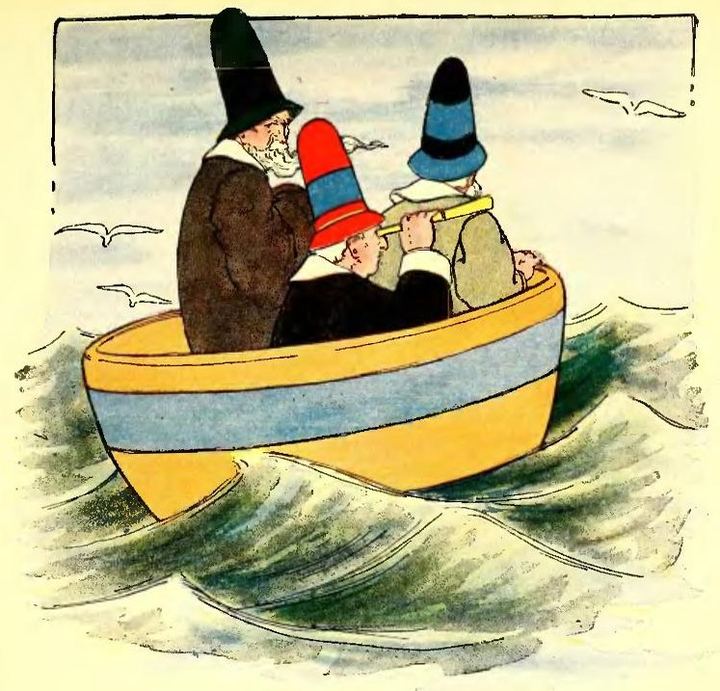
Form. Most pieces run two to eight lines, built on heavy beats, refrain and rhyme, so the ear grasps them before the meaning. Wright's pictures, in a soft flat palette of bonnets, geese and village lanes, are framed by the edition's familiar checkered borders.
Use. The rhymes teach rhythm, vocabulary and memory through choral recitation and picture study. They keep their old words, such as trencher and tuffet, and their comic misfortunes intact, Humpty unrepaired and Jack's crown broken.
Significance. Reprinted constantly, the edition fixed for many American families the look of Mother Goose and became a standard first book of verse; now in the public domain, it remains widely used in schools.
Main characters
- Old Mother Goose: Title figure who flies through the air on a gander
- Humpty Dumpty: Egg-shaped figure whose fall from a wall cannot be mended
- Jack and Jill: Pair who tumble down the hill fetching water
- Little Bo-Peep: Shepherdess who loses her sheep
- Old King Cole: Merry monarch calling for pipe, bowl and fiddlers three
- Little Jack Horner: Boy who pulls a plum from his Christmas pie
- Little Miss Muffet: Girl frightened from her tuffet by a spider
- Simple Simon: Foolish boy who meets a pieman on the way to the fair

Summary
The Real Mother Goose (1916) gathers the nursery rhymes English-speaking children have sung for centuries—Humpty Dumpty, Jack and Jill, Old Mother Goose, Little Bo-Peep, and scores of others—into one illustrated volume by Blanche Fisher Wright. The rhymes themselves are traditional: short, strongly metered verses that stick in the ear and the memory. Wright’s pictures made this edition a household standard in the United States. The book is not a story with one plot but a treasury: each rhyme is a small world of sound, character, and often comic mishap. Humpty Dumpty falls and cannot be put together again; Jack and Jill tumble down the hill; Mother Goose rides a gander through the air. For School Launch’s K–2 band the volume is foundational. Rhythm and rhyme train the ear before long prose; choral recitation builds courage and shared memory; picture study of Wright’s plates pairs looking with hearing. The morals, when present, are light—curiosity, mishap, daily work—but the deeper gift is language itself: strong verbs, clear images, and lines a child can own for life. Reading ‘the real’ Mother Goose means receiving the traditional texts rather than rewritten soft versions, so the old cadences remain intact. The book also serves as a first museum of English folk speech. Words such as trencher, gander, and crown appear in contexts a child can guess from sound and picture, so vocabulary grows without a glossary. Some rhymes are pure play; others glance at work, weather, counting, and the calendar (Thirty Days Hath September). Wright's 1916 edition matters historically because it fixed a visual Mother Goose for American households—bonnets, geese, village lanes—that still shapes how many adults remember the rhymes. For School Launch, the volume supports picture study and choral reading in the same week: look, speak, remember. It also resists the temptation to rewrite away oddity or sting; "the real" Mother Goose keeps Humpty broken and Jack's crown cracked, trusting children with comic mishap. Pair it with Stevenson's authored garden poems to show the difference between folk tradition and a single poet's craft, both worthy of a child's ear and both public domain for free classroom use.
Virtues in this work
Plot or Argument
- A treasury, not a novel
The book arranges traditional English nursery rhymes as separate pieces for reading aloud and memorizing.
- Sound before plot
Meter, refrain, and rhyme do the primary work; narrative is often a single mishap or scene.
- Wright’s pictures
Illustrations invite picture study alongside recitation.
Characters
- Old Mother Goose, title figure
Rides a gander; names the nursery-rhyme tradition.
- Humpty Dumpty, rhyme figure
Falls from a wall and cannot be restored by king’s horses or men.
- Jack and Jill, rhyme figures
Go up the hill for water and tumble down.
Lessons
The ear learns first
Nursery rhymes teach meter, rhyme, and clear diction before a child can hold a long story. Reciting Humpty Dumpty or Jack and Jill is language training as well as play.
- Which rhyme is easiest to remember, and why?
- What sounds repeat in your favorite rhyme?
Mishap without despair
Many rhymes turn on falls and failures treated with humor. Children can laugh at Jack’s crown and still notice cause and effect.
- How is Humpty Dumpty’s fall different from Jack and Jill’s?
- When is a mishap funny, and when is it a warning?
Shared memory
A culture hands on small texts everyone knows. Mother Goose gives a child membership in that shared store.
- Which of these rhymes have you heard before?
- Why might a family want common rhymes?
Context
English nursery rhymes circulated orally and in chapbooks for centuries; collected editions multiplied in the eighteenth and nineteenth centuries.
Composition
The 1916 Wright-illustrated Rand McNally edition popularized a particular American picture-book Mother Goose.
Reception
It remained a standard gift-book and schoolroom rhyme source through the twentieth century.
Comparisons
- a-childs-garden-of-verses
Stevenson’s authored childhood lyrics beside anonymous folk rhyme—both train the ear.
- black-beauty
Another formative children’s classic, in prose rather than verse.
Quotes
“Old Mother Goose, when She wanted to wander, Would ride through the air On a very fine gander.”
“Humpty Dumpty sat on a wall, Humpty Dumpty had a great fall; All the King's horses, and all the King's men Cannot put Humpty Dumpty together again.”
“Jack and Jill went up the hill, To fetch a pail of water; Jack fell down, and broke his crown, And Jill came tumbling after.”
For Students
A reading companion for classical Christian high school students. See the student guide.
Reading Guide
Watch for
- Strong opening lines that invite choral speaking (Humpty Dumpty; Jack and Jill).
- Rhymes that name everyday work—baking, shepherding, fetching water.
- How Wright’s illustrations (if using a picture edition) match or expand the verse.
- Words that are old-fashioned now but clear in context (crown, gander, trencher).
- Which rhymes tell a tiny story versus which are mostly sound and refrain.
Key terms and names
- Nursery rhyme
- A short traditional verse for young children, often sung or chanted.
- Meter
- The patterned beat of strong and weak syllables that makes a line easy to remember.
- Mother Goose
- The traditional name for the English nursery-rhyme collection.
- Picture study
- Looking carefully at an illustration and telling what it shows, then relating it to the text.
Seminar Questions
- Comprehension What happens to Humpty Dumpty, and who cannot put him together again?
- Comprehension Why do Jack and Jill go up the hill, and what happens to each of them?
- Comprehension How does Old Mother Goose travel when she wants to wander?
- Interpretation Why do so many nursery rhymes end in a tumble or a loss that is not fully fixed?
- Interpretation What makes a rhyme easy to memorize? Use one example and point to its sounds.
- Interpretation Is Mother Goose mainly for fun, or does it also teach manners and caution?
- Big Question Should children still learn old rhymes by heart in an age of screens? What is gained by sharing the same small poems?
Faith Connections
- Deuteronomy 6:6-7 (Scripture)
Words taught diligently to children and spoken through the day—nursery rhymes are a natural, smaller parallel for training memory and speech at home.
- Psalm 100:1-2 (Scripture)
Noise and song as glad speech to God; early rhyme trains the voice for later psalm and hymn.
- Tradition of oral folklore (Great Conversation)
Mother Goose stands in the line of folk transmission that also preserves ballads and fairy tales.
Logic and Rhetoric
Central argument: Shared, memorable verse forms a common ear and vocabulary in a household and culture.
Rhetorical device: refrain and parallelism. Repeated names and balanced lines (Humpty Dumpty sat… Humpty Dumpty had…) fix attention by echo.
Debate: Resolved: that memorizing nursery rhymes is a fit first stage of literary education.
Memory Work
Humpty Dumpty sat on a wall, Humpty Dumpty had a great fall; All the King's horses, and all the King's men Cannot put Humpty Dumpty together again.
Writing Prompts
Essay: Copy one rhyme perfectly, then write three sentences explaining what happens in it.
Comparison with A Child's Garden of Verses: Compare Jack and Jill with another rhyme about a mishap. How does each use rhythm to tell the fall?
Medical Lens
Falls, broken crowns, and bodily mishap appear as comic plot points rather than clinical subjects; useful only for noting how folk verse treats injury lightly.
- Jack and Jill
Jack breaks his crown in the fall down the hill.
Creative Prompts
- Classroom
Choir two rhymes; then have each child illustrate one line and recite it from memory.
- Fiction
Write a new four-line nursery rhyme with a clear beat about a daily chore.
- Essay
Why keep odd or sharp traditional rhymes instead of rewriting them to be softer?
Further Reading
- A Child's Garden of Verses, Robert Louis Stevenson
Authored poems of childhood to set beside traditional rhyme.
Verification notes
Rhyme texts verified against PG #10607 Wright edition. Authorship of individual rhymes is traditional/anonymous.
No verification flags recorded.