Work record
The Log of a Cowboy: A Narrative of the Old Trail Days
Andy AdamsThe Log of a Cowboy; Log of a CowboyThe Log of a Cowboy: A Narrative of the Old Trail Days by Andy Adams (1903)The Log of a Cowboy is the story of a five-month drive of more than three thousand cattle from Brownsville, on the Rio Grande, north to the Blackfoot Agency in Montana in 1882.Also known as: The Log of a Cowboy · Log of a Cowboy
1903 · Early 20th Century · Novel · English
Read this when you want a true-feeling story of hard work on a long cattle drive.
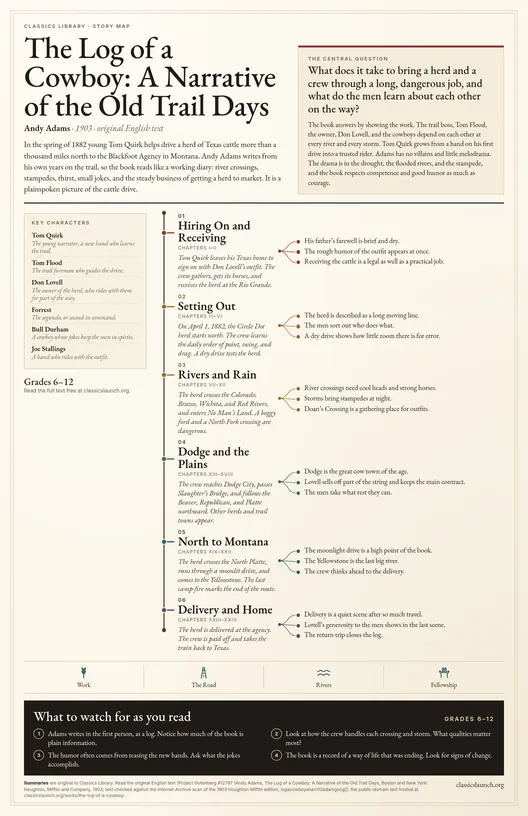 Story mapSee the story mapThe whole book on one page: the story in movements, the characters, and what to watch for. Free to print.
Abstract
The outfit. Tom Quirk, a young Texan, hires on under the owner Don Lovell and the foreman Flood, to drive a great herd of cattle from the Rio Grande north to Montana in 1882. The narrative stays with the Circle Dot outfit, from the day the herd is taken over until the final camp, and it attends to horses, night guards, the cook’s wagon, and the unwritten law of the trail.
The work. The men cross the Atascosa, endure a waterless stretch, swim the Brazos and the Wichita, and pass Doan’s Crossing, and push on across No Man’s Land to Dodge, then the Platte and the Yellowstone. They lose cattle in bogs and rivers, meet Indians and town sharps, hold the herd through a stampede, and learn that courage is often a matter of staying at a post when the body is tired.
The end. At last the cattle are delivered at the Blackfoot Agency in Montana. Lovell pays the men and names the length of the drive, and they turn back toward Texas. Tom has been schooled in loyalty, patience and self-command, and the book leaves him with the honor of a job completed rather than with easy treasure.
Main characters
- Tom Quirk: young cowboy and narrator
- Flood: trail boss
- Don Lovell: cattle owner
Summary
The Log of a Cowboy is the story of a five-month drive of more than three thousand cattle from Brownsville, on the Rio Grande, north to the Blackfoot Agency in Montana in 1882. The narrator, Tom Quirk, is a young Texan who signs on with Don Lovell and the trail boss Flood, and the book follows the Circle Dot outfit from the receiving of the herd to the day the cattle are delivered and the men turn home. Adams wrote from the life he knew, and he is careful about distances, water, weather and the order of work. The men have a cook, a horse wrangler, and a string of night guards; they cross the Atascosa, make a dry drive, swim the Brazos and the Wichita, pass Doan’s Crossing, and move on through No Man’s Land toward Dodge, the Platte and the Yellowstone. Along the way they meet Indians, thieves, and towns that would rather take a cowboy’s wages than see him ride on sober. They lose cattle in bogs and rivers, bury a drowned hand, and hold the herd through a stampede. The book is a record of patience as much as of adventure. Tom learns the unwritten law of the trail: to stay with the cattle, to take one’s turn at night, to keep faith with the outfit, and not to quit because the work is long. When the herd is at last delivered in Montana, Lovell pays the men and they start south again, poorer in some ways and richer in a kind of earned pride. Parents and teachers will find a story that honors hard work, courage and loyalty without dressing them up as romance. The language is of the old trail, plain and sometimes rough, and a younger reader may need help with the length, but the book is a sound picture of what it cost to move a herd a thousand miles and keep it together.
Virtues in this work
- Industry: The book honors the long labor of moving a herd a thousand miles and staying with the work until delivery.
- Fortitude: The men face thirst, flood, stampede and loss, and the good hand is the one who does not quit.
- Friendship: The outfit lives by loyalty of one man to another and to the boss who trusts them with the cattle.
Plot or Argument
- The start from Texas
Tom Quirk joins Don Lovell’s Circle Dot outfit near Brownsville. The cattle are received, the men and horses are chosen, and the herd starts north under the trail boss Flood, with the cook and wrangler in their places.
- Rivers, dry drive, and No Man’s Land
The outfit crosses the Atascosa, suffers a dry drive, and swims the Brazos and the Wichita. They pass Doan’s Crossing and enter No Man’s Land, losing cattle in bogs and learning how little water a herd can live on.
- Dodge, the Platte, and delivery in Montana
They reach Dodge, cross the Beaver, the Republican, the Platte and the Yellowstone, hold the cattle through storm and stampede, and at last deliver the herd in Montana. Lovell pays the men, and they turn back toward Texas.
Characters
- Tom Quirk, young narrator
The young narrator who joins the drive and learns the work of a trail hand.
- Don Lovell, cattle owner
The cattle owner who hires the outfit and later meets the men in the northern towns.
- Flood, trail boss
The trail boss who plans the crossings, keeps the herd moving, and answers for the outfit.
- McCann, cook
The cook who travels with the wagon and feeds the men at each camp.
- Quince Forrest, lively hand
A lively hand, quick with a story and a prank, who rides with the herd.
- Fox Quarternight, fellow hand
A fellow hand whose talk and work fill out the life of the outfit.
Lessons
Keep faith with the outfit
The men live by a simple rule: stay with the cattle, take your turn at night, and do not quit because the work is long or the water is short. A Christian reader can set this beside the duty to be faithful in small things and to bear one another’s burdens.
- What does Flood require of a man on night guard, and why does it matter?
- Where does Tom learn that a job is not finished until the herd is delivered?
- How does loyalty to an outfit differ from mere love of adventure?
Courage is often patience
The book’s hard moments are not only fights but dry marches, boggy fords, and the long waiting of a night watch. Courage here is to stay at a post when the body is tired.
- Which crossing or dry drive costs the men the most, and what do they do?
- How does a stampede test both skill and nerve?
- Is the bravest act in the book a fight, or something quieter?
Wages and self-command
Towns along the trail offer drink, cards and easy spending. Some men keep their pay; others do not. The book shows how quickly a season’s wages can vanish, and how self-command is part of a man’s honor.
- What happens when the outfit reaches Dodge or the later towns?
- How does Lovell treat the men when he pays them?
- What would it mean to finish a hard job and then throw away the reward?
Context
After the Civil War, Texas cattle were driven north to railheads and ranges along trails such as the Great Western, which ran from the Rio Grande toward Dodge City, Nebraska and Montana. The work was seasonal, hard and poorly paid, and it lasted only a few decades before railroads and fences closed the long drives. Adams places this story in 1882, near the end of that world.
Composition
Andy Adams had worked as a cowboy in Texas and on the trails. He published The Log of a Cowboy in 1903 with Houghton Mifflin, offering a plainer account than the dime-novel West then popular. The book is fiction, told as a narrator’s log, but it is built on the order of a real drive and on talk Adams had heard in camps.
Reception
The book was praised early as one of the truest cowboy narratives in American print, and it has remained a standard picture of trail life. Later readers still come to it for the work, the geography and the unpretending voice, rather than for a single plot twist.
Comparisons
- Captains Courageous
Kipling’s fishing schooner, like Adams’s cattle outfit, is a school of hard work in which a young man learns to take his place and keep faith with a crew.
- Treasure Island
Stevenson’s sea adventure is quicker and more romantic; Adams’s drive is slower and closer to daily labor, but both ask a young man to prove his nerve far from home.
- Ragged Dick
Alger’s street boy rises by industry in the city; Tom Quirk’s schooling is the trail, where pay is earned by staying with the herd through dust and flood.
- Hondo
L’Amour’s later Western, in this library as a companion guide, shares the honor of a hard country, though it is a tale of one man rather than of a whole outfit on the move.
Quotes
Frequently cited
““Our cattle also shall go with us.””
“Just why my father moved, at the close of the civil war, from Georgia to Texas, is to this good hour a mystery to me.”
“This outfit has made one of the longest cattle drives on record, and the best is none too good for them.”
For Students
A reading companion for classical Christian high school students. See the student guide.
Reading Guide
Watch for
- How Flood divides the work of the day and the night, and what happens when a man fails at his post.
- Where water, or the want of it, decides the next move of the herd.
- How the men act in town once they have wages in hand.
- What Tom has learned by the time the cattle are delivered in Montana.
Key terms and names
- Trail boss
- The man who directs the drive, chooses crossings, and answers for the herd and the outfit.
- Wrangler
- The hand who keeps and drives the remuda, the string of spare saddle horses.
- Remuda
- The herd of extra horses on which the cowboys depend as they change mounts.
- Night guard
- The watch, taken in turns, that keeps the cattle quiet through the night.
- Dry drive
- A long march with little or no water, hard on cattle and men alike.
Seminar Questions
- Comprehension Where does the drive begin and where are the cattle to be delivered?
- Comprehension What is a dry drive, and where does this outfit face one?
- Interpretation How does Flood’s authority differ from mere force, and why do the men obey him?
- Interpretation What does the book praise in a cowboy, and what does it quietly blame?
- Big Question Is hard work done in company a sufficient school of character, or does it need a higher law?
- Big Question What does a man owe the people he works with once the job is finished and the wages are paid?
Faith Connections
- Exodus 10:26 (Scripture)
The book’s epigraph, “Our cattle also shall go with us,” is Moses’ word that the people will not leave their flocks behind. The whole drive is a picture of not abandoning what one has been given to keep.
- Luke 16:10 (Scripture)
The duty to be faithful in little things, and in another man’s cattle, is the unwritten law of the outfit, and it gives a Christian measure of the trail boss’s trust.
- Theodore Roosevelt, Ranch Life and the Hunting-Trail (Great Conversation)
Roosevelt’s account of cattle work in the same decades offers a useful companion on the actual labor of the plains.
Logic and Rhetoric
Central argument: A long, hard job done in company can school a young man in courage, self-command and loyalty, if he will stay until the work is finished.
Rhetorical device: plain narrative and camp talk. Adams tells the drive in the order of the days and lets the men speak in their own way, so that the lesson is in the work itself rather than in a speech.
Debate: Resolved: That loyalty to an outfit is a sufficient rule of life for a young man.
Memory Work
“Our cattle also shall go with us.”
This outfit has made one of the longest cattle drives on record, and the best is none too good for them.
Writing Prompts
Essay: Choose one hard stretch of the drive and explain what it teaches Tom about courage and loyalty, using three concrete details from the text.
Comparison with Captains Courageous: Compare the schooling Tom Quirk receives on the trail with the schooling Harvey Cheyne receives on the fishing schooner, and say what each book holds up as a mark of a true man.
Medical Lens
The drive brings thirst, exhaustion, a drowning, and rough drinking in town. It is a literary source on the bodily cost of trail labor rather than a medical study.
- Chapter V: A Dry Drive
The herd and the men suffer for want of water on a long dry march.
Creative Prompts
- Essay
Write an account of one river crossing or the dry drive, showing what each man must do and what it costs the herd.
- Dialogue
Write a dialogue in camp the night after a stampede, in which two hands disagree about whether to go on.
- Classroom
On a map, mark the outfit’s path from the Rio Grande to Montana and note where water, towns and danger change the work.
Further Reading
- Captains Courageous, Rudyard Kipling
Another story of a young man schooled by hard outdoor work, in this library.
- Treasure Island, Robert Louis Stevenson
A classic adventure of nerve and loyalty far from home, in this library.
- Hondo, Louis L’Amour
A later Western of honor in a hard country, in this library as a companion guide.
Verification notes
The text is the 1903 Houghton Mifflin edition from Project Gutenberg eBook #12797, checked against the Internet Archive scan logacowboyanarr02adamgoog. The narrative year 1882 and the identification of the route with the Great Western Cattle Trail follow standard accounts of the book and are not all stated in so many words in the hosted text. The epigraph is printed as Exodus iv. 26; the words are those of Exodus 10:26.
- The identification of the 1882 route with the Great Western Cattle Trail follows standard reference accounts of the book.
- The hosted title page cites the epigraph as Exodus iv. 26; the familiar numbering of the same words is Exodus 10:26.
- Adams’s dates (1859–1935) and the Colorado years follow standard reference accounts and are not stated in the hosted text.