Work record
The Raven
1845 · 19th Century · Poetry · English
Abstract
Background. Poe was a struggling New York editor and critic when a newspaper ran this piece ahead of its magazine appearance, and it brought him sudden celebrity. He held that a poem should be brief enough for one sitting and aim at a single mood.
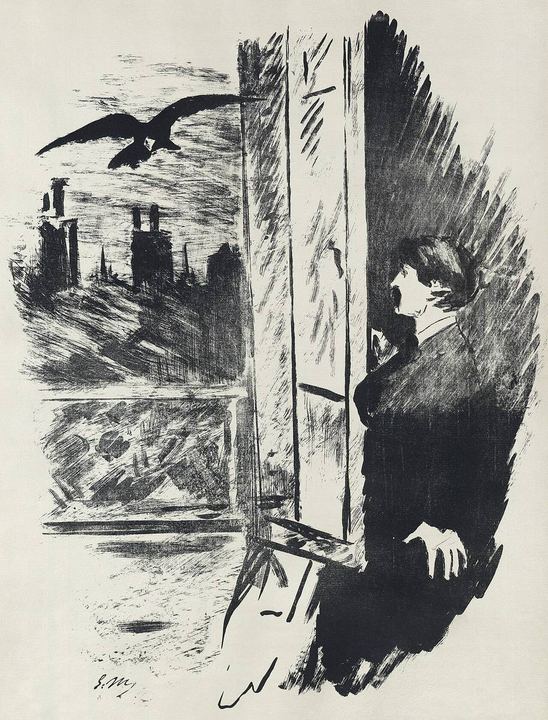
Narrative. A grieving reader hears knocking, finds nothing outside, and calls a dead woman's name into the dark. At the window a dark bird enters and settles above the door, replying to every question with its single word. Amusement becomes obsession; he asks it for oblivion, for a cure, and for a promise of meeting his beloved in paradise, and is denied each time. He orders it out, but it stays, and his spirit lies trapped beneath its shadow.
Form. Insistent internal rhyme, repeated end-sounds on door and floor, and a closing short line give the stanzas an incantatory, hypnotic sound. Each six-line unit rhymes its second, fourth, fifth, and sixth lines on one sound.
Themes. Bereavement, the mind's habit of reading meaning into chance, and the refusal of consolation dominate. Biblical and classical remedies are named only to be withheld.
Significance. Poe later published an essay claiming he composed it by method, French poets translated it, and it remains among the most recited American verse.
Main characters
- The speaker: Sleepless, bookish mourner whose curiosity turns to anguish
- The Raven: Black bird perched on Athena's bust, able to utter one word
- Lenore: Dead maiden whose absence haunts the room

Summary
The Raven is a narrative poem of eighteen six-line stanzas in which a grieving student, alone at midnight in December, is visited by a talking bird that can say only one word. It appeared in the New York Evening Mirror on 29 January 1845, ahead of its printing in The American Review, and made Poe famous almost overnight. The speaker is reading old books to escape his sorrow for the lost Lenore when he hears a tapping at his chamber door. Nervous, he reassures himself that it is only a visitor, opens the door, and finds darkness; he whispers the name Lenore and hears only an echo. A louder tapping comes at the window. When he opens the shutter, a stately raven steps in and perches on a bust of Pallas above the door. At first the bird amuses him. Asked its name, it answers Nevermore, and the speaker takes the word as a learned phrase from some unhappy former owner. Then, drawing a cushioned seat before the bird, he begins linking fancy to fancy, and each question becomes more desperate. He imagines angels swinging a censer and begs for nepenthe, the drug of forgetting, to ease his memories of Lenore; the raven says Nevermore. He asks if there is balm in Gilead, any healing for his grief; Nevermore. He asks whether he will embrace Lenore in a distant Eden; Nevermore. Shrieking, he orders the bird back into the night, and once more it refuses. In the last stanza the raven still sits on the pale bust, its eyes like a dreaming demon's, and the speaker's soul lies in its shadow on the floor, to be lifted nevermore. The poem's insistent trochaic rhythm, internal rhymes, and refrain build an atmosphere of mounting dread. In The Philosophy of Composition (1846), Poe claimed he had built the poem methodically, choosing the refrain and the death of a beautiful woman as the most melancholy subject.
Virtues in this work
- Hope: The poem portrays hope's absence with such precision, as the speaker refuses forgetting, healing, and reunion, that it shows by contrast what hope would require.
- Prudence: The speaker's error lies in treating a bird's single learned word as a prophecy, a lesson in judging what deserves to be believed.
Plot or Argument
- The midnight tapping (stanzas 1-6)
A weary student, reading to forget the dead Lenore, hears tapping at his chamber door. He tells himself it is a late visitor, opens the door to darkness, and whispers Lenore's name into it, hearing only the echo. A louder tapping sounds at the window.
- The raven enters (stanzas 7-9)
He flings open the shutter and a stately raven steps in, perches on the bust of Pallas, and answers his half-joking question about its name with Nevermore. The speaker marvels that a bird should speak at all.
- Musing and growing dread (stanzas 10-13)
The speaker predicts the bird will leave him as his hopes have, and it answers Nevermore. He reasons that it learned the word from a ruined master, then sits before it, linking fancy to fancy, as its fiery eyes burn into him and he remembers that Lenore will never again sit on the velvet cushion.
- The three pleas (stanzas 14-16)
He asks for nepenthe to forget Lenore, for balm in Gilead to heal him, and for assurance that he will clasp her in Aidenn. Each plea receives the same answer, turning the bird into an oracle of despair.
- The final command and the shadow (stanzas 17-18)
He orders the bird to leave and take its beak from his heart; it answers Nevermore. The closing stanza shows the raven still sitting, and the speaker's soul trapped in its shadow, never to be lifted.
Characters
- The speaker, Narrator
A scholarly young man, grieving and sleepless, whose questions move from curiosity to torment.
- The Raven, The visitor
A black bird that perches on the bust of Pallas and answers every question with a single word.
- Lenore, The lost beloved
The dead young woman whom the speaker mourns; she never appears, existing only as a name and a memory.
Lessons
Grief that feeds on its own questions
The raven only ever says one word; it is the speaker who frames each question so that the answer must wound him. The poem shows grief turning a meaningless sound into a verdict, as the mourner interrogates the bird about the very hopes he most fears to lose.
- At what point does the speaker realize what answer the raven will give, and why does he keep asking?
- Is the raven supernatural, or does the speaker give it its meaning?
- What does the poem suggest about the danger of seeking answers in solitude?
Sound as meaning
Poe's trochaic rhythm, internal rhymes, and repeated door and floor endings create the poem's mood before its content does. The refrain Nevermore gathers weight with each repetition until it closes the poem with the speaker's own voice.
- How does the rhythm of the first line set the mood of the whole poem?
- How does the meaning of Nevermore shift from stanza 8 to stanza 18?
- Why does the speaker, not the raven, speak the final nevermore?
Comfort refused
The speaker's three pleas name the classic remedies for grief: forgetting, healing, and reunion. The bird denies all three. The poem is a portrait of a mind that has lost hope rather than an argument that no hope exists.
- What is the difference between nepenthe and balm in Gilead as remedies?
- Why does the speaker invoke God and the angels while denying himself comfort?
- How might a reader of Jeremiah answer the question about balm in Gilead differently from the raven?
Context
Poe wrote during the boom of American magazines in the 1840s, when poems and tales were reprinted widely and authors were poorly paid. His criticism stressed that a poem should be short enough to read at one sitting and should produce a single effect. The poem's meter recalls Elizabeth Barrett's Lady Geraldine's Courtship, and a talking raven named Grip appears in Dickens's Barnaby Rudge, which Poe had reviewed.
Composition
The poem was first printed in the New York Evening Mirror on 29 January 1845, in advance of the February issue of The American Review, where it appeared under the pseudonym Quarles. It gave its title to The Raven and Other Poems later that year. Poe explained his supposed method of composition in The Philosophy of Composition, published in Graham's Magazine in April 1846, though many readers doubt that account was as systematic as he claimed.
Reception
The poem was reprinted, recited, and parodied widely, and Poe gave public readings of it. In France, Baudelaire translated it, and Mallarmé published a translation in 1875 with illustrations by Édouard Manet. It remains one of the best-known poems in American literature.
Comparisons
- the-odyssey
The speaker's plea for nepenthe recalls Book 4 of the Odyssey, where Helen mixes an Egyptian drug into the wine to banish grief; the Homeric remedy works, while Poe's speaker is denied it.
- my-last-duchess
Both poems center on a dead woman who exists only in the speaker's words, and both reveal a disordered mind through a single monologue, though Browning's duke is calm and the student is frantic.
- because-i-could-not-stop-for-death
Dickinson treats death as a courteous visitor and an unhurried journey, a striking contrast to Poe's ominous midnight intruder.
- the-narrative-of-arthur-gordon-pym-of-nantucket
Poe's only novel shares the poem's interest in dread, mounting terror, and the limits of knowledge, at far greater length.
- poe-tales
The six tales in the library's Poe selection date from the same years as The Raven (1845); The Fall of the House of Usher and The Tell-Tale Heart share the poem's haunted first-person speaker and Poe's aim of a single, unified effect.
Quotes
Frequently cited
“Once upon a midnight dreary, while I pondered, weak and weary, Over many a quaint and curious volume of forgotten lore—”
Frequently cited
“Quoth the Raven, “Nevermore.””
Frequently cited
“And my soul from out that shadow that lies floating on the floor Shall be lifted—nevermore!”
“From my books surcease of sorrow—sorrow for the lost Lenore— For the rare and radiant maiden whom the angels name Lenore— Nameless here for evermore.”
“Deep into that darkness peering, long I stood there wondering, fearing, Doubting, dreaming dreams no mortals ever dared to dream before;”
“Quaff, oh quaff this kind nepenthe and forget this lost Lenore!”
“Is there—is there balm in Gilead?—tell me—tell me, I implore!”
“Take thy beak from out my heart, and take thy form from off my door!”
For Students
A reading companion for classical Christian high school students. See the student guide.
Reading Guide
Watch for
- How the speaker explains away the tapping in stanzas 1-6 before the raven appears.
- The bust of Pallas, goddess of wisdom, on which the bird of ill omen perches.
- The change in stanza 12 as the speaker stops being amused and starts linking fancy unto fancy.
- The three pleas of stanzas 14-16: forgetting, healing, and reunion with Lenore.
- The last stanza, where the speaker, not the bird, says nevermore.
Key terms and names
- Nevermore
- The raven's only word; first a name, then an answer, then a sentence on the speaker's soul.
- Pallas
- Pallas Athena, Greek goddess of wisdom; the bird of grief sits on her bust above the scholar's door.
- Nepenthe
- A drug of forgetfulness from Homer's Odyssey, Book 4; in stanza 14 the speaker imagines it sent by angels.
- Balm in Gilead
- A healing resin named in Jeremiah 8:22; the speaker uses the phrase to ask whether any cure for grief exists.
- Aidenn
- Poe's spelling of Eden, used in stanza 16 for the paradise where the speaker hopes to meet Lenore.
- Plutonian shore
- The shore of the underworld ruled by Pluto, which the speaker imagines as the raven's home.
- Internal rhyme
- Rhyme within a line, as in dreary and weary or napping and tapping, which drives the poem's incantatory sound.
Seminar Questions
- Comprehension What is the speaker doing when the poem begins, and why is he doing it?
- Comprehension What explanation does the speaker first give for the raven's word in stanza 11?
- Interpretation Why does the speaker move his seat in front of the bird and begin to interpret its word, when he has already explained it?
- Interpretation Why does the speaker call the raven prophet, thing of evil, bird or devil all at once?
- Interpretation What is the effect of placing the bird of despair on a bust of the goddess of wisdom?
- Big Question The speaker asks about balm in Gilead and reunion in Eden but accepts a bird's answer. Where should a grieving person seek an answer to such questions?
- Big Question Is there a kind of grief that a person chooses to keep? Does the speaker want to be comforted?
Faith Connections
- Jeremiah 8:22 (Scripture)
The speaker borrows the prophet's question about balm in Gilead; in Jeremiah the question laments a people who have refused the healing God offers, which sharpens the speaker's refusal of comfort.
- 1 Thessalonians 4:13-18 (Scripture)
Paul tells believers not to sorrow as those who have no hope and promises reunion with the dead in Christ, the very hope the speaker asks of the raven in stanza 16.
- 1 Kings 17:1-6 (Scripture)
In Scripture, ravens bring Elijah bread and flesh at God's command; Poe's raven brings only a word of despair, an inversion worth noticing.
- C. S. Lewis, A Grief Observed (Great Conversation)
Lewis records his own questions to God after his wife's death and the silence that seemed to answer them, a Christian account of the same midnight interrogation of grief.
Logic and Rhetoric
Central argument: The speaker reasons that if the raven is a prophet sent by God or the devil, its answers must be true; it answers Nevermore to every hope of forgetting, healing, or reunion; therefore his soul can never rise from grief. The poem lets the reader see that the premise, a bird's one learned word, cannot bear the conclusion.
Rhetorical device: Refrain. Nevermore closes stanza after stanza, beginning with the raven's first answer in stanza 8 and ending in the speaker's own mouth in stanza 18.
Debate: Resolved: The raven in Poe's poem is a projection of the speaker's despair rather than a supernatural messenger.
Memory Work
Once upon a midnight dreary, while I pondered, weak and weary, Over many a quaint and curious volume of forgotten lore—
And my soul from out that shadow that lies floating on the floor Shall be lifted—nevermore!
Writing Prompts
Essay: Trace the speaker's questions from stanza 8 to stanza 17 and argue whether the raven drives him to despair or merely confirms a despair he already holds.
Comparison with The Odyssey: Compare Helen's nepenthe in Book 4 of the Odyssey, which banishes grief for a day, with the nepenthe Poe's speaker begs for and is denied. What does each work suggest about whether grief should be forgotten?
Medical Lens
The poem is a study of bereavement turning into despair. The speaker is awake at midnight, half dozing, trying to read his sorrow away, and his questions move from rationalizing (the bird learned its word from an unhappy master) to pleading and finally to a state he describes as permanent. Poe's vocabulary draws on older medicine: nepenthe is the grief-banishing Egyptian drug that Helen gives in Book 4 of the Odyssey, often speculatively identified with opium, though the text does not say so; balm in Gilead is Jeremiah's image of a resin-based remedy for a wounded people. Poe himself described melancholy as the most legitimate poetic tone. Biographical readings that tie the poem to his wife Virginia's long illness are common but should be treated as interpretation; she was still living when it appeared.
- Stanzas 1-2
Midnight sleeplessness and the attempt to find relief from sorrow in books.
- Stanza 14
The speaker imagines a heaven-sent drug of forgetting and begs to drink it, a pharmacological wish for relief from memory.
- Stanzas 15-18
Escalating questions about healing and reunion end in the speaker's own declaration that his soul will never rise from the shadow.
Listen to the book
Public-domain audiobook from LibriVox, read by Chris Goringe. Recording: Raven on LibriVox (Internet Archive).
LibriVox recordings are volunteer readings released into the public domain. The reading may follow a different edition from the text in this library.
Creative Prompts
- Poetry
Write a poem with a one-word refrain whose meaning changes as the speaker asks it different questions, imitating Poe's escalating structure.
- Classroom
Have students mark every internal rhyme in stanzas 1 and 11, then perform the poem aloud in pairs to hear how the rhyme and rhythm create dread.
- Essay
Weigh Poe's account in The Philosophy of Composition against the poem itself: does the poem read as calculated design or as an outpouring of grief?
Further Reading
- The Philosophy of Composition, Edgar Allan Poe
Poe's 1846 essay on how he claimed to have composed The Raven.
- Edgar A. Poe: Mournful and Never-ending Remembrance, Kenneth Silverman
- Edgar Allan Poe: A Critical Biography, Arthur Hobson Quinn
Verification notes
The first printing in the New York Evening Mirror on 29 January 1845 and the American Review appearance under the name Quarles are well documented, as is The Philosophy of Composition (1846). Quotations follow the stored Project Gutenberg text, including its spelling visiter and its curly quotation marks. The identification of nepenthe with opium is a later conjecture and is presented as such. Virginia Poe died in 1847, after the poem's publication.
No verification flags recorded.