Work record
Mark Antony's Funeral Oration ("Friends, Romans, countrymen")
1599 · Renaissance Early Modern · Drama · English
Abstract
Background. Shakespeare built his Roman tragedy on North's English Plutarch for the Globe's opening season. In the Forum scene the killers' leader explains himself first, in measured prose, then yields the platform to the dead ruler's ally under a pledge of restraint.
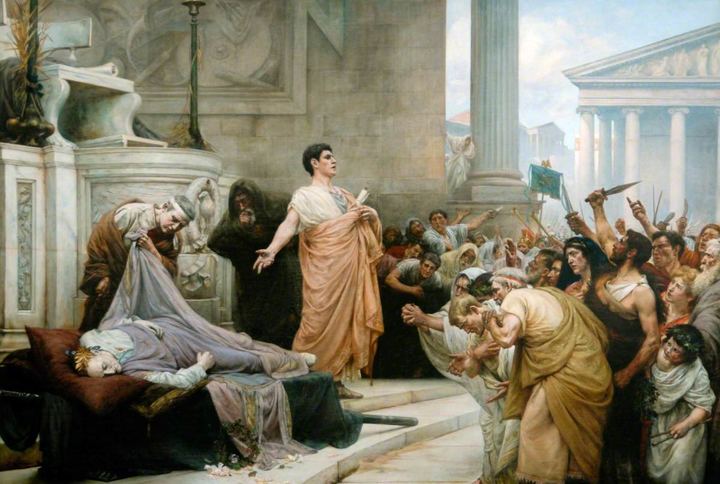
Content. Antony disowns any intention to eulogize, then lists generosity, pity for the needy and a declined diadem against the accusation of overreaching. He halts as if choked, teases the citizens with an unread bequest, steps down, and traces each gash in the bloodied garment before revealing the mutilated body itself. Once the hearers cry for vengeance he professes clumsy speech, finally discloses the legacy of money and riverside gardens, and watches the mob depart to set fires.
Technique. Repeated praise of the assassins' integrity curdles into accusation; rhetorical questions, staged hesitation and visual props let listeners reach the verdict themselves.
Themes. Loyalty and vengeance, the fickleness of crowds, and eloquence divorced from or joined to truth. The final private aside, welcoming the disorder just unleashed, leaves audiences uncertain how much of the earlier sorrow was calculation and how much genuine love.
Significance. The hinge of the drama, it reverses Rome's mood, drives Brutus and Cassius out, and has served generations of teachers as the model study of persuasive speech in English.
Main characters
- Mark Antony: Caesar's loyal lieutenant, speaking by Brutus's leave
- The Citizens: Roman plebeians whose shouts punctuate the speech
- Julius Caesar: The murdered dictator, present as a corpse
- Brutus: Conspirator, absent but ironically called honourable
- Cassius and Casca: Assassins identified by the tears in the cloak

Summary
Mark Antony's funeral oration, which opens Friends, Romans, countrymen, lend me your ears, is the turning point of Shakespeare's Julius Caesar (1599). Caesar has been stabbed to death in the Capitol by Brutus, Cassius and the other conspirators. Brutus, trusting in the justice of his cause, has allowed Antony, Caesar's friend, to speak at the funeral on condition that he blame no one, and has just persuaded the crowd in plain prose that he killed Caesar for love of Rome. Antony speaks in blank verse and appears to keep the terms. He says he comes to bury Caesar, not to praise him, and repeats that Brutus is an honourable man. But he answers the charge of ambition with facts the crowd remembers: Caesar filled the treasury with ransoms, wept when the poor cried, and three times refused the crown on the Lupercal. Each refrain about honourable men sounds more hollow. He pauses, overcome, saying his heart is in the coffin with Caesar, and lets the citizens begin to murmur on their own. Then he produces Caesar's will and refuses to read it, which makes them demand it. He comes down from the pulpit, gathers them round the body, and holds up the torn mantle, naming each wound as though he had seen it made: Cassius's dagger, the envious Casca, and the well-beloved Brutus, the most unkindest cut of all. When he uncovers the body, the crowd cries for revenge. He restrains them twice, protesting that he is no orator as Brutus is, only a plain blunt man, and then reads the will: seventy-five drachmas to every citizen, and Caesar's gardens beyond the Tiber as public parks. The crowd runs off to burn the conspirators' houses, and Antony, alone, says Mischief, thou art afoot. Shakespeare drew the scene from Plutarch's Lives in Thomas North's translation, but the speech's ironic refrains and pacing are his own. It is one of the most studied examples of persuasion in English, a demonstration of how emotion, timing and denial of intent can overturn an argument.
Virtues in this work
- Friendship: Antony speaks for a murdered friend who was faithful and just to him, at personal risk before a crowd that had just cheered his killers.
- Prudence: The speech is a study in the practical wisdom of timing: Antony pauses, withholds the will, and descends to the body only when the crowd is ready.
- Justice: Antony answers the charge of ambition with evidence the citizens saw themselves, the ransoms, the tears for the poor and the refused crown.
Plot or Argument
- The disclaimer and the refrain
Antony says he comes to bury Caesar, not to praise him, and answers Brutus's charge of ambition with Caesar's ransoms, his tears for the poor, and the thrice-refused crown, each time repeating that Brutus is an honourable man.
- The pause
Claiming his heart is in the coffin with Caesar, Antony breaks off; the citizens begin to say among themselves that Caesar has had great wrong.
- The will withheld
He mentions Caesar's will, refuses to read it lest it inflame them, and lets their demands grow until they compel him to come down to the body.
- The mantle and the wounds
Holding the torn mantle, he names the rents made by Cassius, Casca and Brutus, then uncovers the body, and the crowd cries for revenge.
- The plain blunt man and the will
He disclaims all eloquence, imagines what Brutus would do in his place, recalls the crowd to the will, and reads Caesar's gifts; the citizens rush off with the body to burn the traitors' houses.
Characters
- Mark Antony, speaker
Caesar's friend and ally, permitted by Brutus to speak at the funeral.
- The Citizens, the Roman crowd
Plebeians, four of them named only by number, who turn from Brutus to Antony.
- Julius Caesar, the dead
Murdered dictator whose body, mantle and will Antony displays.
- Brutus, leader of the conspirators
Absent from the oration but named repeatedly as an honourable man.
- Cassius and Casca, conspirators
Named by Antony as he points to the rents in Caesar's mantle.
Lessons
Saying the opposite of what you mean
Antony never directly calls Brutus a liar; he repeats that Brutus is an honourable man until the phrase means its opposite. The speech shows how irony and repetition can carry an argument the speaker has promised not to make.
- How many times does Antony call Brutus or the conspirators honourable, and how does the meaning change?
- Did Antony keep or break his promise to Brutus not to blame the conspirators?
- Is irony a fair weapon in public argument?
Evidence the audience supplies
Antony asks questions instead of drawing conclusions (Did this in Caesar seem ambitious?) and lets the citizens answer for themselves. He appeals to what they saw on the Lupercal and to what they feel at the sight of the wounds, so that their own judgment seems to convict the conspirators.
- Why does Antony pause after My heart is in the coffin there with Caesar?
- What do the citizens conclude during that pause, and from what evidence?
- When does a speaker's question become a form of manipulation?
The power and danger of persuasion
The oration ends with a crowd rushing to burn houses, and in the next scene that crowd kills Cinna the poet for having the same name as a conspirator. Shakespeare shows rhetoric as a force that can serve loyalty and grief and also unleash disorder its speaker welcomes but cannot direct.
- What does Antony mean by Now let it work. Mischief, thou art afoot?
- Is Antony a loyal friend avenging Caesar, an ambitious politician, or both?
- What responsibility does a speaker bear for what a crowd does afterward?
Context
Julius Caesar was assassinated in the Senate's meeting place at the Theatre of Pompey on the Ides of March, 44 BC. In the days that followed, the Senate granted an amnesty to the conspirators while confirming Caesar's acts, and his public funeral in the Forum turned the city against them. Plutarch reports that Antony stirred the people by displaying Caesar's bloodstained robe, and that the crowd burned the body in the Forum and attacked the conspirators' houses. Suetonius, by contrast, says Antony added only a few words of his own to the reading of decrees.
Composition
Shakespeare's chief source was Thomas North's 1579 English translation of Plutarch's Lives, especially the lives of Caesar, Brutus and Antony; the seventy-five drachmas of the will come from Plutarch. The Swiss traveller Thomas Platter recorded seeing a play about Caesar on Bankside in September 1599, usually identified as this one at the new Globe. The ironic refrain, the withheld will and the mantle's catalogue of wounds are Shakespeare's invention. The play was first printed in the First Folio of 1623.
Reception
Antony's oration became a fixture of school recitation and the classic example of dramatic persuasion in English, admired by teachers of rhetoric for its use of irony, repetition, pathos and timing. It is often staged as the hinge of the play, and its opening line is among the best known in Shakespeare.
Comparisons
- julius-caesar
The oration's meaning depends on the whole play: Brutus's idealism that allowed Antony to speak, and the civil war that follows from the crowd Antony arouses.
- pericles-funeral-oration
Both are funeral speeches before a whole city, but Pericles praises the dead to steady Athens in war, while Antony praises Caesar while denying it, to unsettle Rome.
- st-crispins-day-speech
Shakespeare's two most famous orations: Henry rouses an army to unity and courage, Antony rouses a crowd to fury, and both show the playwright's command of a listening audience.
- cicero-first-catilinarian
A real Roman oration from twenty years earlier, in which Cicero openly accuses a conspirator, offers a contrast to Antony's indirect method of accusing Caesar's killers.
Quotes
Frequently cited
“Friends, Romans, countrymen, lend me your ears; I come to bury Caesar, not to praise him. The evil that men do lives after them, The good is oft interred with their bones;”
Frequently cited
“For Brutus is an honourable man, So are they all, all honourable men,”
Frequently cited
“If you have tears, prepare to shed them now.”
Frequently cited
“This was the most unkindest cut of all;”
“When that the poor have cried, Caesar hath wept; Ambition should be made of sterner stuff:”
“O judgement, thou art fled to brutish beasts, And men have lost their reason. Bear with me. My heart is in the coffin there with Caesar, And I must pause till it come back to me.”
“I am no orator, as Brutus is; But, as you know me all, a plain blunt man,”
“Now let it work. Mischief, thou art afoot, Take thou what course thou wilt!”
For Students
A reading companion for classical Christian high school students. See the student guide.
Reading Guide
Watch for
- The opening disclaimer, I come to bury Caesar, not to praise him, and how quickly Antony begins praising him.
- Every repetition of honourable, and the moment the Fourth Citizen throws the word back as They were traitors.
- The pause after My heart is in the coffin there with Caesar, when the citizens talk among themselves.
- Antony's refusal to read the will, which makes the crowd demand it.
- The descent from the pulpit and the tour of the mantle's wounds, ending with the most unkindest cut of all.
Key terms and names
- Lupercal
- The Roman festival of the Lupercalia, at which Antony says he three times offered Caesar a crown that Caesar refused.
- Mantle
- Caesar's cloak, which Antony says Caesar first wore on the day he defeated the Nervii and which now shows the dagger rents.
- Nervii
- A warlike Belgic tribe defeated by Caesar in Gaul; Antony recalls the victory to stir pride and pity.
- Testament
- Caesar's will, which leaves seventy-five drachmas to every citizen and his gardens beyond the Tiber to the people.
- Pompey's statue
- The statue at whose base Caesar fell, the image of his defeated rival presiding over his death.
- Verbal irony
- Saying one thing while meaning its opposite, as in Antony's refrain about honourable men.
Seminar Questions
- Comprehension What three pieces of evidence does Antony give that Caesar was not ambitious?
- Comprehension What does Caesar's will give to the people of Rome?
- Interpretation At what point does the crowd's opinion of the conspirators begin to change, and what causes it?
- Interpretation Why does Antony refuse to read the will at first, and why does he come down from the pulpit before reading it?
- Interpretation Is Antony's grief for Caesar real, staged, or both? Point to lines that support your view.
- Interpretation Why does Antony claim to be no orator at the very moment his oratory is most effective?
- Big Question Can a speech that tells the truth about a friend's virtues still be a dishonest speech?
Faith Connections
- James 3:5-6 (Scripture)
James compares the tongue to a small fire that kindles a great forest, which is what Antony's words do when the crowd runs off with brands to burn the conspirators' houses.
- Matthew 27:15-26 (Scripture)
Before Pilate a crowd moved by its leaders demands Barabbas and calls for crucifixion; the Gospel and the play both show how quickly a public assembly can be swayed.
- Augustine, On Christian Doctrine IV (Church Fathers)
Augustine, himself a former teacher of rhetoric, argues that eloquence should serve wisdom and truth and that its power to move can be used for good or ill, a frame for judging Antony's art.
Logic and Rhetoric
Central argument: Brutus claims Caesar was killed for ambition. But Caesar enriched the treasury, wept for the poor, refused the crown, and loved the people enough to leave them his wealth. Therefore the charge of ambition is false, the honourable men are traitors, and Caesar's death deserves revenge; yet Antony leads the crowd to this conclusion while appearing never to state it.
Rhetorical device: paralipsis (apophasis). Antony draws attention to what he says he will not do: he will not praise Caesar, will not read the will, will not wrong the honourable men, and claims to be no orator, while doing each of these things.
Debate: Resolved: that Antony's oration is a just act of loyalty to his murdered friend rather than a manipulation of the Roman people.
Memory Work
Friends, Romans, countrymen, lend me your ears; I come to bury Caesar, not to praise him. The evil that men do lives after them, The good is oft interred with their bones;
This was the most unkindest cut of all;
Writing Prompts
Essay: Trace the word honourable through Antony's oration and analyze how its repetition turns praise into accusation without Antony ever breaking his promise to Brutus outright.
Comparison with Pericles' Funeral Oration: Pericles and Antony both speak over the dead before a whole city. Compare what each speaker wants the crowd to feel and do, and how each uses the dead to achieve it.
Medical Lens
The scene is built around a corpse and its wounds: Antony uncovers Caesar's body, catalogues the stab wounds through the mantle, and turns the crowd's grief into rage. For the history of medicine, the ancient sources add a notable detail Shakespeare omits: Suetonius (Julius 82) reports that Caesar received twenty-three wounds and that the physician Antistius judged only one, the second, in the breast, to have been mortal, an early recorded opinion on the cause of a death. Antony's warning that the will would inflame the crowd and make them mad, and the riot that follows, give a dramatic picture of collective emotion; any reading of it in terms of crowd psychology is interpretive.
- Act 3, Scene 2 (at Caesar's body)
Antony points to the rents in Caesar's mantle made by Cassius, Casca and Brutus, then uncovers the wounded body before the crowd.
- Act 3, Scene 2 (close of the first speech)
Antony breaks off, saying his heart is in the coffin with Caesar, a display of grief that moves the citizens.
Creative Prompts
- Classroom
Perform the scene with a narrator who stops after each Antony speech to record on the board what the citizens now believe, tracing step by step how their opinion of Brutus changes.
- Dialogue
Write the conversation in which Brutus, hearing what happened in the Forum, asks a citizen what Antony said and why the crowd turned.
- Essay
Compare Brutus's prose speech earlier in Act 3, Scene 2 with Antony's verse oration and argue why Antony's succeeds.
Further Reading
- Shakespeare's Plutarch, T. J. B. Spencer (ed.)
- Julius Caesar (The Arden Shakespeare, Third Series), David Daniell (ed.)
- Shakespeare's Rome, Robert S. Miola
- 1599: A Year in the Life of William Shakespeare, James Shapiro
Verification notes
The stored text is an excerpt of Act 3, Scene 2 from the library's Project Gutenberg edition, beginning with Antony's ascent and ending with Mischief, thou art afoot; Brutus's preceding speech is not included. Line numbers vary between editions, so quotes are located by their position within the oration. The 1599 date rests on Thomas Platter's account. The ancient accounts of the real funeral differ, and the record notes both Plutarch's and Suetonius's versions. All quotes are found verbatim in the stored text.
No verification flags recorded.