Work record
The Last of the Mohicans
1826 · 19th Century · Novel · English
Abstract
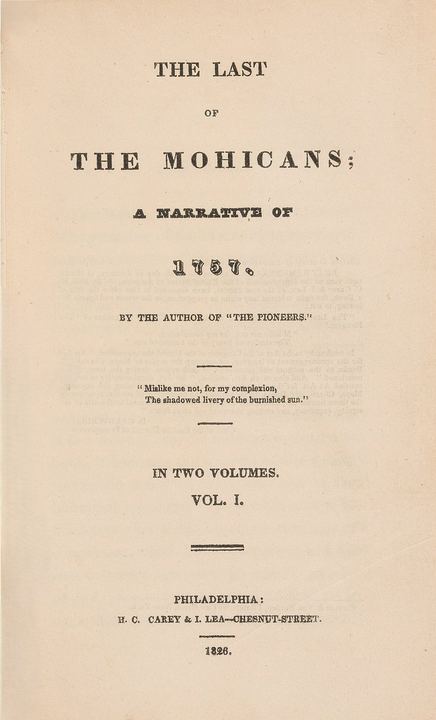
Background. Following The Pioneers, Cooper returned to Natty Bumppo in his prime and set him amid the 1757 siege of Fort William Henry, a real British defeat on Lake George. A Philadelphia firm brought out the book in early 1826.
Plot. Leading the Munro sisters toward their father's post, a treacherous runner abandons them, and the scout and his two Mohican companions take charge. A fight in the riverside caverns, captivity, and a fog-bound dash into the beleaguered fort lead to capitulation and a slaughter of the departing column. Magua's prisoners are hunted through Huron and Delaware villages by means of costumes and tricks until a ruling by the patriarch Tamenund, a last battle and a struggle on a cliff leave Cora, Uncas and their enemy dead.
Themes. Revenge and its cost, loyalty between Hawkeye and Chingachgook, the courage of women in war, and mourning for a people near its end. Cooper also contrasts the scout's woodcraft with the formal warfare of European armies.
Significance. The most widely read of the Leatherstocking Tales, it defined the frontier adventure for readers in Europe and America. Its chase, captivity and rescue patterns passed into dime novels, Westerns and cinema, and its elegiac close made the phrase of its title proverbial.
Main characters
- Hawkeye: White frontier scout famed for his long rifle
- Chingachgook: Mohican chief, the Great Serpent
- Uncas: His son, last of the Mohican line
- Magua: Vengeful Huron guide, Le Renard Subtil
- Cora Munro: Steadfast elder sister, Magua's chosen captive
- Alice Munro: Delicate younger sister, loved by Heyward
- Duncan Heyward: Gallant British major from Virginia
- David Gamut: Psalm-singing teacher, spared as simple
- Tamenund: Venerable Delaware sage and judge

Summary
The Last of the Mohicans: A Narrative of 1757 is set in the wilderness of northern New York during the French and Indian War. Colonel Munro, the Scottish commander of Fort William Henry on Lake George, which the scout calls the Horican, is threatened by the French general Montcalm and his Native allies. His daughters, dark-haired, grave Cora and fair, timid Alice, set out from Fort Edward to join him, escorted by Major Duncan Heyward and accompanied by David Gamut, a gentle, gangling singing-master. Their guide, the Huron runner Magua, called Le Renard Subtil, leads them astray. They are rescued by the white scout Hawkeye, known to the French as La Longue Carabine, and his friends, the Mohican chief Chingachgook and his son Uncas, the last of their line. Magua escapes. The party hides in a cave on an island at Glenn's Falls on the Hudson, where Hurons attack; when their powder runs out, Cora persuades Hawkeye and the Mohicans to swim away for help. The others are captured, and Magua reveals his grievance: Munro once had him flogged for drunkenness, and he offers to spare the party if Cora becomes his wife. She refuses, and Hawkeye and the Mohicans rescue the captives. After a night march they reach the besieged fort through the fog. Munro reveals to Heyward that Cora's mother was a West Indian woman descended in part from slaves, and gives him leave to court Alice. When General Webb sends no relief, Munro surrenders with the honours of war, but as the garrison and its families march out, Montcalm's Native allies fall on them in a massacre, and Magua carries off the two sisters, with David following. Hawkeye, the Mohicans, Heyward and Munro track them north. Heyward enters a Huron village disguised as a French juggler-physician, Hawkeye joins him disguised in a bearskin as a conjurer, and they free Alice; Uncas, captured and condemned, escapes in the bearskin while David takes his place. At the Delaware village the aged sage Tamenund at first judges for Magua, until Uncas is revealed by the tortoise tattooed on his breast as heir of the ancient Lenape chiefs. Bound by Delaware law, Tamenund lets Magua leave with Cora, and Uncas warns him that pursuit will begin once the sun clears the trees. In the battle that follows the Delawares rout the Hurons; on a mountain ledge a Huron stabs Cora, Magua kills Uncas, and Hawkeye shoots Magua as he tries to leap a chasm. The novel ends with the funerals of Cora and Uncas, Chingachgook's lament, and Tamenund's farewell to the last warrior of the Mohicans. Cooper published the novel in Philadelphia in 1826, the second of his Leatherstocking Tales.
Virtues in this work
- Friendship: At Uncas's grave Hawkeye takes Chingachgook's hand and tells him that he is not alone.
- Fortitude: Cora refuses Magua's offer of life as his wife and kneels calmly before his knife on the mountain ledge.
- Charity: At Glenn's Falls Cora urges Hawkeye and the Mohicans to escape for help rather than die defending the captives.
- Piety: David Gamut sings his psalms in the cave, in captivity and at the sick woman's bedside, trusting in God amid every danger.
Plot or Argument
- Chapters I-IV: The secret path
Heyward, Cora, Alice and David leave Fort Edward with Magua as guide. Hawkeye, Chingachgook and Uncas, talking by a stream, meet the lost party; Hawkeye suspects Magua, who escapes into the forest.
- Chapters V-X: Glenn's Falls
The party shelters in the caves of a river island. Hurons attack, the defenders' powder fails, and Cora sends the scout and the Mohicans downstream for help; the rest are taken prisoner.
- Chapters XI-XII: Magua's revenge
Magua tells Cora that Munro had him whipped for drunkenness and demands that she become his wife. As the Hurons prepare to torture the captives, Hawkeye and the Mohicans fall on them and free the prisoners.
- Chapters XIII-XVI: The siege of Fort William Henry
After a night in a ruined blockhouse and a dash through the French lines in fog, the party reaches Munro. Munro speaks of Cora's mother, Montcalm parleys, and Webb's intercepted letter shows that no help will come.
- Chapter XVII: The massacre
The garrison surrenders and marches out with the honours of war, but the Native allies of the French attack the column. Magua seizes Cora and Alice, and David follows them.
- Chapters XVIII-XXI: The pursuit
Among the ruins of the fort Hawkeye and the Mohicans find the trail. The pursuers cross the lake by canoe under fire and follow the traces north into Huron country.
- Chapters XXII-XXVI: Disguises in the Huron village
David, spared as one touched in mind, leads Heyward to the village, where Heyward poses as a French healer. Hawkeye, in a bearskin, helps him carry off Alice from a cave; Uncas, captured and condemned, escapes in the bearskin, and David takes his place.
- Chapters XXVII-XXX: Tamenund's judgment
Magua claims his prisoners before the Delawares. The ancient Tamenund judges for him until Uncas is revealed by his tortoise sign as a chief of the Lenape. Magua is allowed to leave with Cora, but Uncas warns him that the Delawares will follow once the sun is seen above the trees.
- Chapters XXXI-XXXII: Battle and pursuit
The Delawares under Uncas defeat the Hurons. On a mountain ledge Cora is stabbed, Magua kills Uncas, and Hawkeye shoots Magua as he clings to the edge of the precipice.
- Chapter XXXIII: The funerals
The Delaware maidens lament Cora and Uncas. Munro thanks them in words Hawkeye declines to translate; Chingachgook mourns his son, Hawkeye clasps his hand at the grave, and Tamenund dismisses his people.
Characters
- Hawkeye (Natty Bumppo), scout and hunter
A white woodsman raised among the Delawares, called La Longue Carabine for his rifle killdeer, who insists he is a man without a cross of mixed blood.
- Chingachgook, Mohican chief
Hawkeye's lifelong friend, called the Great Serpent, father of Uncas and last sagamore of his people.
- Uncas, Chingachgook's son
A swift, noble young warrior, the last of the Mohicans, revealed as heir of the Lenape chiefs and drawn to Cora.
- Magua, Huron runner and chief
Le Renard Subtil, an exile among the Hurons who seeks revenge on Munro through his daughter Cora.
- Cora Munro, Munro's elder daughter
Dark-haired, dignified and fearless, the daughter of Munro's West Indian first wife.
- Alice Munro, Munro's younger daughter
Fair, gentle and easily overcome by fear, beloved of Heyward.
- Major Duncan Heyward, British officer
A brave young Virginian who escorts the sisters and courts Alice.
- David Gamut, singing-master
An awkward, devout teacher of psalmody whose simplicity protects him among the Hurons.
- Colonel Munro, commander of Fort William Henry
A proud Scottish veteran and loving father, broken by the fall of his fort and the loss of Cora.
- Montcalm, French general
The courteous commander of the French army besieging Fort William Henry.
- Tamenund, Delaware sage
A chief of extreme age, revered by the Lenape, who judges between Magua and his captives.
Lessons
Friendship across peoples
Hawkeye and Chingachgook have hunted and fought together for years. At Uncas's grave in Chapter XXXIII Hawkeye tells the grieving chief that he is not alone, and the two men bow their heads together over the grave. Cooper places the deepest loyalty in the book in a friendship between men of different peoples.
- How do Hawkeye and Chingachgook depend on each other's skills throughout the novel?
- What does Hawkeye mean when he says that God has placed them to journey in the same path?
- Why does Cooper end the novel with this friendship rather than with Heyward and Alice?
The roots of revenge
Magua's hatred begins with drink and a flogging at Munro's order. In Chapter XI he asks whether it is justice to make evil and then punish it, and Cora answers that her father did justice. Cooper lets Magua argue his case forcefully while showing where vengeance leads: to the deaths of Cora, Uncas and Magua himself.
- Is Magua's grievance against Munro just? Is his revenge?
- Why does Magua want Cora rather than Munro's death?
- How does Magua's revenge finally destroy him?
Courage of different kinds
Cora's courage is calm and selfless: at Glenn's Falls she sends her rescuers away to save themselves, and on the mountain she kneels and gives herself to God. Alice is fragile, Heyward gallant, David gently stubborn in his psalms. Cooper shows that courage can take quiet forms as well as the scout's skill with a rifle.
- Why does Cora urge Hawkeye and the Mohicans to leave the cave?
- What does Cora's prayer on the ledge in Chapter XXXII show about her?
- Is David Gamut brave or simply innocent?
Elegy for a vanishing people
Chingachgook's lament in Chapter III and Tamenund's farewell in Chapter XXXIII frame the book as a lament for a people whose line ends with Uncas. Cooper honors the dignity of the Mohicans and Delawares and the grief of their passing from the land.
- What image does Chingachgook use for the members of his family who have died?
- Why does Tamenund say that his day has been too long?
- How does the title change in meaning by the end of the novel?
Context
The novel's frame is real: in August 1757, during the French and Indian War, the Marquis de Montcalm besieged Fort William Henry at the head of Lake George. Its commander, Lieutenant Colonel George Monro, surrendered when General Daniel Webb at Fort Edward sent no relief, and Native warriors allied to the French then attacked the paroled garrison and its followers as they marched away. Cooper's Munro, Webb and Montcalm are drawn from these men, while Hawkeye, the Munro sisters, Magua and the Mohicans are invented. His Mohicans combine traits of the Mahicans of the Hudson valley and the Mohegans of Connecticut, and much of his picture of Delaware life came from the Moravian missionary John Heckewelder's account of the Delawares.
Composition
Cooper wrote the book in 1825 and published it in Philadelphia in February 1826. It was the second Leatherstocking Tale, following The Pioneers (1823), in which an aged Natty Bumppo and Chingachgook appear. For the 1831 London edition in Bentley's Standard Novels Cooper added an introduction explaining the Indian names and his sources, with a later addition of about 1850 in which he admits inventing the name Horican for Lake George; the library text includes this introduction.
Reception
The novel was Cooper's most popular book and was quickly translated across Europe, shaping the European picture of the American wilderness and its peoples for generations. Mark Twain mocked Cooper's style in a famous 1895 essay, but the story's set pieces, the cave at Glenn's Falls, the massacre and the chase to the mountain, have been retold in many films, including adaptations of 1920, 1936 and 1992.
Comparisons
- ivanhoe
Cooper was often called the American Scott: both write historical romances of peoples in conflict, with captive heroines, sieges, disguises and a doomed love between a dark heroine and a man who marries her fair rival.
- the-song-of-hiawatha
Longfellow drew on the same early ethnography that shaped Cooper's Delawares, and his poem likewise closes with an elegy for a passing Native world.
- the-sign-of-the-beaver
Speare's younger novel turns on a friendship between a white boy and a Native boy in the Maine woods, echoing Hawkeye's bond with Chingachgook and Uncas.
- the-scarlet-letter
Hawthorne and Cooper both used the early American forest as a place of danger and freedom outside the settled town, though Hawthorne's interest is moral and psychological rather than adventurous.
- the-iliad
Both works end with funerals and laments for a fallen young warrior; Chingachgook mourning Uncas recalls Priam and the Trojans mourning Hector.
Quotes
Frequently cited
“Where are the blossoms of those summers!—fallen, one by one; so all of my family departed, each in his turn, to the land of spirits. I am on the hilltop and must go down into the valley; and when Uncas follows in my footsteps there will no longer be any of the blood of the Sagamores, for my boy is the last of the Mohicans.”
Frequently cited
“The gifts of our colors may be different, but God has so placed us as to journey in the same path.”
Frequently cited
“My day has been too long. In the morning I saw the sons of Unamis happy and strong; and yet, before the night has come, have I lived to see the last warrior of the wise race of the Mohicans.”
“is it justice to make evil and then punish for it? Magua was not himself; it was the fire-water that spoke and acted for him!”
“The Indians never harm a non-composser.”
“I am thine; do with me as thou seest best!”
“Tell them, that the Being we all worship, under different names, will be mindful of their charity; and that the time shall not be distant when we may assemble around His throne without distinction of sex, or rank, or color.”
For Students
A reading companion for classical Christian high school students. See the student guide.
Reading Guide
Watch for
- The contrast between Cora and Alice in every danger, from the forest path to the mountain ledge.
- Hawkeye's repeated insistence that he is a man without a cross, and his talk of the different gifts of white men and Indians.
- Magua's speeches to Cora in Chapter XI and to the Delaware council in Chapter XXIX, where Cooper lets him argue his own case.
- The disguises in the Huron village: Heyward as a healer, Hawkeye as a bear, Uncas and David changing places.
- The two laments that frame the book: Chingachgook's in Chapter III and the funeral rites in Chapter XXXIII.
Key terms and names
- Sagamore
- A chief; Hawkeye addresses Chingachgook by this title, and Chingachgook calls his line the blood of the Sagamores.
- La Longue Carabine
- The Long Rifle, the name Hawkeye's enemies give him for his marksmanship with his rifle killdeer.
- Horican
- Cooper's name for Lake George, put in Hawkeye's mouth; Cooper admits in his introduction that he chose it from an old map.
- Mingo
- Hawkeye's contemptuous name for the Iroquois and their allies, including Magua's Hurons.
- Lenape
- The Delawares' name for themselves; Tamenund is their revered sage, and Uncas descends from their ancient chiefs.
- Tortoise
- The sign tattooed on Uncas's breast that reveals him to the Delawares as heir of their oldest line.
- Fort William Henry
- The British fort at the head of Lake George commanded by Munro and surrendered to Montcalm in 1757.
- Psalmody
- The singing of psalms, which David Gamut teaches and practises in every danger.
Seminar Questions
- Comprehension How does Magua betray the party in the opening chapters, and who rescues them?
- Comprehension Why does Munro surrender Fort William Henry, and what happens to the garrison afterward?
- Comprehension How is Uncas revealed to the Delawares, and what does Tamenund decide?
- Interpretation Why does Cooper make Cora, not Alice, the one Magua desires and Uncas admires?
- Interpretation Why does Hawkeye refuse to translate Munro's message to the Delaware women in Chapter XXXIII?
- Interpretation What does Cooper suggest by giving the last words of the novel to Tamenund?
- Big Question Can a just grievance ever justify revenge like Magua's?
Faith Connections
- Acts 17:26 (Scripture)
Paul tells the Athenians that God has made of one blood all nations of men. Munro's hope of a day when all will gather before God's throne without distinction of color echoes this teaching.
- Revelation 7:9 (Scripture)
John sees a great multitude of all nations, kindreds, people and tongues before the throne. Munro's funeral words look toward the same vision.
- Romans 12:19 (Scripture)
Vengeance belongs to the Lord. Magua's private revenge on Munro through Cora consumes the innocent and ends in his own fall from the precipice.
- Luke 23:46 (Scripture)
Christ commends his spirit into the Father's hands. Cora, kneeling before Magua's knife, gives herself to God in words of the same surrender.
Logic and Rhetoric
Central argument: The wilderness war of 1757 sets peoples against one another and rewards treachery and revenge; yet loyalty, courage and friendship can cross every boundary of nation and color. Because the Mohicans' line ends with Uncas, the novel's victory is also an elegy, and its consolation lies in friendship and in the hope of a final gathering before God.
Rhetorical device: metaphor. In Chapter III Chingachgook calls the dead of his family the blossoms of past summers and pictures himself on a hilltop about to go down into the valley.
Debate: Resolved: that Magua is more sinned against than sinning.
Memory Work
Where are the blossoms of those summers!—fallen, one by one; so all of my family departed, each in his turn, to the land of spirits. I am on the hilltop and must go down into the valley; and when Uncas follows in my footsteps there will no longer be any of the blood of the Sagamores, for my boy is the last of the Mohicans.
The gifts of our colors may be different, but God has so placed us as to journey in the same path.
Writing Prompts
Essay: Cooper ends his novel with two funerals. Argue what the deaths of Cora and Uncas mean for the book's view of friendship, love and the future of the American wilderness.
Comparison with Ivanhoe: Compare Cora Munro with Scott's Rebecca. Both are dark, courageous heroines who do not marry the hero. Argue what each author gains by denying her a happy ending.
Medical Lens
Medicine is marginal, but several threads interest a historian of psychiatry. Alcohol drives the plot: Magua traces his ruin to the fire-water brought by Europeans, and his flogging for drunkenness in Munro's camp is the source of his revenge. David Gamut moves safely among the Hurons because they take his oddity for a mind touched by the Great Spirit, the custom Hawkeye sums up by saying they never harm a non-composser; this reflects a widespread report, in Cooper's sources, of Native reverence for the mentally afflicted. In Chapters XXIV-XXV Heyward poses as a French healer called to drive an evil spirit out of a Huron woman who lies in a kind of paralysis, unconscious of her surroundings; Cooper describes the Native belief in possession and the pretended physician's discomfort at deceiving the sick. Munro's grief after Cora's death, Tamenund's extreme age, and the wounds of the fighting complete the picture. Any modern diagnosis of the sick woman or of David would be speculation.
- Chapter XI
Magua tells Cora how fire-water led him into Munro's camp and to a public flogging.
- Chapter XXII
David explains that he passes freely among the Hurons, and Hawkeye attributes it to their sparing of those touched in mind.
- Chapters XXIV-XXV
Heyward, disguised as a French healer, is led to a sick Huron woman lying paralysed in a cave, where David sings to her and Hawkeye appears as a bear-conjurer.
- Chapter XXXIII
Munro sinks into melancholy at Cora's funeral, and Tamenund, worn by great age, laments having lived too long.
Listen to the book
Public-domain audiobook from LibriVox, read by Gary W. Sherwin. Recording: Last Of The Mohicans - A Narrative of 1757 on LibriVox (Internet Archive).
LibriVox recordings are volunteer readings released into the public domain. The reading may follow a different edition from the text in this library.
Creative Prompts
- Classroom
Trace the journey on a map from Fort Edward to Glenn's Falls, Fort William Henry, the Huron village and the Delaware village, noting what happens at each place.
- Essay
Is Magua simply a villain, or does Cooper give him a case? Argue from Chapters XI, XXIX and XXXII.
- Dialogue
Write the conversation Hawkeye and Chingachgook might have on the night after Uncas's funeral.
- Poetry
Write a lament for Uncas in the voice of one of the Delaware maidens at his funeral.
- Fiction
Retell the siege and surrender of Fort William Henry from the point of view of a soldier of Munro's garrison.
Further Reading
- The Deerslayer, James Fenimore Cooper
The last-written Leatherstocking Tale, showing Natty Bumppo and Chingachgook as young men.
- The Pioneers, James Fenimore Cooper
The first Leatherstocking Tale, with Natty and Chingachgook in old age.
- Studies in Classic American Literature, D. H. Lawrence
Includes two essays on the Leatherstocking novels.
- Montcalm and Wolfe, Francis Parkman
Classic history of the war, including the siege of Fort William Henry.
Verification notes
Plot details, chapter locators and the funeral scene were checked against the attached Gutenberg text, which includes Cooper's introduction. The 1831 Bentley Standard Novels introduction and its addition of about 1850 were confirmed via library catalogue and exhibition records (e.g. https://web.uwm.edu/lib-omeka-spc2/items/show/170). The historical siege of August 1757, Monro, Webb and Montcalm are standard history. Quotes were checked against the attached text.
- Exact month of first publication (February 1826 is usually given) and the firm of Carey and Lea as publisher.