Work record
The Tower Treasure
Franklin W. DixonFranklin W. Dixon; Franklin W Dixon; FranklinWDixon; The Hardy Boys: The Tower Treasure; Hardy Boys No. 1; The Hardy Boys Mystery Stories: The Tower TreasureThe Tower Treasure by Franklin W. Dixon (1927)The Tower Treasure is the first of the Hardy Boys books, and this library hosts the original 1927 wording, not the later rewrite of 1959.Also known as: The Hardy Boys: The Tower Treasure · Hardy Boys No. 1 · The Hardy Boys Mystery Stories: The Tower Treasure
1927 · Early 20th Century · Novel · English
Read this when brothers refuse to leave an honest man under a false charge.
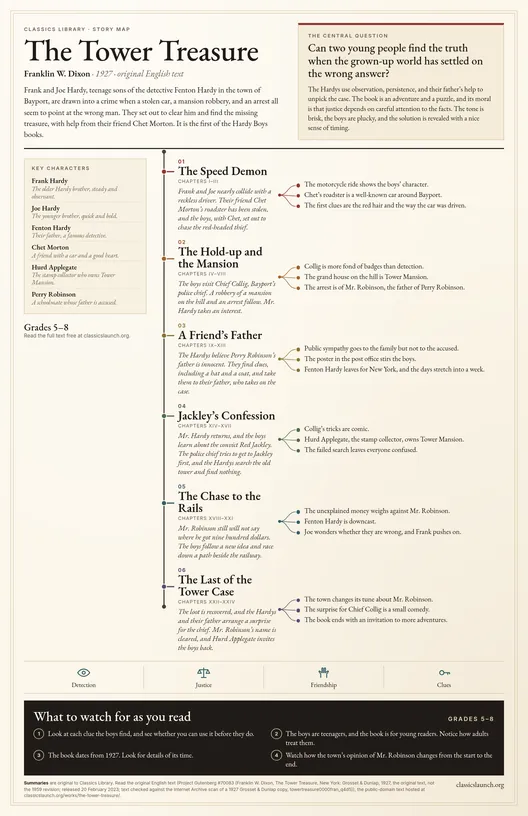 Story mapSee the story mapThe whole book on one page: the story in movements, the characters, and what to watch for. Free to print.
Abstract
The first clues. The brothers Frank and Joe Hardy, whose father Fenton is a detective, see a speeding car on a Bayport shore road and shortly learn that the roadster of their friend Chet Morton is gone, stolen. A hold-up and a red-haired thief start them on a trail of tracks, witnesses and false leads, and they already hope to follow their father’s profession in a coastal American town of motorcycles, police and family loyalty.
The charge. Tower Mansion is robbed of jewels and securities, and an honest man connected with the house is accused. The boys, while their father works the case in his own way, visit poor quarters, wait on news of a thief named Red Jackley, and refuse to treat the accusation as the end of the matter, because a family’s name is at stake as well as a hoard of bonds.
The towers. Jackley’s confession points them to a tower. They search the old tower and the new, follow a flash at night, and at last find the hidden loot, clearing the innocent man. The 1927 wording, not the later rewrite, is the text hosted here, with Frank about sixteen and Joe a year younger.
Main characters
- Frank Hardy: older brother, about sixteen
- Joe Hardy: younger brother
- Fenton Hardy: their detective father
Summary
The Tower Treasure is the first of the Hardy Boys books, and this library hosts the original 1927 wording, not the later rewrite of 1959. Frank and Joe Hardy, sons of the detective Fenton Hardy, live in Bayport and already hope to follow their father’s work. The story opens on a Saturday ride, when the boys see a speeding car and soon find that their friend Chet Morton’s roadster has been stolen. A hold-up, a red-haired thief, and a robbery at Tower Mansion follow, and an honest man who has worked at the mansion is accused. The brothers, with their father’s example before them and with help from friends such as Chet and Tony Prito, follow tire tracks, listen in poor quarters, and wait on a dying thief named Red Jackley, whose confession points them toward a tower. The search of the old tower and then of the new one, a flash at night, and a last idea about where stolen bonds and jewels might be hidden bring the case to its end. Adelia Applegate, the sharp-tongued sister of the mansion’s owner, has her say, and the innocent man is cleared. The book is a clean, swift mystery for middle-grade readers, written in the plain style of early series fiction. It honors curiosity, perseverance and loyalty between brothers, and it treats detective work as a craft that requires patience as well as nerve. Some passages give a comic dialect to Italian speakers in Bayport; a teacher may wish to pause there. The rest is a story of boys who will not let a false charge stand, and who learn that a useful clue may be small, and that a father’s good name is a trust. It is a good first mystery for grades 5 to 8, if a teacher is ready to say a word about the dialect and about the difference between this text and the later rewrite.
Virtues in this work
- Justice: The boys will not rest while an honest man stands accused, and the finding of the loot is bound to the clearing of a name.
- Industry: They search, wait and try again, treating detective work as labor rather than as a mere lark.
- Friendship: The brothers work as a pair, and their friends Chet and Tony have a part in the help that solves the case.
Plot or Argument
- The roadster and the hold-up
Frank and Joe, riding out on a Saturday, see a speeding car and soon learn that Chet Morton’s roadster has been stolen. A hold-up and a red-haired thief set the first problem of the book, and the boys begin to look for tracks and witnesses.
- The mansion robbery and a false charge
Tower Mansion is robbed of jewels and securities, and an honest man connected with the place is accused. Fenton Hardy is called in, but the boys keep at the case, visiting poor quarters and waiting for a break.
- Jackley’s confession and the towers
The dying thief Red Jackley points the search toward a tower. The boys search the old tower and the new, follow a night-time flash, and at last find where the treasure was hidden, clearing the innocent man.
Characters
- Frank Hardy, older brother
The older brother, about sixteen, dark-haired, already serious about detective work.
- Joe Hardy, Frank’s brother
Frank’s brother, a year younger, his companion on the motorcycles and in the search.
- Fenton Hardy, Their father
Their father, a famous detective, whose example the boys hope to follow.
- Chet Morton, stout
A stout, good-humored friend whose stolen roadster starts the case moving.
- Red Jackley, thief
A thief whose confession, near death, points the boys to the tower.
- Adelia Applegate, sharp
The sharp, old-fashioned sister of the Tower Mansion’s owner, who at last gives the boys their due.
Lessons
Do not leave an honest man under a charge
The heart of the case is not the treasure only, but the clearing of a man who would otherwise be ruined. The boys treat that duty as part of detective work.
- Who is accused, and what would a conviction cost his family?
- What do the brothers do when the evidence seems to point the wrong way?
- How is justice here more than catching a thief?
Patience is part of courage
The boys wait, watch and search more than they fight. The book treats careful looking, and the humility to try a new idea, as the real work of a detective.
- Where does a small clue matter more than a chase?
- What do they learn from their father about waiting?
- When does a first idea about the tower prove incomplete?
Brothers in a craft
Frank and Joe work as a pair, and their friendship is a kind of apprenticeship. A Christian reader can see in that a picture of two walking together in a good work.
- How do the brothers differ, and how do they help each other?
- What do they owe their father besides admiration?
- Is detective work in this book a game, or a responsibility?
Context
The Hardy Boys were created by the Stratemeyer Syndicate and first published by Grosset & Dunlap in 1927 as a test of a new series for boys. The books are American small-town mysteries of motorcycles, police, and a professional detective father, written for middle-grade readers in a growing market for series fiction.
Composition
The original 1927 text of The Tower Treasure is widely attributed to Leslie McFarlane, working from a syndicate outline. In the late 1950s the early books were rewritten and shortened; those revisions remain under copyright. The 1927 wording entered the public domain in the United States on 1 January 2023. The hosted text is Project Gutenberg eBook #70083, checked against the Internet Archive scan of a 1927 Grosset & Dunlap copy (towertreasure0000fran_q4d5). Frank is about sixteen, Joe a year younger, which marks the original, not the later rewrite.
Reception
The series became one of the best-known American juvenile mysteries. This first book is still the right place to begin, and the original text is of interest both as a story and as the wording first offered to boys in 1927.
Comparisons
- The Secret of the Old Clock
The first Nancy Drew book, also hosted here in its original 1930 wording, is the sister series from the same syndicate: a young detective, a hidden fortune, and a first case that tests nerve and kindness.
- The Adventures of Tom Sawyer
Twain’s earlier boy of a river town has more idleness and more depth; the Hardy boys are already apprentices to a craft, but both books honor nerve, friendship and a taste for a secret.
- Treasure Island
A classic adventure of a search and a hidden hoard, in this library, useful as a contrast in tone and in moral danger.
- Kidnapped
Stevenson’s tale of a wrongly pursued young man is a sterner companion on innocence, pursuit and perseverance.
Quotes
Frequently cited
“After the help we gave dad on that forgery case I guess he'll begin to think we could be detectives when we grow up.”
“Isn't he one of the most famous detectives in the country? And aren't we his sons? If the profession was good enough for him to follow it should be good enough for us.”
“The older of the two boys was a tall, dark youth, about sixteen years of age. His name was Frank Hardy.”
“He's a pretty good old scout after all, isn't he?”
For Students
A reading companion for classical Christian high school students. See the student guide.
Reading Guide
Watch for
- How the stolen roadster and the red-haired driver first lead the boys, and where that trail is incomplete.
- What a conviction would cost the accused man and his family.
- How the old tower and the new tower both matter to the hiding place.
- Where the book uses comic dialect for Italian speakers, and how a reader should take it.
Key terms and names
- Bayport
- The boys’ hometown, a coastal American city of the series, with a shore road, police, and Tower Mansion.
- Tower Mansion
- The house of the Applegates, robbed of jewels and securities, with an old tower and a newer one.
- Fenton Hardy
- The boys’ father, a professional detective whose methods they try to copy.
- Red Jackley
- The thief whose last confession points the search to the tower.
- 1927 original
- This wording, now public domain in the U.S., as distinct from the copyrighted 1959 rewrite.
Seminar Questions
- Comprehension What is stolen in the early chapters, and what is taken from Tower Mansion?
- Comprehension How do the boys finally learn where to look for the treasure?
- Interpretation What kind of detectives are Frank and Joe, and how do they differ from their father?
- Interpretation Why does the book spend so much time on an accused man who is not the real thief?
- Big Question What does a person owe to someone who has been falsely accused, even if the treasure would be found anyway?
- Big Question Is detective work a game for clever children, or a form of justice that requires patience and mercy?
Faith Connections
- Proverbs 18:17 (Scripture)
The first to state his case seems right, until the other comes and examines him: a word over a book in which a first accusation nearly ruins an honest man.
- Micah 6:8 (Scripture)
The call to do justice, love mercy, and walk humbly is a measure of the boys’ work, which is not finished when the loot is found, but when a name is cleared.
- Mark Twain, The Adventures of Tom Sawyer (Great Conversation)
Twain’s earlier American boys, in this library, offer a companion on nerve, friendship and the difference between a lark and a duty.
Logic and Rhetoric
Central argument: A first case can teach that detective work is a craft of patience and that justice is not done until an honest name is cleared, not only until stolen goods are found.
Rhetorical device: plain series mystery. The book moves in short chapters, from chase to search to confession, with talk among boys and a last hidden place, so that the lesson is in the solving rather than in a sermon.
Debate: Resolved: That finding the treasure is of no worth if an innocent man remains accused.
Memory Work
After the help we gave dad on that forgery case I guess he'll begin to think we could be detectives when we grow up.
The older of the two boys was a tall, dark youth, about sixteen years of age. His name was Frank Hardy.
Writing Prompts
Essay: Show how Frank and Joe clear an honest man as well as find a treasure, and explain what this first case teaches about patience and justice.
Comparison with The Secret of the Old Clock: Compare the first Hardy Boys case with the first Nancy Drew case, both in their original wordings, and say how brothers working together differ from a girl who often works alone, and what each book honors.
Medical Lens
The book is a light mystery. A dying thief’s confession and a scare around a bomb for the chief of police are the chief bodily incidents.
- Red Jackley’s confession
A dying criminal’s last words become the clue that turns the case.
Creative Prompts
- Essay
Explain how Frank and Joe prove that detective work is more than a chase, using three moments of waiting, looking or changing their minds.
- Dialogue
Write a short dialogue in which Fenton Hardy questions his sons after the case and asks what they will do differently next time.
- Classroom
List the false leads in the book and show how each one was set aside, so that students can see a mystery as a chain of tests.
Further Reading
- The Secret of the Old Clock, Carolyn Keene
The first Nancy Drew book, hosted here in the 1930 original, a companion first case from the same period.
- The Adventures of Tom Sawyer, Mark Twain
An earlier American boys’ book of nerve and invention, in this library.
- Treasure Island, Robert Louis Stevenson
A classic search for hidden treasure, in this library.
Verification notes
The text is the 1927 Grosset & Dunlap original, Project Gutenberg eBook #70083, checked against the Internet Archive scan towertreasure0000fran_q4d5 (copyright page 1927; Frank about sixteen, Joe a year younger; original chapter titles). The 1959 rewrite is not used. The attribution to Leslie McFarlane and the syndicate process follow standard publishing history and are not stated in the hosted text. Franklin W. Dixon is a house name.
- The attribution of the 1927 wording to Leslie McFarlane, working from a Stratemeyer Syndicate outline, follows standard reference accounts and is not stated in the book.
- The name of the accused workman and some lesser character details follow the hosted text; if a guide names him, it should be from this wording, not from the 1959 revision.