Work record
The Secret of the Old Clock
Carolyn KeeneNancy Drew: The Secret of the Old Clock; Nancy Drew Mystery Stories No. 1The Secret of the Old Clock by Carolyn Keene (1930)The Secret of the Old Clock is the first of the Nancy Drew books, and this library hosts the original 1930 wording, not the later rewrite of 1959.Also known as: Nancy Drew: The Secret of the Old Clock · Nancy Drew Mystery Stories No. 1
1930 · Early 20th Century · Novel · English
Read this when a girl of sixteen will not let a hidden will go to the greedy.
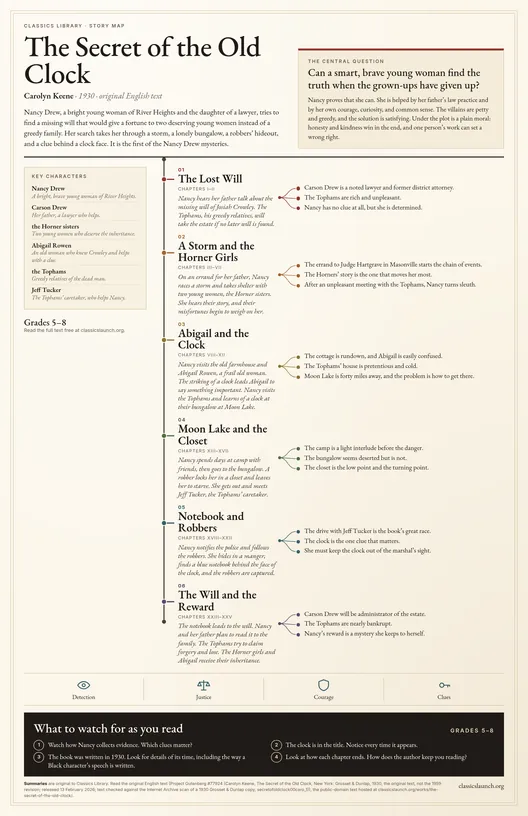 Story mapSee the story mapThe whole book on one page: the story in movements, the characters, and what to watch for. Free to print.
Abstract
The fortune. Nancy Drew, sixteen, living with her father the lawyer Carson Drew, hears that Josiah Crowley’s money may go to the proud Tophams and not to poorer kin who cared for him, among them Allie and Grace. She takes the wrong as a reason to act, and a trail of talk, a storm, and a chance meeting soon turn upon an old clock that may hide a later will.
The danger. She tries to see the Tophams, follows a clue, and is shut up at a closed bungalow, where she meets the caretaker Jeff Tucker, in wording a teacher should pause over. Robbers, fear and a police chase test her nerve, and she is not only clever but also in real danger in this original text, which is sharper in action than the later rewrite.
The clock. A last examination of the old clock yields the hidden will. The fortune is set on a juster path, and Nancy is left with the clock as a keepsake of her first venture as a detective. The hosted text is the 1930 wording, not the later rewrite, and Nancy is sixteen throughout, as in the first edition.
Main characters
- Nancy Drew: girl of sixteen, first case
- Carson Drew: her father, a lawyer
- Jeff Tucker: caretaker at a closed bungalow
Summary
The Secret of the Old Clock is the first of the Nancy Drew books, and this library hosts the original 1930 wording, not the later rewrite of 1959. Nancy Drew, a pretty girl of sixteen, lives with her father, the lawyer Carson Drew, and with Hannah Gruen, who keeps the house. She is already quick, kind and determined, and she takes it as a wrong that Josiah Crowley’s fortune should go to the snobbish Tophams rather than to poorer relations who loved him, including the girls Allie and Grace. A chance meeting, a storm, and a trail of talk about an old clock start her on a search for a later will. She visits the Tophams, follows a clue, is shut up and left in danger at a closed bungalow, and meets Jeff Tucker, the caretaker, in wording that a teacher should pause over. Robbers, a police chase, and a last examination of the old clock bring the hidden paper to light, and the deserving girls are remembered as Crowley had wished. Nancy keeps the clock as a trophy of her first case. The book is a swift mystery for middle-grade readers, written in the plain style of early series fiction, and it honors courage, perseverance and a sense of justice that is also a sense of kindness. It is of its time in manners and in some of its language, and this library keeps the 1930 wording so that students read what first readers saw, not a silent later polish. A parent may wish to read the caretaker passages and the sharper action with a younger child. Taken as a first case, it shows a girl who uses her wits, who will take a risk for a just cause, and who still comes home to a father who trusts her.
Virtues in this work
- Justice: Nancy will not let a fortune go only to the proud, if a later will can still speak for the dead man’s kindness.
- Fortitude: She faces a night of real danger and does not give up the search.
- Charity: Her motive is not the thrill alone, but the help of girls who have little and who loved Crowley.
Plot or Argument
- The lost will and the Tophams
Nancy, at sixteen, hears that Josiah Crowley’s money is likely to go to the Tophams, whom she thinks ungrateful and proud, rather than to poorer relations who loved him. She begins to ask questions, meets two of those relations, and hears of an old clock.
- The search and the bungalow
She tries to see the Tophams, follows a clue, and is shut up at a closed cottage in the care of the caretaker Jeff Tucker. Robbers and a dangerous night test her nerve, and the police are called.
- The clock and the reward
A last close look at the old clock yields the hidden will. The fortune is set on a juster path, and Nancy keeps the clock as a reminder of her first work as a detective.
Characters
- Nancy Drew, girl of sixteen
A girl of sixteen, quick and kind, who takes up a search for a hidden will as her first case.
- Carson Drew, her father
Her father, a lawyer and former district attorney, who trusts her and gives her room to act.
- Hannah Gruen, woman
The woman who keeps the Drew house and looks after Nancy in her mother’s absence.
- Allie and Grace, Poorer relations of Josiah Crowley
Poorer relations of Josiah Crowley, whom Nancy hopes to see remembered in a later will.
- The Tophams, Proud heirs apparent
Proud heirs apparent, whose claim Nancy thinks unjust if a later will can be found.
- Jeff Tucker, caretaker at a closed bungalow
The caretaker at a closed bungalow, spoken of in the 1930 wording in language a teacher should pause over.
Lessons
Justice is also kindness
Nancy’s case is not only a puzzle; she wants a fortune to go to people who loved the dead man, not only to people who can claim him. Justice here has a face.
- Why does Nancy care who inherits Crowley's money?
- What do Allie and Grace need, besides a legal right?
- How is kindness related to the search for a will?
Nerve and prudence together
Nancy takes risks, including a night of real danger, but she also thinks, asks, and goes to her father and to the police when the time comes. Courage in this book is not rashness alone.
- Where does Nancy go too far, and where does she show good sense?
- What does her father allow, and what does he still guard?
- How should a young reader judge a heroine who walks into a closed house alone?
Read the 1930 wording with care
The original text speaks of Jeff Tucker in the language of its day, and it is franker in action than the later rewrite. A good reading keeps the original and names what is dated, without losing Nancy’s real virtues.
- What words does the book use of Jeff Tucker, and how should a reader take them?
- Why host the 1930 wording rather than a later polish?
- What in Nancy is worth imitating?
Context
Nancy Drew was created by the Stratemeyer Syndicate and first published by Grosset & Dunlap in 1930, as a girls’ companion to the Hardy Boys series of 1927. The books are American small-town mysteries of cars, lawyers, and a girl who acts with unusual freedom for the popular fiction of the time.
Composition
The original 1930 text of The Secret of the Old Clock is widely attributed to Mildred Wirt Benson, working from a syndicate outline. In the late 1950s the early books were rewritten and shortened; those revisions remain under copyright. The 1930 wording entered the public domain in the United States on 1 January 2026. The hosted text is Project Gutenberg eBook #77924, released 13 February 2026, checked against the Internet Archive scan of a 1930 Grosset & Dunlap copy (secretofoldclock00caro_1). Nancy is sixteen, which marks the original, not the later rewrite.
Reception
The series became the best-known American juvenile mystery for girls. This first book is still the right place to begin, and the original text is of interest both as a story and as the wording first offered to readers in 1930.
Comparisons
- The Tower Treasure
The first Hardy Boys book, hosted here in its 1927 original, is the brother series from the same syndicate: a first case, a hidden hoard, and young detectives who will not leave a wrong in place.
- The Adventures of Tom Sawyer
Twain’s earlier American young people have more idleness and more depth; Nancy is already a girl with a purpose, but both books honor nerve and a taste for a secret.
- Treasure Island
A classic search for a hidden hoard, in this library, useful as a contrast in danger and in tone.
- Ragged Dick
Alger’s story of a poor youth who rises by industry is a useful companion on money, kindness and the wish to see a decent person fairly treated.
Quotes
Frequently cited
“Nancy Drew, a pretty girl of sixteen, leaned over the library table and addressed her father who sat reading a newspaper by the study lamp.”
“I was saying I think it's mean if those snobbish Tophams fall heir to all of Josiah Crowley's fortune. Can't something be done about it?”
“There's a negro caretaker who looks after it—they call him Jeff Tucker.”
“I'll always prize this clock as a trophy of my first venture as a detective,”
For Students
A reading companion for classical Christian high school students. See the student guide.
Reading Guide
Watch for
- Why Nancy thinks the Tophams should not have the fortune, and whom she hopes to help.
- How the old clock keeps appearing, and what is at last found in it.
- What happens at the closed bungalow, and how Nancy gets out of danger.
- How Jeff Tucker is described in this wording, and how a reader should take those lines.
Key terms and names
- Josiah Crowley
- The dead man whose fortune and last wishes start the case.
- The Tophams
- The proud relations who stand to inherit if no later will is found.
- The old clock
- The timepiece in which the hidden will is at last discovered, and which Nancy keeps as a trophy.
- Jeff Tucker
- The caretaker at the closed bungalow, spoken of in dated language in this 1930 text.
- 1930 original
- This wording, now public domain in the U.S., as distinct from the copyrighted 1959 rewrite.
Seminar Questions
- Comprehension Why does Nancy begin to look for a later will, and who might be helped if she finds it?
- Comprehension What is found in the old clock at the end?
- Interpretation What kind of detective is Nancy, and how does her father’s trust matter?
- Interpretation How should a reader describe the book’s language about Jeff Tucker?
- Big Question Is it just to try to change an inheritance, and when does kindness become meddling?
- Big Question What does a young person owe to the weak when the law seems to favor the proud?
Faith Connections
- Isaiah 1:17 (Scripture)
The call to seek justice and to help the fatherless is a measure of Nancy’s wish that a fortune not go only to the proud, but also to those who have little and who loved the dead man.
- Proverbs 31:8-9 (Scripture)
The word to open one’s mouth for the needy is a measure of a girl who uses her nerve not only for a thrill, but for people who cannot search as she can.
- Franklin W. Dixon, The Tower Treasure (Great Conversation)
The first Hardy Boys book, in this library, is the companion first case from the same syndicate years, useful for comparing brothers’ work with Nancy’s.
Logic and Rhetoric
Central argument: A first case can teach that a search for a hidden paper may be a work of justice and kindness, if the searcher will take a risk for people who have little, and if a teacher will also name what is dated in the wording.
Rhetorical device: plain series mystery. The book moves in short chapters, from talk in a library to a closed bungalow to a last look at a clock, so that nerve and kindness are shown in action.
Debate: Resolved: That a hidden will should be sought when the proud would otherwise take all.
Memory Work
Nancy Drew, a pretty girl of sixteen, leaned over the library table and addressed her father who sat reading a newspaper by the study lamp.
I'll always prize this clock as a trophy of my first venture as a detective,
Writing Prompts
Essay: Show how Nancy’s first case is a work of kindness as well as of cleverness, and explain how a reader should take the 1930 wording’s dated lines.
Comparison with The Tower Treasure: Compare Nancy’s first case with the first Hardy Boys case, both in their original wordings, and say how a girl working largely alone differs from the brothers, and what each book honors.
Medical Lens
Nancy is shut up and left in danger at a closed bungalow, a chapter of fear and want rather than of medical interest.
- Chapter XVI: Left to Starve
Nancy is locked in and left without help, a test of nerve in the original wording.
Creative Prompts
- Essay
Explain why Nancy cares who inherits the fortune, and how the search for the will is a work of kindness as well as of cleverness.
- Dialogue
Write a dialogue in which Carson Drew, after the case, asks Nancy what she will do differently the next time she walks into danger alone.
- Classroom
Compare a page of this 1930 wording, if you have access to a later printing, only to note that this library hosts the original; do not import copyrighted later text.
Further Reading
- The Tower Treasure, Franklin W. Dixon
The first Hardy Boys book, hosted here in the 1927 original, the brother series from the same years.
- The Adventures of Tom Sawyer, Mark Twain
An earlier American book of young nerve and invention, in this library.
- Treasure Island, Robert Louis Stevenson
A classic search for a hidden hoard, in this library.
Verification notes
The text is the 1930 Grosset & Dunlap original, Project Gutenberg eBook #77924, checked against the Internet Archive scan secretofoldclock00caro_1 (copyright page 1930; Nancy sixteen; twenty-five original chapters). The 1959 rewrite is not used. The attribution to Mildred Wirt Benson and the syndicate process follow standard publishing history and are not stated in the hosted text. Carolyn Keene is a house name.
- The attribution of the 1930 wording to Mildred Wirt Benson, working from a Stratemeyer Syndicate outline, follows standard reference accounts and is not stated in the book.
- Some names of lesser Crowley relations follow the hosted text; a teacher comparing later printings should not mix the two wordings.