Work record
Second Reply to Hayne
1830 · 19th Century · Oratory · English
Abstract
Background. A Connecticut proposal to slow western land sales became, in January 1830, a contest over sectional loyalty. Hayne of South Carolina, seeking western allies, attacked New England's record and defended a state's power to void a federal tariff, while Calhoun, the doctrine's quiet author, held the chair.
Content. Webster first recalls the debate to its starting point, then parries Hayne's jibes, vindicates the Northwest Ordinance, and reviews Carolina's former enthusiasm for protective duties and national roads. A compact salute to Massachusetts answers the charges of disloyalty. The longest section asks who created the federal government, answers that the people did, and finds in the supremacy clause and the jurisdiction of federal courts the provisions without which the country would be a mere league. A comic sketch of nullification enforced at a Charleston custom-house shows it collapsing into armed resistance.
Themes. Popular sovereignty, a single national allegiance above section, the courts as final umpire, and the inseparability of freedom from union. Memory does much of the work: the battlefields of 1775 and the distress of the Confederation years are offered as evidence.
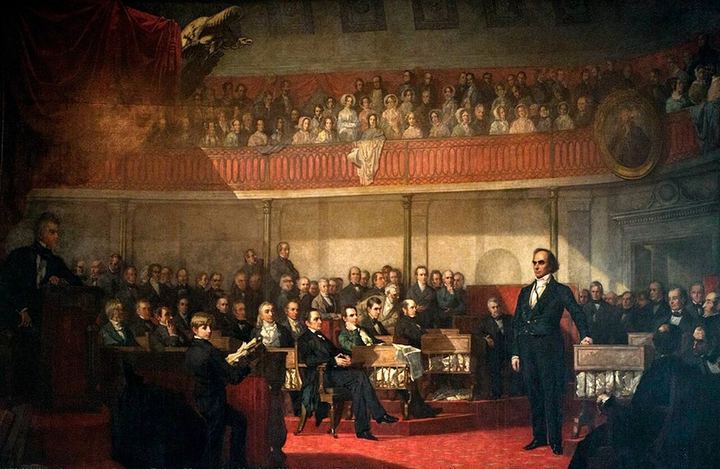
Significance. Printed copies spread nationwide, Healy painted the scene for Faneuil Hall, and the closing motto entered school readers. Lincoln drew on the argument in 1861, and South Carolina's 1832 ordinance tested it within three years.
Key figures
- Daniel Webster: Senator from Massachusetts and the speaker
- Robert Y. Hayne: Senator from South Carolina whose speech Webster answers
- John C. Calhoun: Vice President presiding over the Senate, theorist of state interposition
- Samuel Foot: Connecticut Senator whose land resolution opened the debate
- Thomas Hart Benton: Missouri Senator who spoke for western interests against New England
- Nathan Dane: Massachusetts lawyer credited with drafting the Ordinance of 1787

Summary
Daniel Webster's Second Reply to Hayne was delivered in the United States Senate on 26 and 27 January 1830, during a debate that began with a modest resolution from Senator Samuel Foot of Connecticut about limiting the sale of public lands in the West. Robert Y. Hayne of South Carolina had turned the debate into an attack on New England, accusing it of selfishness toward the West and of disloyalty during the War of 1812, and had defended the doctrine, associated with Vice President John C. Calhoun, who was presiding, that a state may declare a federal law unconstitutional and refuse to enforce it. Webster's answer ran over two days and fills about thirty thousand words in the 1879 edition. He opens with the image of a storm-tossed mariner taking his bearings and asks that the resolution be read, noting that Hayne had discussed everything except the public lands. He then answers personal thrusts, including Hayne's use of Banquo's ghost from Macbeth, defends Nathan Dane and the Northwest Ordinance of 1787, and sets out New England's view that the states are united and that a Senator must regard the good of the whole. He recalls South Carolina's own earlier support for the tariff of 1816 and for internal improvements, and answers the charges against New England with a short, famous tribute to Massachusetts and its battlefields. The heart of the speech is constitutional. Webster asks whose agent the federal government is, answers that it is the people's, not the creature of the state legislatures, and argues that the supremacy clause and the judicial power together are the keystone of the arch. He imagines a South Carolina nullifier trying to stop duties at a custom-house and shows that the doctrine ends in force. The peroration refuses to look beyond the Union into the abyss and closes with the flag inscribed Liberty and Union, now and for ever, one and inseparable. The speech was printed and distributed in great numbers and its last sentences became standard schoolroom recitation.
Virtues in this work
- Prudence: Webster opens by asking the Senate, like a mariner after a storm, to recover its true course before going further.
- Justice: He insists that each Senator must regard the good of the whole with an equal eye and that federal law binds every state alike.
- Honor: He answers attacks on New England by pointing to Massachusetts' sacrifices at Concord, Lexington, and Bunker Hill rather than by abusing South Carolina.
- Magnanimity: He recalls the early harmony of Massachusetts and South Carolina and wishes it restored even while refuting Hayne.
Plot or Argument
- Exordium: the mariner takes his bearings
Webster compares the Senate to a ship driven off course, has Foot's resolution on the public lands read, and points out that Hayne's two-day speech touched every topic but that one.
- Personal rejoinders and the Ordinance of 1787
He answers Hayne's taunts about matches and overmatches and the ghost of the murdered Coalition, turning the Banquo allusion back on its author, and defends Nathan Dane's Northwest Ordinance and its exclusion of slavery from the territory north of the Ohio.
- The West, public lands, and internal improvements
Webster denies that New England has been hostile to the West, explains that his region regards the states as one country, and recalls that South Carolina's leading men supported the tariff of 1816 and federal internal improvements before reversing course.
- The defence of New England and Massachusetts
He answers the charges about the Hartford Convention and the embargo, shows that New England's opposition never claimed a constitutional right of state nullification, and delivers his brief tribute to Massachusetts, Boston, Concord, Lexington, and Bunker Hill.
- The constitutional argument against nullification
Webster states the South Carolina doctrine, argues that the Constitution is the people's and not the state legislatures', identifies the supremacy clause and the judicial power as the keystone of the arch, and satirizes the practical working of nullification at a custom-house, concluding that the doctrine leads either to revolution or to civil war.
- Peroration: Liberty and Union
He praises the Union as the source of the country's safety and prosperity, refuses to look into the abyss of disunion, and prays that his last sight may be the flag bearing the motto Liberty and Union, now and for ever, one and inseparable.
Key claims
The main steps of the argument, in order, and how they fit together.
- Hayne's speech wandered from the actual question, the sale of public lands, and must be brought back to its starting point.How it is supported: Image of the storm-tossed mariner taking his bearings and the rereading of Foot's resolution.
- New England has not been hostile to the West, and the Northwest Ordinance shows its wise concern for the whole country.How it is supported: Defense of Nathan Dane and the Ordinance's exclusion of slavery north of the Ohio.
- South Carolina once supported the tariff and national improvements, so its present charges against New England are inconsistent.How it is supported: Record of Carolina leaders' support for the tariff of 1816 and internal improvements.
- Massachusetts and New England have proven their loyalty and never claimed a constitutional right of nullification.How it is supported: Tribute to Boston, Concord, Lexington, and Bunker Hill, and review of past opposition.
- The federal government was made by the people of the United States, not by the state legislatures.How it is supported: Reading of the Constitution's origin and the memory of the weak Confederation years.
- The supremacy clause and federal judicial power make the Constitution a true government rather than a mere league of states.How it is supported: Constitutional text naming the courts as final umpire in cases arising under federal law.
- In practice, nullification leads either to revolution or to civil war, not to peaceful constitutional remedy.How it is supported: Satirical sketch of nullification enforced at a Charleston custom-house.
- Liberty and Union are inseparable, and the Union is the source of the nation's safety and prosperity.How it is supported: Peroration on the flag and the abyss of disunion.
Argument map
Supported by
- 5The federal government was made by the people of the United States, not by the state legislatures.
which rests on
- 6The supremacy clause and federal judicial power make the Constitution a true government rather than a mere league of states.
- 7In practice, nullification leads either to revolution or to civil war, not to peaceful constitutional remedy.
- 4Massachusetts and New England have proven their loyalty and never claimed a constitutional right of nullification.
which rests on
- 1Hayne's speech wandered from the actual question, the sale of public lands, and must be brought back to its starting point.
- 2New England has not been hostile to the West, and the Northwest Ordinance shows its wise concern for the whole country.
- 3South Carolina once supported the tariff and national improvements, so its present charges against New England are inconsistent.
- 8Liberty and Union are inseparable, and the Union is the source of the nation's safety and prosperity.
Therefore
Plain-language summaries of the author's argument, not quotations.
Lessons
Who is sovereign over the Constitution
Webster's central question is whose agent the national government is. By answering that it was erected by the people rather than by the state legislatures, he concludes that no single state can sit as judge over federal law, and that disputes must go to the courts, to elections, or to amendment. The argument shows how a constitutional question turns on a prior question of origins.
- Why does Webster think the question of origin settles the question of who interprets the Constitution?
- What four or five safeguards does Webster say the people have chosen instead of state nullification?
- Is Webster right that a constitution open to twenty-four interpretations would be no government at all?
Answering an opponent without losing the subject
Hayne's speech ranged widely and grew personal. Webster opens by recalling the actual resolution, answers the personal charges with wit rather than anger, and then moves the whole debate to the ground he chose, the nature of the Union. The structure is a model of regaining control of an argument.
- How does the mariner image at the opening set up Webster's strategy for the whole speech?
- How does Webster turn Hayne's allusion to Banquo's ghost against him?
- When is it wise to answer personal attacks, and when should a speaker ignore them?
Union and liberty held together
Webster rejects the slogan Liberty first and Union afterwards, insisting that each depends on the other. His peroration presents the Union not as a cage for liberty but as the only ground on which American liberty had been secured, from Bunker Hill to the Constitution.
- Why does Webster call Liberty first and Union afterwards words of delusion and folly?
- How does the tribute to Massachusetts prepare the argument that liberty cannot survive outside the Union?
- Can loyalty to a nation and loyalty to one's own state or region ever be in conflict, and how should a citizen weigh them?
Context
By 1830 the tariff of 1828, which South Carolinians called the Tariff of Abominations, had provoked a theory of state interposition. Calhoun's anonymous South Carolina Exposition and Protest (1828) argued that a state convention could declare a federal law void within its borders. Senator Foot's resolution on public land sales opened a debate in which Thomas Hart Benton of Missouri and Hayne sought to join the South and West against New England, and Hayne went on to defend the Carolina doctrine on the Senate floor while Calhoun presided as Vice President.
Composition
Webster spoke without a full manuscript, from notes, on 26 and 27 January 1830, after Hayne had concluded on the 25th. The speech was revised for publication soon afterwards and circulated in pamphlet editions. The stored text is from Edwin P. Whipple's The Great Speeches and Orations of Daniel Webster (1879), which includes an editor's headnote on the occasion.
Reception
The speech was reprinted in great numbers and made Webster the leading spokesman for the Union. Its close was memorized by generations of schoolchildren. G. P. A. Healy's large painting Webster Replying to Senator Hayne, completed in 1851, has hung in the Great Hall of Faneuil Hall, Boston, since 1852. South Carolina nonetheless passed its Ordinance of Nullification in 1832, and the crisis ended with President Jackson's proclamation against it and the compromise tariff of 1833. Lincoln's law partner William Herndon recorded that Lincoln consulted the Reply to Hayne when preparing his First Inaugural Address.
Comparisons
- gettysburg-address
Webster's people's government, made for the people, made by the people, and answerable to the people anticipates the triad that closes Lincoln's address thirty-three years later.
- washington-farewell-address-and-selected-letters
Washington called the unity of government the main pillar of American independence and warned against geographical parties; Webster defends that same Union against a sectional theory of the Constitution.
- house-divided-speech
Webster refuses to look into the abyss of disunion; Lincoln in 1858 argues that the Union cannot endure half slave and half free, carrying the question Webster postponed to its crisis.
- the-federalist-papers
Webster's case that the Constitution acts on individuals rather than through state agency, and that the judiciary must settle disputes of power, restates arguments Hamilton and Madison made for ratification.
Quotes
Frequently cited
“When the mariner has been tossed for many days in thick weather, and on an unknown sea, he naturally avails himself of the first pause in the storm, the earliest glance of the sun, to take his latitude, and ascertain how far the elements have driven him from his true course.”
Frequently cited
“Mr. President, I shall enter on no encomium upon Massachusetts; she needs none. There she is. Behold her, and judge for yourselves.”
Frequently cited
“It is, Sir, the people's Constitution, the people's government, made for the people, made by the people, and answerable to the people.”
Frequently cited
“Liberty and Union, now and for ever, one and inseparable!”
“We look upon the States, not as separated, but as united.”
“They are, in truth, the keystone of the arch! With these it is a government; without them it is a confederation.”
“That Union we reached only by the discipline of our virtues in the severe school of adversity.”
“God grant that, in my day, at least, that curtain may not rise!”
For Students
A reading companion for classical Christian high school students. See the student guide.
Reading Guide
Watch for
- The storm-tossed mariner in the opening sentence and the request that the clerk read Foot's resolution, which shows how far Hayne has drifted.
- Webster's handling of Banquo's ghost from Macbeth, where he shows that the murdered man's spirit troubled his murderers, not his friends.
- The short tribute to Massachusetts that names Boston, Concord, Lexington, and Bunker Hill instead of arguing for them.
- The chain of questions in the constitutional argument: whose agent is the government, who shall construe the grant, to whom lies the last appeal.
- The imagined scene of a nullifier marching on the custom-house in Charleston, and the peroration's turn from the abyss of disunion to the flag.
Key terms and names
- Foot's resolution
- Senator Samuel Foot's proposal to inquire into limiting sales of western public lands; the debate that grew out of it ranged far beyond it.
- Nullification
- The doctrine, defended by Hayne and called by Webster the South Carolina doctrine, that a state may declare a federal law void and stop its operation within the state.
- Consolidation
- Hayne's charge that Webster wanted to merge the states into one central power; Webster accepts only the consolidation of the Union in the sense of the Constitution's framers.
- Supremacy clause
- The provision that the Constitution and federal laws made under it are the supreme law of the land, which Webster reads aloud as half of the keystone of the arch.
- Ordinance of 1787
- The Northwest Ordinance governing the territory north of the Ohio River, which excluded slavery there; Webster credits Nathan Dane of Massachusetts with drafting it.
- Hartford Convention
- The 1814-1815 meeting of New England Federalists opposed to the War of 1812, which Hayne cited against New England's loyalty.
Seminar Questions
- Comprehension What was Foot's resolution about, and what does Webster say Hayne actually talked about instead?
- Comprehension According to Webster, which two provisions of the Constitution form the keystone of the arch, and why?
- Interpretation Why does Webster spend so long showing that South Carolina once supported the tariff and internal improvements?
- Interpretation What does the imagined march on the custom-house reveal about where Webster thinks nullification must end?
- Interpretation Why does Webster decline to praise Massachusetts and simply name its places instead?
- Interpretation Webster quotes a reply to the state legislatures: who made you a judge over another's servants? What is the force of that borrowed sentence in his argument?
- Big Question When a law seems unjust, what remedies should a citizen or a state use, and when, if ever, is resistance outside the law justified?
Faith Connections
- Romans 14:4 (Scripture)
Webster's imagined reply to the state legislatures, that servants stand or fall to their own masters, adapts Paul's question, Who art thou that judgest another man's servant? Paul forbids believers to judge one another's consciences; Webster applies the principle to agents of the people judging other agents.
- Mark 3:24-25 (Scripture)
Jesus says a kingdom or house divided against itself cannot stand, the text Lincoln would take up in 1858; Webster's peroration imagines the divided house of states dissevered, discordant, belligerent.
- Augustine, City of God XIX.24 (Great Conversation)
Augustine defines a people as a multitude joined by agreement about the things it loves. Webster's appeal to shared memory, from Bunker Hill to the Constitution, is an attempt to name what the American people love in common.
Logic and Rhetoric
Central argument: The federal government was erected by the people of the United States, not by the state legislatures. The people made the Constitution and federal law supreme and gave the federal judiciary power over all cases arising under them. Therefore no single state may judge federal law void; a state that resists must either use the remedies the people provided or resort to revolution, and nullification is no constitutional right.
Rhetorical device: hypophora. In the constitutional argument Webster repeatedly asks a question and answers it himself, as when he asks whose agent the government is and replies that it is the people's Constitution, the people's government, made for the people, made by the people, and answerable to the people.
Debate: Resolved: that Webster was right that only the federal courts, elections, and amendment, and never a single state, may settle whether a federal law is constitutional.
Memory Work
Liberty and Union, now and for ever, one and inseparable!
Mr. President, I shall enter on no encomium upon Massachusetts; she needs none. There she is. Behold her, and judge for yourselves.
Writing Prompts
Essay: Webster calls the supremacy clause and the judicial power the keystone of the arch. Explain his argument for why these provisions make the United States a government rather than a confederation, and evaluate whether his answer to Hayne is complete.
Comparison with The Gettysburg Address: Compare Webster's description of the people's government with the closing sentence of the Gettysburg Address. How does each speaker understand the relation between the people, the Union, and liberty, and how did the Civil War change the question?
Creative Prompts
- Classroom
Stage the debate: one group prepares Hayne's case for state interposition from Webster's own summary of it, another prepares Webster's reply, and the class votes on which argument from the Constitution's text is stronger.
- Essay
Trace the image of the ship and the storm from the opening sentence to the flag floating over sea and land in the peroration, and explain how it frames the whole speech.
- Dialogue
Write a conversation in the Senate gallery between a South Carolina planter and an Ohio farmer on the evening of 27 January 1830, each reacting to the close of Webster's speech.
Further Reading
- The Great Speeches and Orations of Daniel Webster, Edwin P. Whipple (ed.)
- Daniel Webster: The Man and His Time, Robert V. Remini
- The Great Triumvirate: Webster, Clay, and Calhoun, Merrill D. Peterson
- What Hath God Wrought: The Transformation of America, 1815-1848, Daniel Walker Howe
Verification notes
The stored text is Whipple's 1879 edition of the revised published speech, which differs in detail from what Webster said on the floor; no verbatim transcript survives. Dates of the debate follow the editor's headnote. Locators name sections of the argument rather than page numbers, since the speech has no standard paragraph numbering. Calhoun's authorship of the Exposition and Protest was anonymous in 1828 and became known later. All quotes are found verbatim in the stored text.
No verification flags recorded.