Great Churches & Monasteries · Beyond Europe
Basilica of Bom Jesus
The Jesuit church in Goa that holds the body of Francis Xavier, missionary to India and Asia.
Still standing. The basilica stands and holds the remains of Francis Xavier. It is part of the World Heritage group of Churches and Convents of Goa.
San Antonio Missions · St Peter's Basilica
What it is
Goa was taken from the sultanate of Bijapur by the Portuguese under Afonso de Albuquerque in 1510, and it became the capital of the Portuguese in Asia. Francis Xavier, one of the first Jesuits and a friend of Ignatius of Loyola, arrived in Goa in 1542 and worked in India, the East Indies, and Japan. He died on 3 December 1552 on the island of Sancian, off the coast of China, while trying to enter the mainland. His body was brought to Goa in 1554.
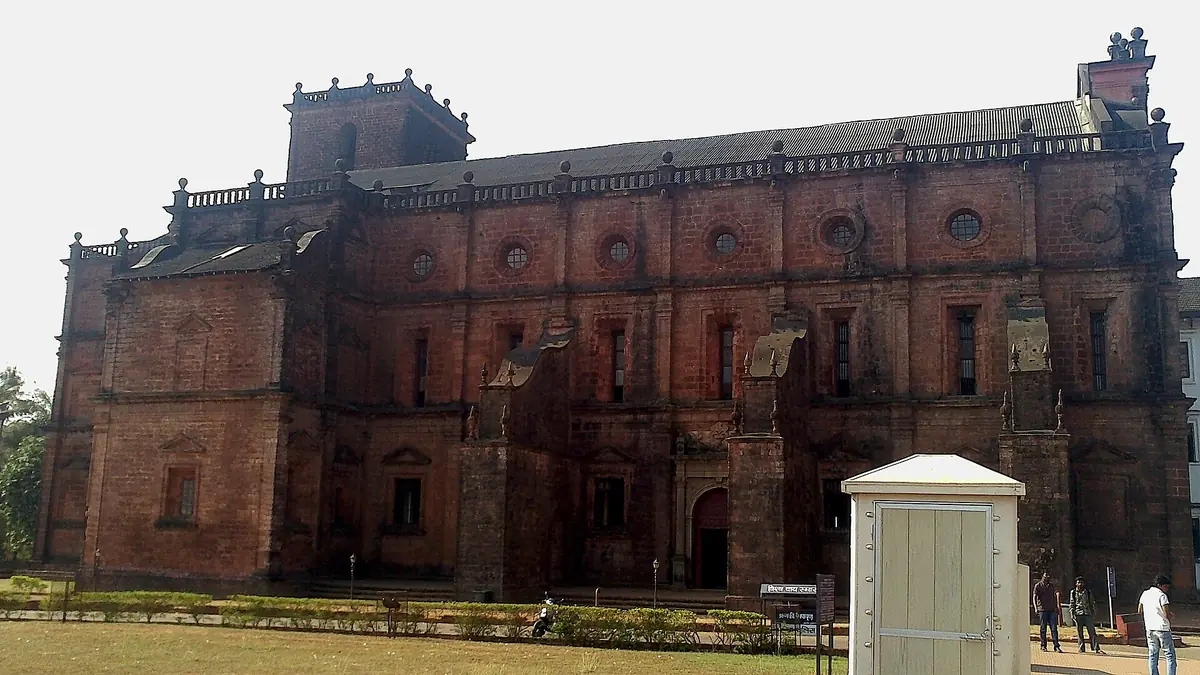
The Jesuits laid the foundation of the church in 1594, and Archbishop Alexis de Menezes consecrated it in 1605. 'Bom Jesus' means 'Good (or Holy) Jesus'. The building is made of dark red laterite stone, left without plaster, with a Baroque front. Xavier's body is held in a silver casket, made in Florence about 1698 and given by the Grand Duke Cosimo III, on a marble tomb. The body is shown to the public at intervals of years, called expositions. Goa was also the seat of the Portuguese Inquisition from 1560 to 1812, and its history is a mixed one.
“Go ye into all the world, and preach the gospel to every creature.”
Why it matters for a classical Christian student
Francis Xavier is a model of costly faith: he left Europe, crossed the ocean, learned from the people he served, and died at the gates of China. A classical Christian student can read the Great Commission in Mark and Matthew alongside the story of a missionary who tried to obey it. The student should also learn that the Portuguese empire, which carried missionaries, was also a project of trade and power, and that the church in Goa was part of both stories.
Read alongside
- The Lusiads: Camões's epic of Portuguese discovery names Goa, 'illustrious Goa's Island world-renown'd'.
- The Bible: The Great Commission is in Matthew 28 and Mark 16.
Great Lives connected here
- Ignatius of Loyola, in Great Lives: Ignatius, founder of the Jesuits, sent Francis Xavier to the East in 1541.
- Vasco da Gama, in Great Lives: Gama's voyage of 1497–1499 opened the sea route to India that brought the Portuguese to Goa.
Look closely
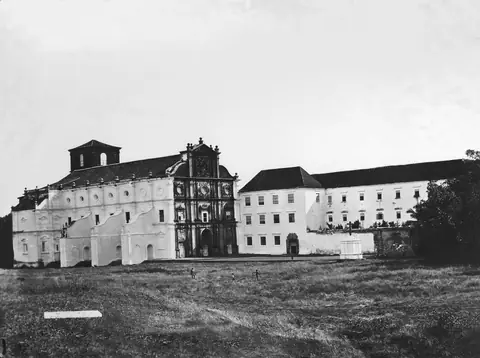
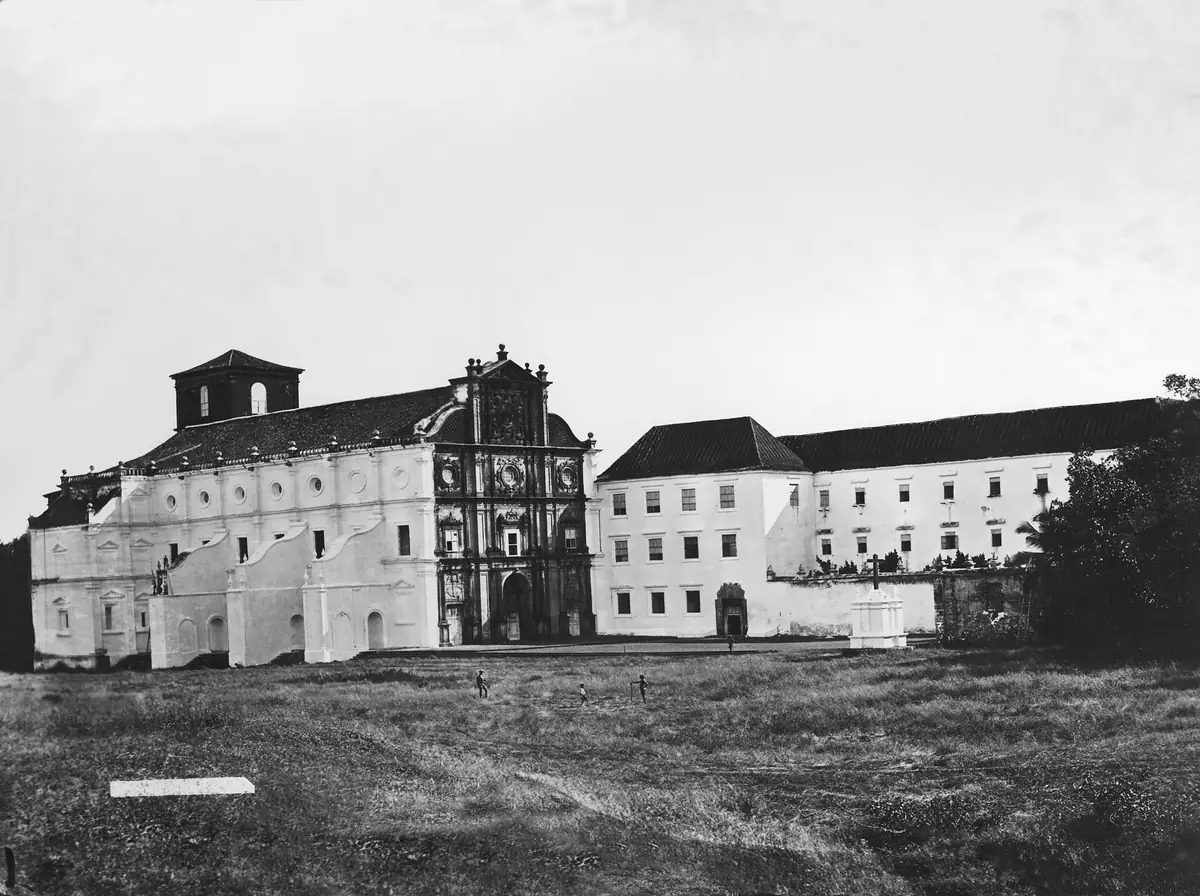
Image: Wikimedia Commons · Public domain (PD-Art) The basilica in about 1870
Look closely. An old photograph shows the whitewashed front with its gables, beside the Jesuit professed house. The walls look whitewashed here, while the stone of the present building is bare.
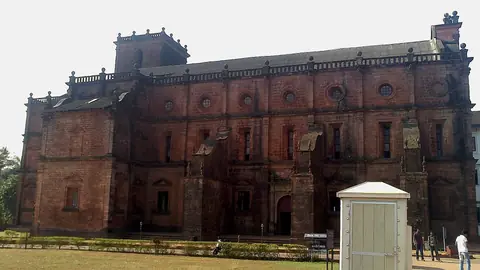
Image: Wikimedia Commons · CC BY 3.0 · Photo: Rohini The side of the church
Look closely. The walls are red laterite, a local stone, left without plaster. The building is plain and strong, with a decorated front.
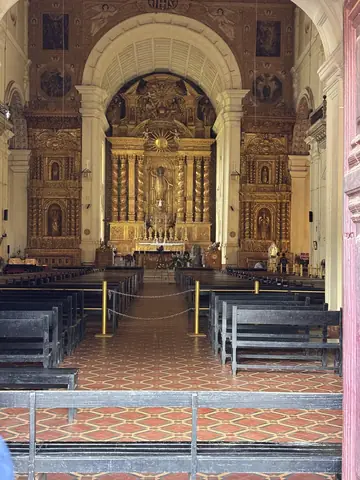
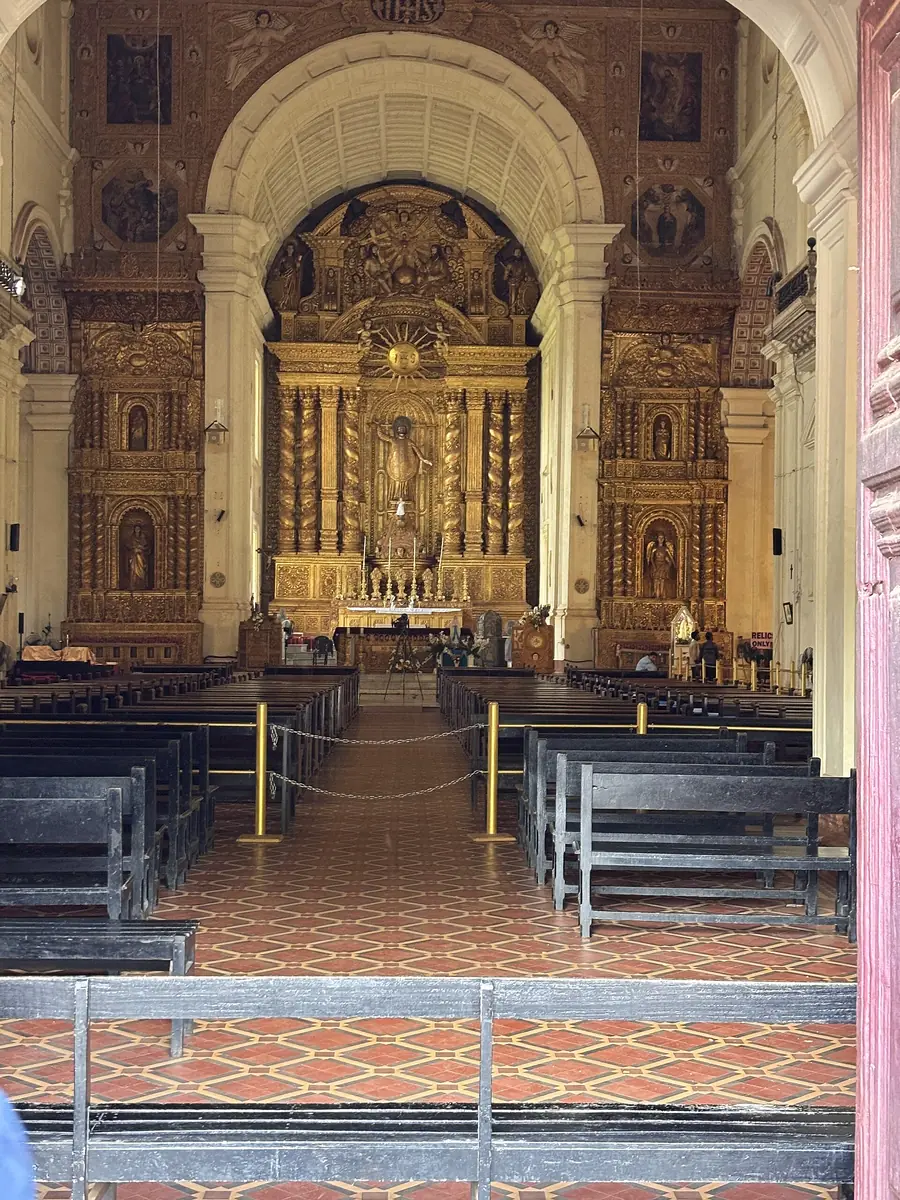
Image: Wikimedia Commons · CC0 (public domain) The nave
Look closely. The nave leads to a gilded Baroque altar. Francis Xavier's tomb stands in a side chapel.


What to watch for
Look slowly- The laterite walls. The red stone is left unplastered.
- The silver casket. It rests on a marble tomb, a gift of the Medici.
- The altarpiece. A Baroque gilded altar with the Christ Child and Ignatius.
- The neighbors. The Se Cathedral stands a short walk away.
Sources
Dates follow standard historical references and, where we quote a book, the wording of the edition hosted in this library. Where a tradition is not certain history, the page says so. Photographs and pictures are used only when the image itself is Public domain, CC0, or CC BY with a named credit. Each picture links to its source page with full licence details. Pictures taken before a site was damaged are labelled with their date.