Great Churches & Monasteries · Western Europe
St Peter's Basilica
The church over the traditional tomb of the apostle Peter, rebuilt in the Renaissance with the greatest dome in the West.
Still standing. The present basilica stands, over the site of the old Constantinian church. It was consecrated in 1626 and is the largest church in Christendom by interior size.
St Peter's, in Wonders & Monuments · Monte Cassino
What it is
Early Christians in Rome honored a place on the Vatican hill as the burial place of the apostle Peter, who, according to tradition, was killed there in the reign of Nero. Constantine had a great basilica built over the site in the early fourth century, and it stood for about eleven hundred years. In it Charlemagne was crowned emperor on Christmas Day in 800. Gregory the Great and many popes were buried there. By the fifteenth century the old church was in poor repair, and Pope Julius II laid the foundation stone of a new church in 1506.
Bramante, Raphael, Michelangelo, Carlo Maderno, and other architects shaped the new building. Michelangelo took charge in 1546 and designed the dome, which was completed after his death by Giacomo della Porta in 1590. Maderno lengthened the nave and built the front in the early seventeenth century, and Bernini made the great bronze canopy over the altar and later the colonnade. The sale of indulgences connected with the building of the new church was a cause of the controversy that led Martin Luther to post his Ninety-Five Theses in 1517. Excavations under the church in the 1940s uncovered a Roman cemetery.
“That thou art Peter, and upon this rock I will build my church; and the gates of hell shall not prevail against it.”
Why it matters for a classical Christian student
St Peter's is the center of the Roman Catholic Church, and a student who is not Catholic can still learn from its story how a church was built, rebuilt, and argued over. The classical Christian student can read the Gospel passage about Peter and the rock, then ask how Christians of different traditions have read it. The building shows what great skill, long labor, and also mixed motives went into a church. The virtue to notice is perseverance across several generations of builders.
Read alongside
- Childe Harold's Pilgrimage: In Canto IV, Byron writes of 'Christ's mighty shrine above his martyr's tomb'.
- Italian Journey (Travels in Italy): Goethe describes his visits to St Peter's during his stay in Rome.
- The Bible: The words of Jesus to Peter are in Matthew 16:13–20.
Great Lives connected here
- Peter the Apostle, in Great Lives: According to tradition Peter was martyred in Rome and buried on the Vatican hill, and the basilica stands over the site.
- Constantine the Great, in Great Lives: Constantine built the first basilica over the traditional tomb.
- Charlemagne, in Great Lives: Charlemagne was crowned emperor in the old basilica on Christmas Day in 800.
- Gregory the Great, in Great Lives: Gregory the Great was buried in the old basilica in 604.
- Michelangelo, in Great Lives: Michelangelo designed the dome from 1546.
- Raphael, in Great Lives: Raphael was named architect of the new church in 1514 after Bramante's death.
- Martin Luther, in Great Lives: The sale of indulgences connected with the new church was one cause of Luther's Ninety-Five Theses in 1517.
- John Paul II, in Great Lives: John Paul II was buried in the grottoes beneath the basilica in 2005 and later moved to a chapel within it.
- Pope Benedict XVI, in Great Lives: Benedict XVI was buried in the grottoes beneath the basilica in 2023.
Look closely
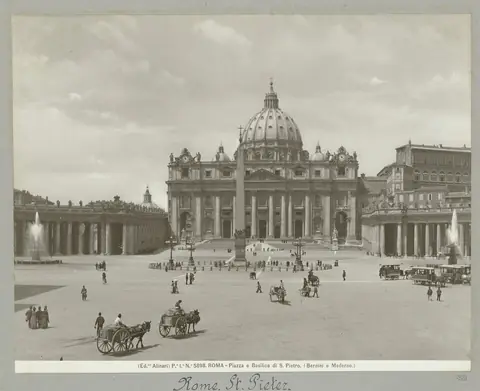
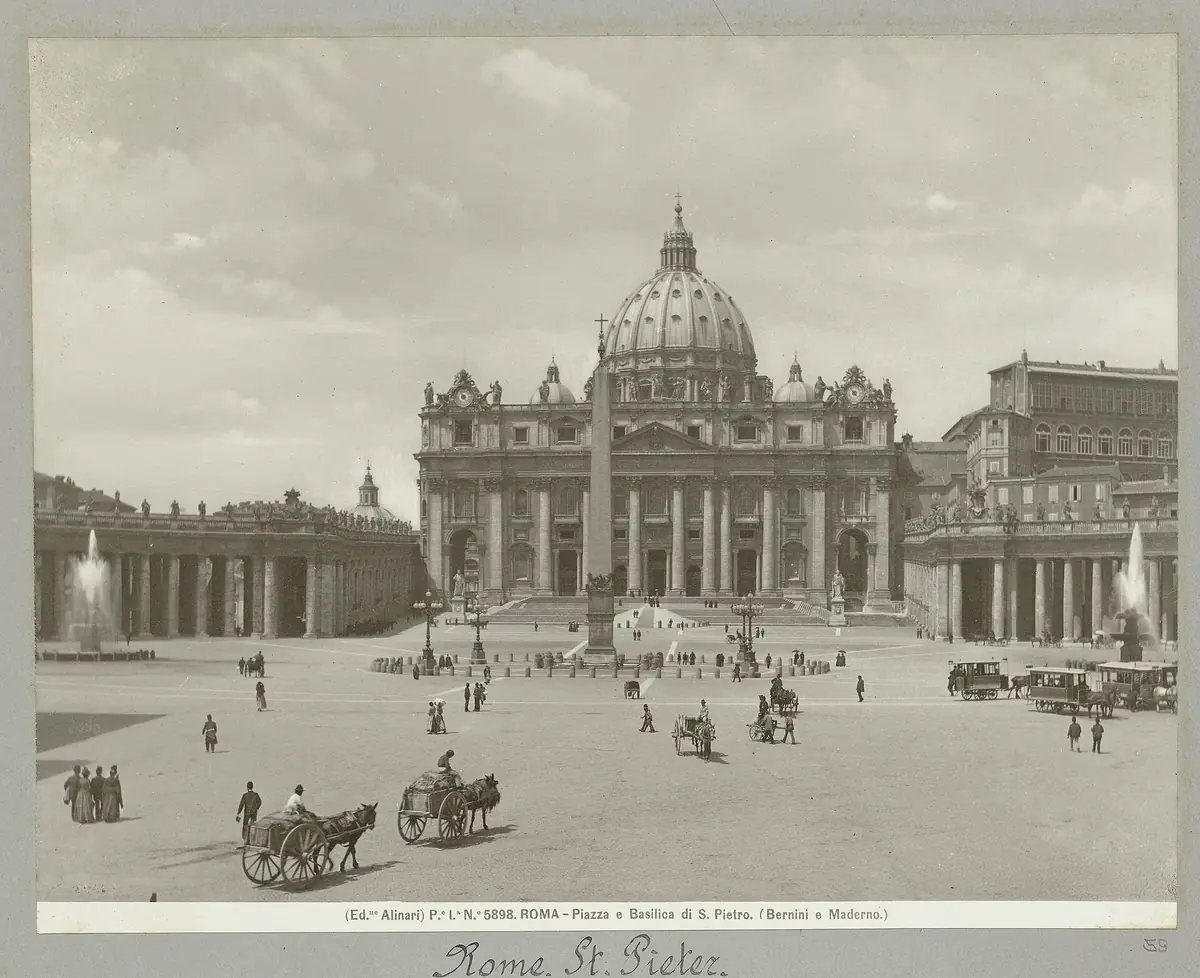
Image: Wikimedia Commons · CC0 (public domain) St Peter’s Square and the basilica
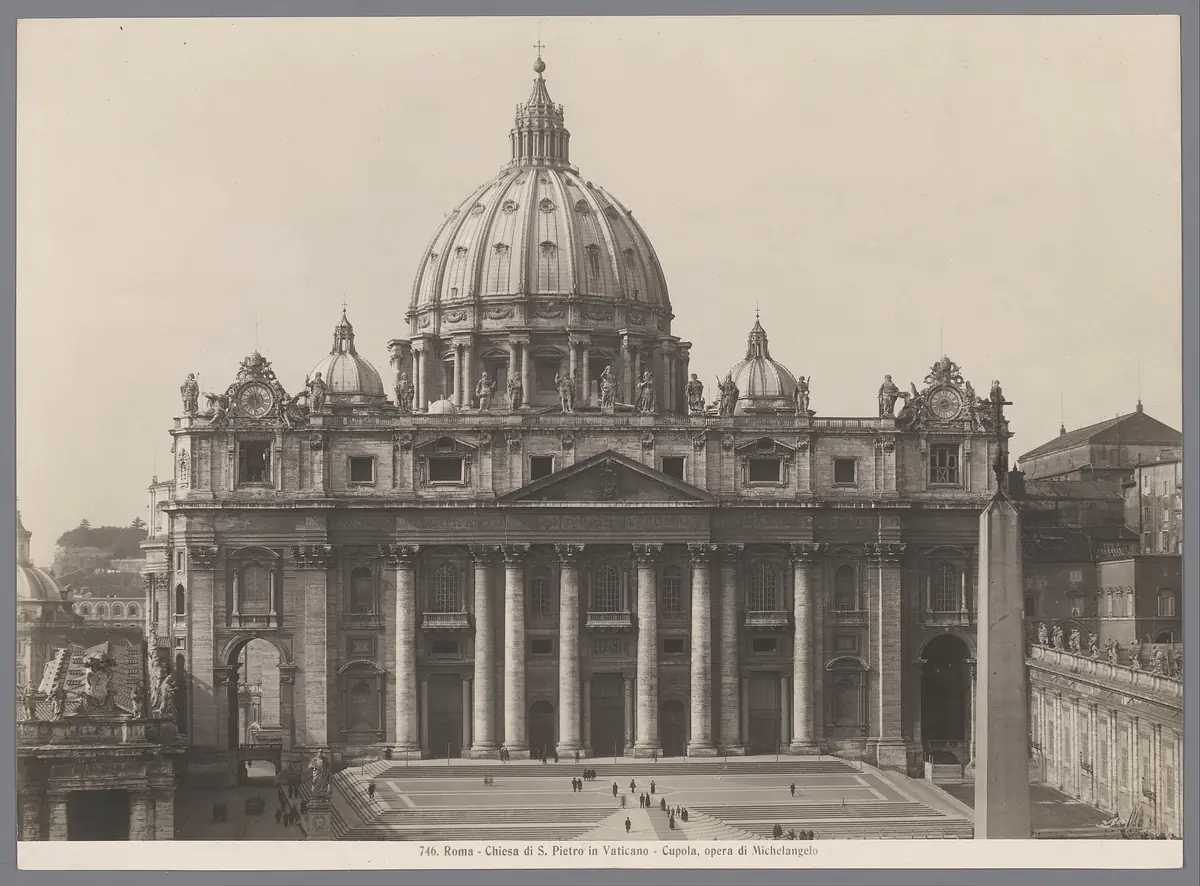
Look closely. A historic photograph of the piazza, with Bernini’s colonnades opening toward the façade and the dome rising behind. Carriages and figures give the square a human scale. This is the completed design as a single scene: court, front and cupola.
In the library: Bernini, in Great Art · Michelangelo, in Great Art
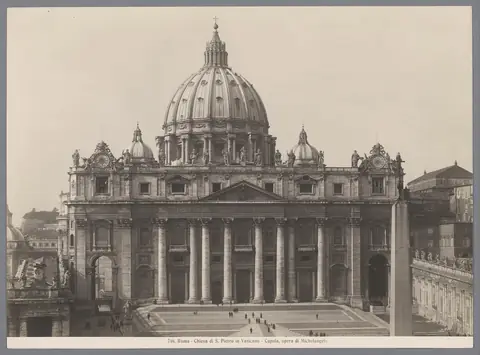
Image: Wikimedia Commons · CC0 (public domain) The façade from the square
Look closely. A closer view of Maderno’s façade from the piazza, with the dome above. Notice the width of the front, the attic statues, and how much of the cupola is hidden or revealed depending on where the photographer stood.
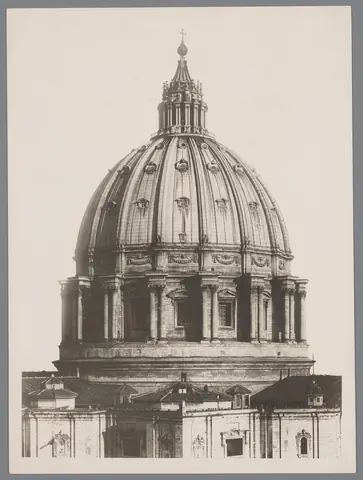
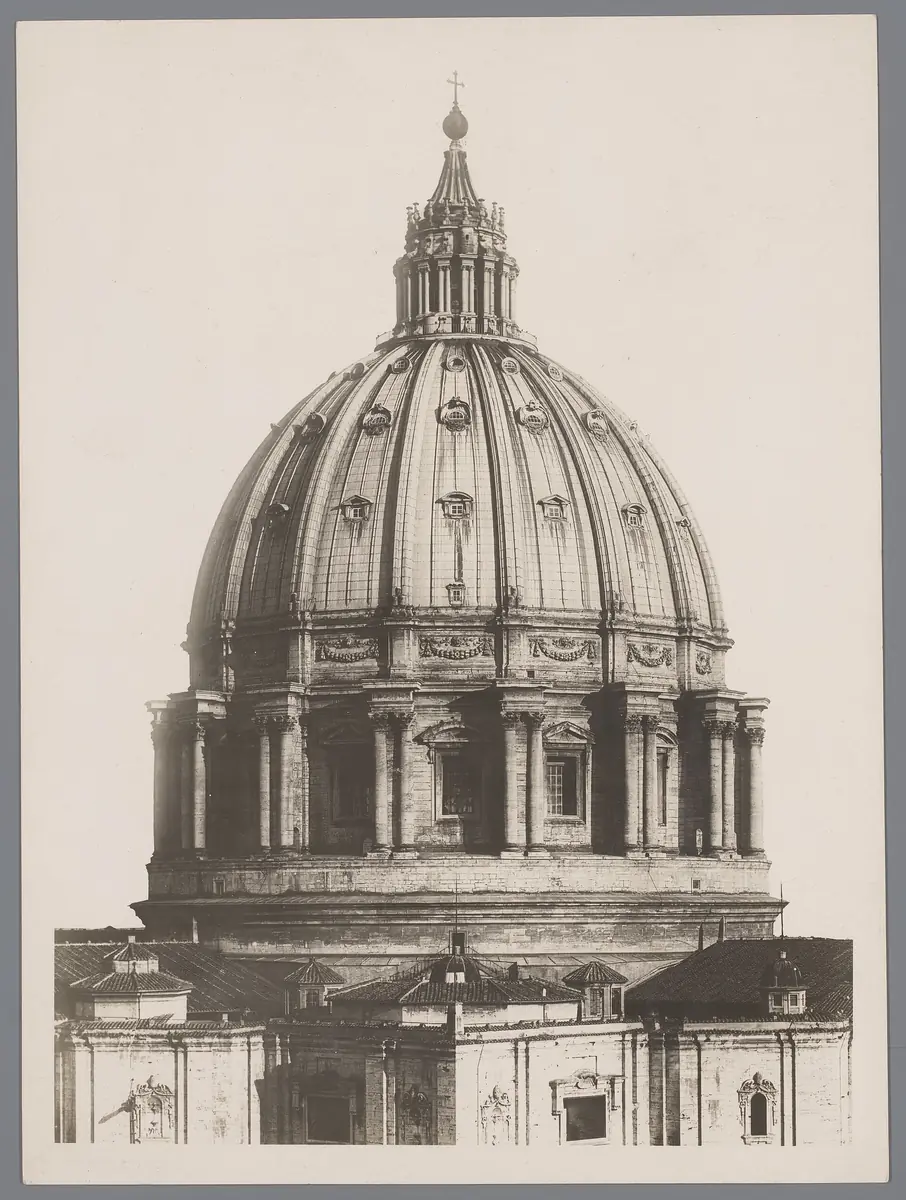
Image: Wikimedia Commons · CC0 (public domain) Michelangelo’s dome
Look closely. A photograph that isolates the dome, so that the drum, the ribs, the lantern and the curve of the cupola can be read without the full width of the façade. This is the part of the church most closely tied to Michelangelo’s design.
In the library: Michelangelo, in Great Art


What to watch for
Look slowly- The dome. Michelangelo's dome rises on a drum with paired columns.
- Layers beneath. The church stands over the old basilica and a Roman cemetery.
- The Pietà. Michelangelo carved it in 1498–1499, before the new church was built.
- The question of money. Read how the building was paid for, and why Luther objected.
Sources
Dates follow standard historical references and, where we quote a book, the wording of the edition hosted in this library. Where a tradition is not certain history, the page says so. Photographs and pictures are used only when the image itself is Public domain, CC0, or CC BY with a named credit. Each picture links to its source page with full licence details. Pictures taken before a site was damaged are labelled with their date.