Great Churches & Monasteries · Holy Land & Middle East
Etchmiadzin Cathedral
The mother church of the Armenian people, the first nation to make Christianity its official faith.
Still standing. The cathedral stands and is the seat of the Catholicos of All Armenians. It has been rebuilt and repaired many times, and its dome and many details are from later centuries.
What it is
According to Armenian tradition, Gregory the Illuminator converted King Tiridates III about 301, and Armenia became the first kingdom to make Christianity the faith of the state. Gregory is said to have seen a vision in which Christ descended and struck the earth with a golden hammer to show where a church should be built. The name Etchmiadzin means 'the Only-Begotten descended'. The first church was built in the early fourth century. The present building is based on a rebuilding of 483–484, in the form of a cross with a central dome on four piers.
The dome was rebuilt in the seventh century and the building was enlarged by later additions, including a bell tower of the seventeenth century and a sacristy of the eighteenth. Etchmiadzin is the seat of the Catholicos of All Armenians, who moved there in 1441, and it holds the museum and library of the Armenian church. The site, with the neighboring churches of St Hripsime and St Gayane, is on the UNESCO list.
“the ark rested in the seventh month, on the seventeenth day of the month, upon the mountains of Ararat.”
Why it matters for a classical Christian student
Armenia is one of the oldest Christian lands, and its church has kept the faith through invasions, empires, and exile. The classical Christian student can learn from this cathedral that a church is a body of people as well as a building. The Armenian alphabet was made in the fifth century so that the Bible could be read in the people's own language, a work of faith and scholarship. Mount Ararat, where Genesis says the ark came to rest, can be seen from the plain.
Read alongside
- The Bible: Genesis 8:4 names the mountains of Ararat, which the Armenian people have long seen across their plain.
Look closely
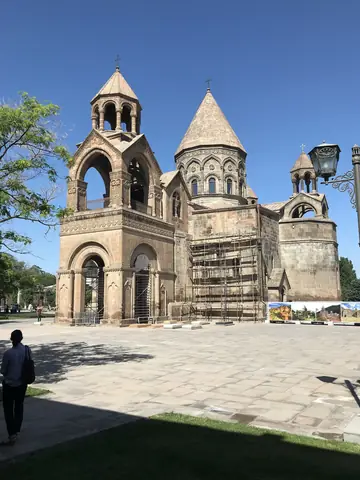
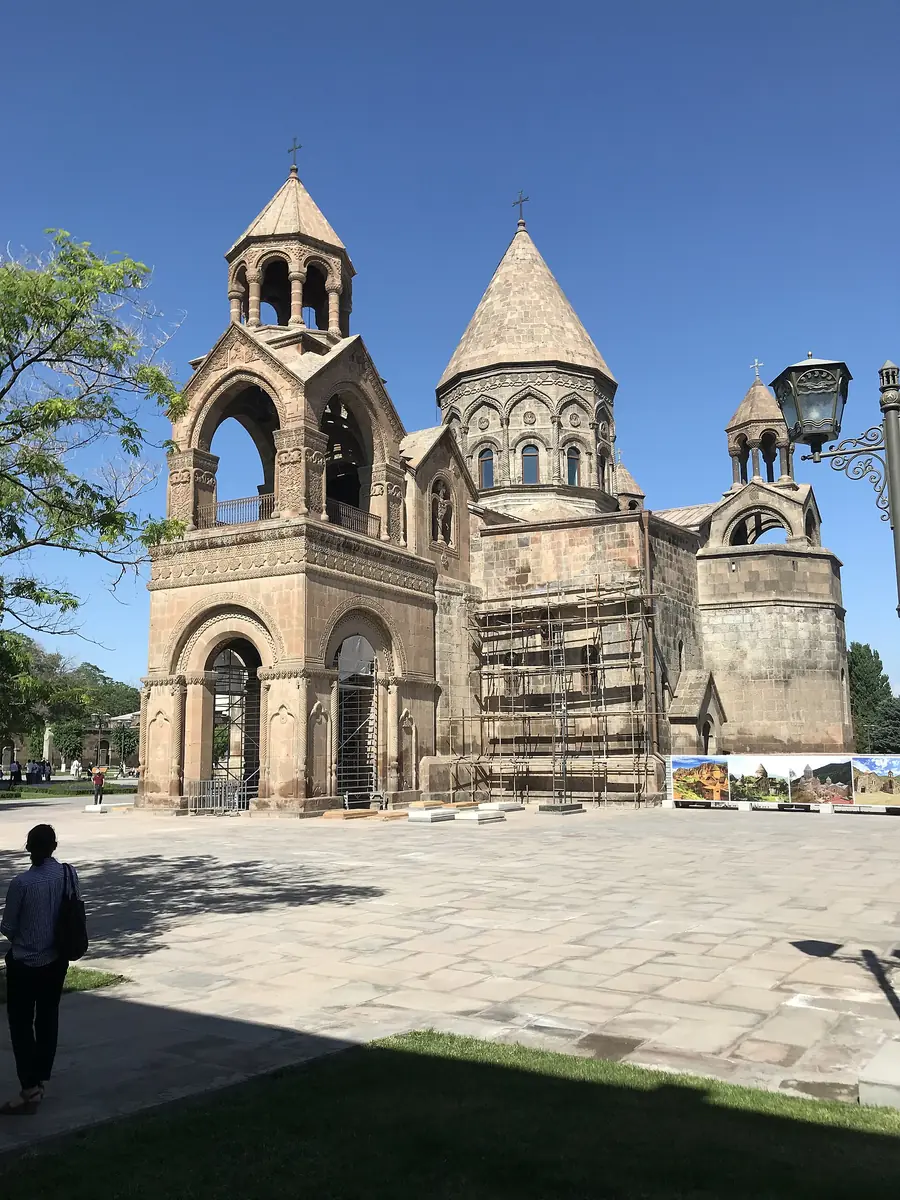
Image: Wikimedia Commons · CC0 (public domain) The cathedral today
Look closely. The cathedral has a central dome on a drum with a conical roof, and later belfries at the west end. Notice the conical roofs, which are typical of Armenian churches. The scaffolding shows that the building is always being cared for.
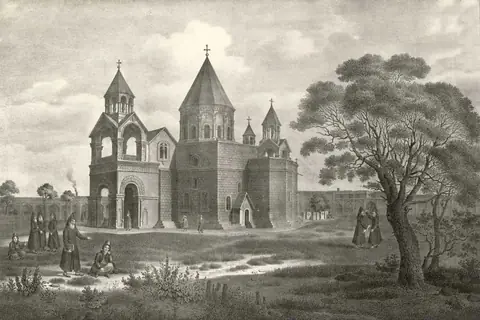
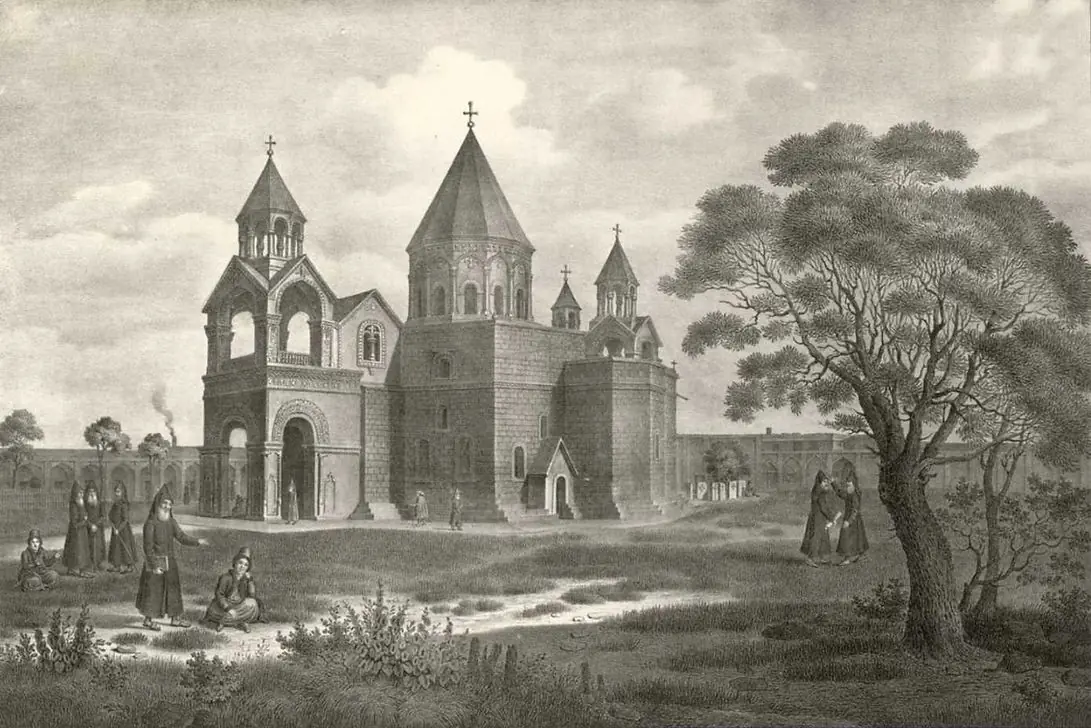
Image: Wikimedia Commons · Public domain (PD-Art) The cathedral in 1843
Look closely. An engraving of the cathedral published in 1843 shows the church standing among trees, with figures in the foreground. Compare the surroundings with the modern ones.
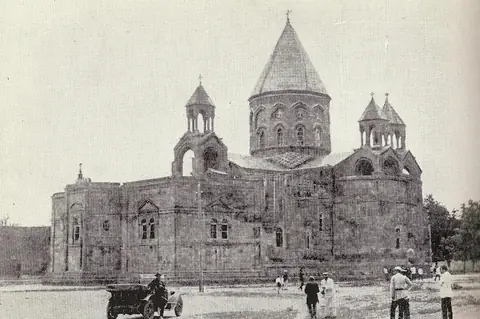
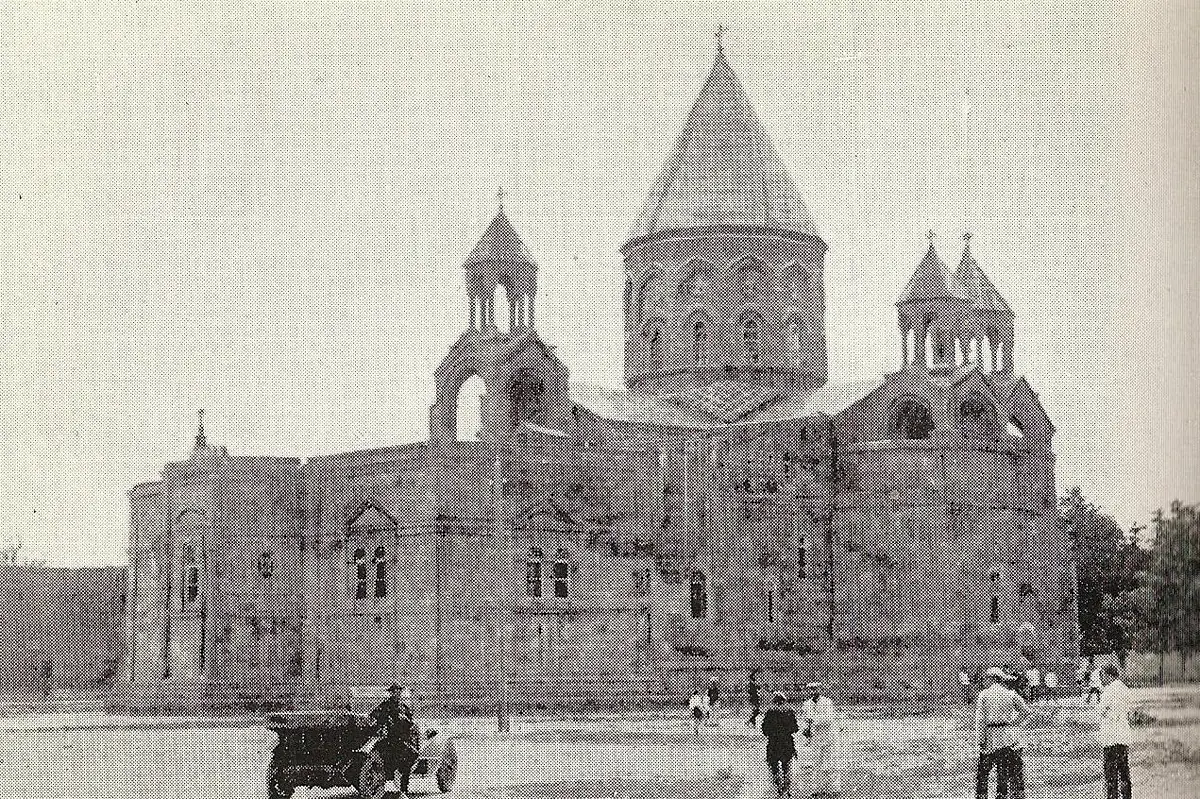
Image: Wikimedia Commons · Public domain (PD-Art) The cathedral in 1927
Look closely. A photograph from the 1920s attributed to Fridtjof Nansen shows the dark stone cathedral, with a car and people in front of it. The central dome rises between the lower belfries.
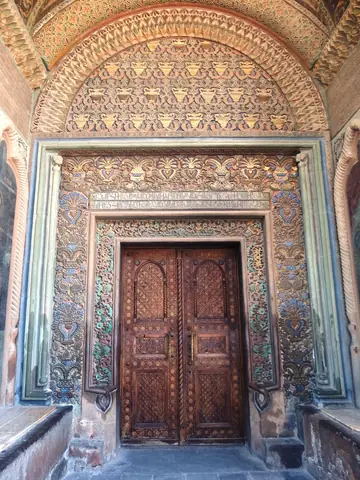
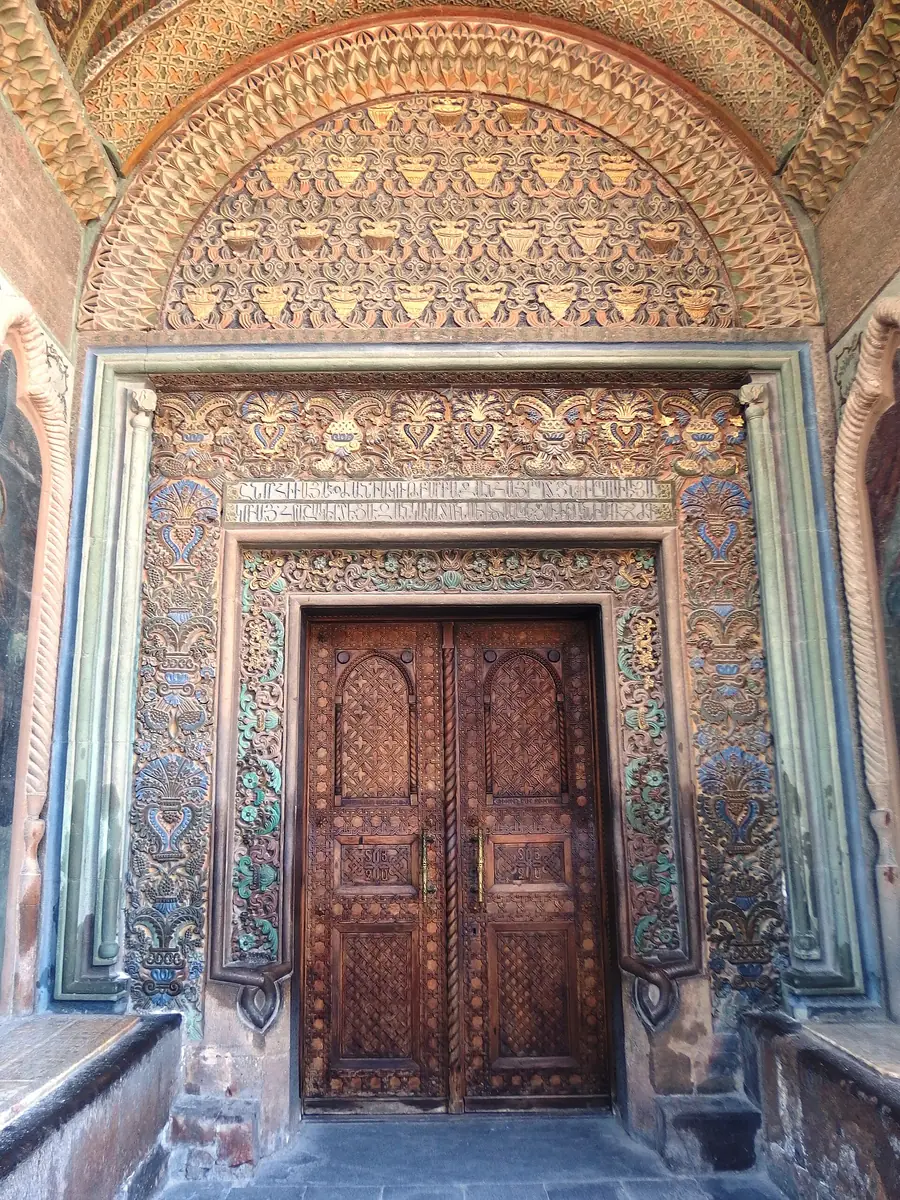
Image: Wikimedia Commons · CC BY 4.0 · Photo: Palickap A carved portal
Look closely. A richly carved stone frame surrounds a wooden door. Carving of geometric and plant forms around entrances is a feature of Armenian church architecture.


What to watch for
Look slowly- The cross plan and dome. The four-piered cross with a central dome is the type later used across the Armenian lands.
- The altar and the tradition of the hammer. The place of the vision is said to lie beneath the altar.
- The khachkars. Carved stone crosses stand in the grounds and in nearby churches.
- Ararat in the distance. Notice the mountain's place in Armenian memory.
Sources
Dates follow standard historical references and, where we quote a book, the wording of the edition hosted in this library. Where a tradition is not certain history, the page says so. Photographs and pictures are used only when the image itself is Public domain, CC0, or CC BY with a named credit. Each picture links to its source page with full licence details. Pictures taken before a site was damaged are labelled with their date.