Great Churches & Monasteries · Holy Land & Middle East
Mar Saba
A monastery hung on the side of a desert canyon, home to hermits for fifteen centuries.
Still standing. The monastery is still lived in by a small community of Greek Orthodox monks. It is built into the wall of a steep canyon. Women are not admitted to the main monastery.
St Catherine's Monastery · Mount Athos
What it is
Sabbas, a monk from Cappadocia, came to Palestine as a young man and in 478 settled in a cave above the Kidron Valley. Monks gathered around him, and he organized them into a lavra, a community where the monks lived in separate cells and came together for services on Saturday and Sunday. The buildings climb the cliff in terraces, with a great church, a tower, and a cave where Sabbas is said to have lived. The monastery was attacked in the Persian invasion of 614, and monks were killed, but it was rebuilt and continued.
Mar Saba was a school of theology and liturgy. John of Damascus, the eighth-century theologian and hymn writer, is said to have lived here, and the liturgical rule of the monastery, the Typikon of Saint Sabbas, became the pattern that spread through the Orthodox world. The relics of Sabbas, taken to Venice by crusaders, were returned to the monastery in 1965. The monks still keep a rule of daily prayer and have few visitors.
“O God, thou art my God; early will I seek thee: my soul thirsteth for thee”
Why it matters for a classical Christian student
Mar Saba stands in the same wilderness of Judah that the Psalms and the Gospels name. The desert is not an escape from the world. It is a place to learn dependence on God. A classical Christian student can see here a way of life that Antony began in Egypt and that Benedict reshaped in Italy. The virtue is the discipline of daily prayer, which has shaped Orthodox worship far beyond this canyon.
Read alongside
- The Bible: Psalm 63 is headed 'in the wilderness of Judah', the desert in which the monastery stands.
Great Lives connected here
- John of Damascus, in Great Lives: John of Damascus is said to have lived and worked at Mar Saba as a monk and hymn writer.
Look closely
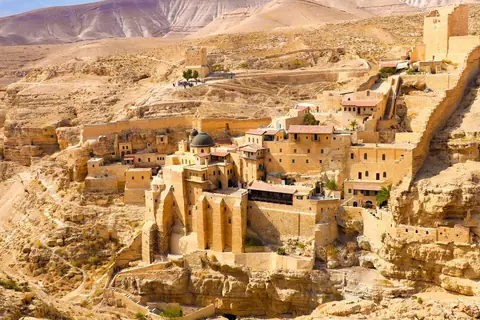
Image: Wikimedia Commons · Public domain Mar Saba in the Kidron Valley
Look closely. The monastery clings to the wall of the gorge above a dry stream bed. Its terraces, towers and domes are built on ledges, one above another. Notice how the buildings follow the cliff.
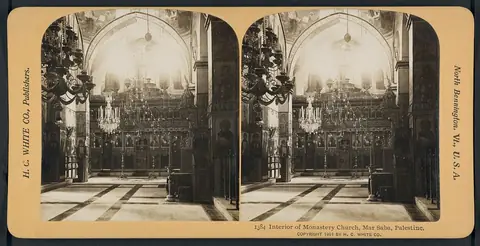
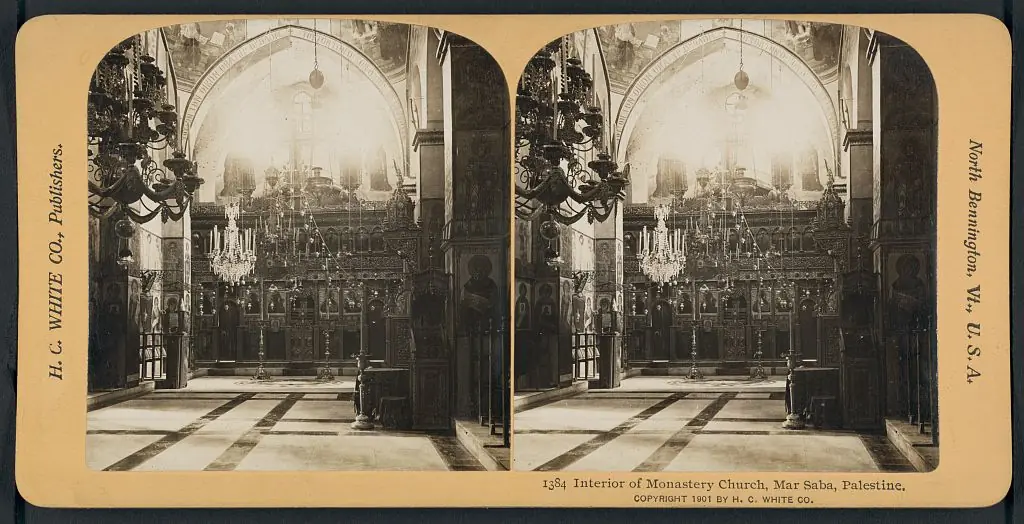
Image: Wikimedia Commons · Public domain Interior of the monastery church
Look closely. A stereograph from about 1901 shows the church interior, with hanging lamps and a carved, screened sanctuary. A stereograph is a pair of photographs meant to be seen in three dimensions.
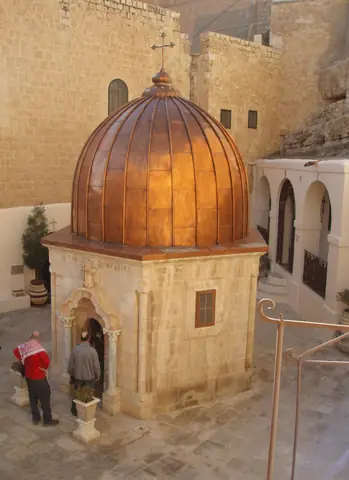
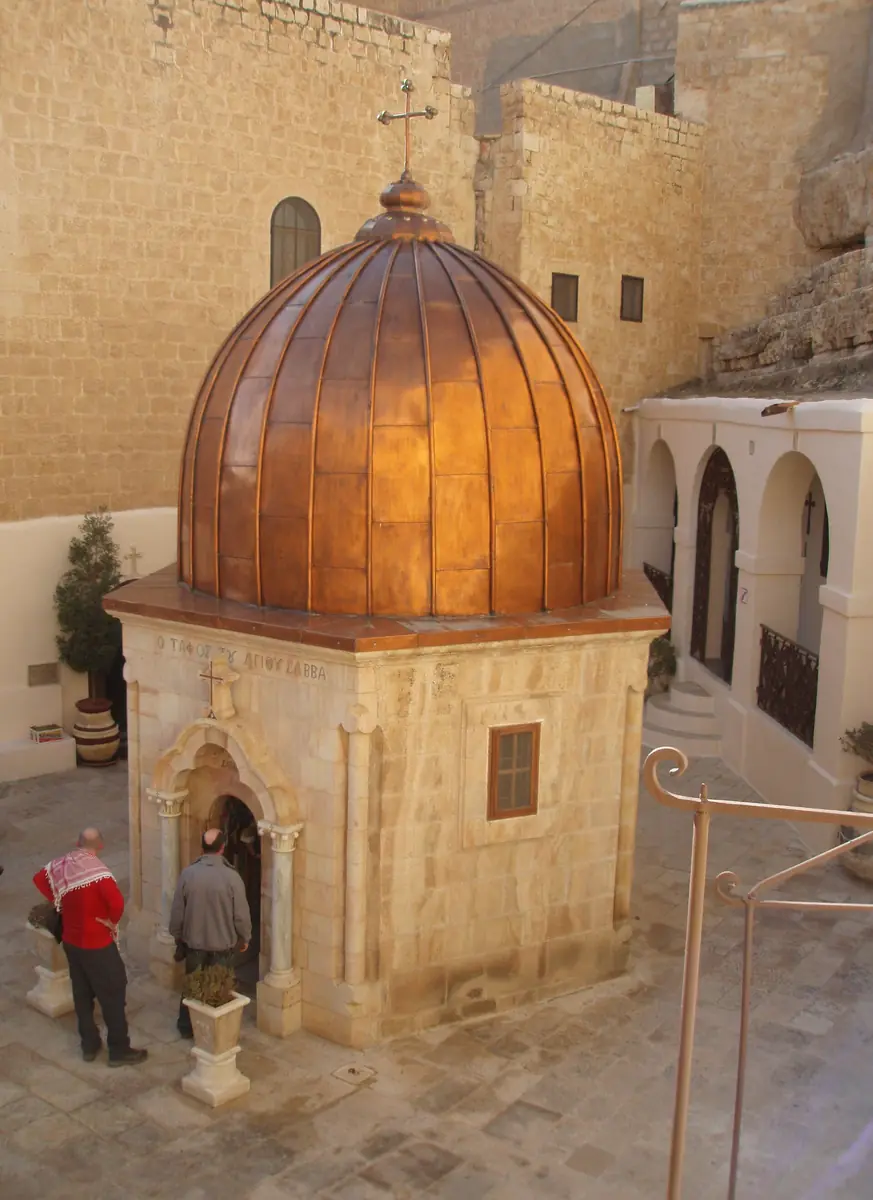
Image: Wikimedia Commons · CC BY 4.0 · Photo: Bukvoed The small domed chapel
Look closely. A small domed chapel with a copper-colored roof stands in the courtyard. It marks the tomb of Saint Sabbas.
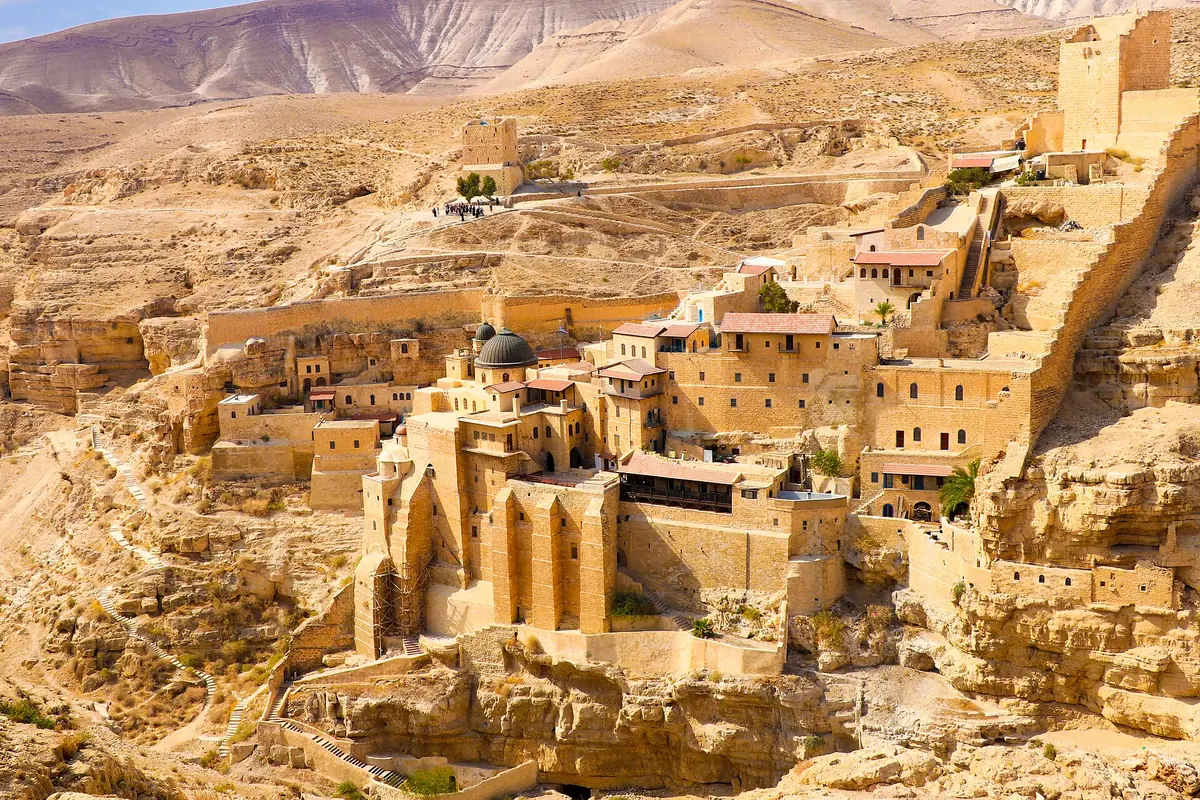


What to watch for
Look slowly- The cliff. The buildings are cut into the canyon wall.
- The cell of the founder. A small cave church marks where Sabbas lived.
- The Typikon. The monastery's order of services was copied across the Orthodox world.
- John of Damascus. Read a hymn or a passage of his teaching on holy images beside the pictures.
Sources
Dates follow standard historical references and, where we quote a book, the wording of the edition hosted in this library. Where a tradition is not certain history, the page says so. Photographs and pictures are used only when the image itself is Public domain, CC0, or CC BY with a named credit. Each picture links to its source page with full licence details. Pictures taken before a site was damaged are labelled with their date.