Great Churches & Monasteries · Eastern Europe & Russia
St Basil's Cathedral
A cluster of nine church towers in bright colors, built to mark a victory and a feast of the Virgin.
Still standing. The cathedral stands and has been a museum since the 1920s; some services are held there. The colors of its domes date from the seventeenth century.
What it is
The cathedral was built by order of Ivan IV, called the Terrible, to give thanks for the capture of Kazan in 1552, which took place near the feast of the Intercession of the Virgin on 1 October. It was begun in 1555 and finished in 1561. Eight chapels stand around a central tent-roofed church, all on one raised platform, each dedicated to a saint on whose feast a battle of the Kazan campaign was fought. A further, smaller chapel was added in 1588 over the grave of Basil the Blessed, a Moscow 'holy fool' who was buried there, and from this the popular name arose.
The architects are named in the sources as Barma and Postnik, and scholars debate whether they were two men or one. The story that Ivan blinded the architects so that they could not build again is a later legend; Postnik is recorded as working on later projects. The domes were at first plain and received their colors and patterns in the seventeenth century. After the Revolution, the building became a branch of the state historical museum, and church services began again there in the 1990s. It is on the UNESCO list with the Kremlin and Red Square.
Why it matters for a classical Christian student
St Basil's is a thanksgiving church and also a war memorial, which asks the student to think about gratitude, victory, and the cost of conquest. The chapel for Basil, who was known for rebuking the powerful, is a contrast with the tsar who built the cathedral. The classical Christian student should read both the glory and the shadow of the age of Ivan IV, as the Christian tradition does.
Great Lives connected here
- Ivan IV the Terrible, in Great Lives: Ivan IV had the church built after his capture of Kazan in 1552; it was finished in 1561.
Look closely
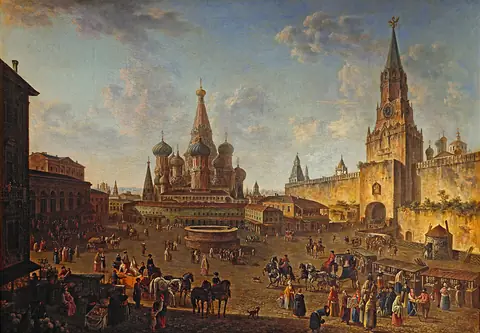
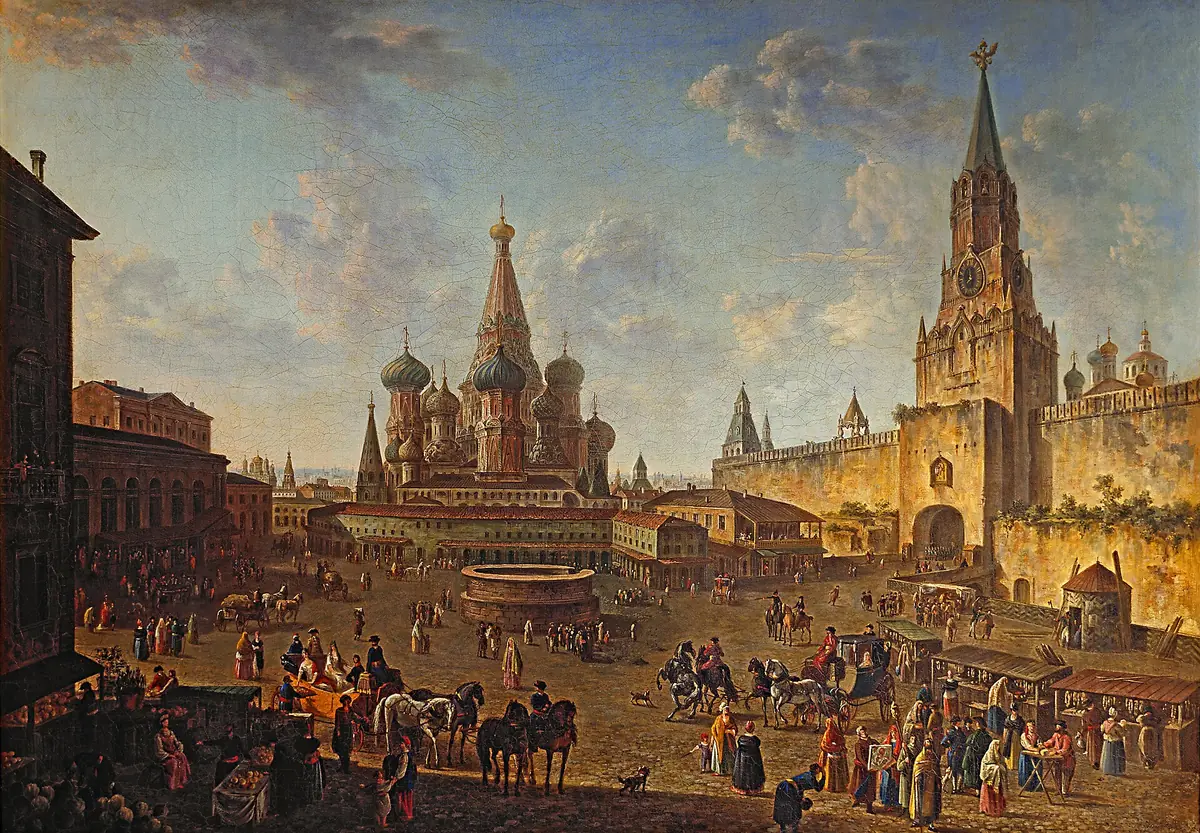
Image: Wikimedia Commons · Public domain (PD-Art) Red Square in 1801
Look closely. A painting of Red Square by Fyodor Alekseyev shows the cathedral near the Kremlin's Spassky tower, with crowds moving through the square. Notice how the cathedral is one cluster among the towers of the old city.
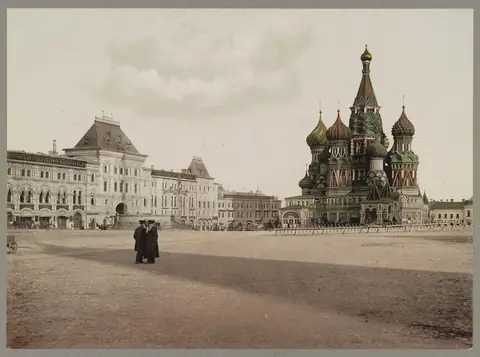
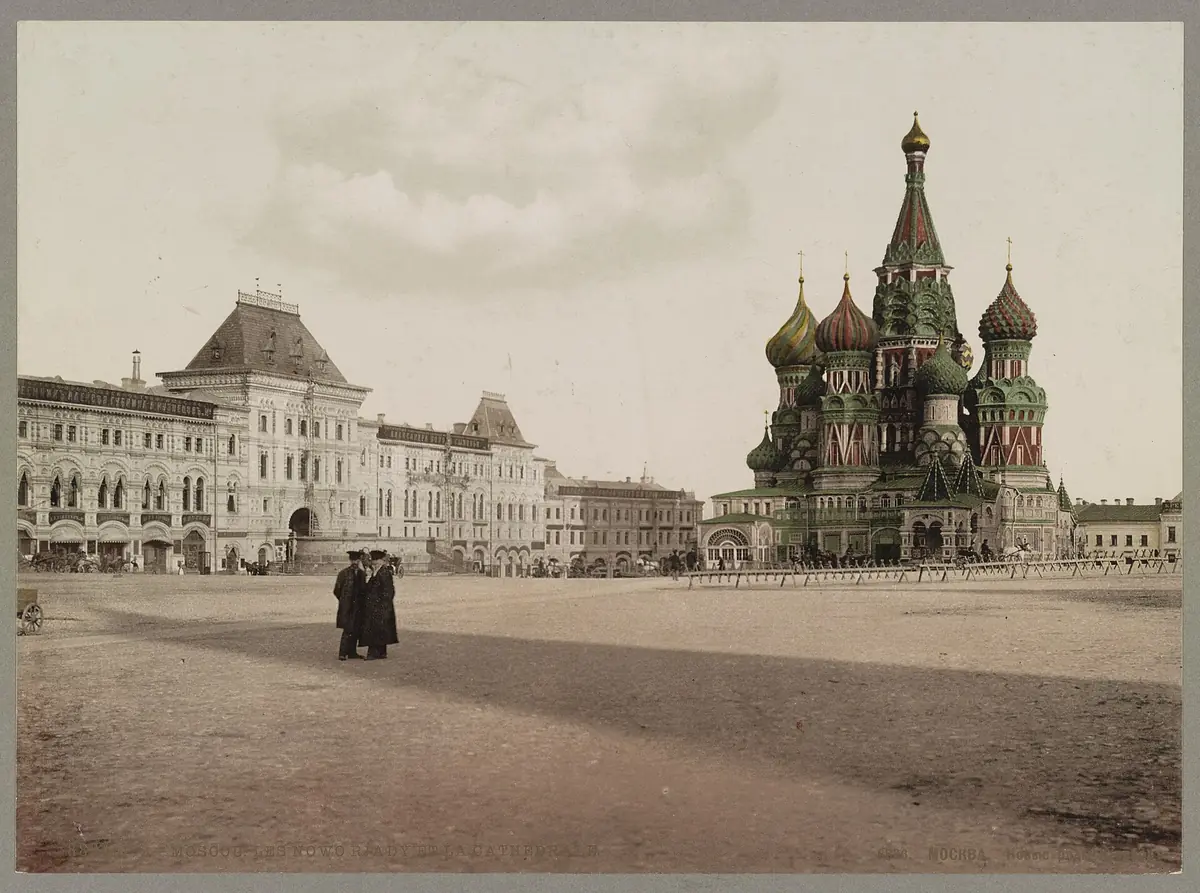
Image: Wikimedia Commons · Public domain (PD-Art) Red Square in 1890
Look closely. A colored print from about 1890 shows the cathedral across an empty square, with the shops on the opposite side. Notice that the domes are of different shapes and patterns.
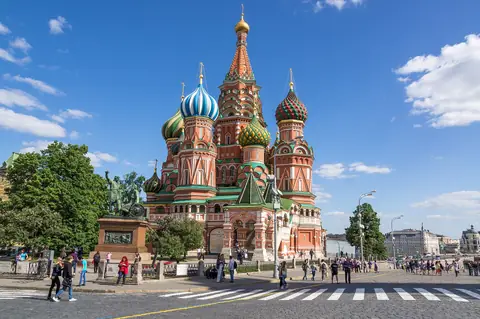
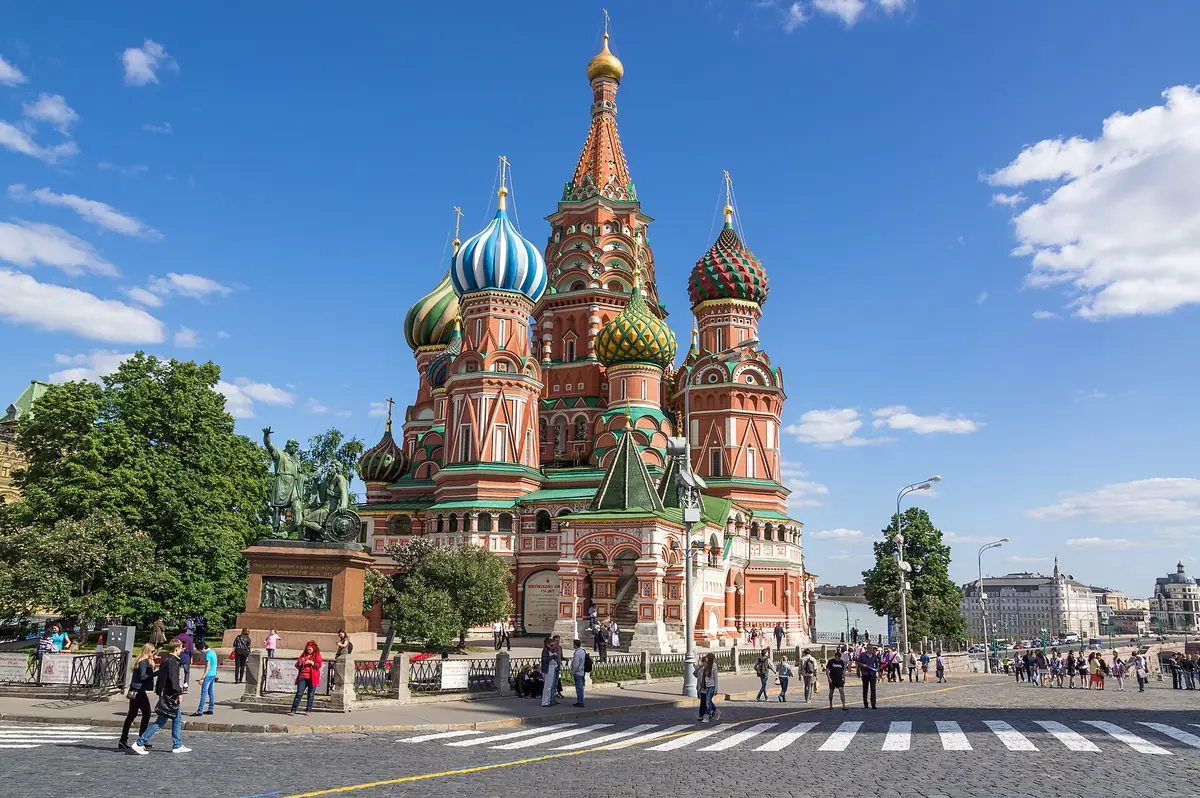
Image: Wikimedia Commons · CC BY 4.0 · Photo: Vyacheslav Argenberg The cathedral today
Look closely. The cathedral is a group of chapels around a central tower. Each dome is different, with stripes, scales, spirals and diamonds. The present colors are later than the 1550s.
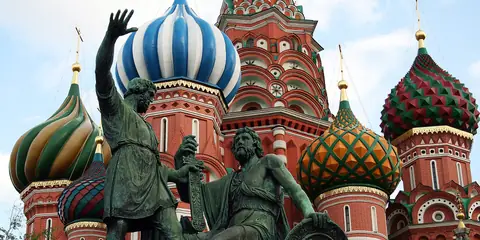
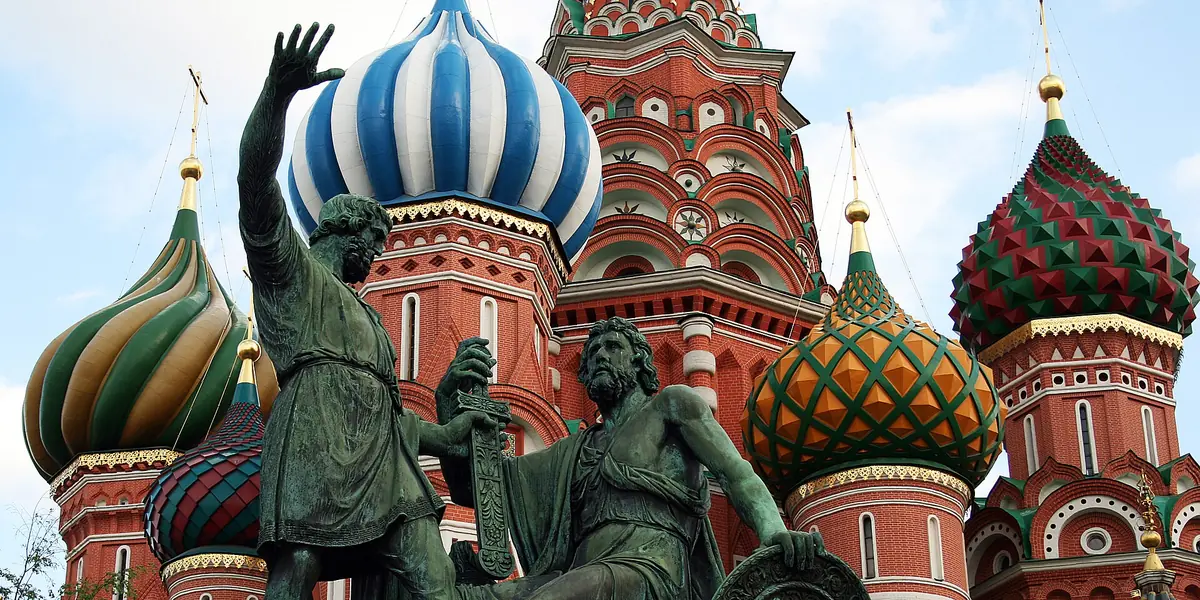
Image: Wikimedia Commons · CC BY 4.0 · Photo: Dr. Ondřej Havelka (cestovatel) Domes and the Minin and Pozharsky monument
Look closely. A close view shows the patterns of the domes, with the statue of Minin and Pozharsky in front. The statue commemorates two leaders of the volunteer army that freed Moscow in 1612 and was erected in Red Square in 1818.


What to watch for
Look slowly- The central tent. The tall tent-roof church is at the center.
- The ring of chapels. Each has its own dome and its own saint.
- The domes. Their present colors are seventeenth-century.
- The legend. The story of the blinded architects is not supported by the records.
Sources
Dates follow standard historical references and, where we quote a book, the wording of the edition hosted in this library. Where a tradition is not certain history, the page says so. Photographs and pictures are used only when the image itself is Public domain, CC0, or CC BY with a named credit. Each picture links to its source page with full licence details. Pictures taken before a site was damaged are labelled with their date.