Great Churches & Monasteries · Eastern Europe & Russia
Trinity Lavra of St Sergius
Russia's most revered monastery, founded by a forest hermit whom the Russians call the abbot of the Russian land.
Still standing. The Lavra stands and is the spiritual center of the Russian Orthodox Church. It was closed by the state in 1920 and monastic life resumed in 1946.
St Basil's Cathedral · Kyiv Pechersk Lavra
What it is
Sergius of Radonezh, born about 1314, left his family's estate at Radonezh and, with his brother for a time, built a small wooden church and cell in a forest, dedicated to the Holy Trinity. Monks came to him, and he led the community by his example, working in the garden and the kitchen. In 1380 Grand Prince Dmitry of Moscow visited him before the battle of Kulikovo against the Tatars, and Sergius blessed him and sent two monks with him. Sergius died in 1392 and was canonized in the fifteenth century.
The stone Trinity Cathedral was built in 1422–1423 over his tomb and was decorated by Andrei Rublev and Daniil Chorny. Rublev's icon of the Holy Trinity, painted in honor of Sergius, hung there for centuries and is now in the Tretyakov Gallery. The Dormition Cathedral was built from 1559 to 1585 on the orders of Ivan IV. The monastery was walled in the sixteenth century and held out in a siege of sixteen months in 1608–1610. Peter the Great took refuge in it as a boy, in 1682, and again in 1689. It now houses a seminary and the Moscow Theological Academy.
Why it matters for a classical Christian student
Sergius is revered as a model of patience and humility. He was a hermit and then an abbot, a counselor to princes who would not seek honors. The Trinity icon of Rublev shows the three visitors to Abraham as the image of the Holy Trinity, a picture of unity and love. A classical Christian student can ask what gave a hermit's blessing weight, and why it might be a Christian virtue to be slow to seek power.
Great Lives connected here
- Peter the Great, in Great Lives: Peter the Great sheltered at the Lavra during the Moscow uprising of 1682 and again in 1689.
Look closely
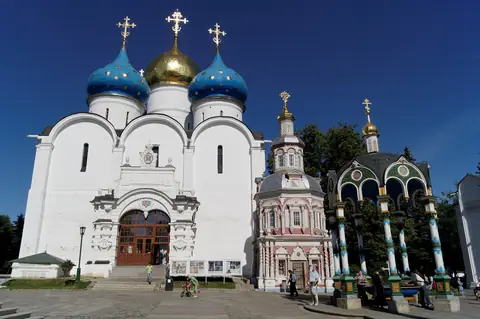
Image: Wikimedia Commons · CC BY 4.0 · Photo: Vyacheslav Argenberg The monastery's churches
Look closely. The main buildings are whitewashed, with blue and gold domes and later additions in other styles. The Lavra is a walled group of churches, chapels and living quarters.
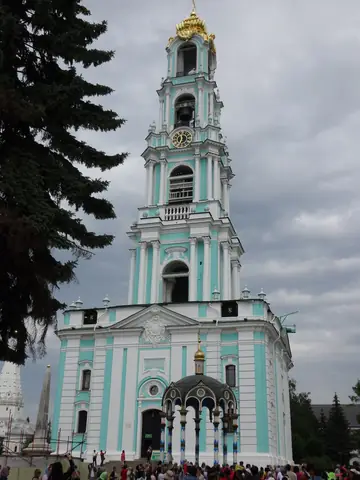
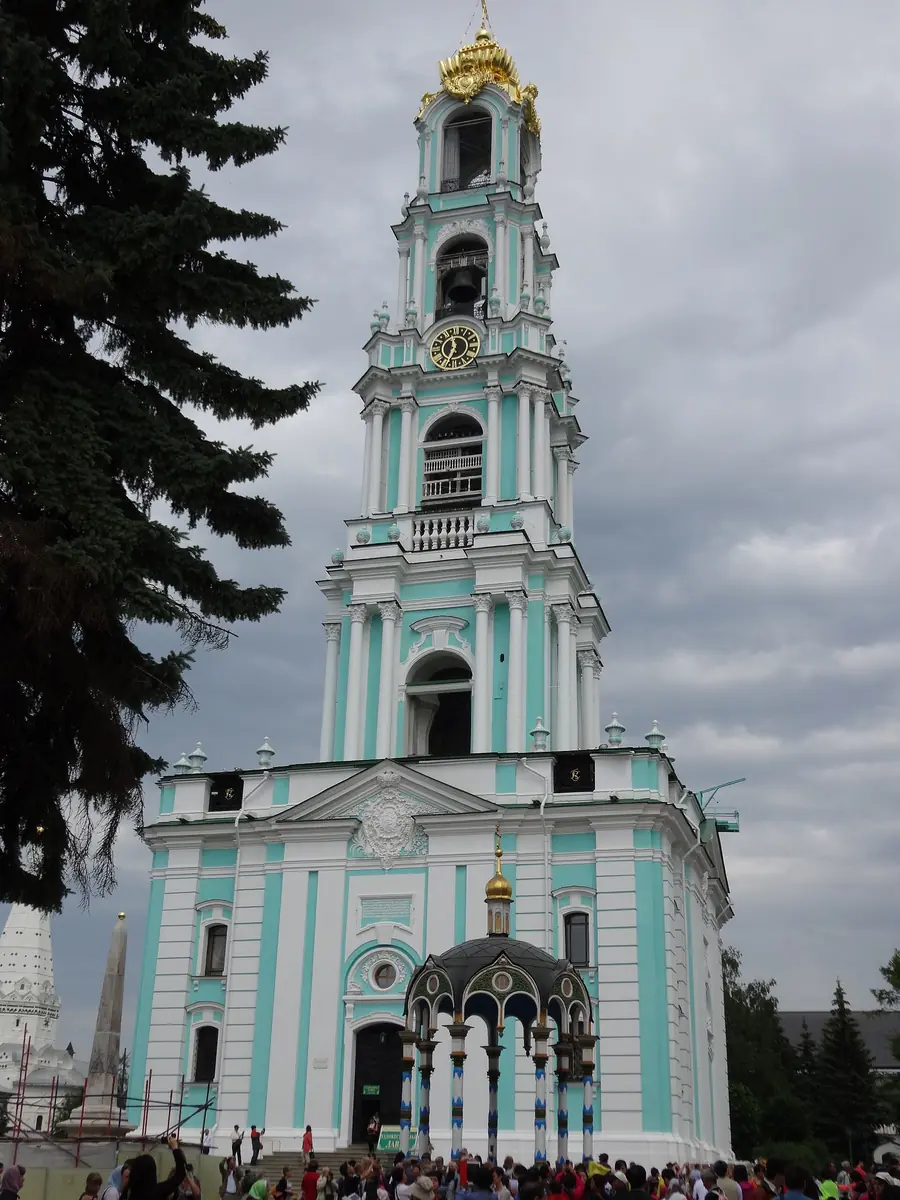
Image: Wikimedia Commons · CC BY 2.0 · Photo: amanderson2 The Great Bell Tower
Look closely. The tall bell tower was built in the eighteenth century in the Baroque style. Its light blue and white walls rise in tiers.
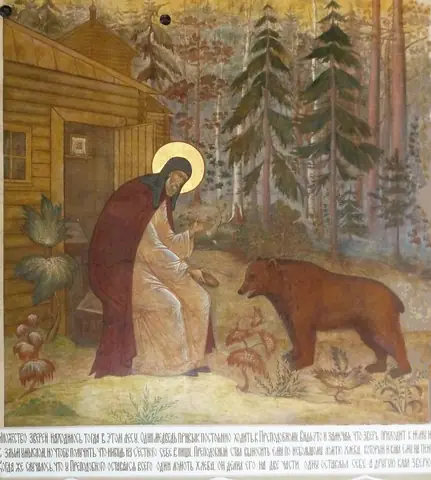
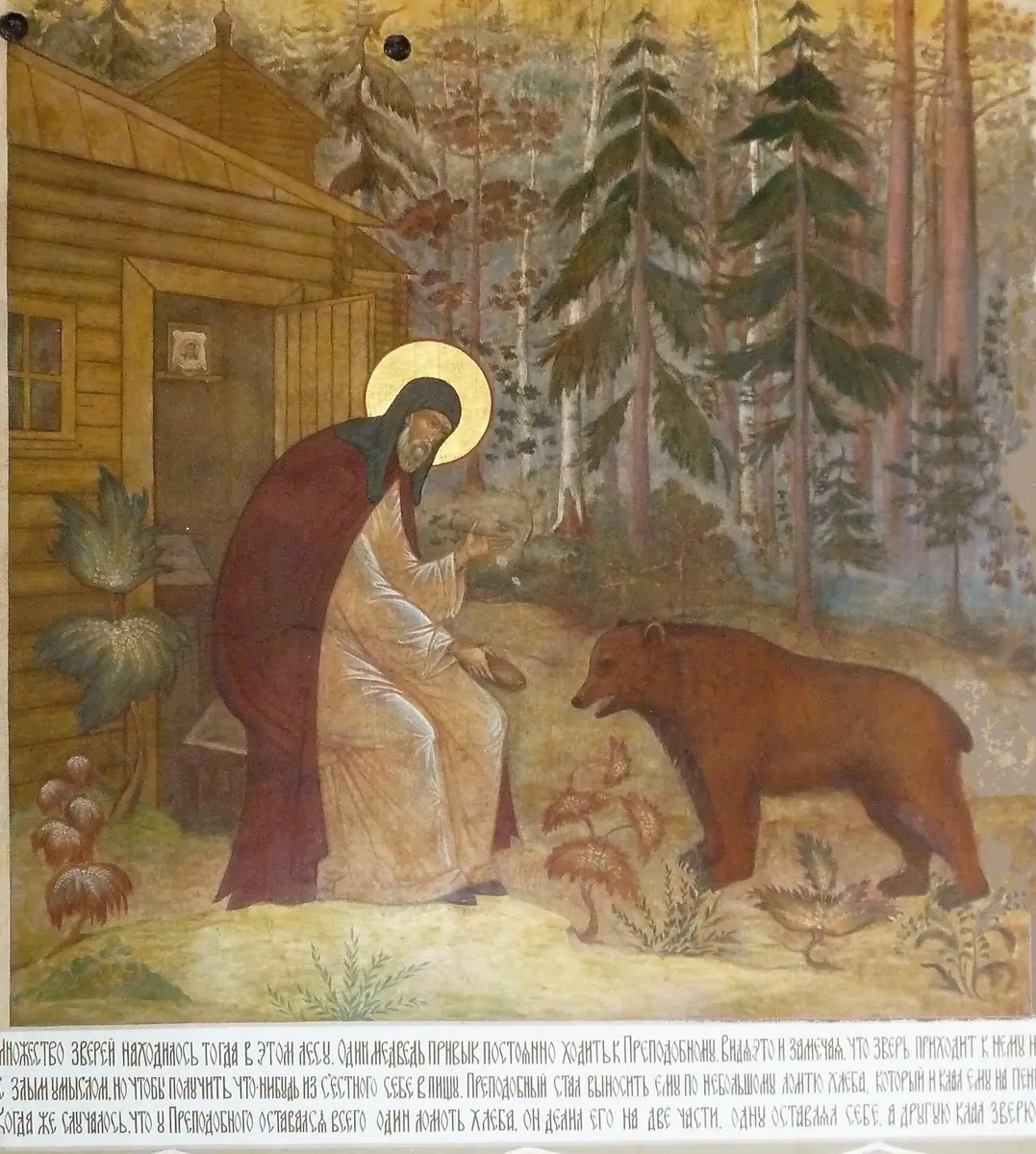
Image: Wikimedia Commons · CC BY 4.0 · Photo: Pierre André Leclercq Sergius and the bear
Look closely. A painted scene shows a monk with a halo and a bear in a forest clearing. A story from the life of Sergius tells of a bear that came to his cell and shared his bread. Notice the log cabin and the tall firs.
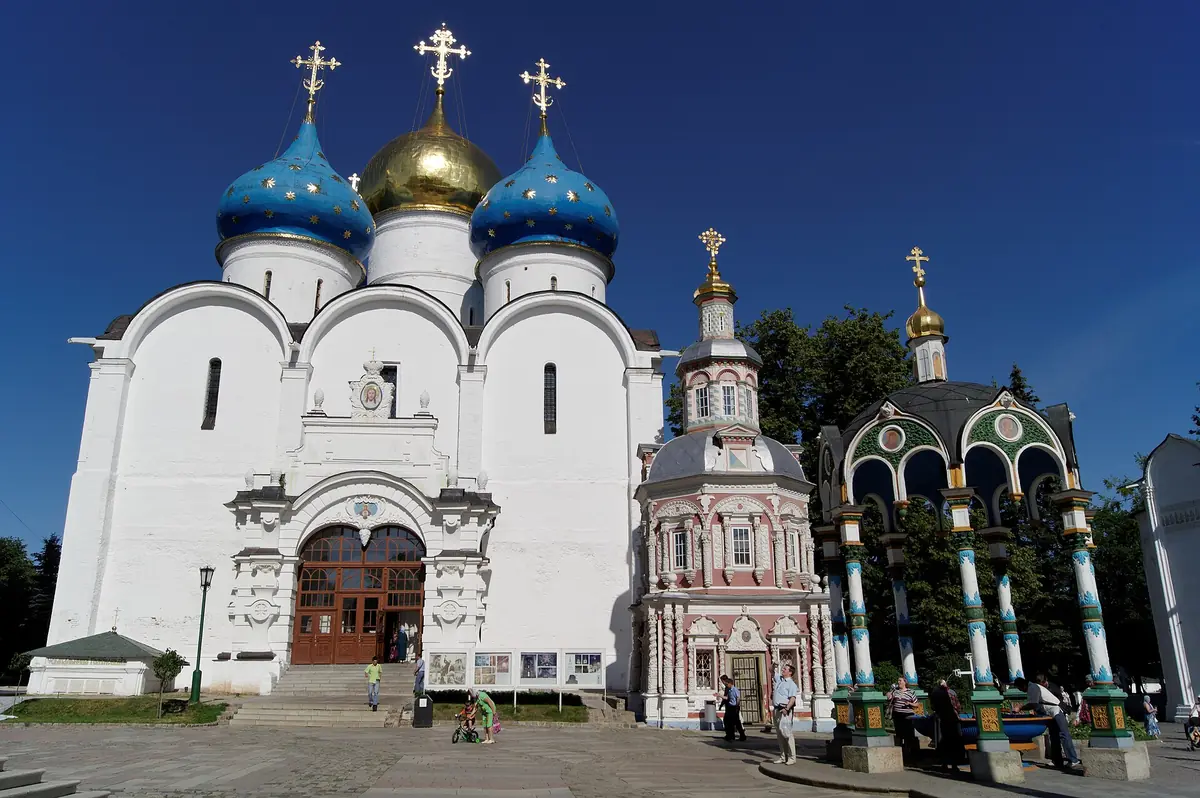


What to watch for
Look slowly- The Trinity Cathedral. The relics of Sergius lie inside.
- The Dormition Cathedral. Its blue domes with golden stars are well known.
- The walls and towers. They are from the age of Ivan IV and the Time of Troubles.
- Rublev's Trinity. The icon is now in a museum, with a copy in the cathedral.
Sources
Dates follow standard historical references and, where we quote a book, the wording of the edition hosted in this library. Where a tradition is not certain history, the page says so. Photographs and pictures are used only when the image itself is Public domain, CC0, or CC BY with a named credit. Each picture links to its source page with full licence details. Pictures taken before a site was damaged are labelled with their date.