Great Churches & Monasteries · Eastern Europe & Russia
Kyiv Pechersk Lavra
The Monastery of the Caves, where the monks of Kyiv first dug cells in the hillside above the Dnipro.
Still standing. The Lavra stands as a monastery complex and museum reserve. Its great Dormition Cathedral was destroyed by an explosion in 1941 and rebuilt, and it was reconsecrated in 2000.
St Sophia's Cathedral, Kyiv · Mount Athos
What it is
According to the Primary Chronicle, a monk named Antony, who had lived on Mount Athos, settled in a cave on the hill above the Dnipro river about 1051, and others joined him. Under Theodosius, the next leader, the community adopted the Studite rule of Constantinople and became the model of Rus monasticism. A great church of the Dormition, the church of the Virgin's falling asleep, was built between 1073 and 1078, and, according to the Chronicle, craftsmen from Constantinople came to help. The monastery was later called a lavra.
The hillside caves, the Near and the Far Caves, became burial places for monks, and the dry air preserved their bodies, which are seen in the caves today. The monastery was sacked by the Mongols in 1240 and later rebuilt, and the Great Bell Tower, nearly 97 meters high, was built in the 1730s and 1740s. The Dormition Cathedral was blown up in November 1941 and rebuilt in the 1990s. The Lavra is on the UNESCO list with St Sophia's Cathedral. It is the source of the Kyiv Pechersk Patericon, a collection of stories of the monks.
Why it matters for a classical Christian student
The Lavra shows how the Christian faith took root in a new land through monks, prayer, and work. The classical Christian student can see a link to the older tradition: Antony came from Athos, and the Athonite monks looked to the desert fathers of Egypt. The virtue is humility, since monks lived in holes in a hillside. The place is also a reminder that churches and monasteries can be destroyed and rebuilt, and that people of later generations choose to rebuild.
Look closely
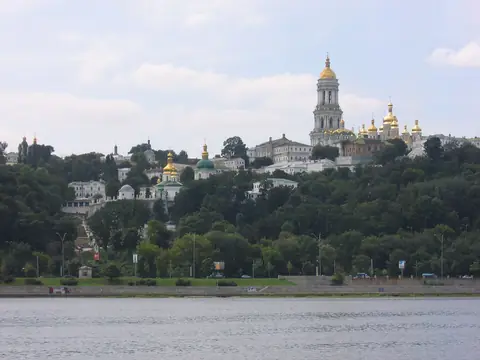
Image: Wikimedia Commons · CC BY 3.0 · Photo: Norbert Aepli The Lavra above the Dnipro
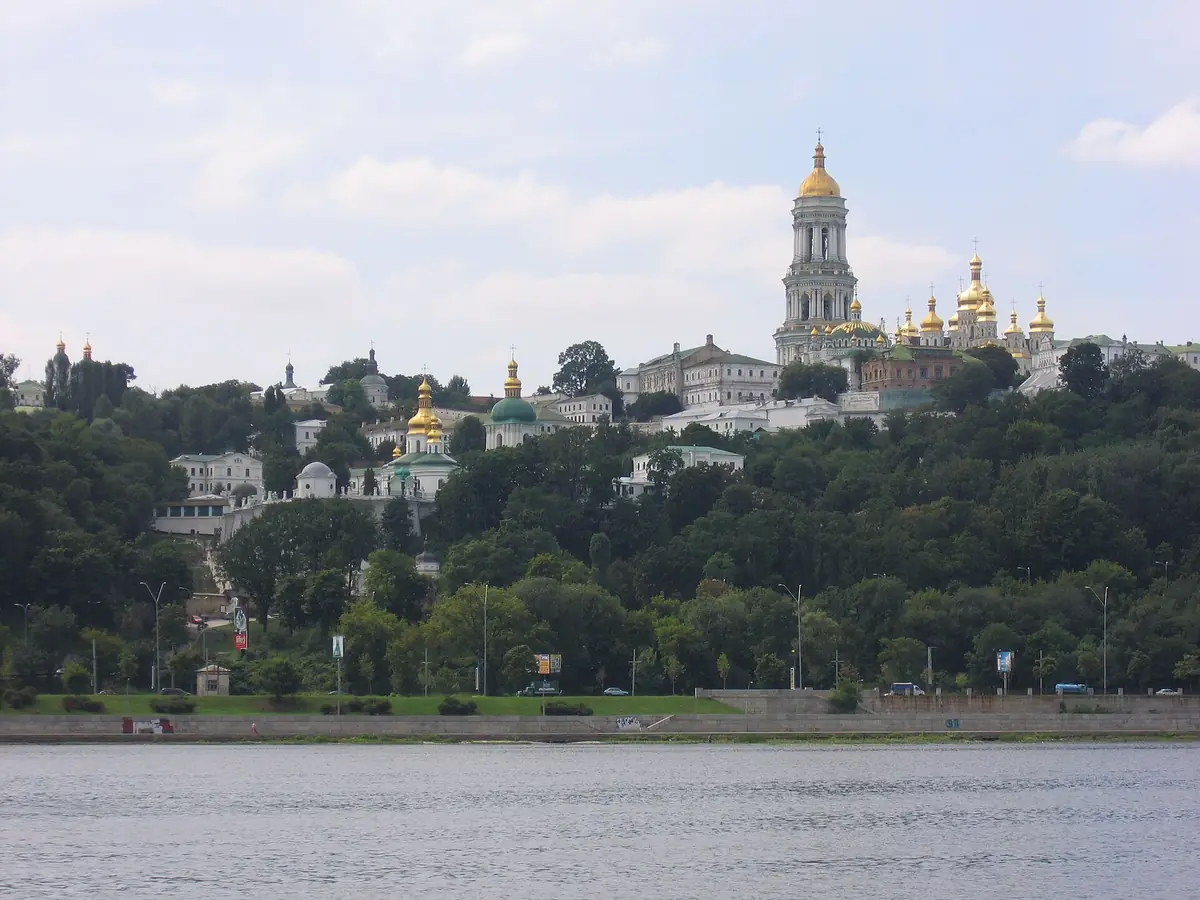
Look closely. From the river the monastery appears on the high bank, with its great bell tower and golden domes above the trees. The caves where the first monks lived lie in the hillside below the buildings.
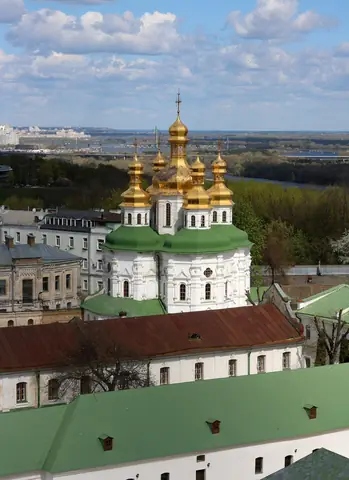
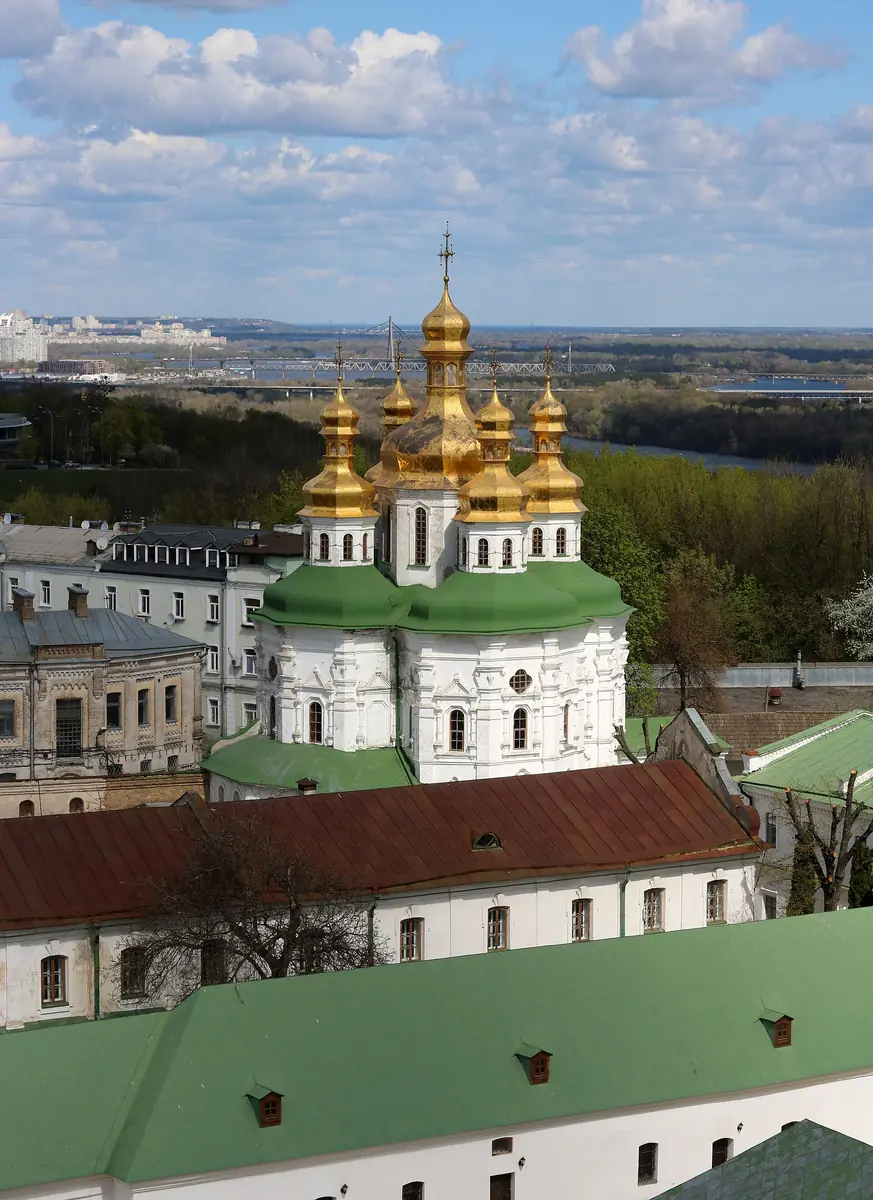
Image: Wikimedia Commons · Public domain The Church of All Saints
Look closely. The church above the Economic Gate has green roofs and a cluster of golden domes. It was built in the late seventeenth century, in the Ukrainian Baroque style.
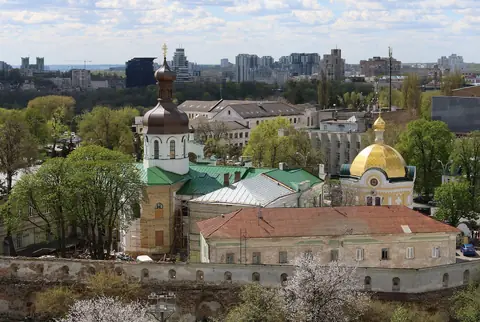
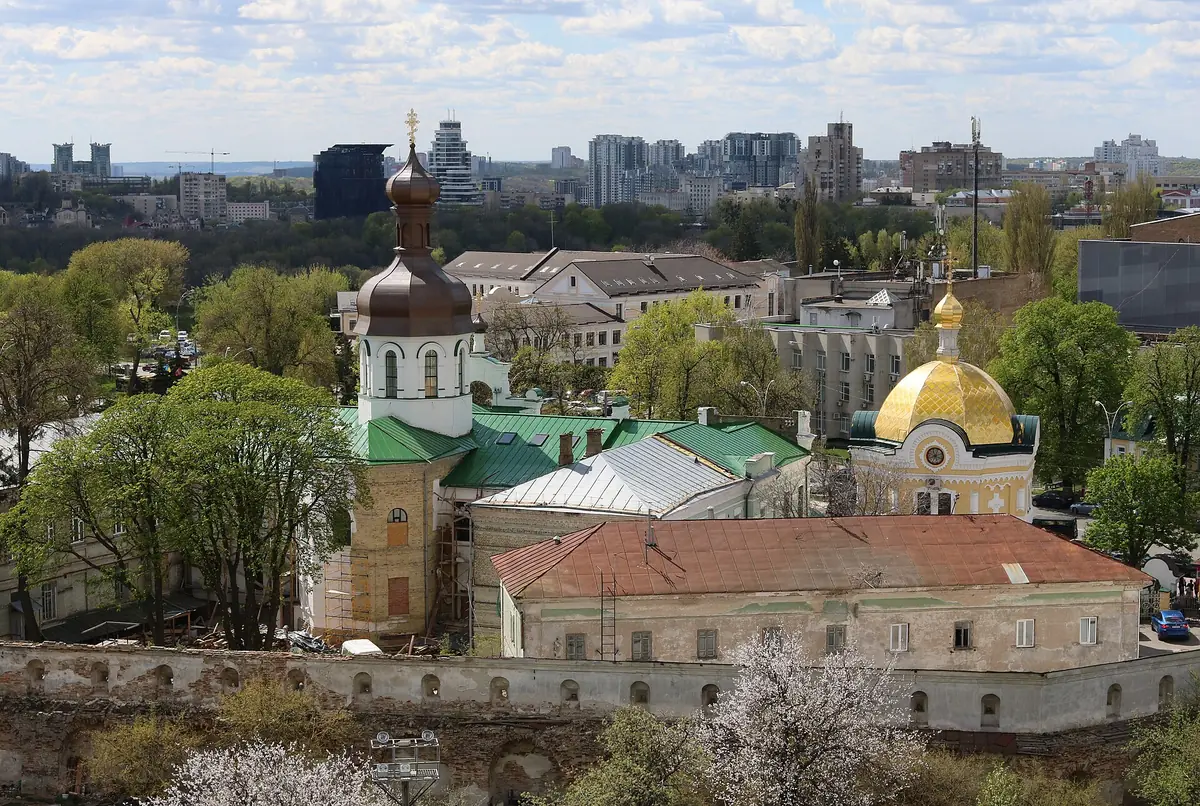
Image: Wikimedia Commons · Public domain Buildings of the Lavra from above
Look closely. A view over the grounds shows the churches, the old walls and the city of Kyiv behind. The Lavra is a group of buildings, not one church.


What to watch for
Look slowly- The Caves. Notice the narrow passages and small chapels cut into the hill.
- The Great Bell Tower. It rises above the whole complex.
- The rebuilt Dormition Cathedral. It is a new building on the site of the old one.
- The Patericon. Read a few of the stories of the monks, which are an early work of Ukrainian and Russian literature.
Sources
Dates follow standard historical references and, where we quote a book, the wording of the edition hosted in this library. Where a tradition is not certain history, the page says so. Photographs and pictures are used only when the image itself is Public domain, CC0, or CC BY with a named credit. Each picture links to its source page with full licence details. Pictures taken before a site was damaged are labelled with their date.