Great Churches & Monasteries · Holy Land & Middle East
St Elijah's Monastery
The oldest Christian monastery in Iraq, standing for about fourteen centuries until it was razed in 2014.
Destroyed. The monastery no longer exists. Satellite images published in 2016 show that it was razed to the ground in the late summer of 2014, when armed forces held the city of Mosul.
What it is
The monastery was built between 582 and 590 by a monk named Elijah, an Assyrian Christian of the Church of the East, on a hill south of Mosul. It was a square stone complex with some twenty-six rooms, a church, and a sanctuary dating from the eleventh century. Over the centuries it served as a place of prayer and of pilgrimage, particularly for the Chaldean Catholic community. A carved cross, with the Greek letters chi and rho, marked the entrance. In 1743, according to reports, as many as 150 monks who refused to convert to Islam were killed on the orders of a Persian general.
In the twentieth century the monastery was part of an Iraqi military training base, and from 2003 United States troops also used the site; a photograph released by the U.S. Army shows soldiers at an Easter Mass there in 2010. Armed forces seized Mosul in June 2014. Images from a commercial satellite company, obtained by the Associated Press and published in January 2016, showed the site razed to rubble between 27 August and 28 September 2014. UNESCO's Director-General expressed deep concern at the destruction of what she called the oldest Christian monastery in Iraq.
Why it matters for a classical Christian student
Some of what is in this companion is lost for good. St Elijah's belongs here because the Christian record should include places that have been destroyed as well as those that survive. A classical Christian student can learn from it that the church is made of people more than of stones, and that the people of Iraq's Christian communities have lost many of their houses of prayer, and many have left the country. We tell the story plainly and with the facts as the sources give them.
Look closely
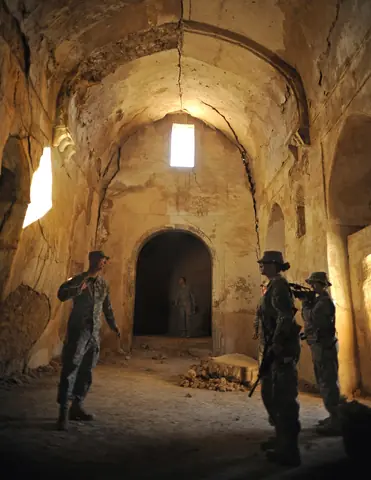
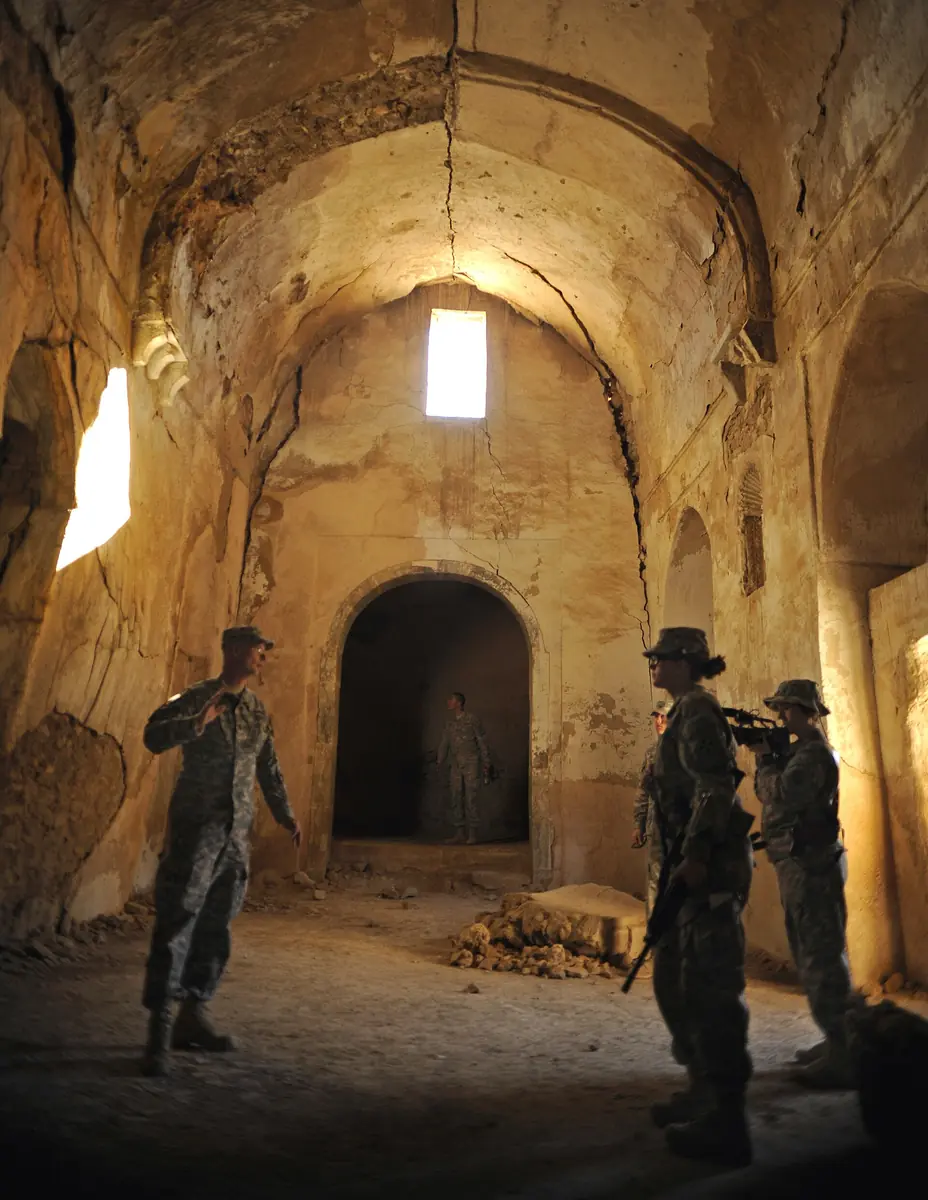
Image: Wikimedia Commons · Public domain A vaulted hall, January 2009
Look closely. A photograph of a vaulted stone hall in the monastery, taken during a visit by soldiers in January 2009. The monastery was destroyed in 2014, so this image preserves how the interior looked before then.
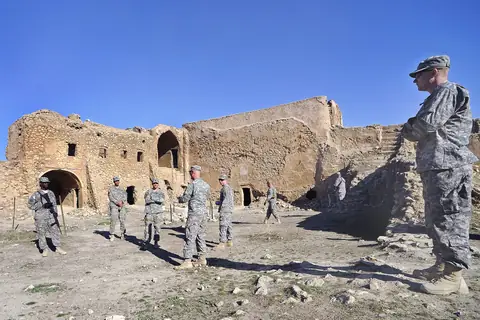
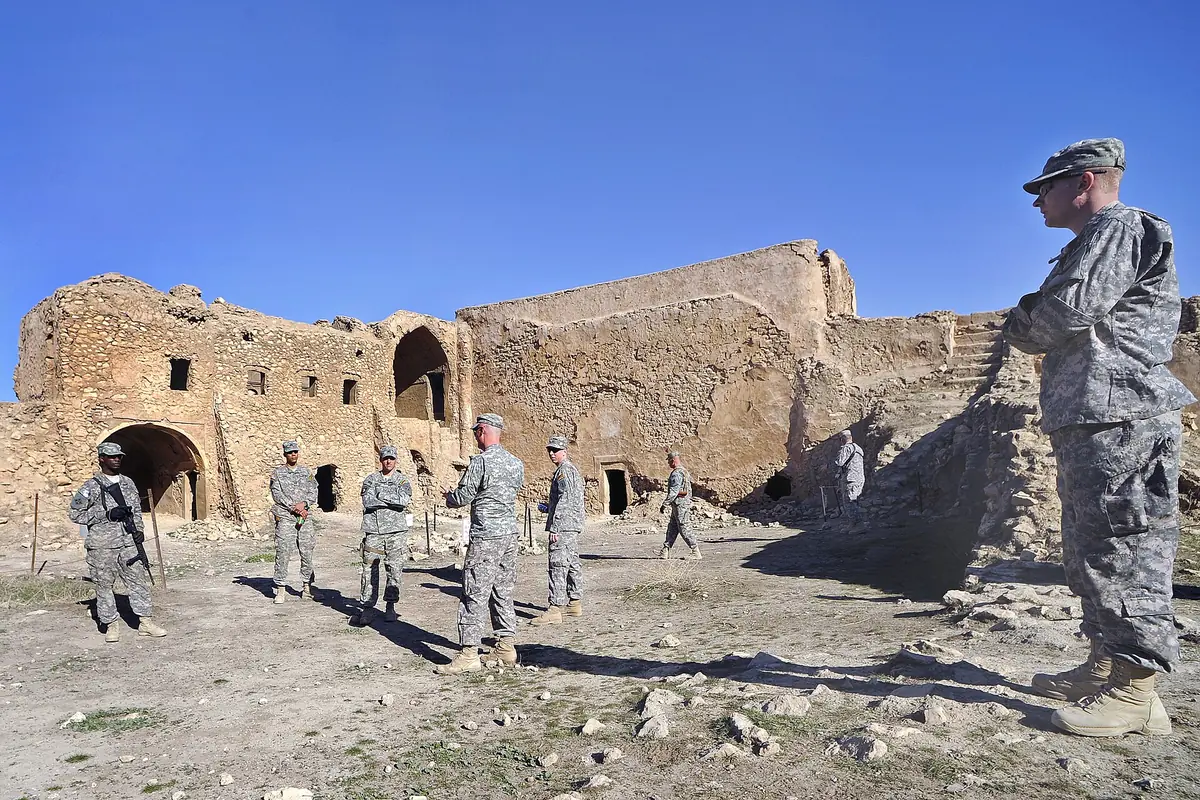
Image: Wikimedia Commons · Public domain The monastery walls, January 2009
Look closely. The mud-brick and stone walls of the monastery stood on a hill on the edge of Mosul. This photograph, taken in 2009, shows the ruined and restored wall.


What to watch for
Look slowly- The satellite comparison. Read the dates of the images and what they show.
- A layered history. The monastery was Assyrian, Chaldean, an army camp, and a place of prayer.
- What remained. The analyst consulted by the Associated Press judged that nothing was left to rebuild.
- Names. Dair Mar Elia is named for the monk Elijah, not for the prophet.
Sources
Dates follow standard historical references and, where we quote a book, the wording of the edition hosted in this library. Where a tradition is not certain history, the page says so. Photographs and pictures are used only when the image itself is Public domain, CC0, or CC BY with a named credit. Each picture links to its source page with full licence details. Pictures taken before a site was damaged are labelled with their date.