Great Churches & Monasteries · Greece & Byzantium
Hagia Sophia
Justinian's great church of the Holy Wisdom, whose dome has stood over Constantinople for fifteen centuries.
Still standing. Justinian's church still stands. It was the great church of the Byzantine capital for nine centuries, then a mosque from 1453, a museum from 1934, and again a mosque since 2020.
Hagia Sophia, in Wonders & Monuments · St Sophia, Kyiv
What it is
The first great church of Holy Wisdom at Constantinople was dedicated in 360 under Constantius II. It was burned in riots in 404, after the exile of John Chrysostom, rebuilt by Theodosius II, and burned again in January 532 during the Nika riots, a revolt that nearly overthrew Justinian. The emperor rebuilt it at once on a grander scale, using Anthemius of Tralles and Isidore of Miletus as architects. The new church was dedicated in December 537. Its central dome, set on pendentives and a ring of windows, seems to hover over a vast nave. After an earthquake brought down part of the dome in 558, it was rebuilt in a higher form in 562 by Isidore's nephew, and that dome survives.
In 1204 the soldiers of the Fourth Crusade sacked Constantinople, and Baldwin of Flanders was crowned emperor in the church. The Byzantines recovered the city in 1261. After the Ottoman conquest in 1453, Hagia Sophia became a mosque, and minarets and other fittings were added. It was opened as a museum in 1934 and returned to use as a mosque in July 2020. The structure of nave and dome is the sixth-century work of Justinian's builders. This library hosts Procopius's Persian War, which tells of the Nika riot that burned the earlier church.
Why it matters for a classical Christian student
Hagia Sophia is a work of costly devotion offered 'to the glory of God' at imperial scale, and it was kept in use for fifteen centuries. The virtue to notice is the daring of the dome and the perseverance of repair. A classical Christian student should read it together with Justinian's own age: an emperor who codified Roman law, built great churches, and also ruled through violence. Its name was taken up by the cathedrals of St Sophia in Kyiv and Novgorod.
Read alongside
- History of the Wars, Books I-II (The Persian War): Book I tells of the Nika revolt, in which the old church of Holy Wisdom was burned.
- Chronicle of the Fourth Crusade and the Conquest of Constantinople: The Fourth Crusade's chronicler tells of the coronation of Baldwin 'in the church of St. Sophia'.
- The History of the Decline and Fall of the Roman Empire (Selections): Gibbon tells of the church of St Sophia in the last years of the Byzantine empire.
- The Travels of Ibn Battuta: A fourteenth-century traveler records the Ayia Sophia as the greatest church of the Greeks.
- Childe Harold's Pilgrimage: Byron, travelling in 1810, writes of Sophia's shrine.
Great Lives connected here
- Justinian I, in Great Lives: Justinian rebuilt the church after the Nika riots and dedicated it in 537.
- Procopius of Caesarea, in Great Lives: Procopius wrote the history of the Persian wars that tells of the Nika revolt, and later a book praising Justinian's buildings.
- John Chrysostom, in Great Lives: The first church was burned in riots after the exile of John Chrysostom, the bishop of Constantinople, in 404.
- Mehmed II, in Great Lives: Mehmed II took Constantinople on 29 May 1453 and had the church made a mosque, which it remained for nearly five centuries.
Look closely
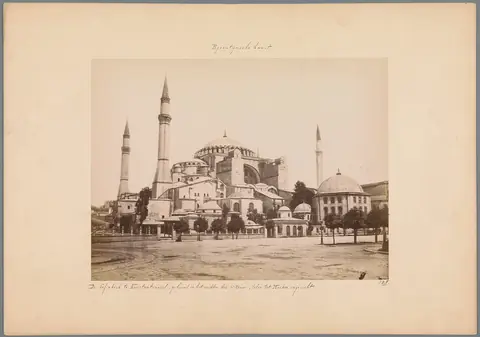
Image: Wikimedia Commons · CC0 (public domain) Hagia Sophia from the outside
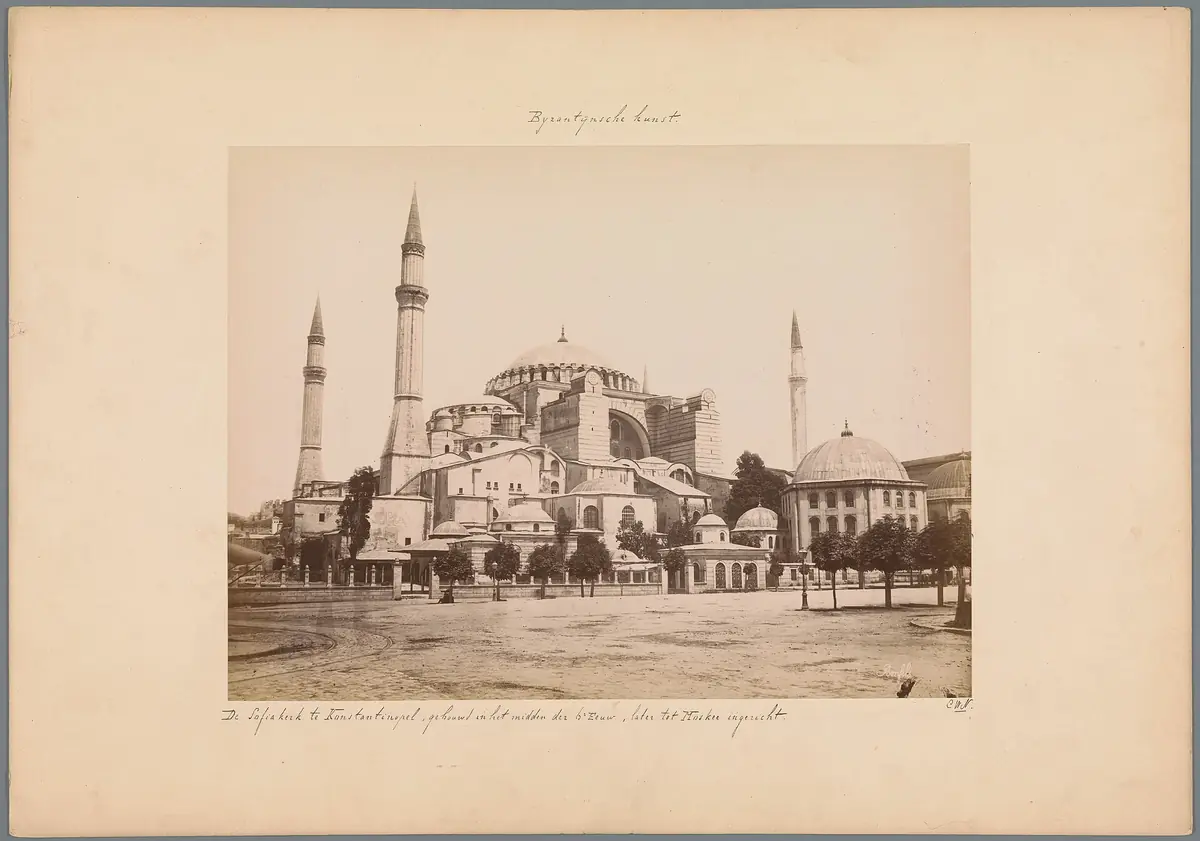
Look closely. A nineteenth-century photograph of the exterior, with the great dome, the buttresses and the later minarets. The church sits in the city, not in an open reconstruction drawing. Use it to read the mass of Justinian’s nave and the additions of later centuries together.
In the library: Justinian I, in Great Lives
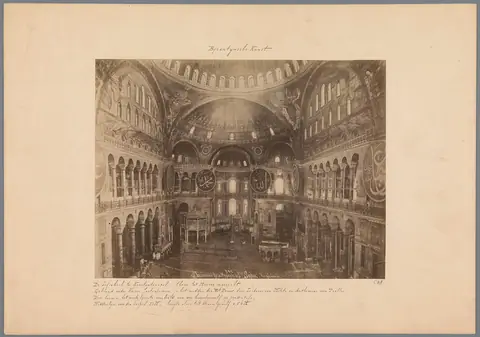
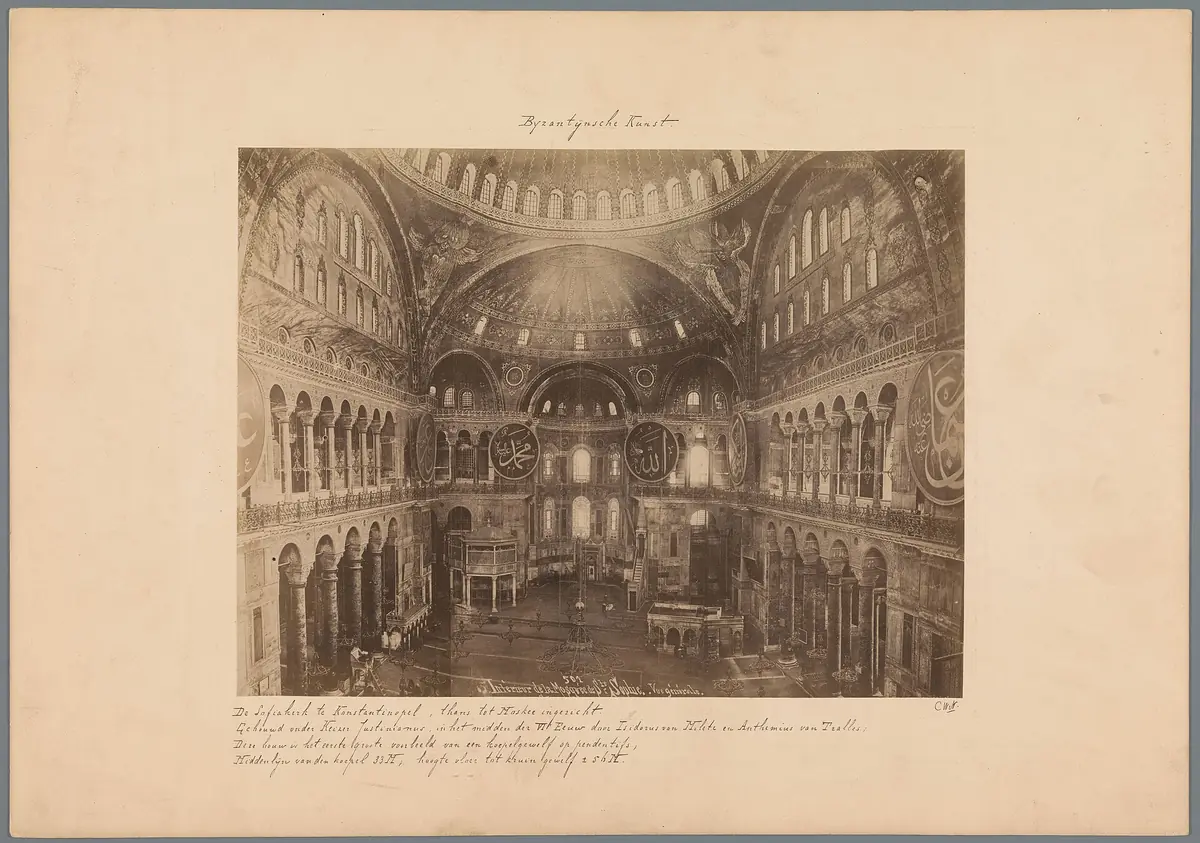
Image: Wikimedia Commons · CC0 (public domain) The interior of Hagia Sophia
Look closely. A historic interior view looking into the nave and the great space under the dome. Columns, galleries and the curve of the vaults are easier to judge here than from a plan. Later fittings are visible; the structure is still the sixth-century hall.
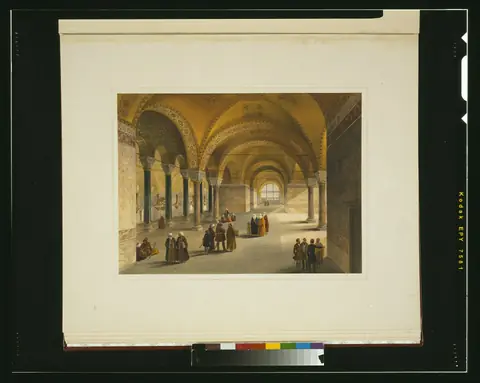
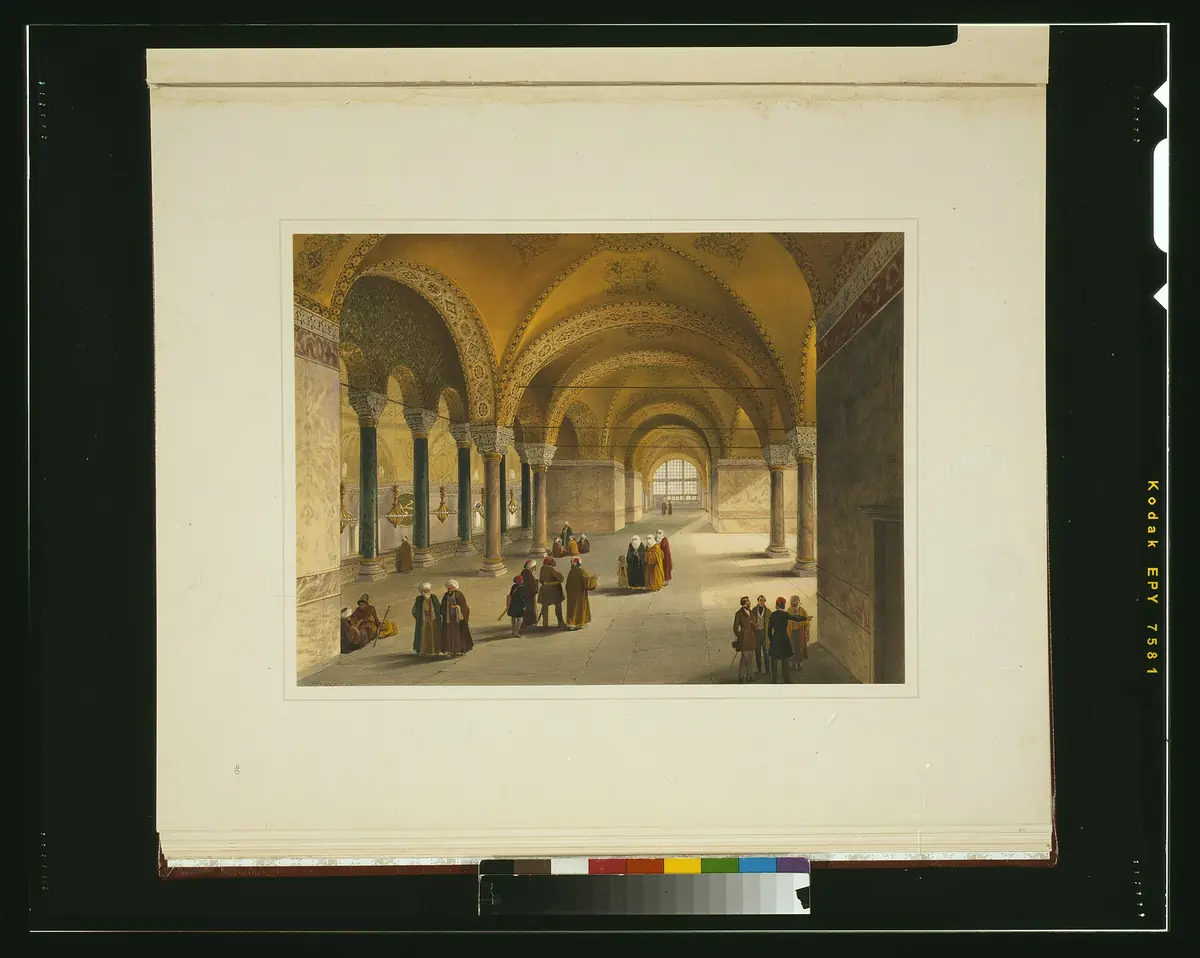
Image: Wikimedia Commons · Public domain (PD-Art) The gallery, after Fossati
Look closely. A lithograph from the mid-nineteenth-century record of the building associated with the Fossati brothers’ repairs. It shows the centre of a gallery, with arches receding in perspective. This is a careful later study of the interior, not a sixth-century drawing.


What to watch for
Look slowly- The dome. From inside it seems to rest on a ring of light.
- Many centuries in one building. Notice sixth-century columns, medieval mosaics, Ottoman minarets, and modern changes.
- The Nika riots. The earlier church burned in the revolt of 532, which Procopius tells.
- Visiting. Rules for visiting the building have changed since 2020; check current arrangements.
Sources
Dates follow standard historical references and, where we quote a book, the wording of the edition hosted in this library. Where a tradition is not certain history, the page says so. Photographs and pictures are used only when the image itself is Public domain, CC0, or CC BY with a named credit. Each picture links to its source page with full licence details. Pictures taken before a site was damaged are labelled with their date.