Great Art · Early Netherlandish
Hieronymus Bosch
The painter of moral visions, who set Scripture and proverb in a world of birds, engines, fires and watchful angels.
His life
Hieronymus Bosch, born Jheronimus van Aken around 1450, lived almost all his life in 's-Hertogenbosch, the Brabant town from which he took his name. He belonged to the Brotherhood of Our Lady, a respected Marian confraternity, and he painted for churches, for civic patrons and for courts as far away as Spain. Little is written about his training or his daily habits; the pictures are what remain.
He filled panels with ordinary objects used in strange ways — a knife, a funnel, a hollow fruit, a burning village — so that a proverb or a Gospel warning could be read at a glance, even by someone who could not parse a learned book. He died in his hometown in 1516. His gift was moral imagination: he made sin look busy and foolish, and holiness, when it appears, look quiet and small against the noise.
Key works
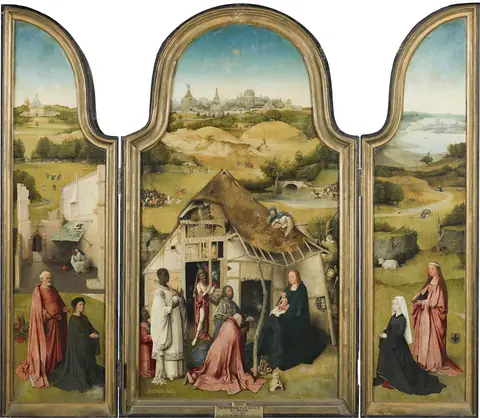
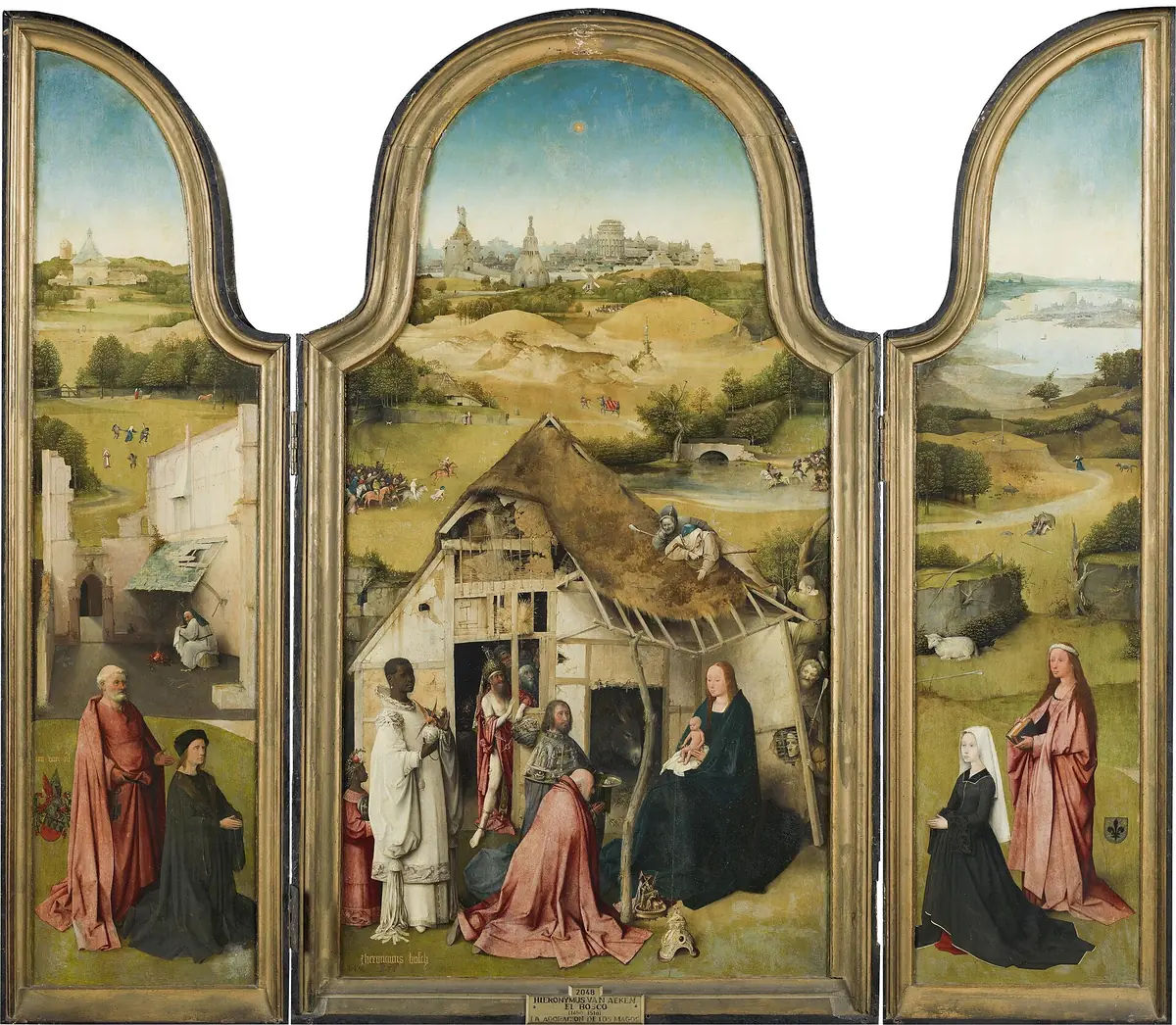
Image: Wikimedia Commons · Public domain (PD-Art) The Adoration of the Magi (The Epiphany)
Look closely. The open triptych: in the centre Mary sits before a ruined hut as the three kings offer their gifts; a strange figure stands in the doorway, and the wings show the donors with their patron saints. Look at the elaborate, almost architectural gifts, at the pale city in the distance, and at how the humble family is set against a world already crowded with omen.
In the library: The Bible (KJV) · Jesus Christ · Mary, mother of Jesus
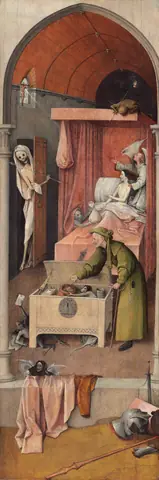
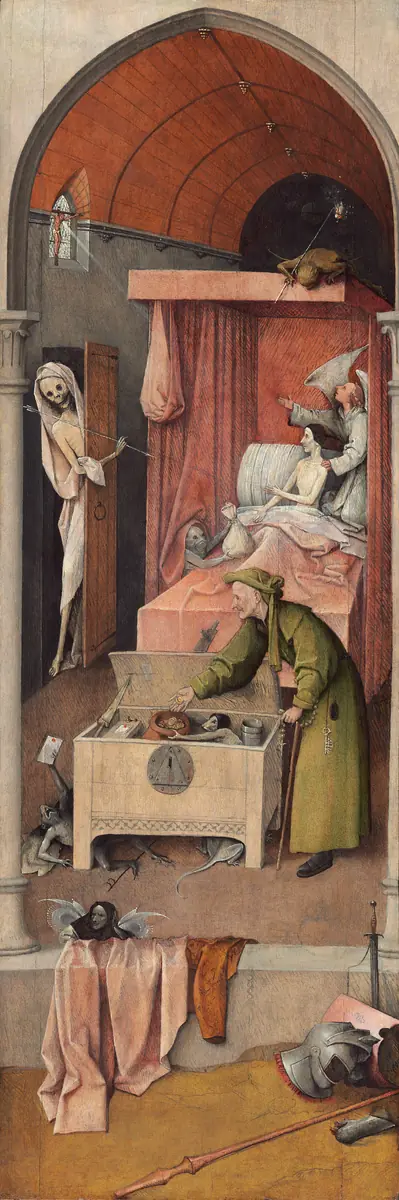
Image: Wikimedia Commons · Public domain (PD-Art) Death and the Miser
Look closely. A dying man sits up in a narrow, high room as Death comes in at the door with an arrow; an angel points toward a crucifix in the window, while a demon offers a bag of coin and another slips a hand into the chest at the foot of the bed. Look at the armour and the gold already discarded in the foreground, and at the two paths still open in the last minute of a life.
In the library: The Bible (KJV)
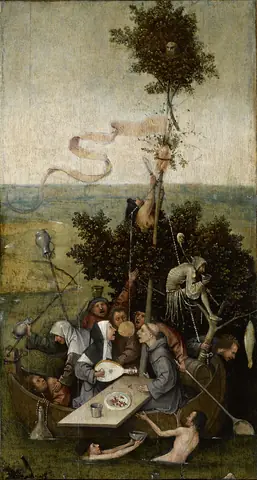
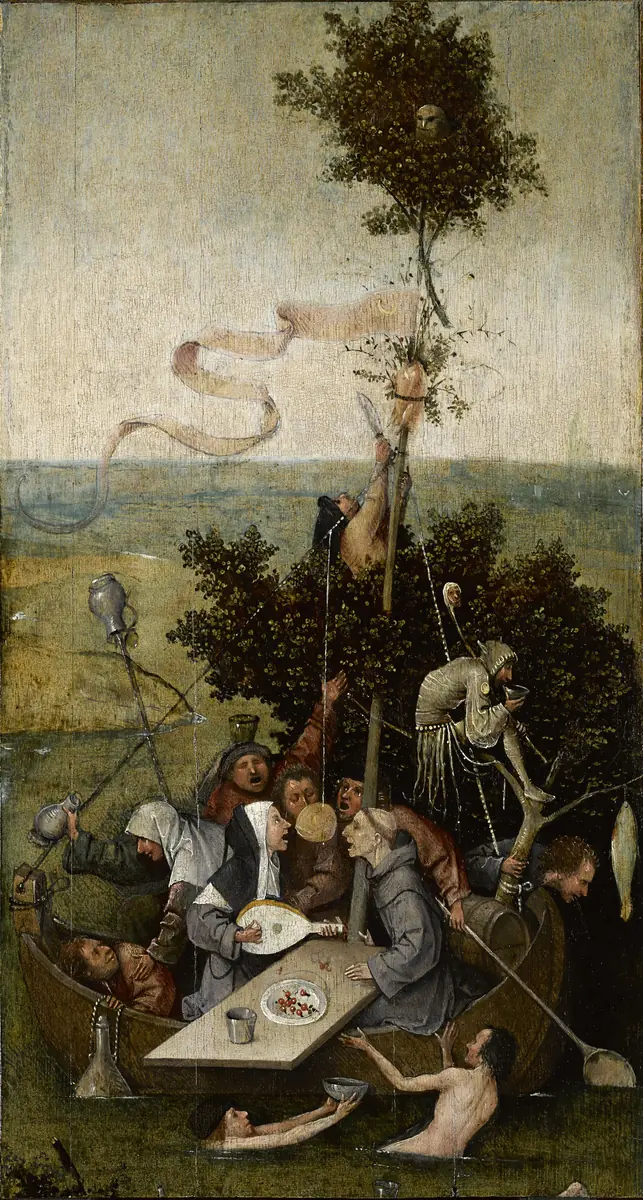
Image: Wikimedia Commons · Public domain (PD-Art) The Ship of Fools
Look closely. A little boat drifts, crowded with singers, drinkers and a singing monk and nun; a broken branch serves as a mast, and someone climbs it to reach a roast bird. Look at the fool in the bow, at the man being ducked or climbing over the side, and at how a picnic on the water becomes a picture of a life with no port and no pilot.
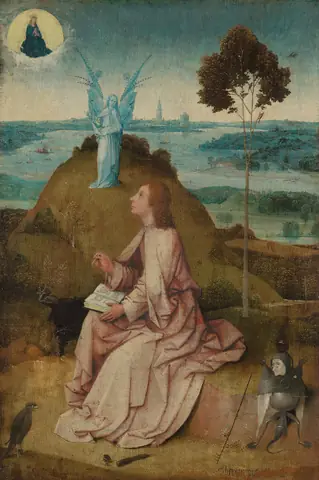
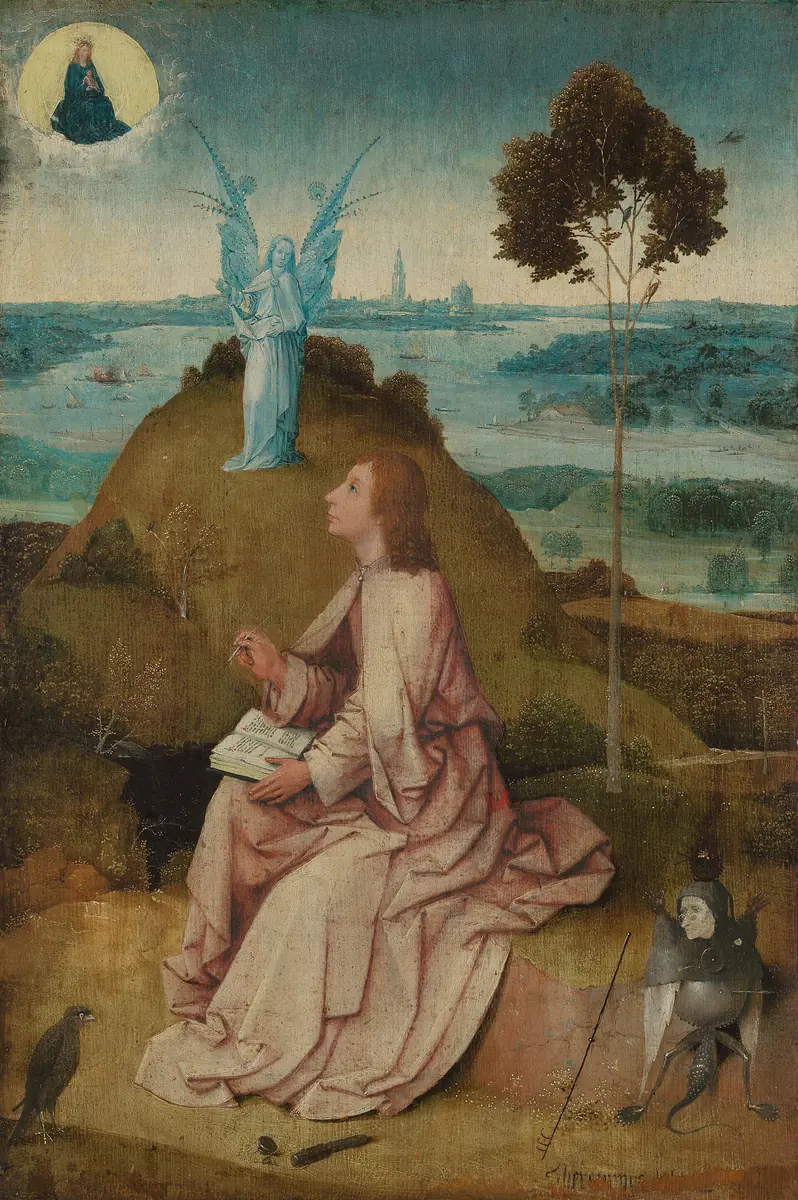
Image: Wikimedia Commons · Public domain (PD-Art) Saint John on Patmos
Look closely. John sits on a green hill with his book and a sharp quill, looking up at a small vision of the Woman of the Apocalypse in the sky; a strange bird-demon waits with the inkwell, and a wide, careful landscape falls away to the sea. Look at the eagle beside him, at the tiny ships, and at the calm of the evangelist at work in the middle of a vision.
In the library: The Bible (KJV) · John the Apostle
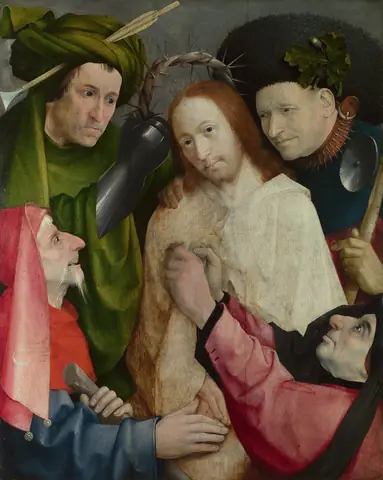
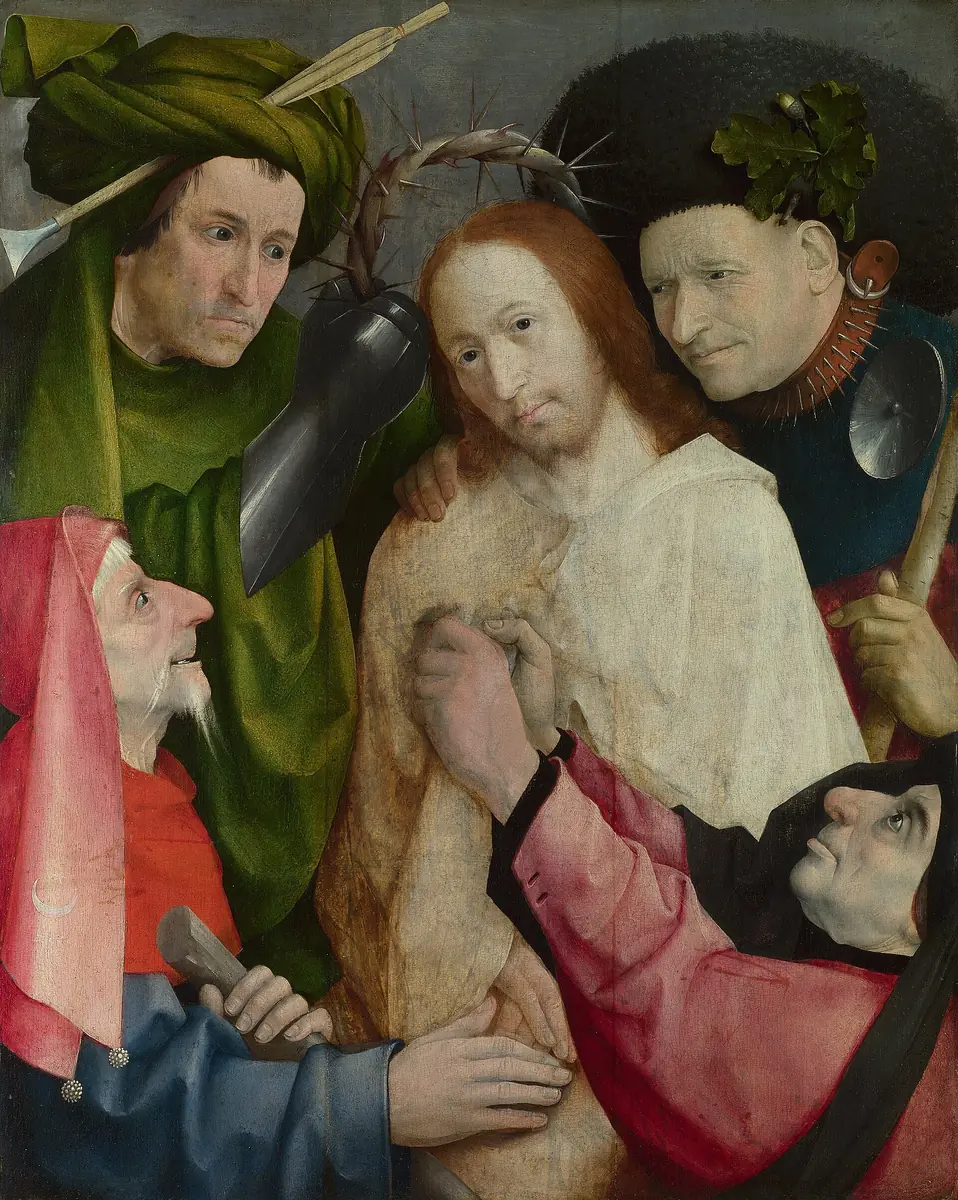
Image: Wikimedia Commons · Public domain (PD-Art) Christ Crowned with Thorns
Look closely. Four men close in on Christ, pressing the crown of thorns down with staves and a mailed fist, while he looks out at us in a red robe. Look at the contrast between his still face and their busy hands, at the crystal and pearl on one cap, and at how tightly the four figures fill the panel, with almost no room left to stand back.
In the library: The Bible (KJV) · Jesus Christ
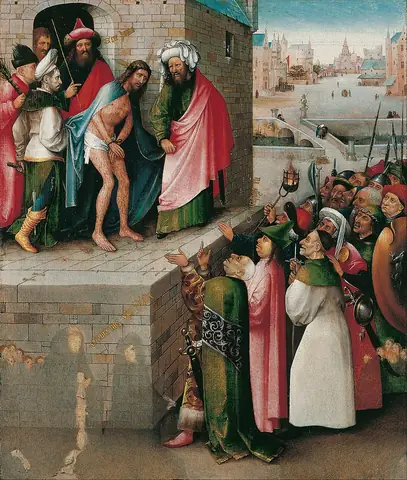
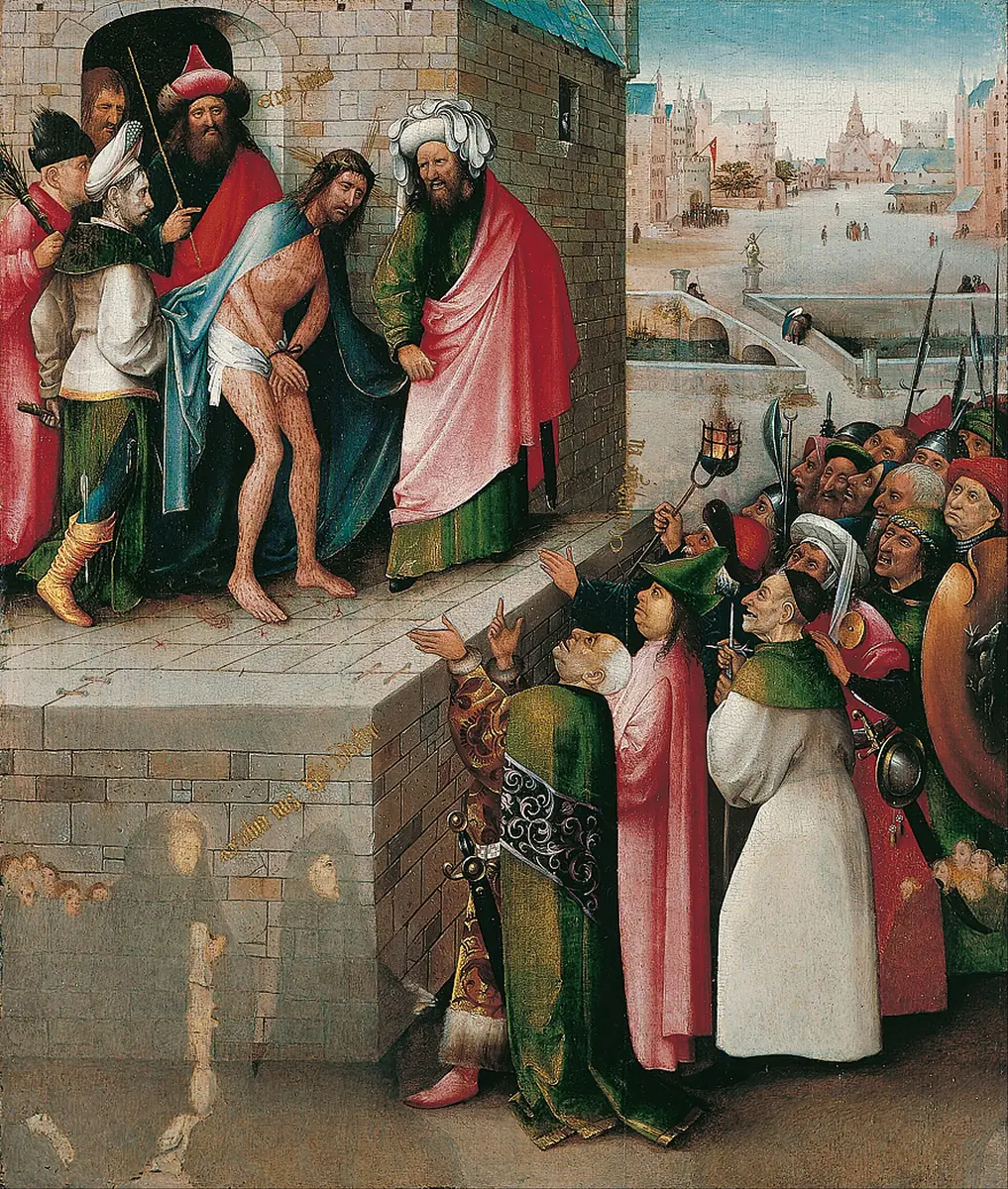
Image: Wikimedia Commons · Public domain (PD-Art) Ecce Homo
Look closely. Christ is led out, bound and bleeding, onto a platform before a crowded street; Pilate and an official present him, and the people below lift hands and weapons in a shout for condemnation. Look at the banners, at the tight packed heads, at the pale body in the middle of the noise, and at the ordinary town that has become the place of a judgement.
In the library: The Bible (KJV) · Jesus Christ
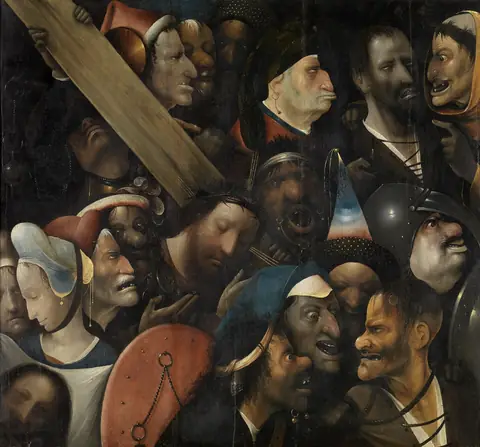
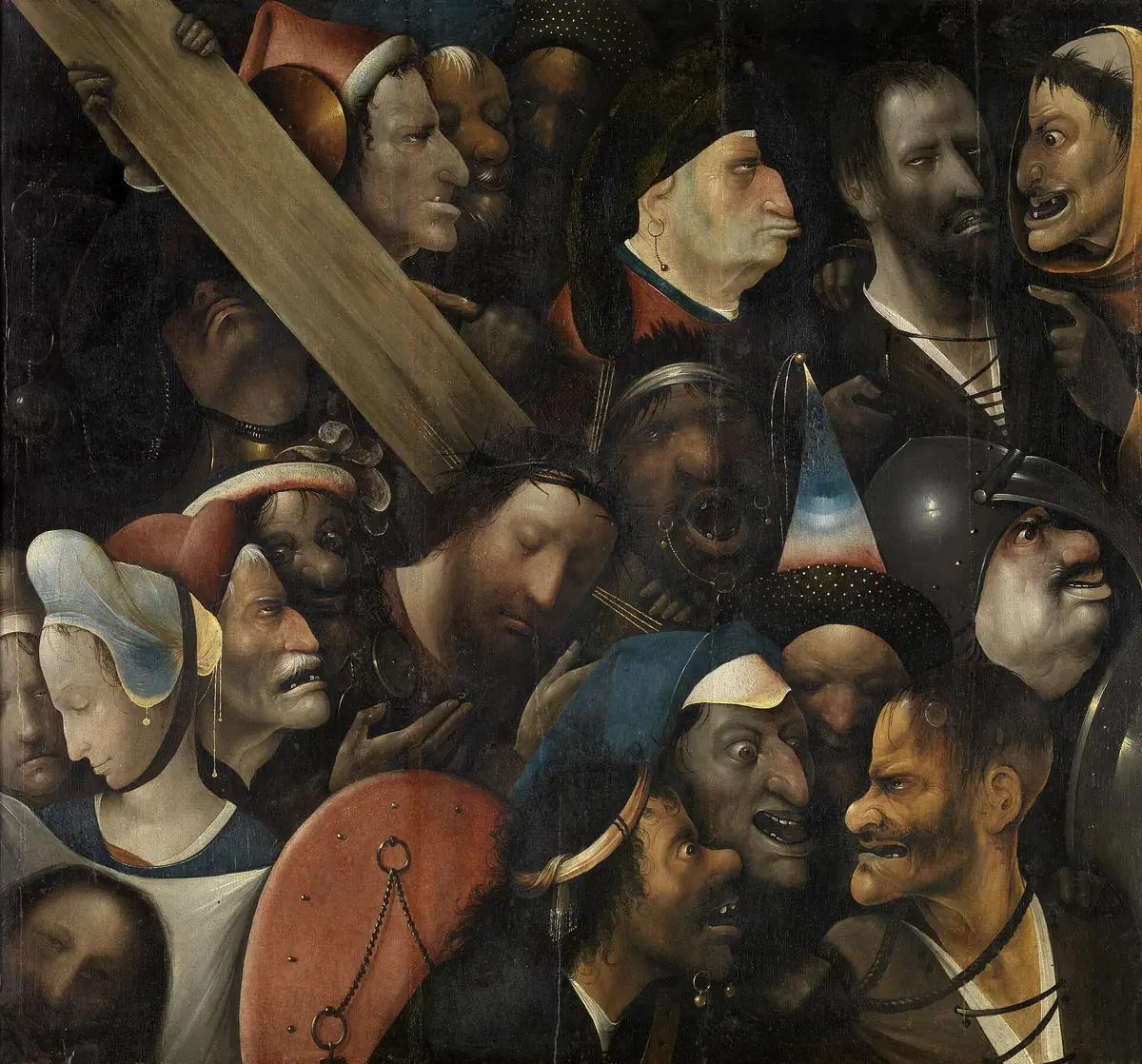
Image: Wikimedia Commons · Public domain (PD-Art) Christ Carrying the Cross
Look closely. A press of heads fills the panel; Christ is almost lost in the middle, eyes closed, the crossbeam cutting the crowd, while Veronica at the left looks down at the veil. Look at the grotesque, invented faces of the escort, at the two thieves, and at how little sky is left: the whole world of the picture has become the road to Golgotha.
In the library: The Bible (KJV) · Jesus Christ


What to watch for in Hieronymus Bosch
Look slowly- A proverb made visible. An odd object or a tiny scene often stands for a saying about folly, greed or death.
- Quiet holiness in a loud world. Saints and Christ are often smaller, calmer, and more still than the crowd around them.
- Fire and a far horizon. A burning house or a pale sky can turn a familiar road into a warning.
- Faces that teach. In the late passion pictures, the escort is a study in cruelty and mockery.
- The back of a panel. Some works once had painted outsides; what we see now may be only part of a larger object.
For older students
These famous works include nudity, so they are named here but not shown. Teachers and parents can decide when to look at them together.
- The Garden of Earthly Delights, c. 1490–1510, Prado, Madrid. The famous triptych moves from Eden through a teeming, often unclothed garden of worldly pleasure to a hell of musical instruments and punishments. It is named here but not shown.
Dates and collections follow the holding museums and Wikidata. Images of paintings are photographs of public-domain pictures from Wikimedia Commons or museum open-access releases; photographs of sculpture are used only when the photograph itself is Public domain, CC0, or CC BY with a named credit. Each picture links to its source page with full licence details.