Great Art · Early Renaissance (Florence)
Sandro Botticelli
The Florentine of graceful line, who painted tender Madonnas, a mystical Nativity, and — for older students — the most famous mythological pictures of his age.
His life
Alessandro Filipepi, called Botticelli after his elder brother, trained in Florence, probably with Fra Filippo Lippi, and worked for the Medici as well as for churches and convents. In the early 1480s he was called to Rome to paint scenes on the walls of the Sistine Chapel. His line is unmistakable: long, springing contours, falling hair, and faces of slightly melancholy sweetness. He painted both Christian altarpieces and, for learned Florentine patrons, stories from classical myth.
Later in life he was among those moved by the Dominican preacher Girolamo Savonarola. His late work, especially the Mystical Nativity, is intensely Christian and more crowded, more urgent, than the calm Madonnas of the 1480s. He died in Florence in 1510 and was buried in his family church of Ognissanti. For a time after his death his name faded; it returned in the 1800s. His gift was line in the service of devotion and of story: a single contour that can make a face, a veil, or an angel's wing seem to move.
Key works
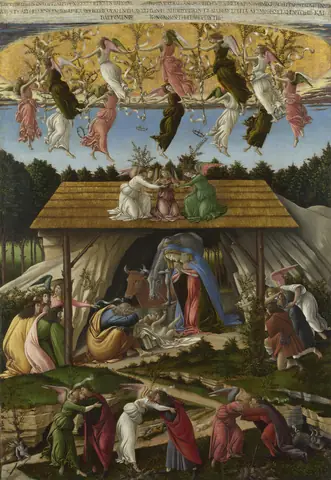
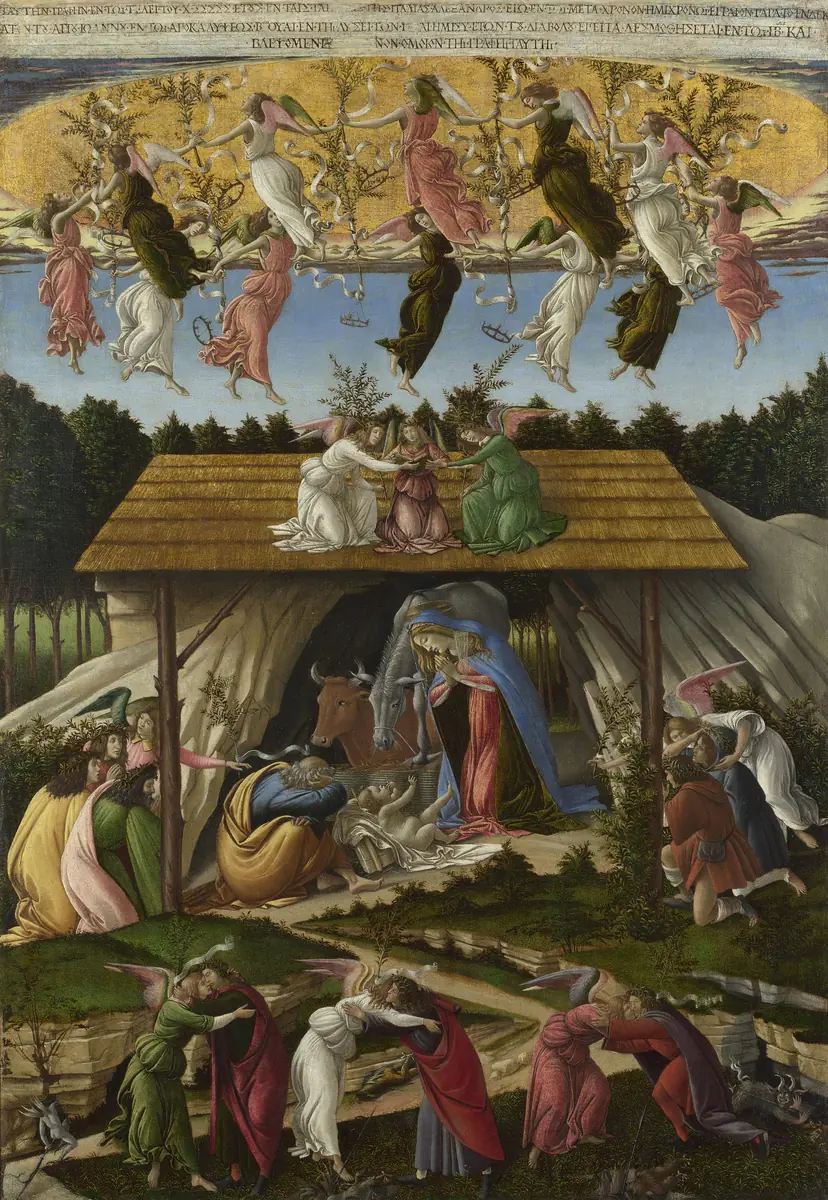
Image: Wikimedia Commons · Public domain (PD-Art) The Mystical Nativity
Look closely. At the centre Mary kneels over the Child, who lies on the ground before a humble shelter. Angels dance in a ring in the sky, and in the foreground men and angels embrace while little demons flee into cracks in the ground. A Greek inscription at the top dates the picture to the end of the year 1500 and speaks of trouble in Italy after the preaching of Savonarola. It is a Nativity seen as a vision of peace at the end of time.
In the library: The Bible (KJV) · Jesus Christ · Mary, mother of Jesus
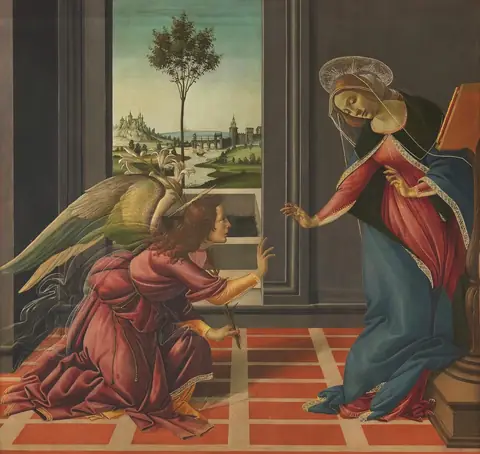
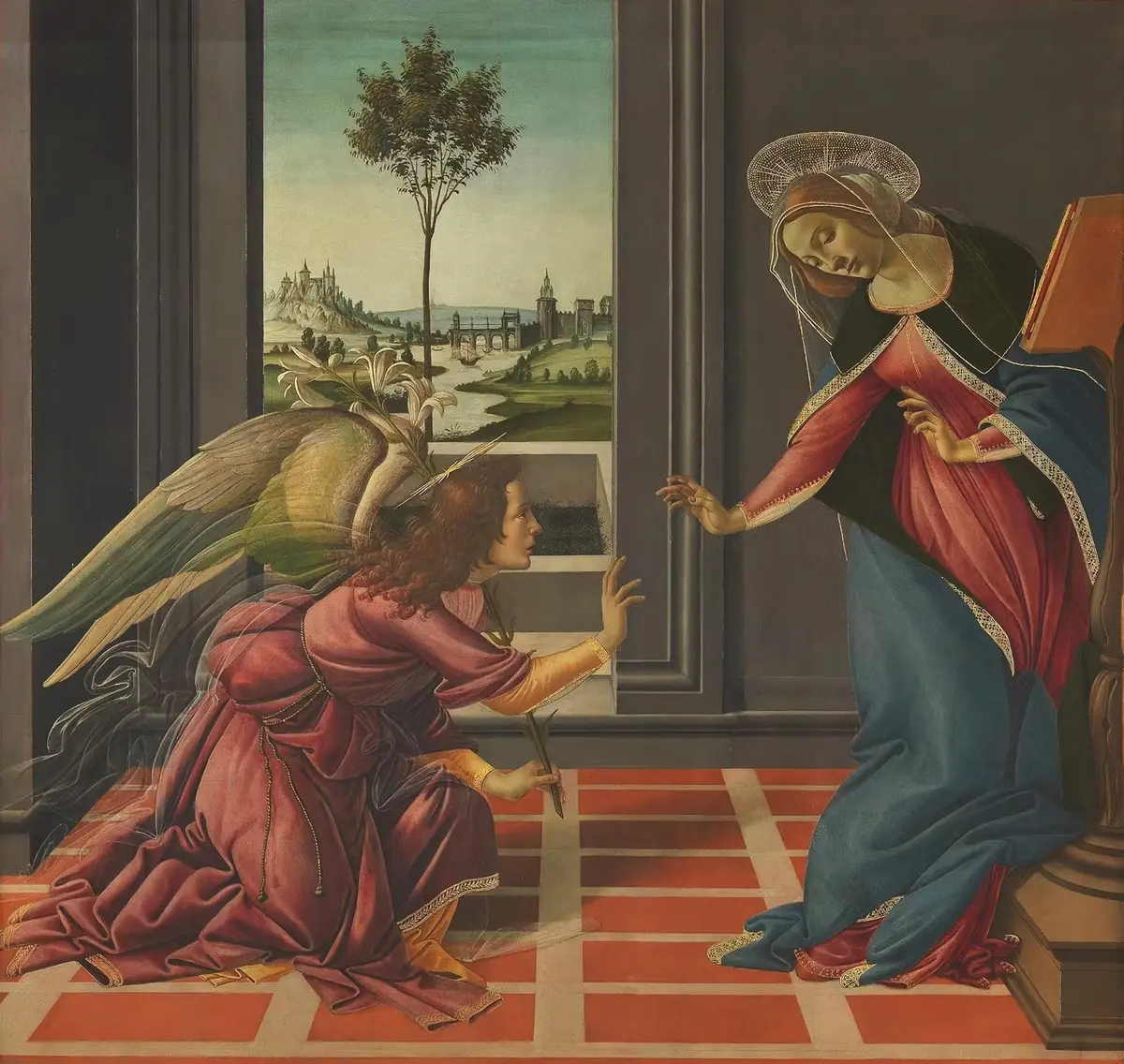
Image: Wikimedia Commons · Public domain (PD-Art) Cestello Annunciation
Look closely. Gabriel kneels and reaches forward; Mary, in a rust-red dress and blue cloak, draws back, her hands raised in a mixture of fear and acceptance. A tall grey room opens to a doorway and a pale landscape. Look at the distance between their hands, almost touching, and at the long, clean lines of Mary's cloak.
In the library: The Bible (KJV) · Mary, mother of Jesus
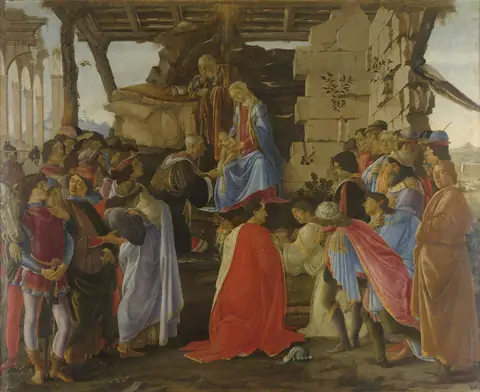
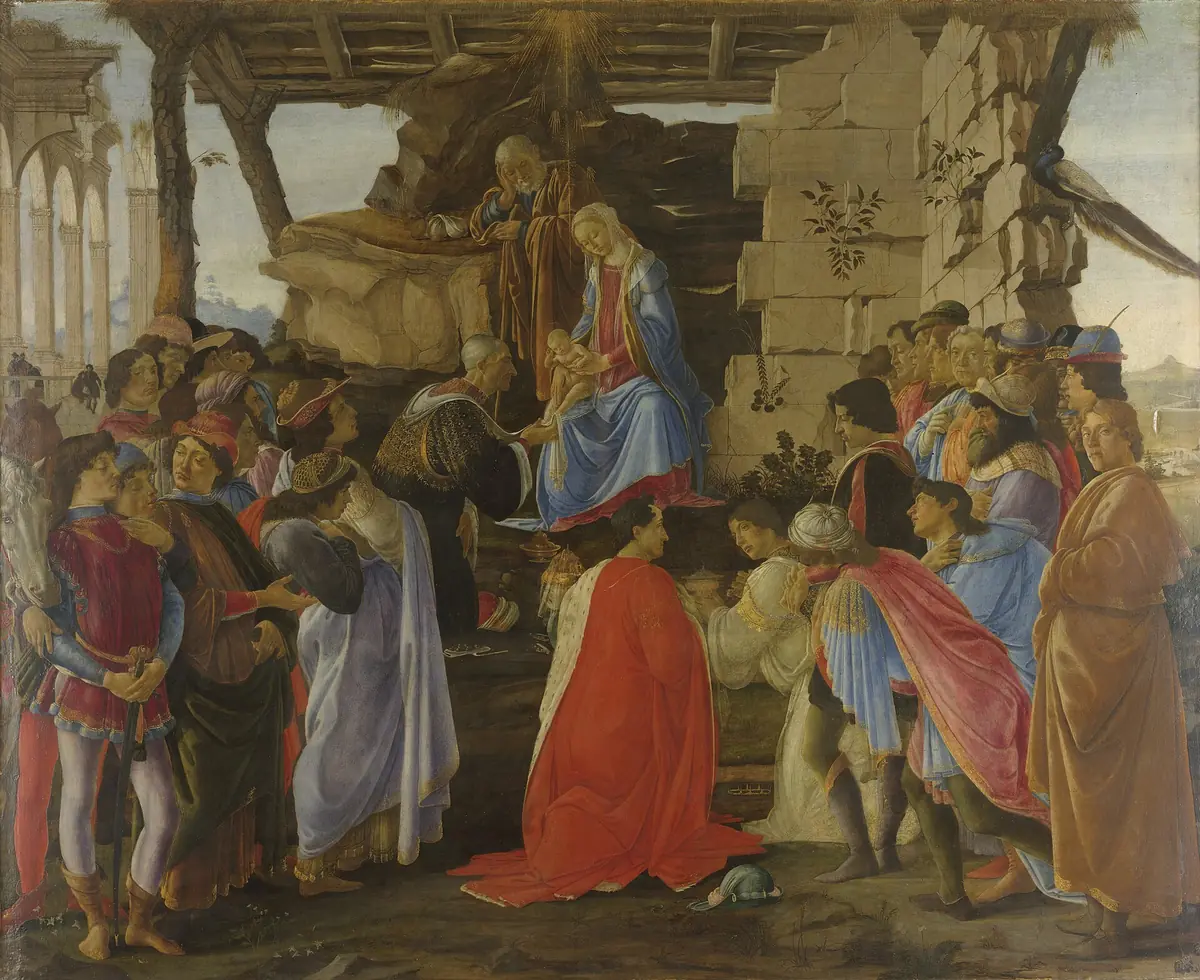
Image: Wikimedia Commons · Public domain (PD-Art) Adoration of the Magi
Look closely. The holy family sits at the centre of a ruined classical building, and the kings and their retinue press in from both sides. Several of the faces are thought to be Medici portraits, and the young man in a yellow cloak at the far right is often taken to be Botticelli himself, looking out at us. The picture was painted for a Florentine merchant's chapel in Santa Maria Novella.
In the library: The Bible (KJV) · Jesus Christ · Mary, mother of Jesus
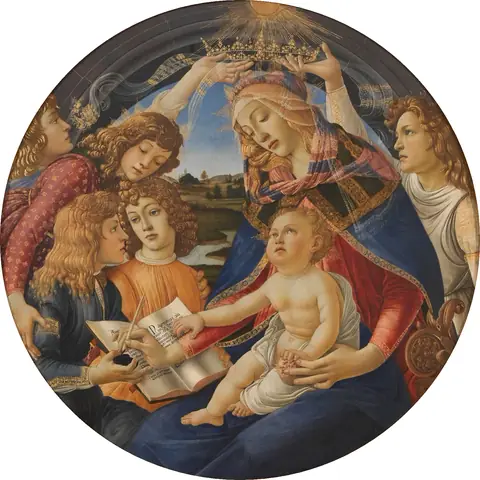
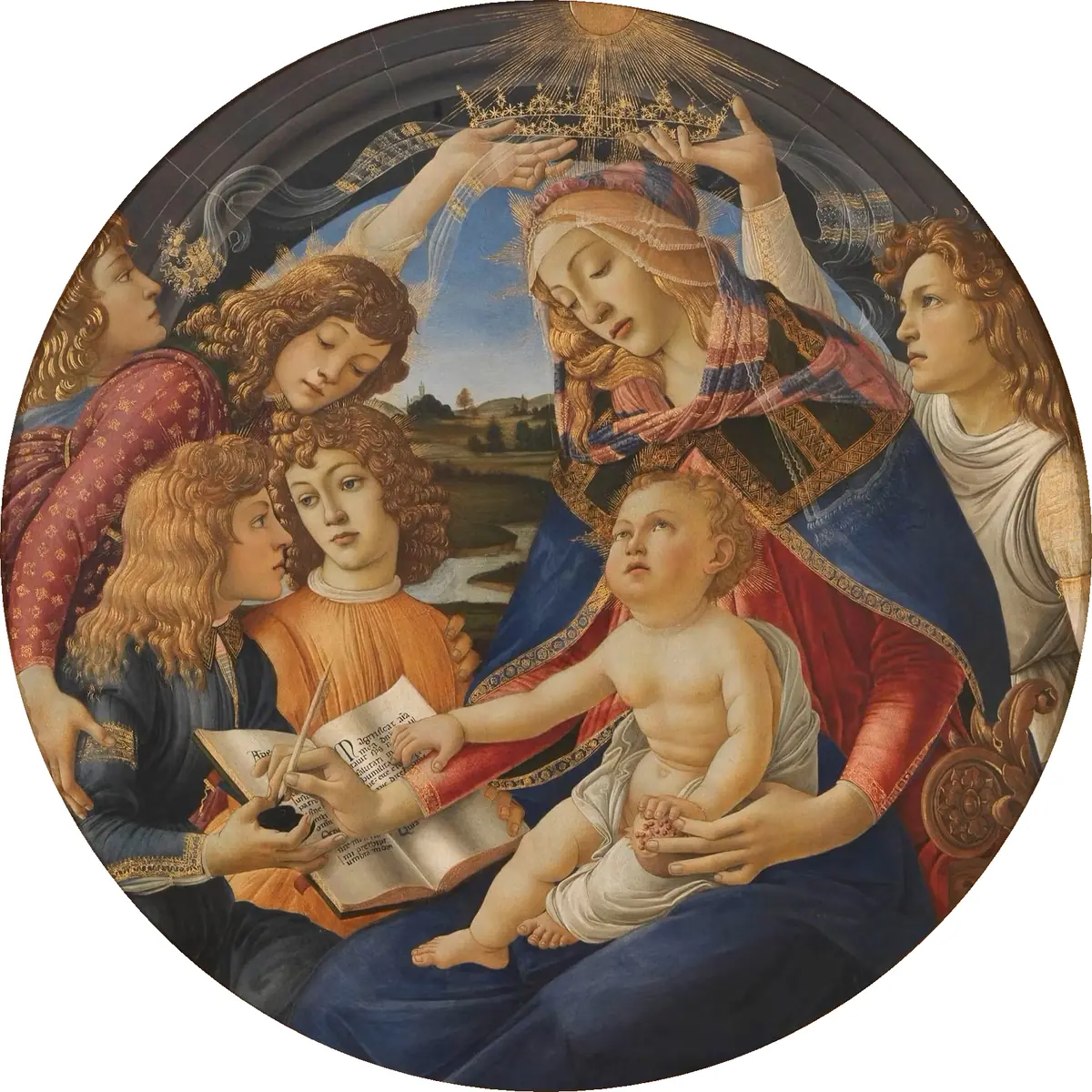
Image: Wikimedia Commons · Public domain (PD-Art) Madonna of the Magnificat
Look closely. Mary, crowned by angels, writes the opening of the Magnificat in a book on her lap, while the Child guides her hand. The picture is a tondo, a round panel, and the curve is filled with angels, gold and a distant landscape. Look at the close work of the illuminated page and at how the round format gathers everyone toward Mary's face.
In the library: The Bible (KJV) · Mary, mother of Jesus · Jesus Christ
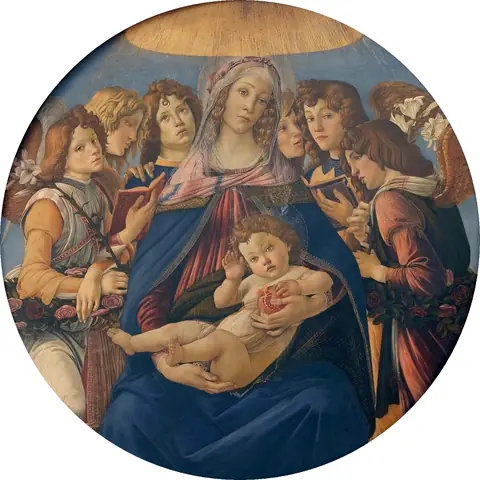
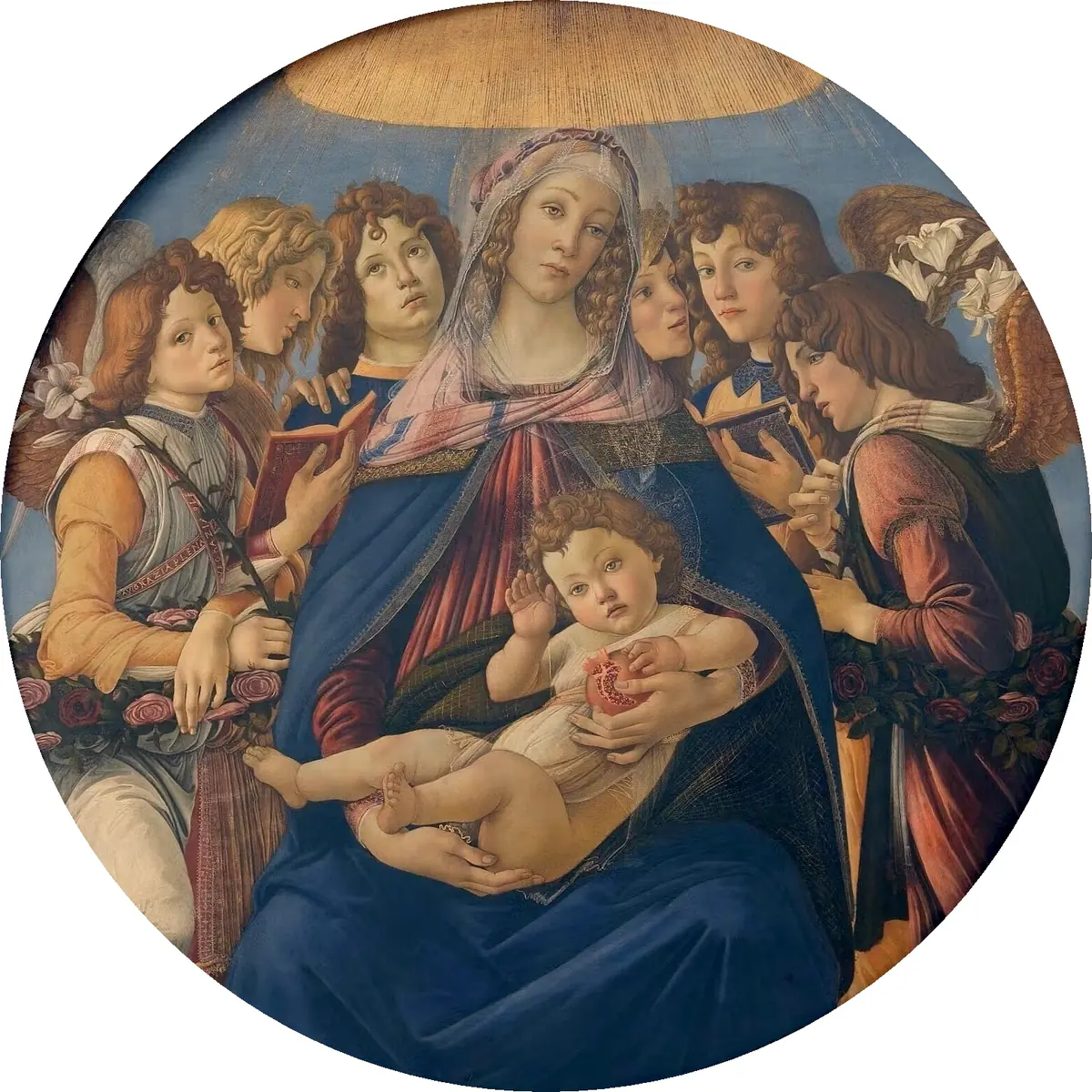
Image: Wikimedia Commons · Public domain (PD-Art) Madonna of the Pomegranate
Look closely. Another tondo: Mary holds the Child, who holds a pomegranate, its red seeds a sign of his coming Passion and of the unity of the church. Six angels crowd the circle with lilies and roses. Mary's face is thoughtful, almost sad, as if she already knows what the fruit means.
In the library: The Bible (KJV) · Mary, mother of Jesus · Jesus Christ
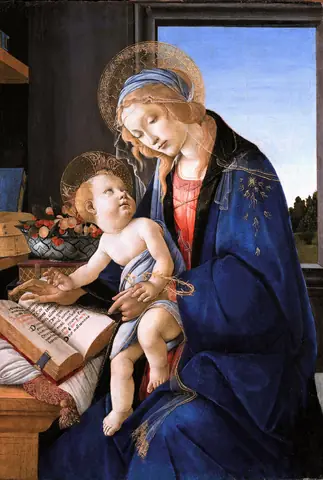
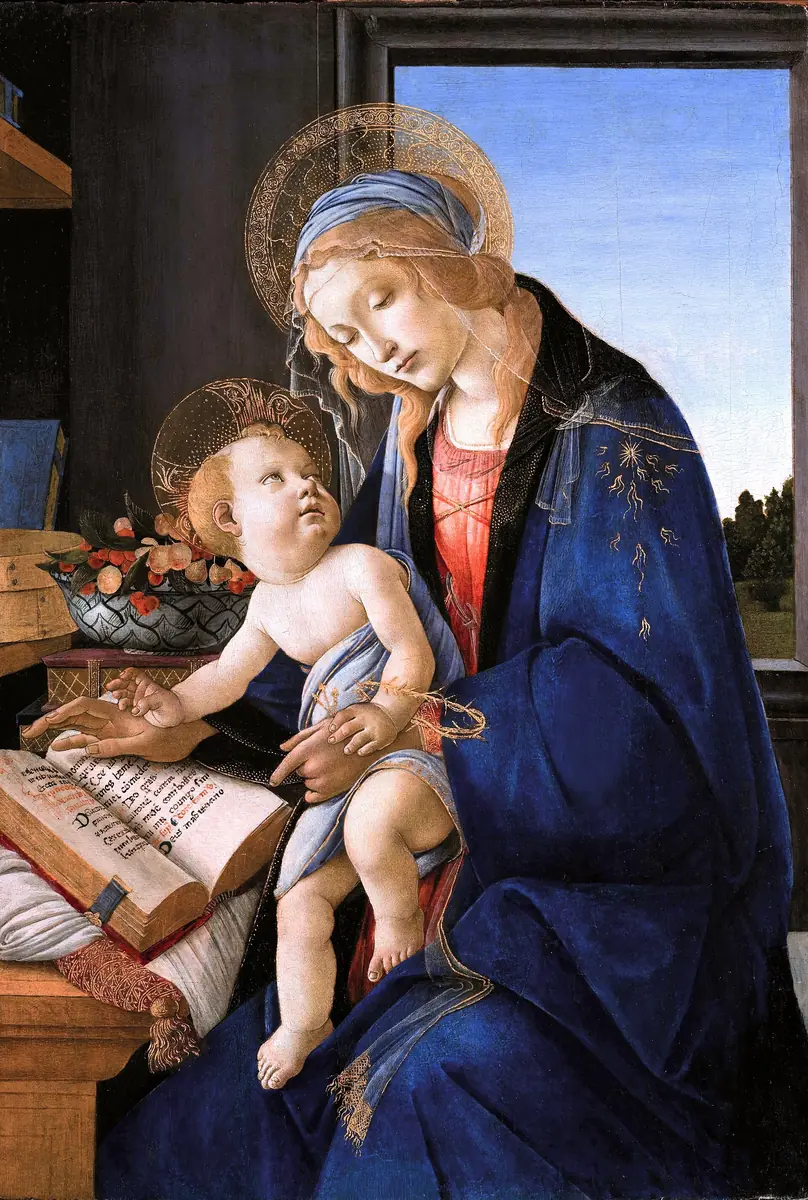
Image: Wikimedia Commons · Public domain (PD-Art) Madonna of the Book
Look closely. In a small, quiet room Mary reads, and the Child looks up from the book, his hand raised in blessing. A bowl of fruit sits on a shelf, and a barred window lets in the sky. Look at the three iron nails and the crown of thorns that lie with the fruit — small signs of the Passion set into a domestic scene.
In the library: The Bible (KJV) · Mary, mother of Jesus · Jesus Christ


What to watch for in Sandro Botticelli
Look slowly- A clear, springing line. Follow the edge of a veil, a sleeve, or a lock of hair.
- Gold tooled into the paint. Halos, inscriptions and patterned fabrics are often incised or gilded.
- Quiet faces. Eyes are slightly downcast; emotion is reserved rather than violent.
- Crowded late work. The Mystical Nativity is busier and more urgent than the earlier Madonnas.
- Text in the picture. Mary may be writing the Magnificat; a Greek inscription may run across the top of a panel.
For older students
These famous works include nudity, so they are named here but not shown. Teachers and parents can decide when to look at them together.
- The Birth of Venus, c. 1484–1486, Uffizi Gallery, Florence. Venus is shown unclothed, arriving on a shell. The picture is among the most famous of the Renaissance and is named here but not shown.
- Primavera, c. 1480, Uffizi Gallery, Florence. This large allegorical painting includes the Three Graces and Venus in light classical dress, with some partial nudity. It is named here but not shown.
Dates and collections follow the holding museums and Wikidata. Images of paintings are photographs of public-domain pictures from Wikimedia Commons or museum open-access releases; photographs of sculpture are used only when the photograph itself is Public domain, CC0, or CC BY with a named credit. Each picture links to its source page with full licence details.