Great Art · Early Renaissance (North Italy)
Andrea Mantegna
The painter of stone, ruin and fierce devotion, who served the Gonzaga court at Mantua and made the dead Christ seem to lie at your feet.
His life
Andrea Mantegna grew up in Padua, a university city full of scholars and of ancient Roman remains, and he was adopted and trained by the painter Francesco Squarcione. As a very young man he painted the Ovetari Chapel and then, in 1453, married into the Bellini family of Venice. In 1460 he became court painter to Ludovico Gonzaga, Marquis of Mantua, and he spent the rest of his life in that small, ambitious court, painting chapel, palace and triumphs.
He loved stone: carved arches, broken Roman reliefs, hard drapery that looks almost like carved marble, and bodies drawn with the severity of ancient sculpture. He was also a printmaker, and his engravings carried his inventions across Europe. He died in Mantua in 1506. His gift was a stern kind of attention — to archaeology, to foreshortening, and to the suffering of Christ — that can still startle a student who expects only softness from the Renaissance.
Key works
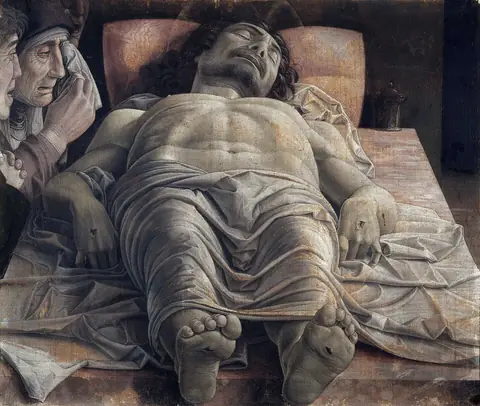
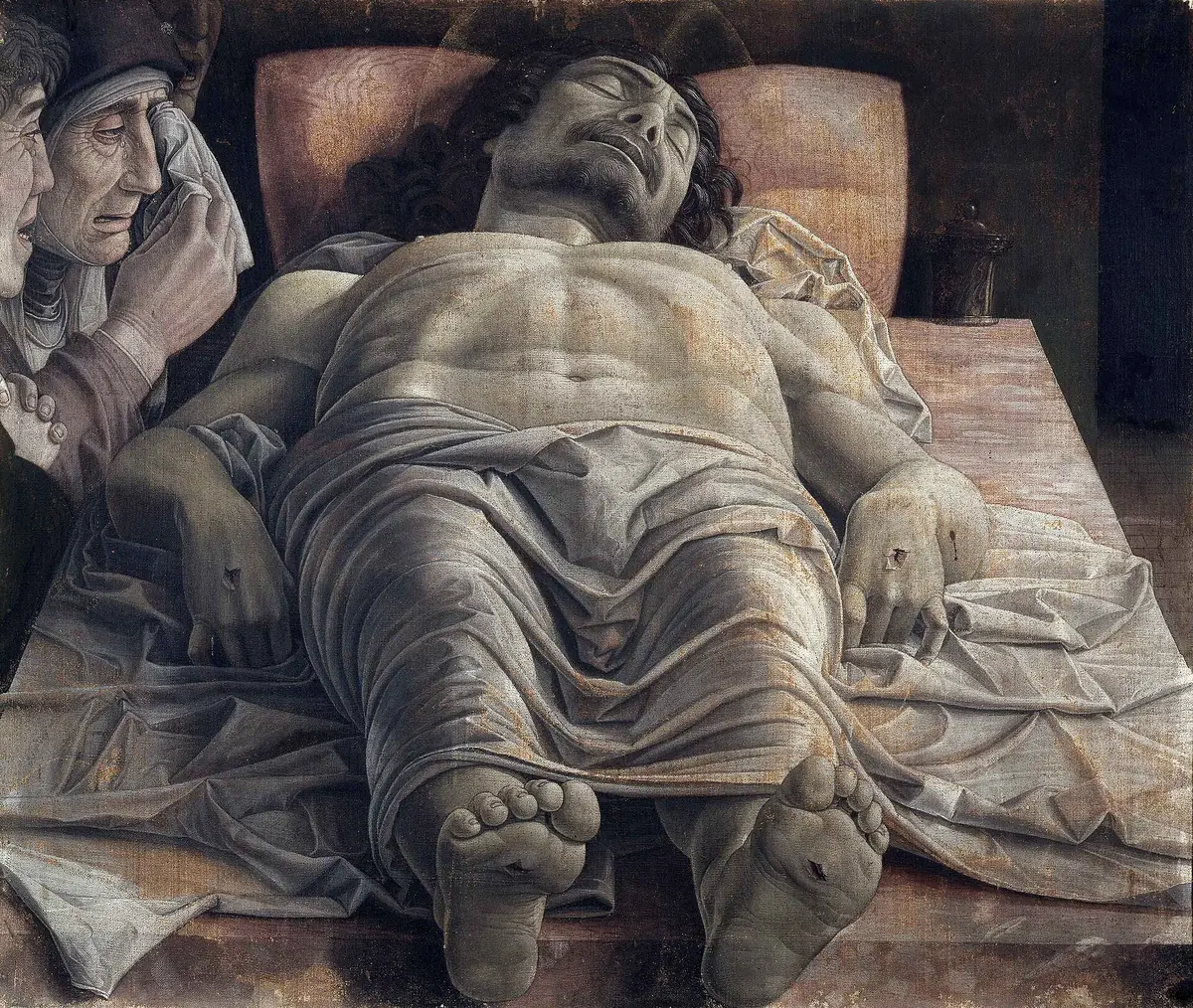
Image: Wikimedia Commons · Public domain (PD-Art) The Lamentation of Christ (Dead Christ)
Look closely. You stand at the foot of the bier. Christ's body is sharply foreshortened, the wounds in the feet close to you, the head far back on a thin pillow. Mary and John crowd in at the left, weeping. The sheet is rumpled, the flesh heavy. Mantegna uses the surprising angle not for display, but so that you cannot look away from the cost of the burial.
In the library: The Bible (KJV) · Jesus Christ · Mary, mother of Jesus · John the Apostle
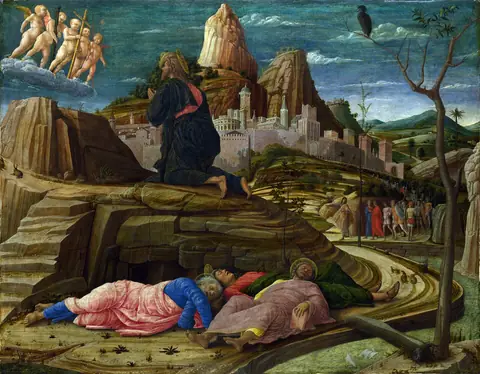
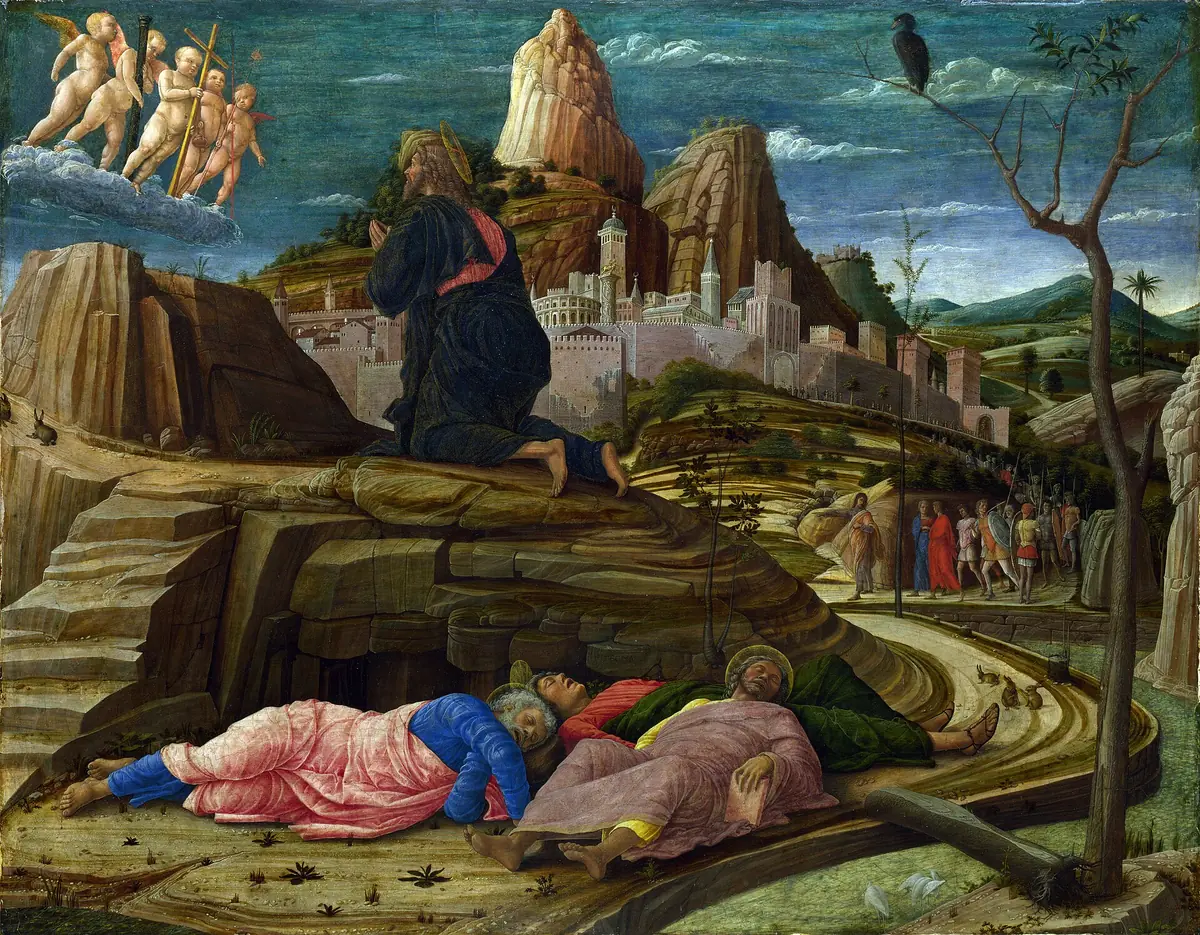
Image: Wikimedia Commons · Public domain (PD-Art) The Agony in the Garden
Look closely. Christ kneels on a rocky platform and an angel shows him the cup of his suffering. Peter, James and John sleep below, and in the distance Judas leads a troop along a winding road. The city behind is like a rebuilt Jerusalem made of Roman stone. Compare this harsh, sculptural garden with Bellini's softer Agony in the same gallery; the two painters were brothers-in-law.
In the library: The Bible (KJV) · Jesus Christ · Apostle Peter · Giovanni Bellini
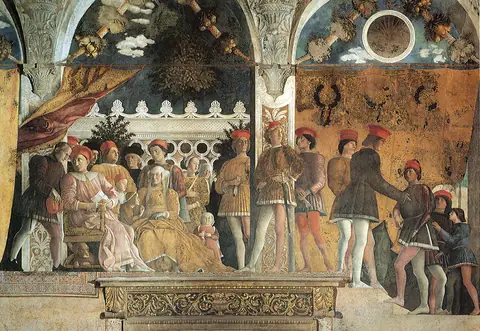
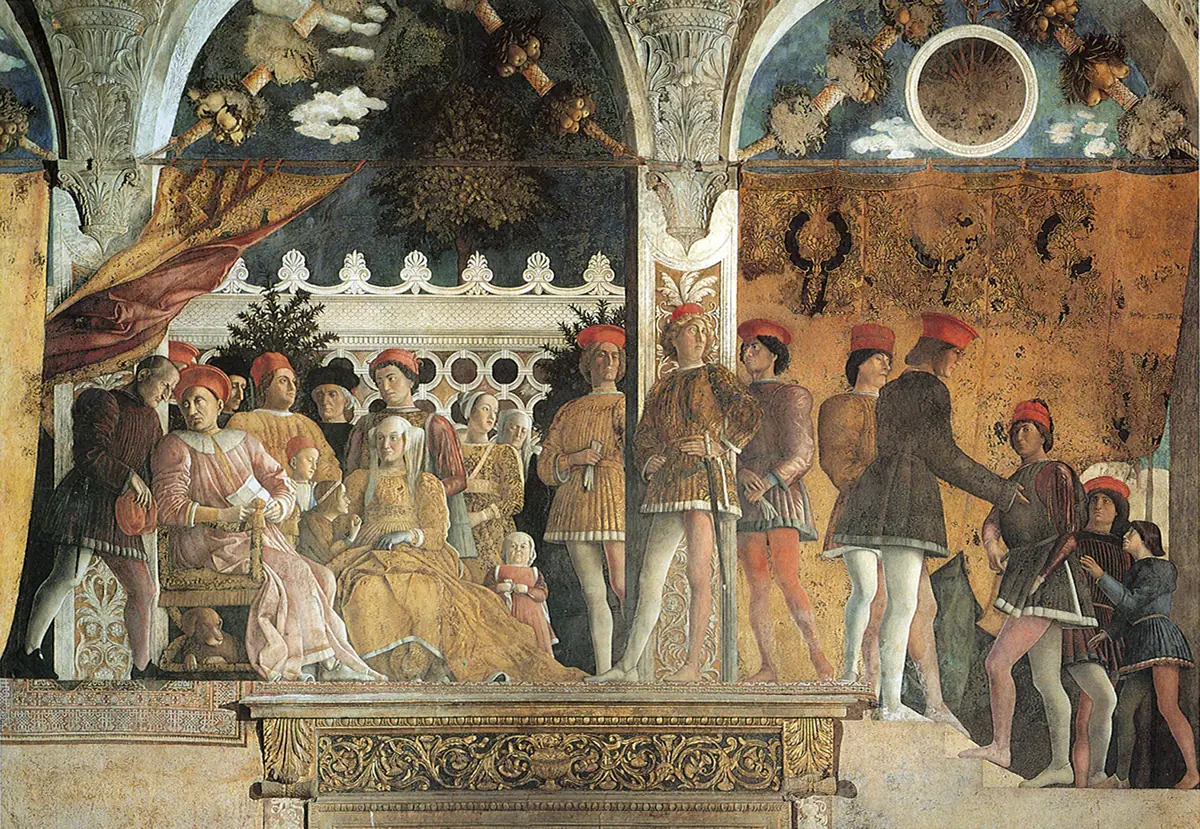
Image: Wikimedia Commons · Public domain (PD-Art) Camera degli Sposi: The Court
Look closely. On the north wall of the painted chamber, Ludovico Gonzaga sits among his family and officials, receiving a letter. The room was both a bedroom and a place of audience. Look at how the painted curtains, pilasters and people seem to occupy the real architecture, so that the court appears to be going on in the same space as the visitor.
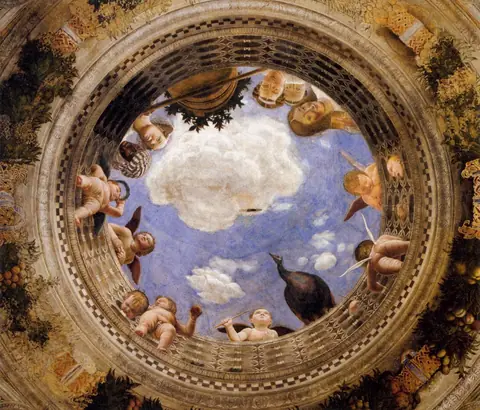
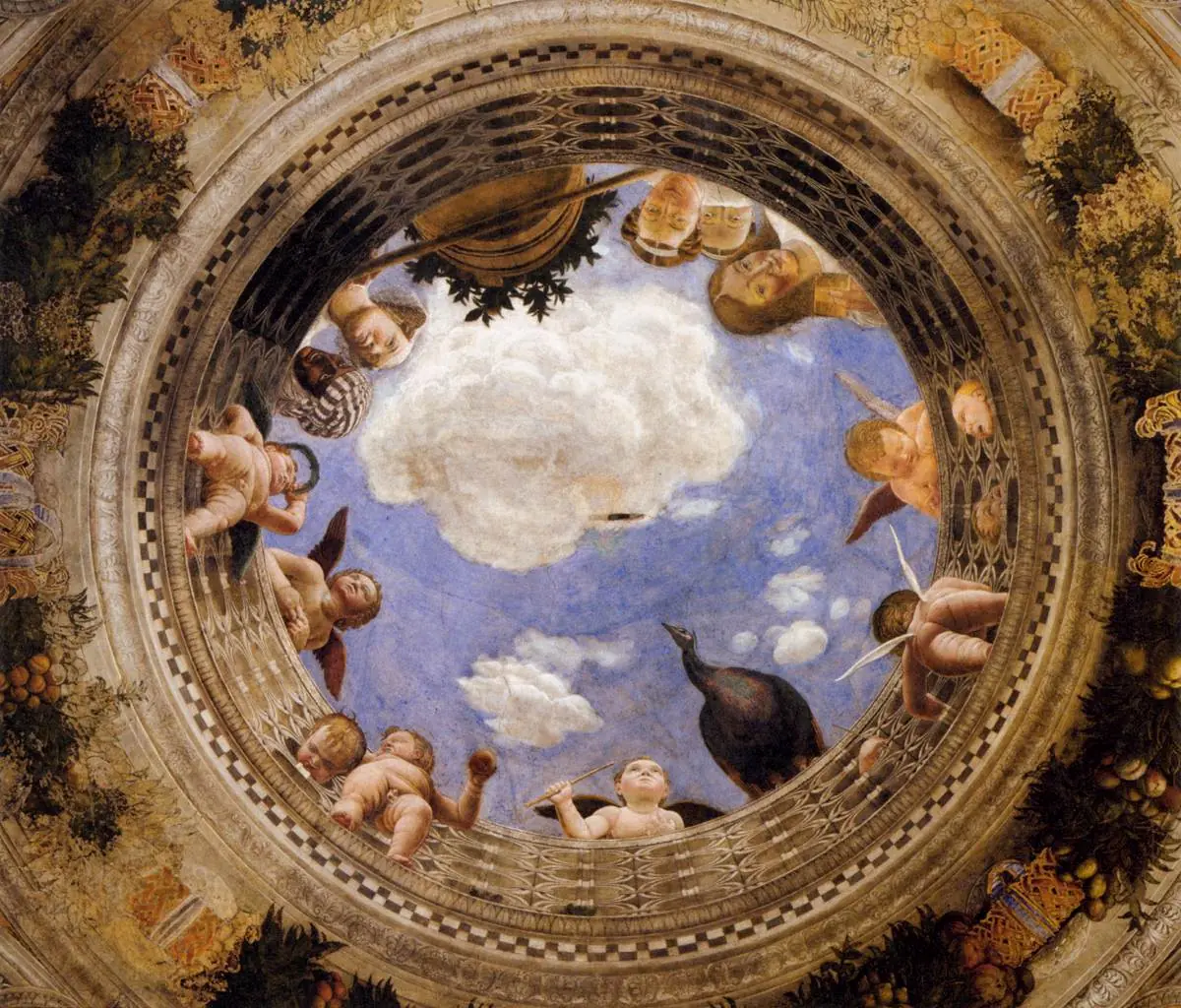
Image: Wikimedia Commons · Public domain (PD-Art) Ceiling Oculus of the Camera degli Sposi
Look closely. Look up: a painted circular balustrade opens to a painted sky, and ladies of the court, a peacock and winged putti lean over the railing. A heavy plant pot seems about to tip. It is one of the first great illusionistic ceilings of the Renaissance, made to amuse and to astonish the Gonzaga household as they stood in an ordinary square room.
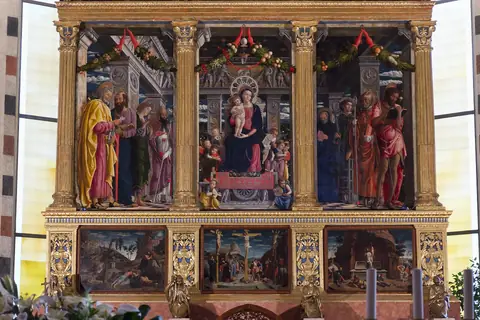
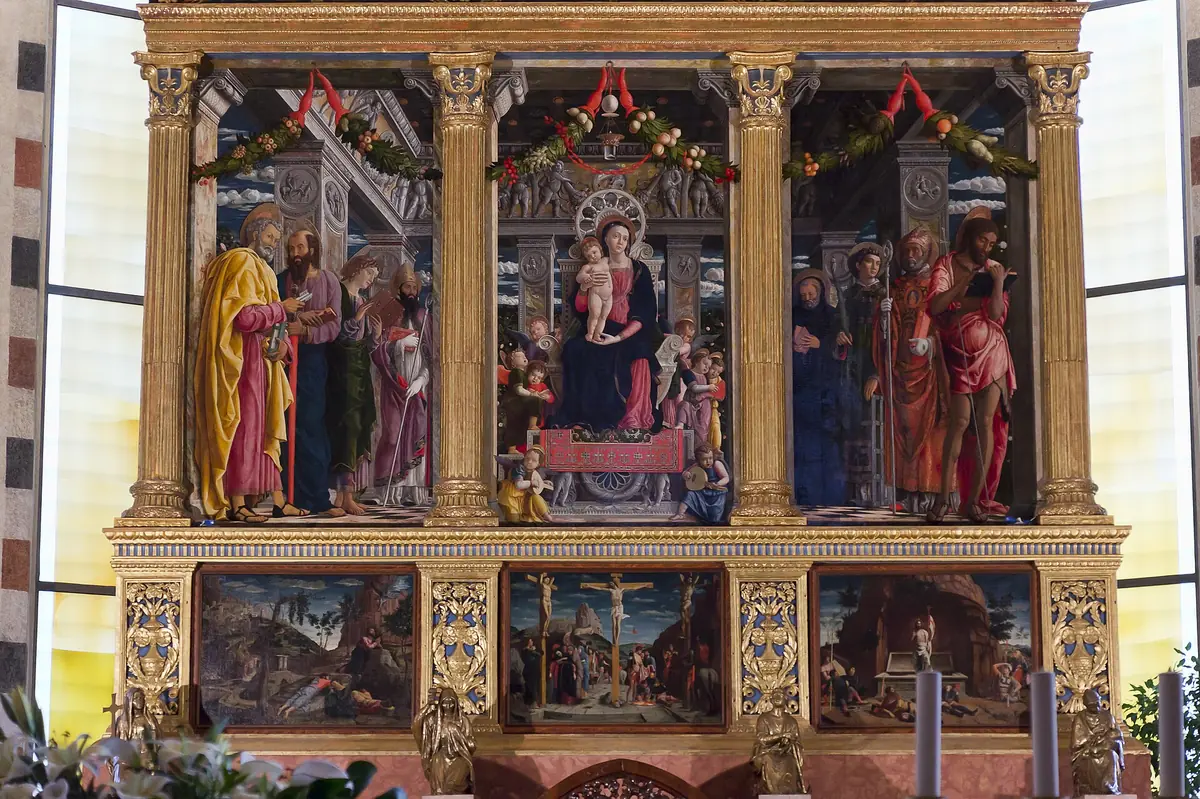
Image: Wikimedia Commons · Public domain (PD-Art) San Zeno Altarpiece
Look closely. The photograph shows the altarpiece still in its church at Verona, with a predella of the Passion below. Mary and the Child sit in an open classical loggia, with saints in the side panels, all framed by a carved gilt architecture that belongs to the real altar. Look at the garland of fruit across the top, and at how the painted columns continue the wooden frame.
In the library: The Bible (KJV) · Mary, mother of Jesus · Jesus Christ
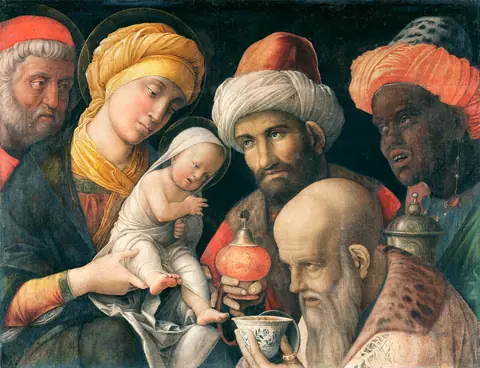
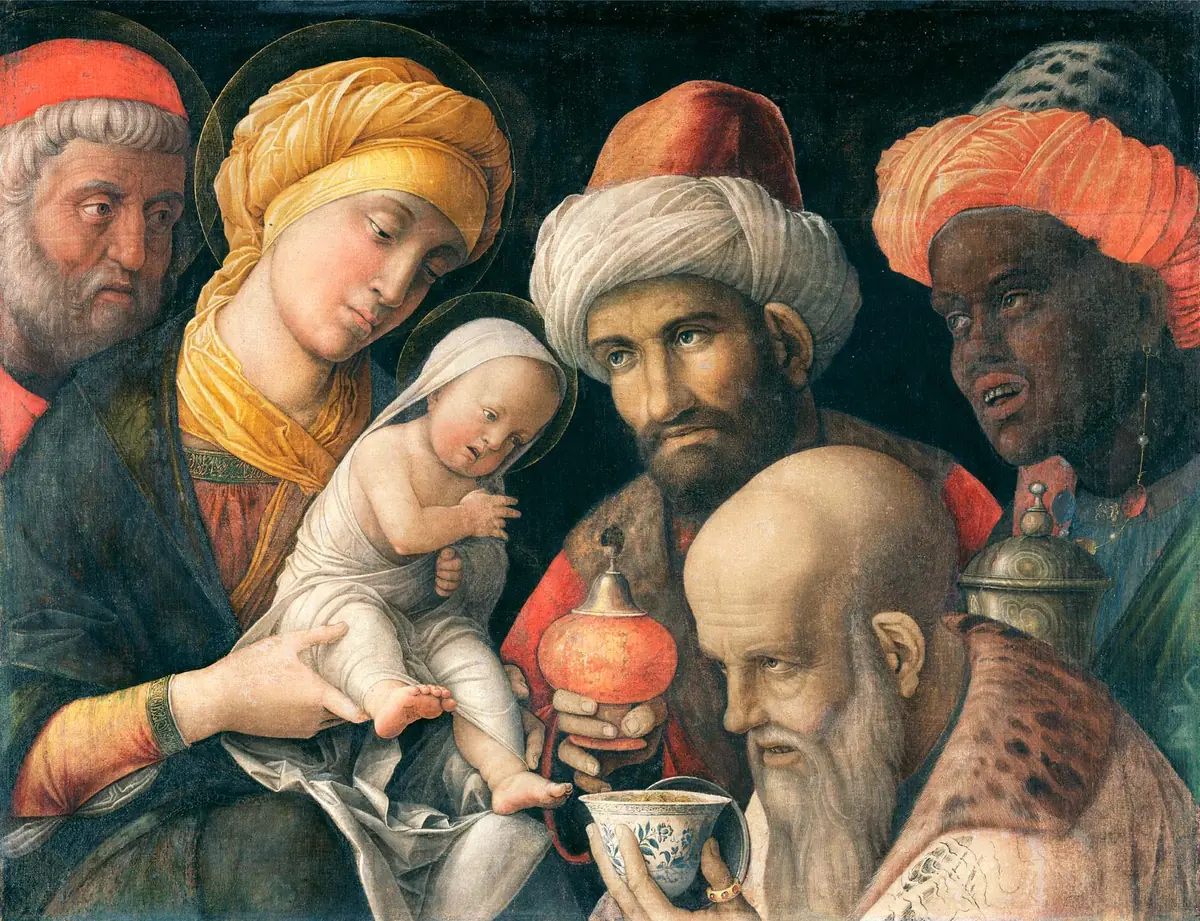
Image: Wikimedia Commons · Public domain (PD-Art) The Adoration of the Magi
Look closely. The picture is painted in a long, frieze-like shape, as if it were a carved relief. The oldest king kneels and kisses the Child's foot; the procession of attendants, horses and camels stretches away to the right in astonishing miniature. Look at the craggy rock behind Mary and at the careful, almost archaeological costumes of the kings.
In the library: The Bible (KJV) · Jesus Christ · Mary, mother of Jesus
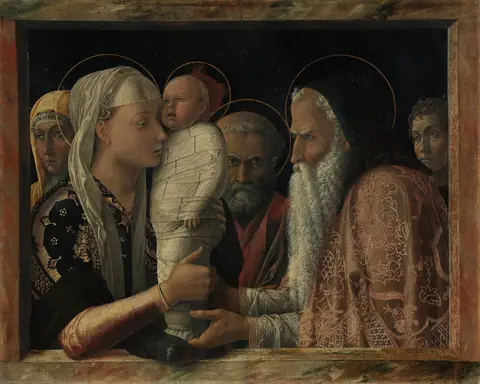
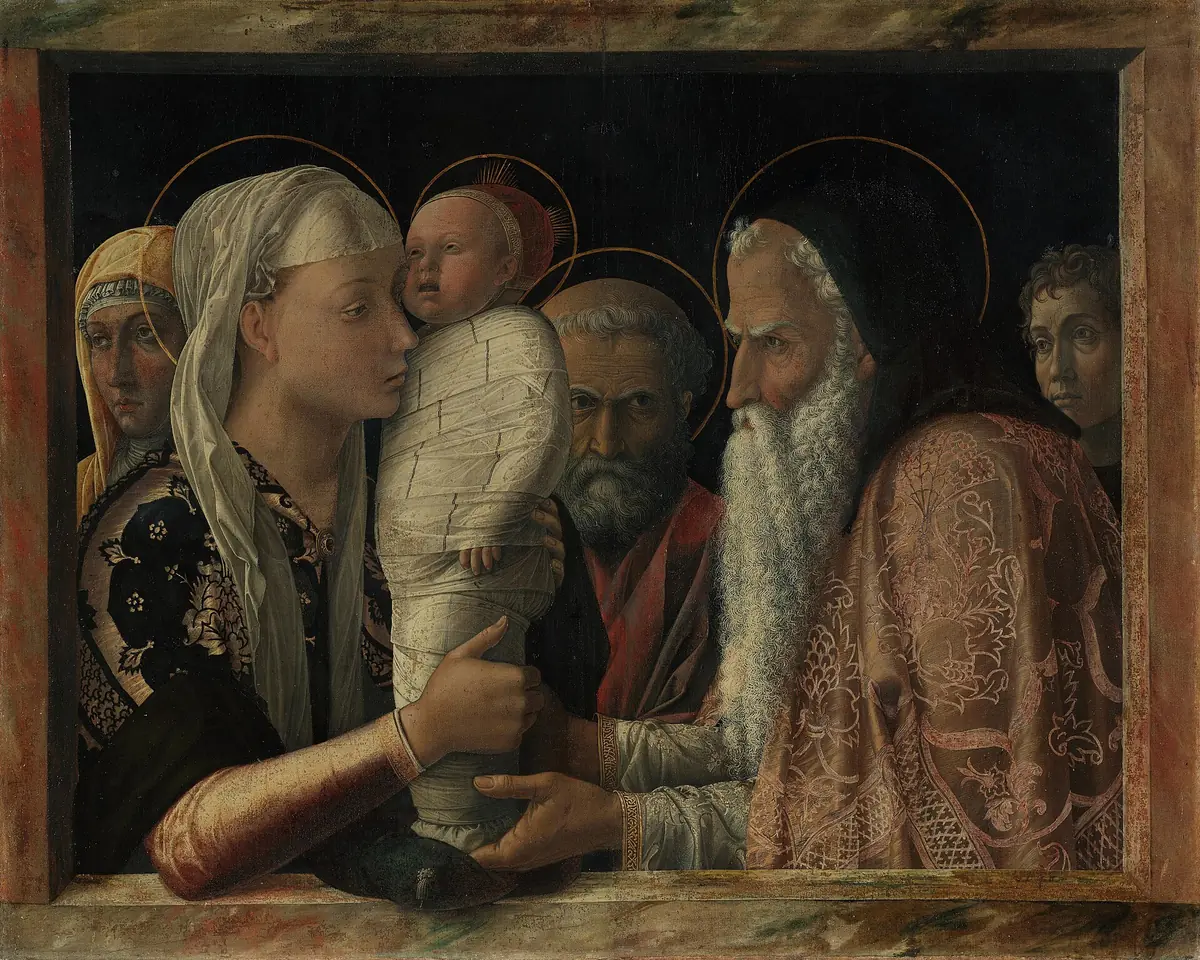
Image: Wikimedia Commons · Public domain (PD-Art) The Presentation at the Temple
Look closely. A stone frame, painted as if it were a window, cuts across the figures: Mary holds the Child out, and Simeon takes him in his arms. Joseph, a prophetess, and other onlookers stand close. The hard ledge makes you feel the Child is being passed across into your space. Mantegna painted this around the time of his marriage into the Bellini family.
In the library: The Bible (KJV) · Jesus Christ · Mary, mother of Jesus · Joseph of Nazareth


What to watch for in Andrea Mantegna
Look slowly- Stone everywhere. Drapery, ruins and even some faces have a carved, mineral hardness.
- Worm's-eye views. He often sets you low, so that figures tower or a ceiling seems to open.
- Ancient Rome remembered. Look for broken inscriptions, reliefs, and triumphs borrowed from old sculpture.
- Foreshortening. In the Lamentation, Christ's body is painted as if you stood at the end of the bier.
- Garlands and putti. In the Camera degli Sposi, painted swags and playful figures frame a real court family.
For older students
These famous works include nudity, so they are named here but not shown. Teachers and parents can decide when to look at them together.
- Saint Sebastian (several versions, including Vienna and the Louvre), c. 1450s–1480s, Belvedere, Vienna; Louvre, Paris; and others. The saint is shown nearly unclothed, bound and pierced with arrows. The pictures are famous for their archaeology and suffering, but they are not shown here.
Dates and collections follow the holding museums and Wikidata. Images of paintings are photographs of public-domain pictures from Wikimedia Commons or museum open-access releases; photographs of sculpture are used only when the photograph itself is Public domain, CC0, or CC BY with a named credit. Each picture links to its source page with full licence details.