Great Art · Northern Renaissance
Pieter Bruegel the Elder
The great observer of peasant life and of the seasons, who set even the Gospel in a wide, working Flemish world.
His life
Pieter Bruegel the Elder was born around 1525, probably in or near Breda, and trained in Antwerp. He travelled to Italy in the early 1550s, but the journey did not make him an Italianate painter: he came home and looked harder at his own country. He designed many prints for the publisher Hieronymus Cock, married Mayken Coecke, and in 1563 moved to Brussels, where he painted the great landscapes and peasant pictures on which his fame rests.
He died in 1569, still in middle life, leaving a family of painters. His gift was a generous eye. He could fill a hill with hunters, a village with a hundred proverbs, or a winter wedding with guests who each have a job to do, and he could set the Census at Bethlehem or the road to Calvary in the same ordinary world, so that the sacred story happens among people who are busy with carts, barrels and children.
Key works
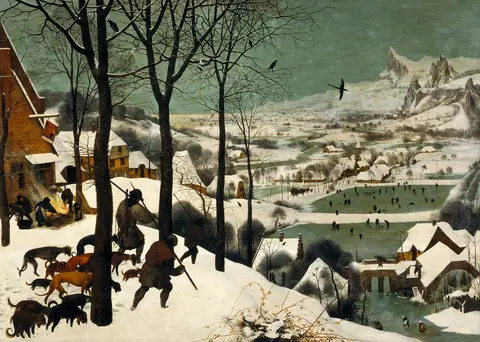
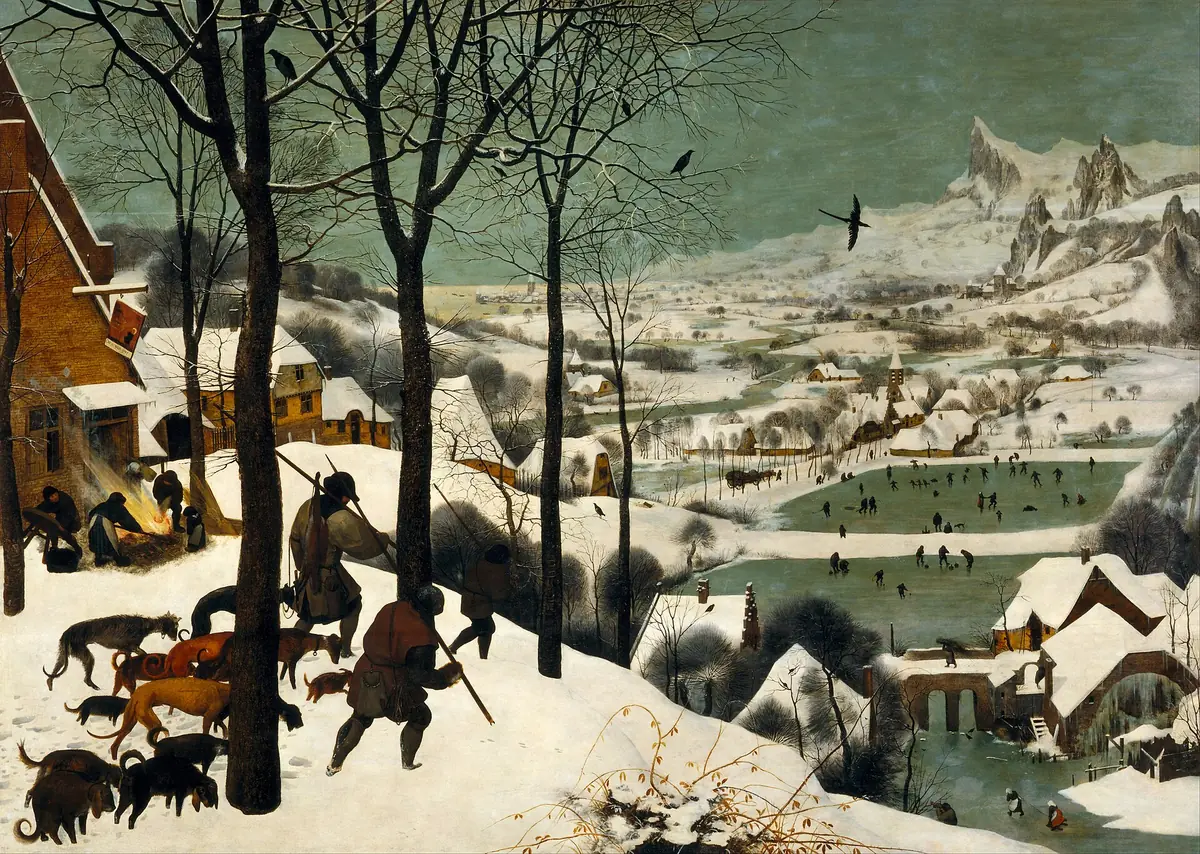
Image: Wikimedia Commons · Public domain (PD-Art) The Hunters in the Snow
Look closely. Three hunters and their dogs come over a hill toward a winter village; below, people skate and tend fires beside frozen ponds, and a jagged mountain range closes the distance. Look at the tired bodies of the men, at the inn sign hanging above the fire at the left, at the magpies in the trees, and at how many small lives are going on in the valley at once.
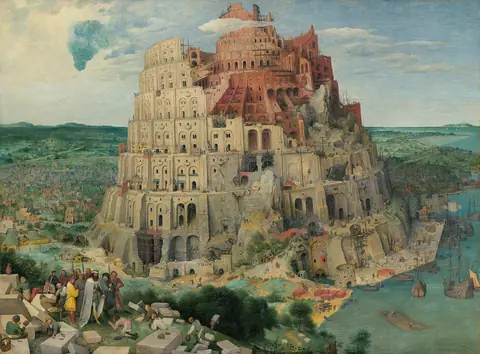
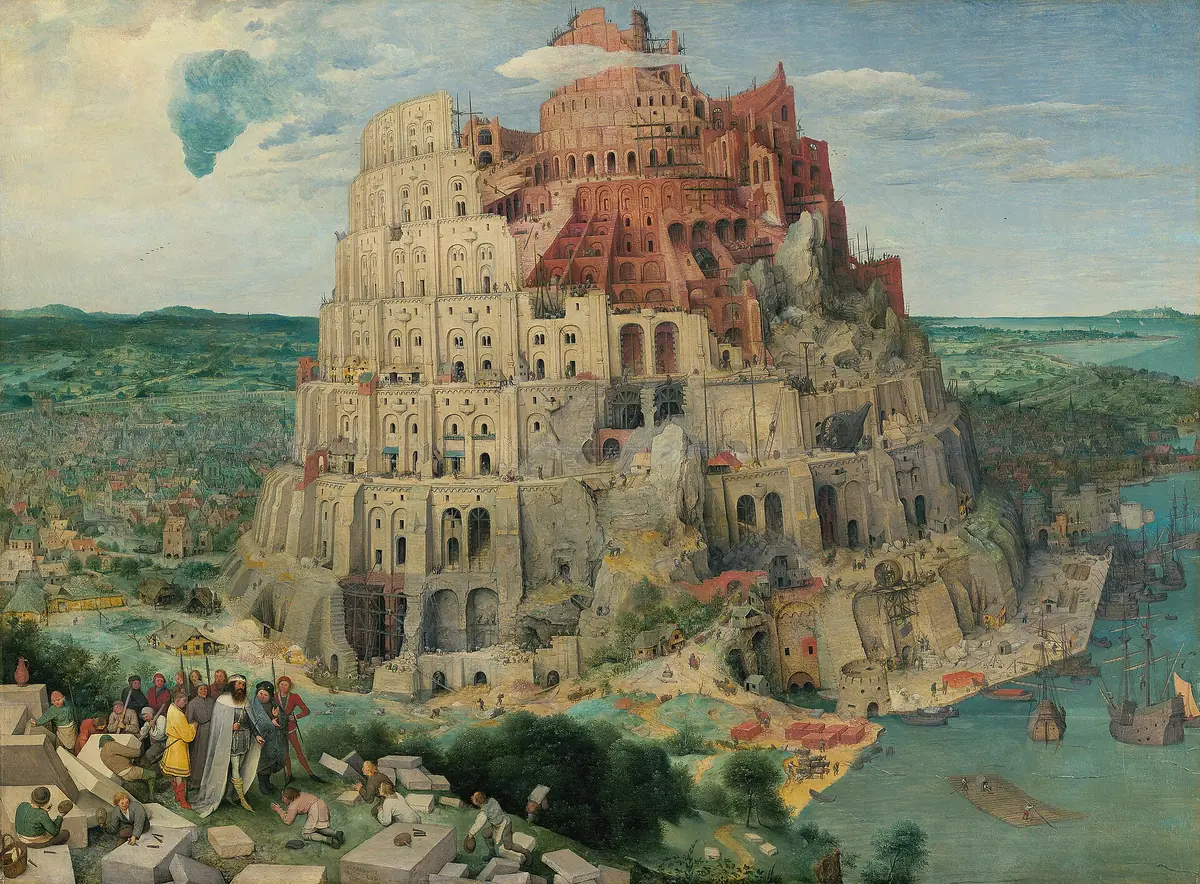
Image: Wikimedia Commons · Public domain (PD-Art) The Tower of Babel
Look closely. A colossal, half-built tower, already leaning and already weathered, rises from a busy port; King Nimrod and his train appear as small figures at the base. Look at the cranes, the scaffolding and the cut stone, at the ships in the harbour, and at how the tower is both a feat of building and a picture of a work that will never be finished.
In the library: The Bible (KJV)
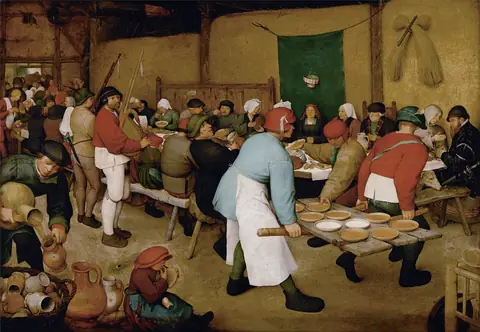
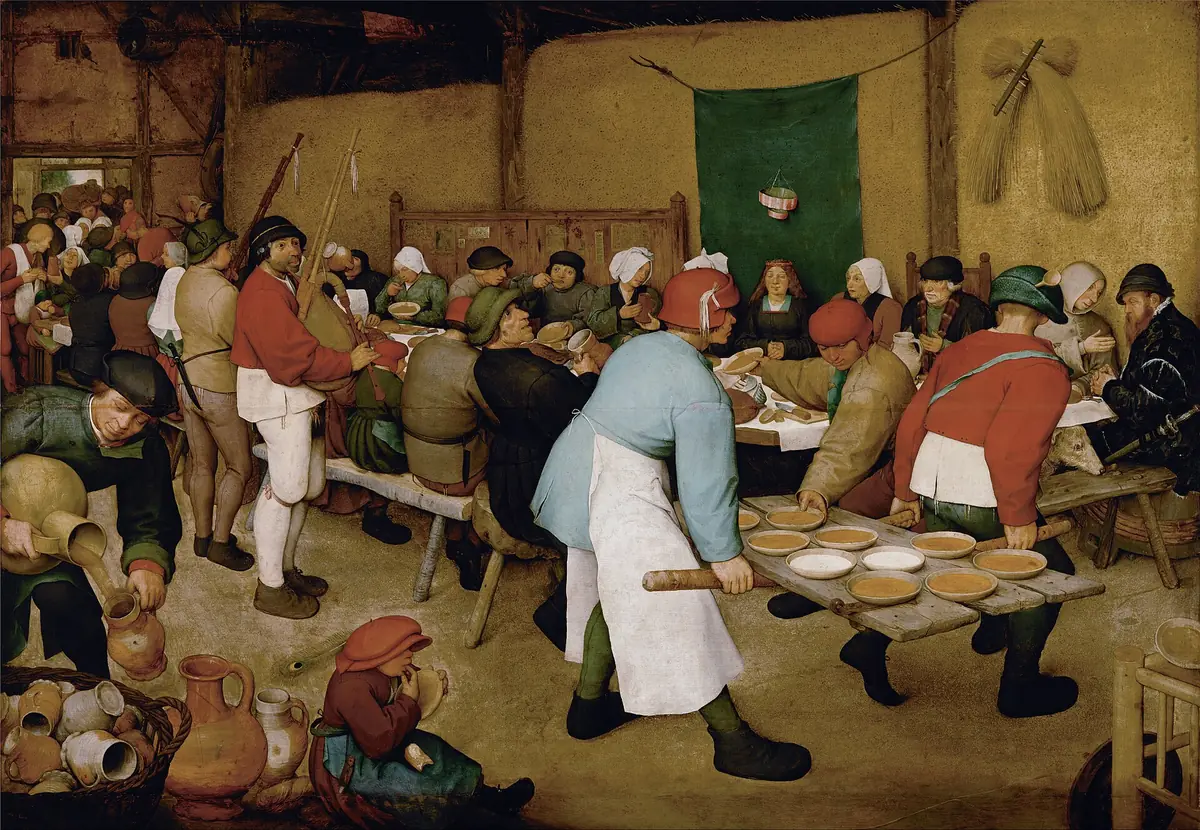
Image: Wikimedia Commons · Public domain (PD-Art) The Peasant Wedding
Look closely. Guests sit at a long table in a barn; two men carry a door used as a tray of bowls, a child licks a plate in the foreground, and the bride sits quietly under a paper crown. Look at the bagpiper, at the way the table recedes, at the stacked hat and the hanging lantern, and at how seriously the feast is organised — no one here is only a joke.
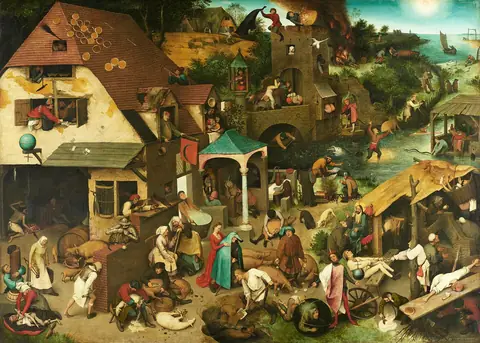
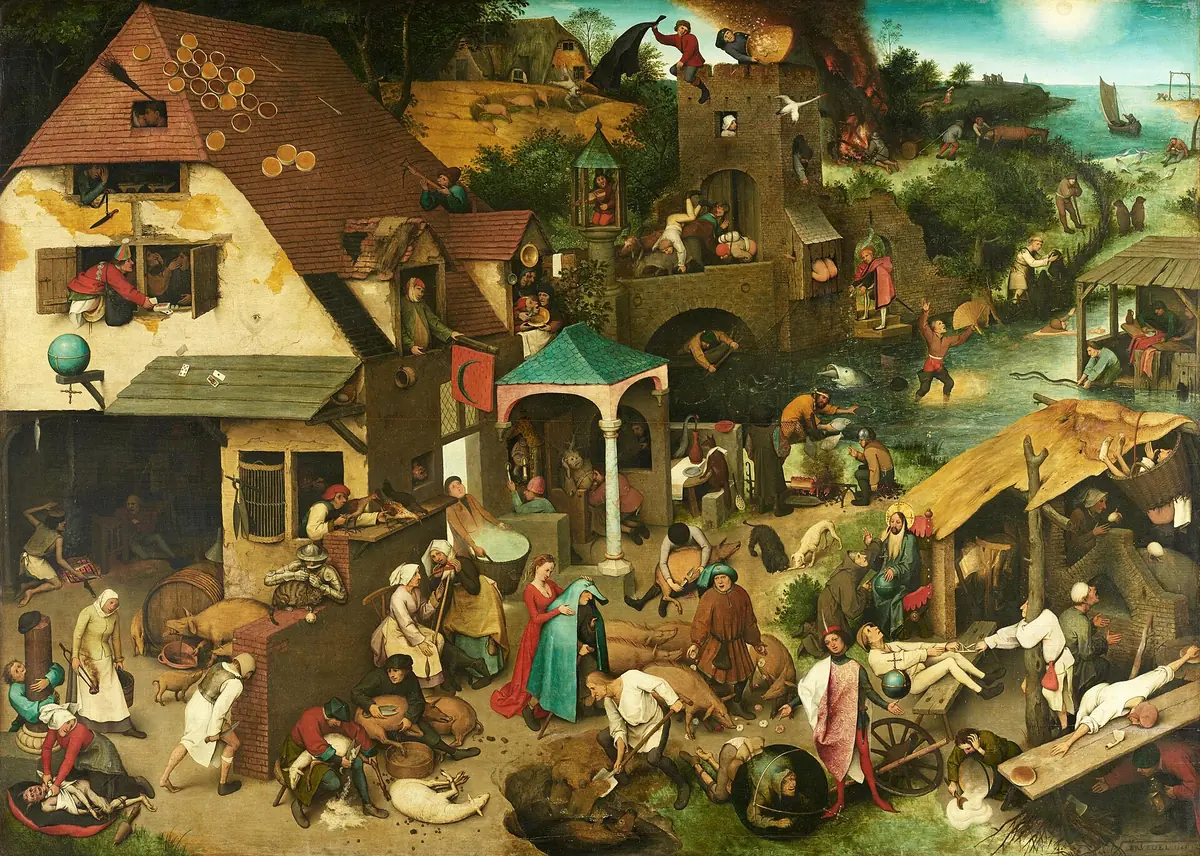
Image: Wikimedia Commons · Public domain (PD-Art) Netherlandish Proverbs
Look closely. A whole village is busy acting out sayings: a man shears a pig, another bangs his head against a wall, a roof is tiled with tarts, and more than a hundred proverbs can be read if you take the time. Look first at the blue-cloaked figure in the centre, then let the eye wander; the picture is meant to be searched, not taken in at a glance.
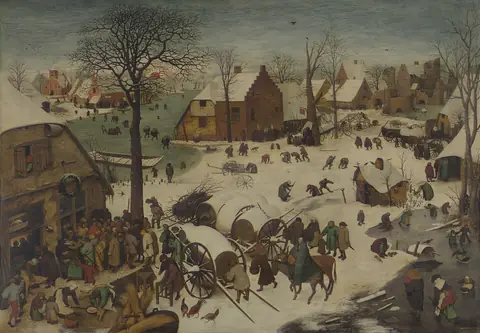
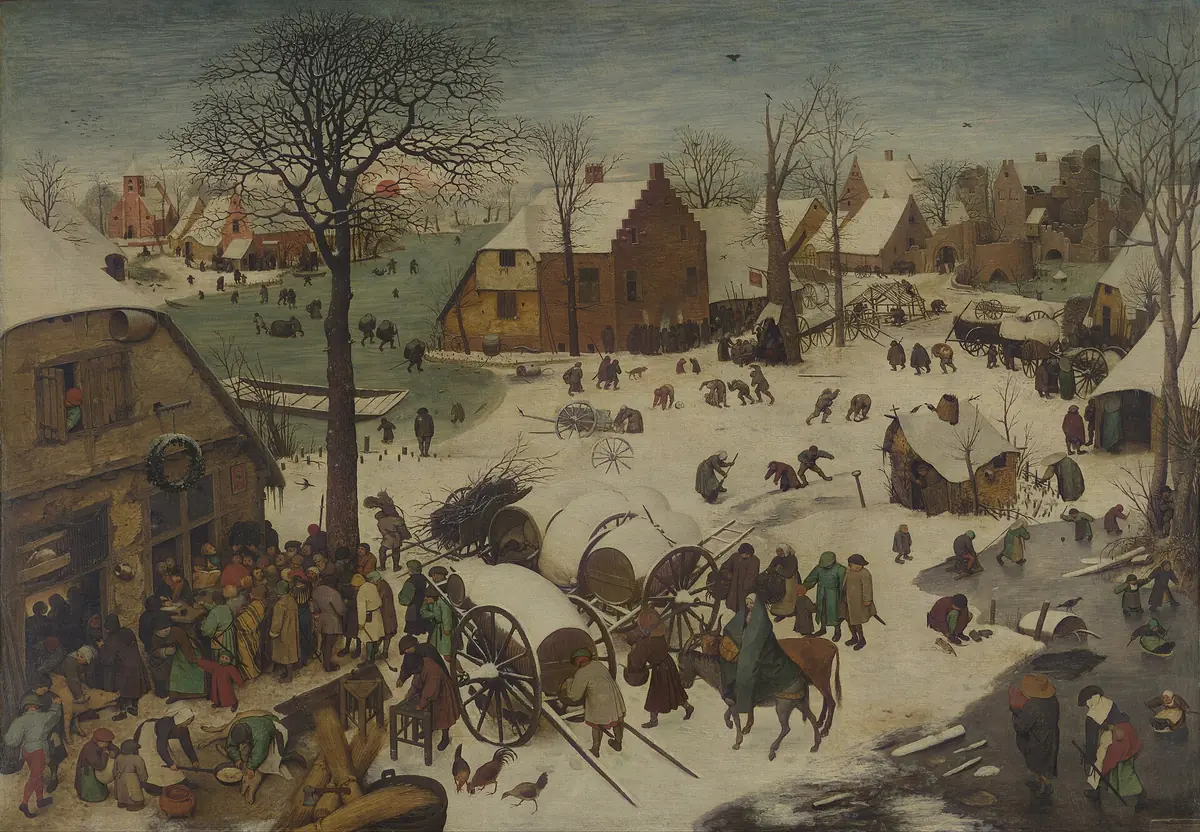
Image: Wikimedia Commons · Public domain (PD-Art) The Census at Bethlehem
Look closely. A Flemish village in winter is crowded with people paying a tax, skating, hauling loads and slaughtering a pig; almost hidden, Mary on the donkey and Joseph with a carpenter's saw arrive at the inn. Look for the ox and the donkey, for the bare trees and the frozen pond, and for how quietly the Holy Family enters a world that is not waiting for them.
In the library: The Bible (KJV) · Mary, mother of Jesus · Joseph of Nazareth · Jesus Christ
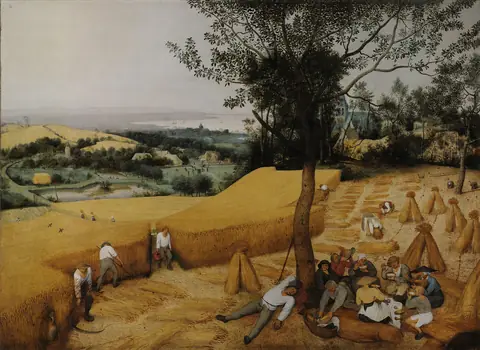
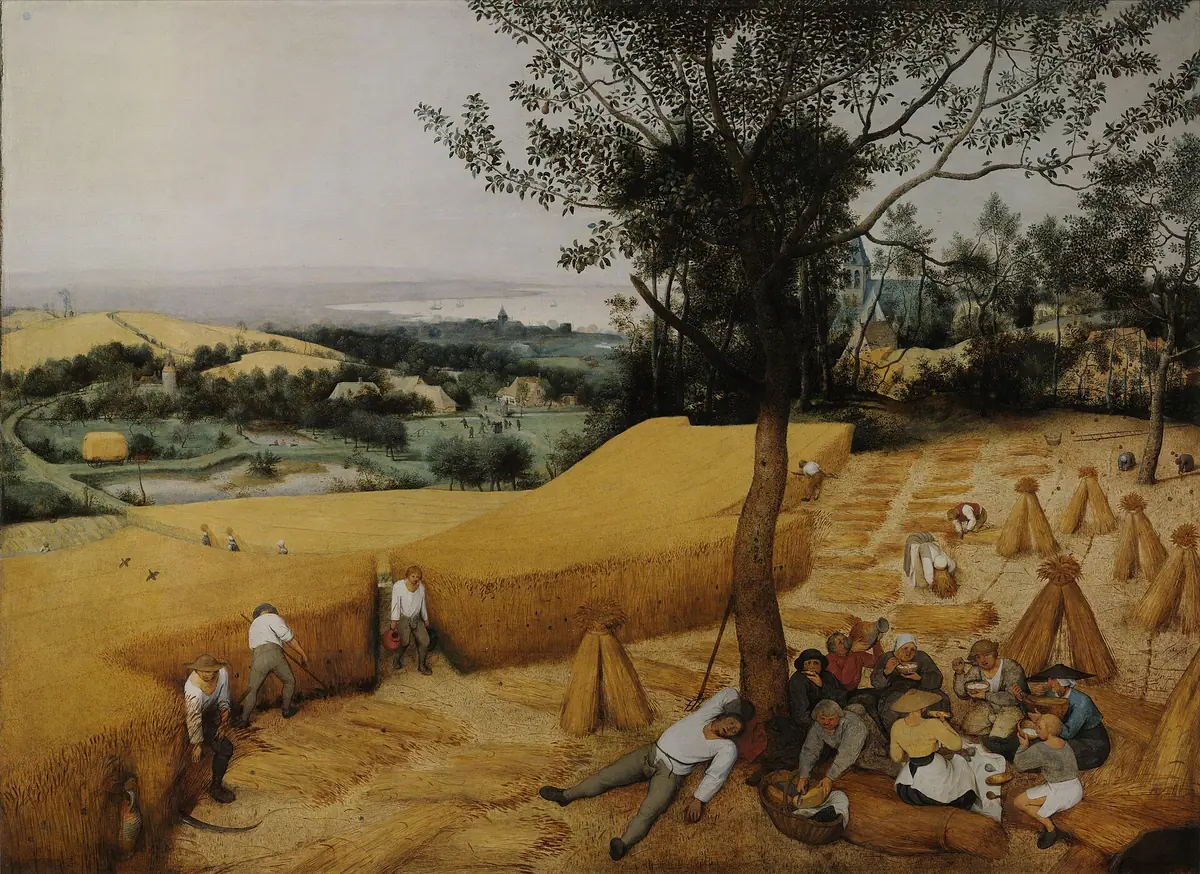
Image: Wikimedia Commons · Public domain (PD-Art) The Harvesters
Look closely. A wheat field has been partly cut; some labourers still swing their scythes, others eat and sleep under a pear tree in the heat of the day, and a village and a far bay open beyond. Look at the path through the grain, at the gold of the standing wheat against the worn green of the rest, and at the ordinary tiredness of men at mid-day.
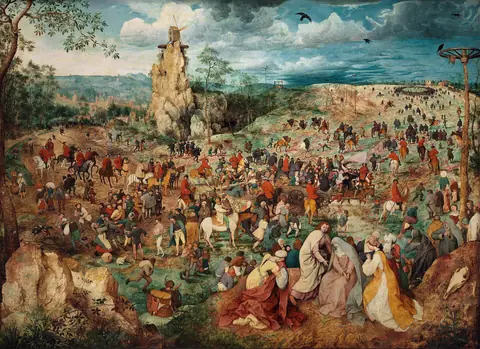
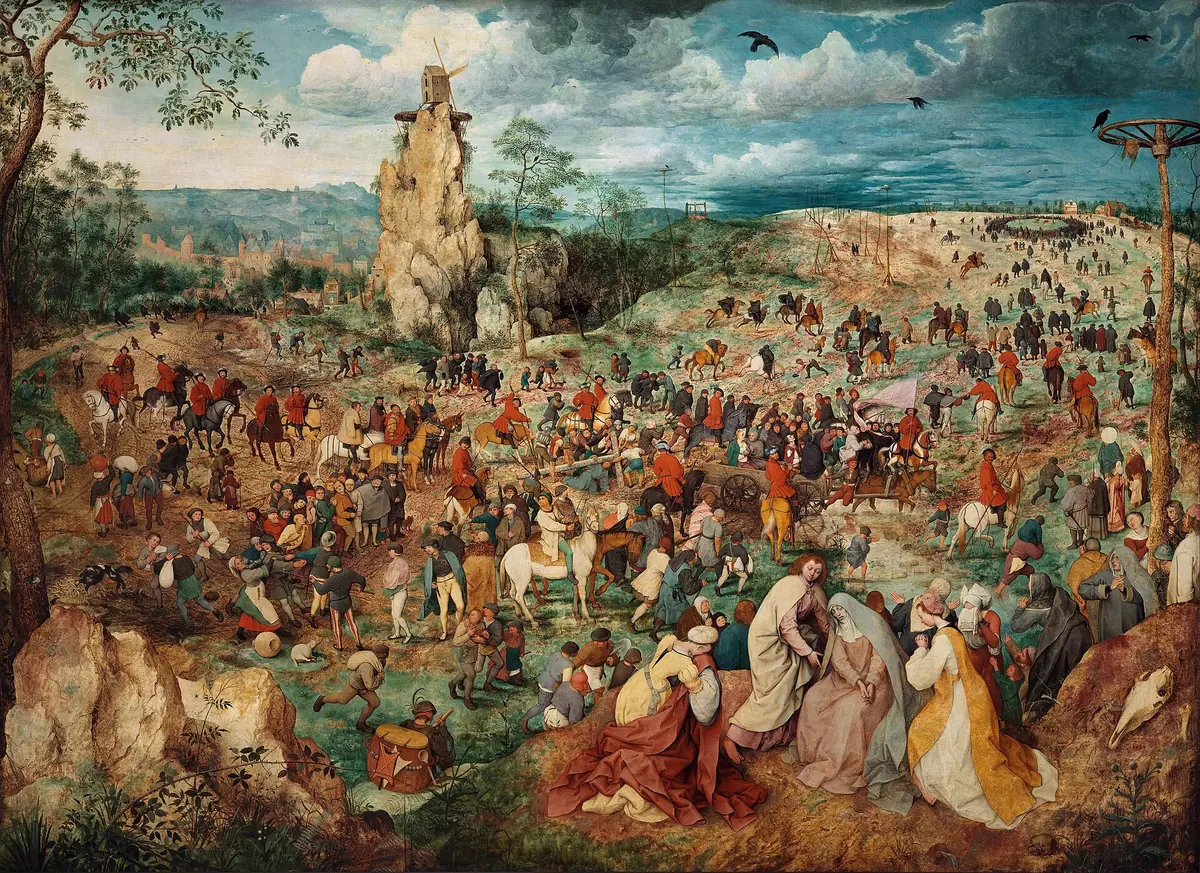
Image: Wikimedia Commons · Public domain (PD-Art) The Procession to Calvary
Look closely. A wide, windy landscape is filled with a procession; Christ fallen under the cross is a small figure in the middle, and the mourning women sit, larger and closer, in the foreground at the right. Look at the circle of onlookers already waiting on the far hill, at the cart with the two thieves, and at how public and how ordinary the road to the Crucifixion is made to seem.
In the library: The Bible (KJV) · Jesus Christ · Mary, mother of Jesus


What to watch for in Pieter Bruegel the Elder
Look slowly- A high view. Many pictures look down and out, so that a whole valley, village or season can be read at once.
- The story in the crowd. The sacred subject may be small: a tiny Mary on a donkey, a distant Calvary. Search for it.
- Work and weather. Hunters, harvesters, skaters and wedding guests are painted as people with jobs, not as types only.
- Proverbs and play. A comical group is often a saying made flesh.
- The far white distance. Ice, a river, or a pale mountain range can carry the eye out of the main scene.
For older students
These famous works include nudity, so they are named here but not shown. Teachers and parents can decide when to look at them together.
- The Triumph of Death, c. 1562, Prado, Madrid. An army of skeletons overruns a wide, burning landscape. It is a grim picture, named here but not shown.
Dates and collections follow the holding museums and Wikidata. Images of paintings are photographs of public-domain pictures from Wikimedia Commons or museum open-access releases; photographs of sculpture are used only when the photograph itself is Public domain, CC0, or CC BY with a named credit. Each picture links to its source page with full licence details.