Great Art · Venetian / Mannerism
Tintoretto
The rapid Venetian of the scuole, who filled immense walls with light, shadow and the Gospel told at a rush.
His life
Jacopo Robusti, called Tintoretto from his father's trade as a dyer, was born in Venice in 1518 and spent almost his whole life there. He is said to have worked briefly in Titian's studio and then gone his own way, painting at great speed, often on a huge scale, for parish churches and for the great confraternities. The Scuola Grande di San Rocco became his life's work: wall after wall of the life of Christ and of the Virgin, painted over decades.
He died in Venice in 1594 and was buried in the Madonna dell'Orto, a church he had already filled with paintings. His gift was drama in light. Figures turn, stoop and reach in sudden beams, and a sacred story can look as if it were happening this minute, in a deep hall or on a steep flight of steps, among ordinary Venetian faces.
Key works
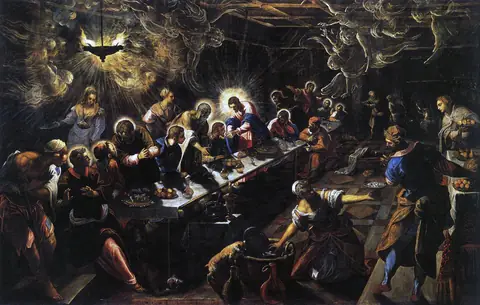
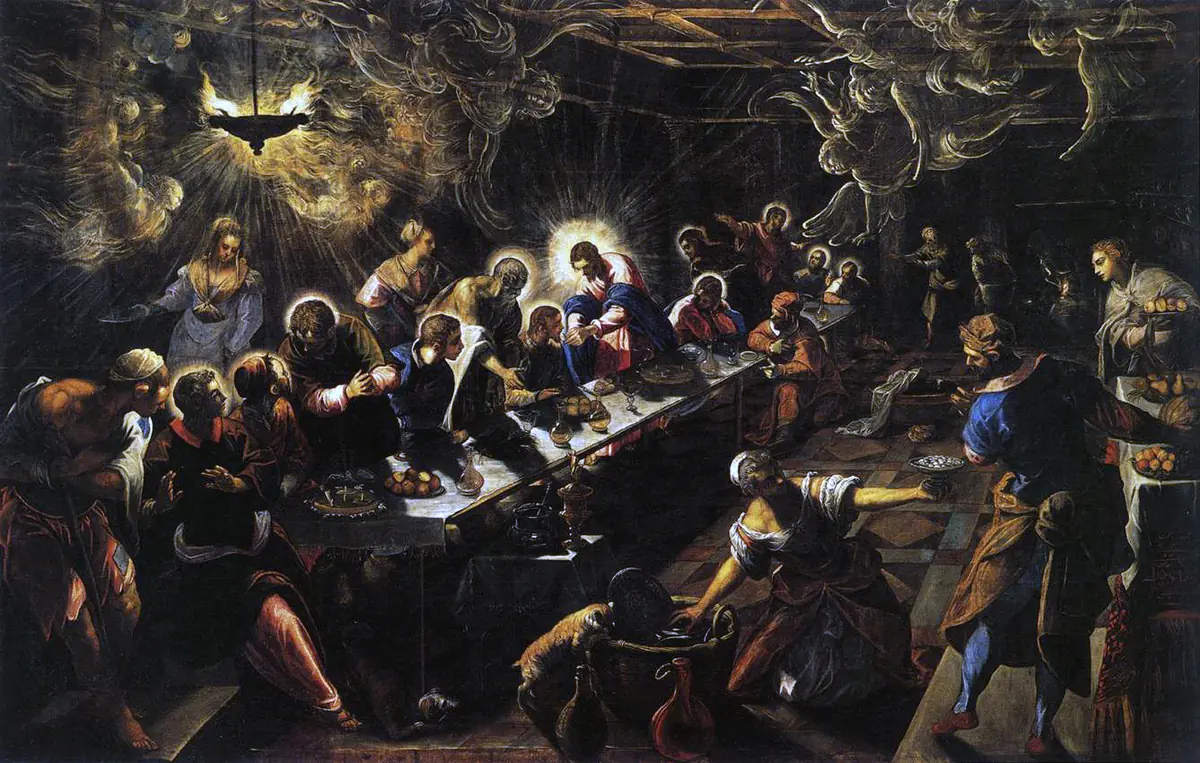
Image: Wikimedia Commons · Public domain (PD-Art) The Last Supper
Look closely. In a deep, lamp-lit hall the table is set on a sharp diagonal; Christ is at the centre offering bread, the apostles react along the board, and ghostly angels gather in the rafters. Look at the servants and the cat in the foreground, at the hanging lamp, and at how a familiar subject is turned into a night scene of mystery and hospitality at once.
In the library: The Bible (KJV) · Jesus Christ · Peter
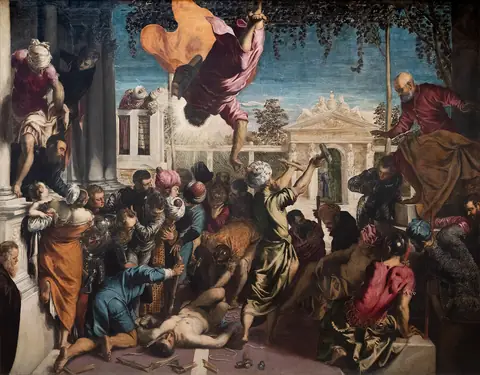
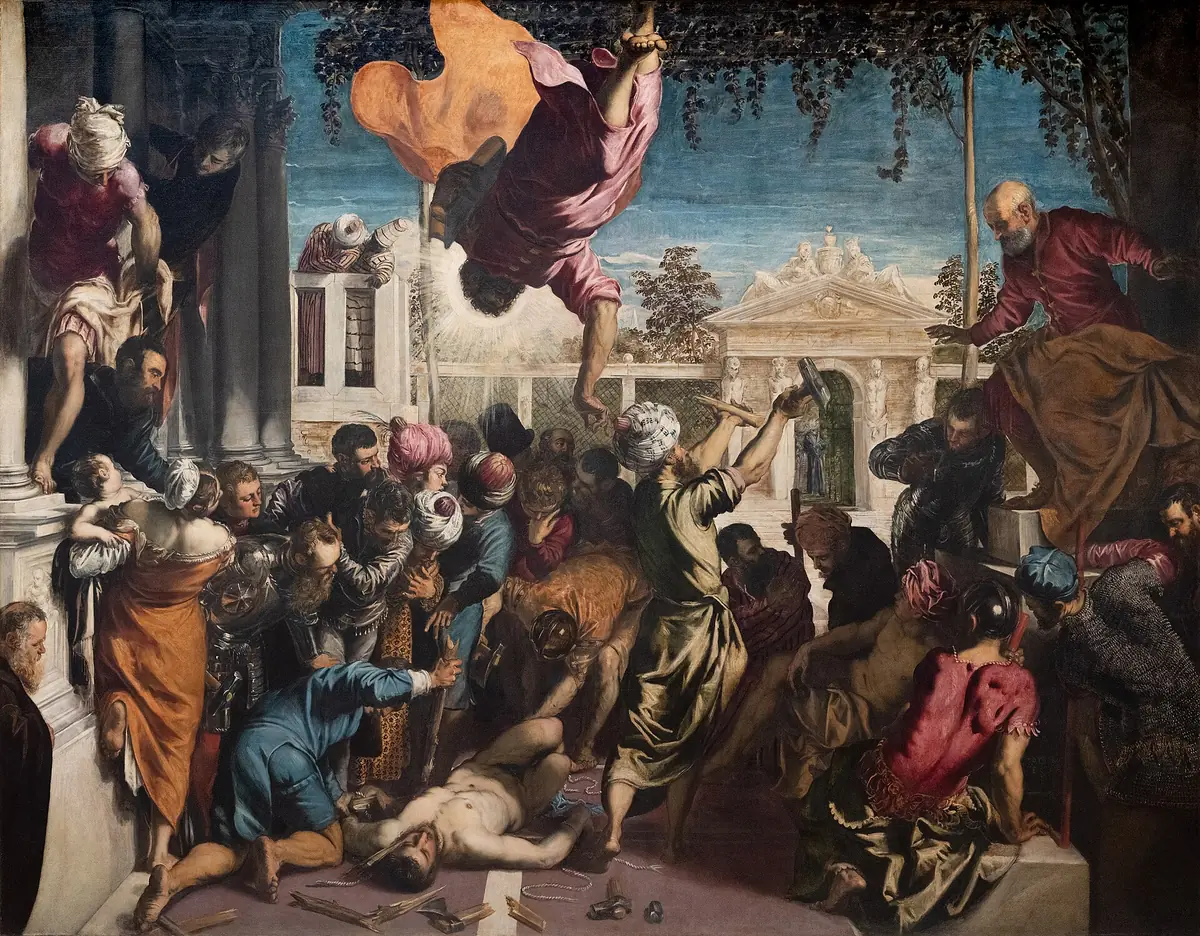
Image: Wikimedia Commons · Public domain (PD-Art) The Miracle of the Slave
Look closely. Saint Mark plunges down from the sky to free a slave who was being punished for visiting the saint's tomb; the broken instruments of torture lie on the ground, and a crowd in rich dress fills a wide loggia. Look at the foreshortened body of the saint in the air, at the pale slave on the stone, and at the stunned faces of the judges and spectators.
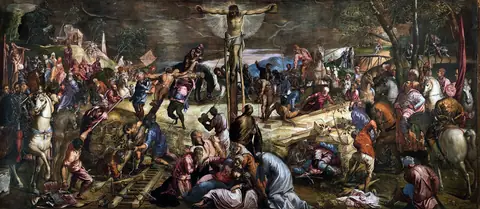
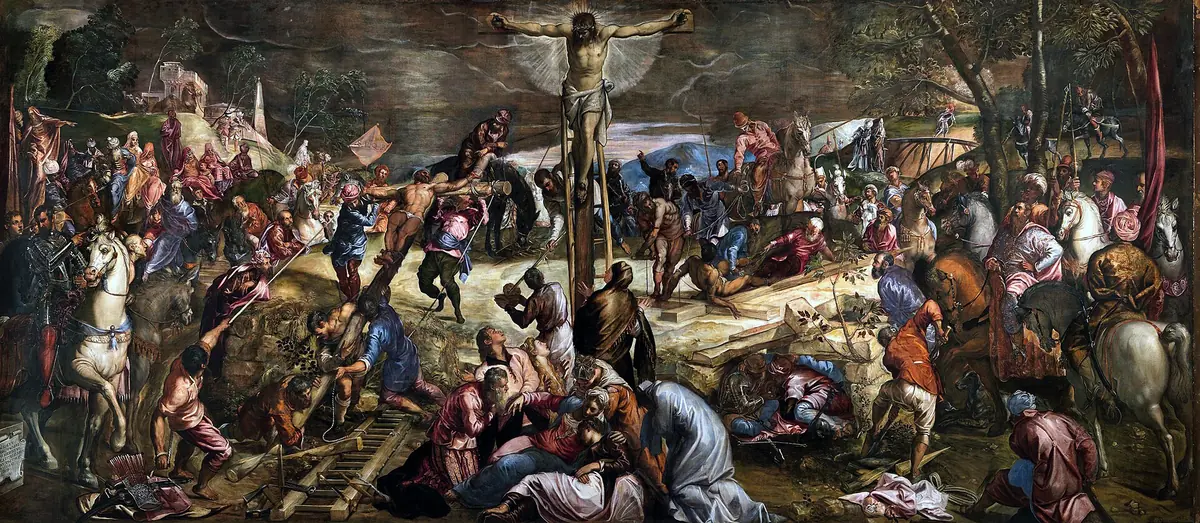
Image: Wikimedia Commons · Public domain (PD-Art) The Crucifixion
Look closely. A vast wall of the Crucifixion: Christ is already raised at the centre, the two thieves are still being lifted or bound, and a crowd of soldiers, mourners and workers fills the hill. Look at the men straining at the ropes, at the group of women at the foot of the cross, and at how many smaller stories are going on at the edges of the one great death.
In the library: The Bible (KJV) · Jesus Christ · Mary, mother of Jesus
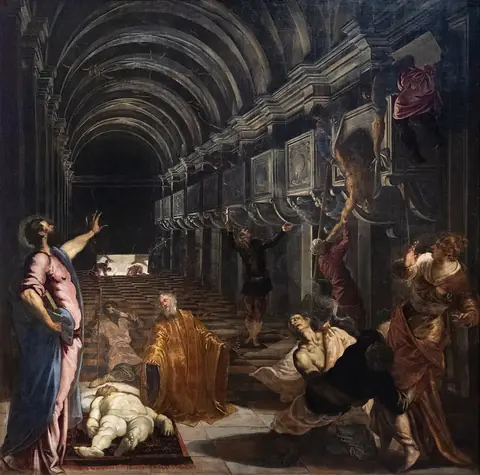
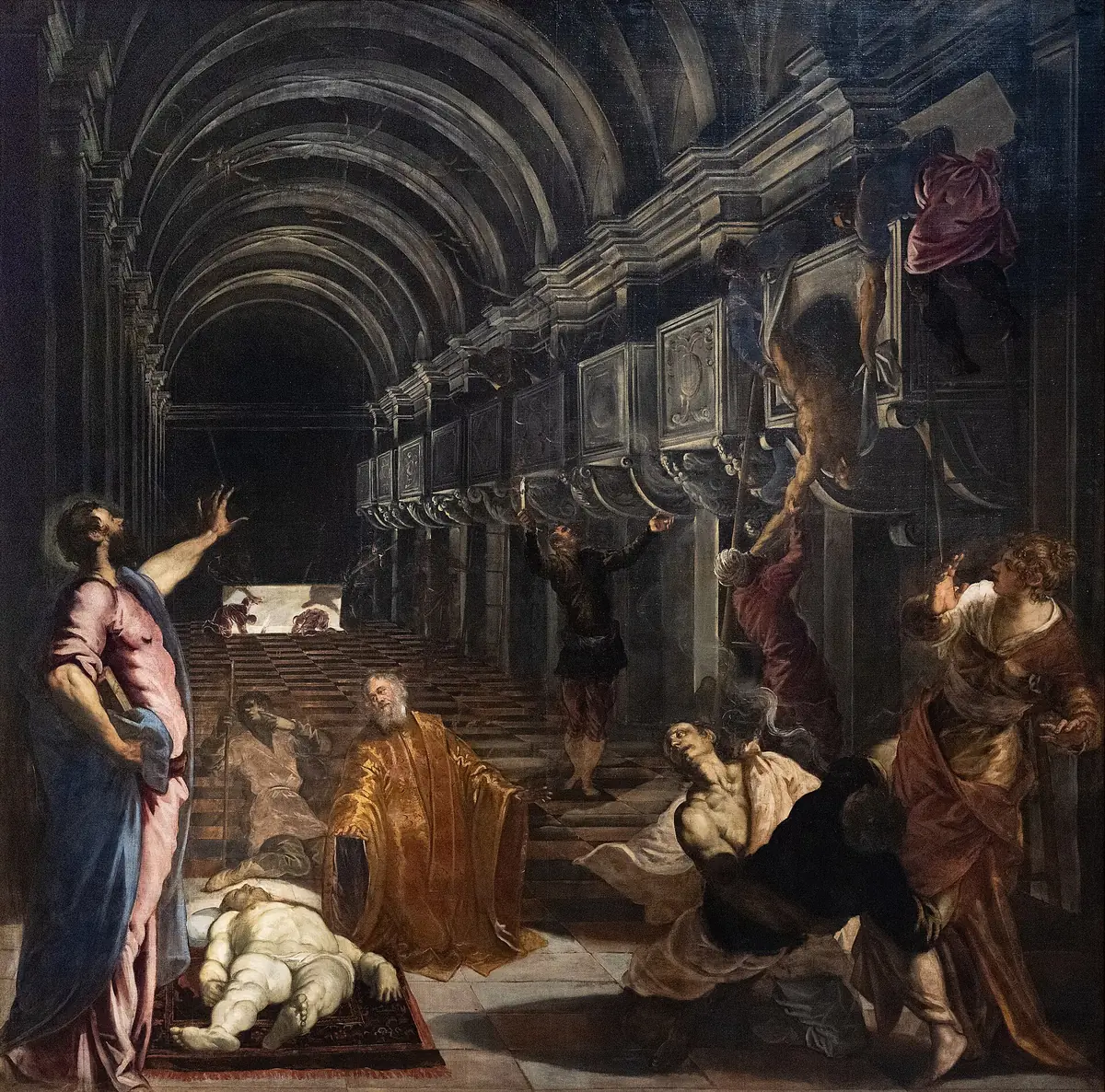
Image: Wikimedia Commons · Public domain (PD-Art) The Finding of the Body of Saint Mark
Look closely. In a long, vaulted interior, Saint Mark himself appears and halts the searchers who are pulling bodies from tombs; a corpse lies in the foreground, and a steep chequered floor runs away into the dark. Look at the sudden gesture of the saint, at the falling, twisting figures, and at the cold light on stone and flesh.
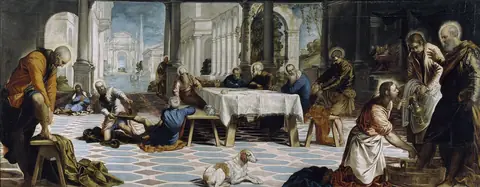
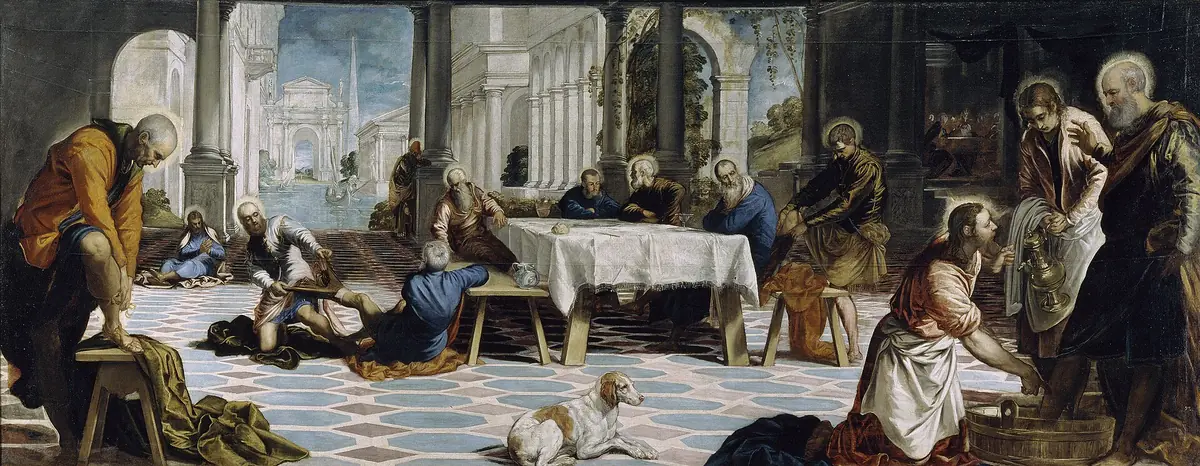
Image: Wikimedia Commons · Public domain (PD-Art) Christ Washing the Disciples' Feet
Look closely. Christ kneels to wash a disciple's feet in a wide hall that opens toward a distant feast; other apostles wait, talk, or pull at a stocking, and the space is almost as important as the act. Look at the deep perspective, at Peter's reluctance made visible in a gesture, and at how a humble service is given the scale of a public event.
In the library: The Bible (KJV) · Jesus Christ · Peter
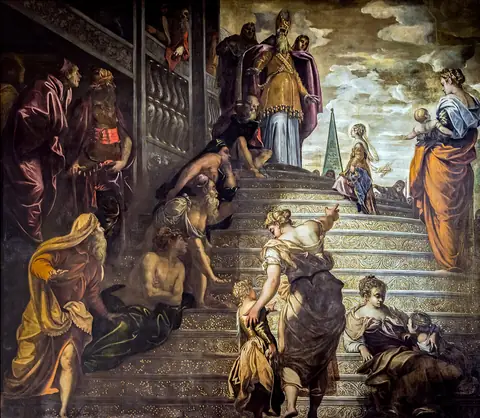
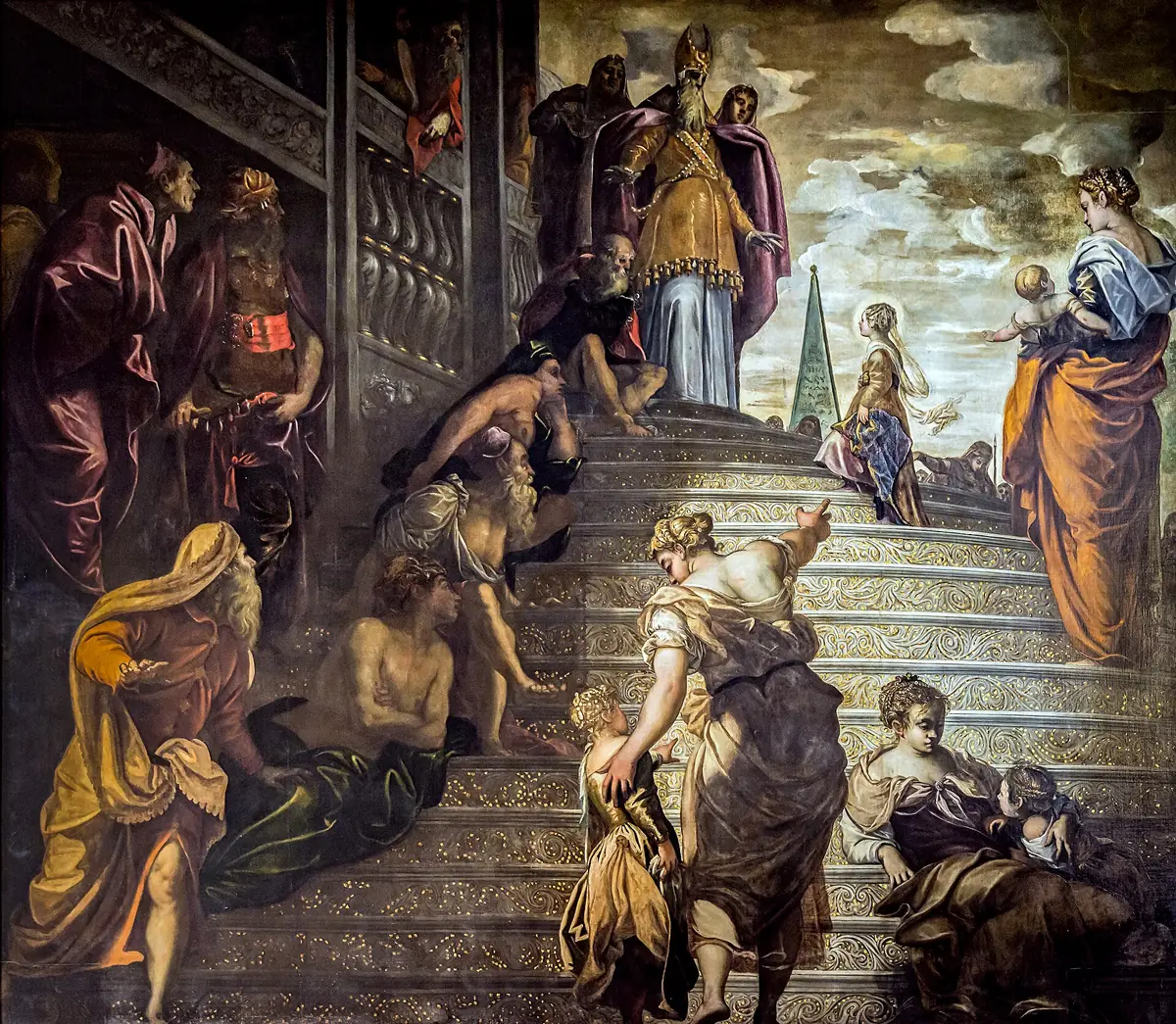
Image: Wikimedia Commons · Public domain (PD-Art) The Presentation of the Virgin
Look closely. A little girl climbs a steep, crowded flight of steps toward the high priest, her mother and a press of onlookers below. Look at the bold, almost plunging staircase, at the tiny upright figure of Mary, and at the way ordinary spectators — a woman, a child, a sitting man — fill the lower steps and make the old story feel like a civic ceremony.
In the library: Mary, mother of Jesus
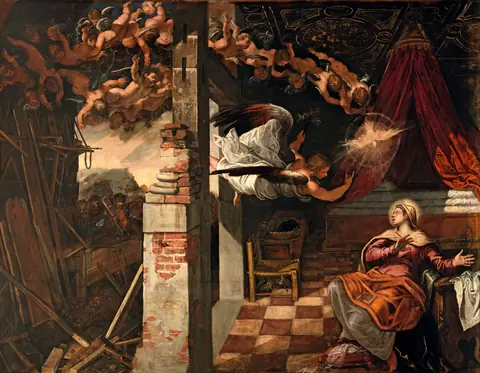
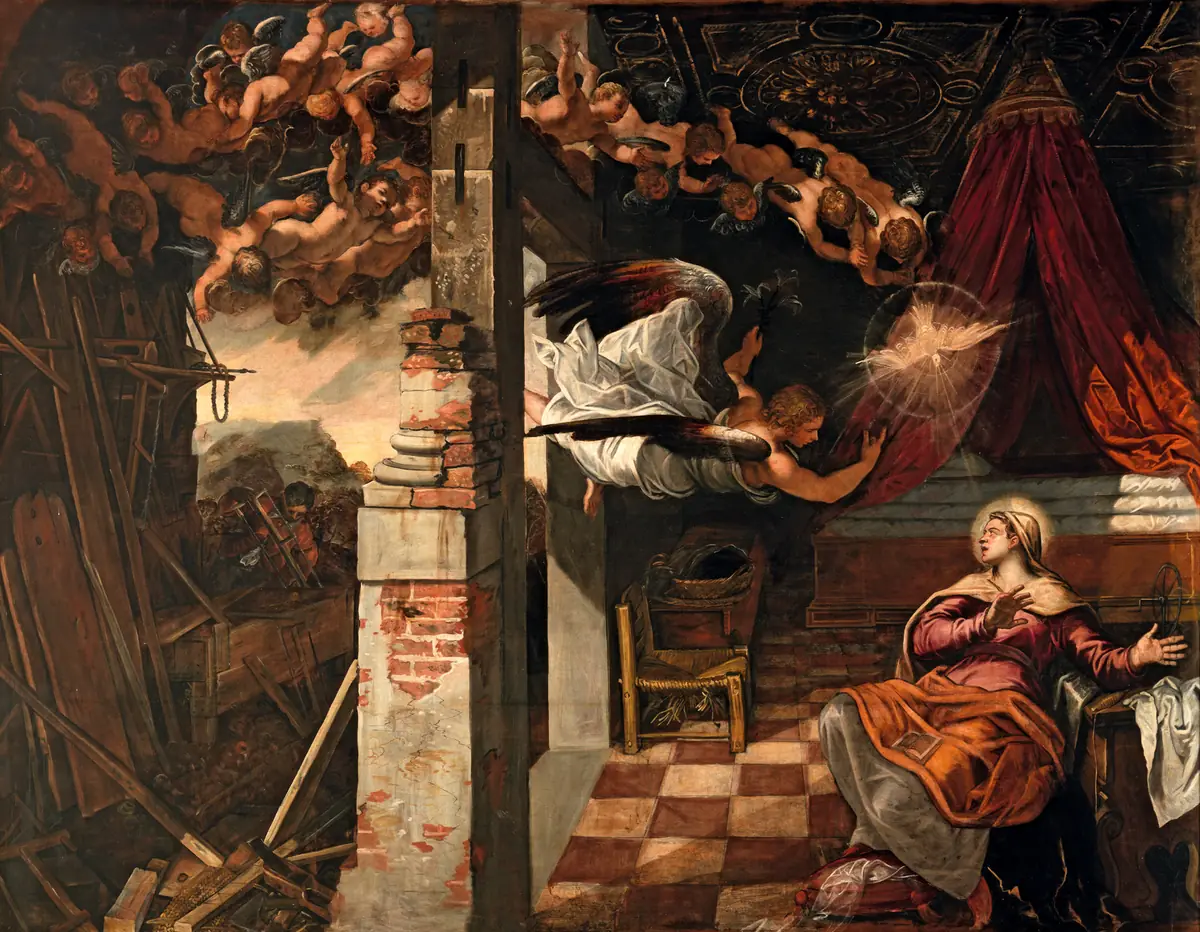
Image: Wikimedia Commons · Public domain (PD-Art) The Annunciation
Look closely. Gabriel rushes in from the left, a tumble of angels behind him, while Mary turns at her reading desk in a ruined, very solid Venetian room. Look at the carpenter's tools and the broken brickwork, at the dove in a burst of light, and at the contrast between the battered workshop and the sudden arrival of the message.
In the library: The Bible (KJV) · Mary, mother of Jesus


What to watch for in Tintoretto
Look slowly- A shaft of light. A lamp, a window, or a supernatural glow often cuts the darkness and shows you where to look.
- Steep space. Tables, steps and floors tip up or run away, so that you seem to stand in the room.
- Speed of the brush. Edges can be rough; the energy is part of the meaning.
- Ordinary people in a sacred story. Servants, boatmen and onlookers crowd the edges of miracles.
- A whole wall as one picture. At San Rocco, stand back first, then go close.
For older students
These famous works include nudity, so they are named here but not shown. Teachers and parents can decide when to look at them together.
- Susanna and the Elders, c. 1555–56, Kunsthistorisches Museum, Vienna. Susanna is shown unclothed at her bath, watched by the elders. Named here but not shown.
- The Origin of the Milky Way, c. 1575, National Gallery, London. A mythological picture with unclothed figures of Juno and Jupiter. Named here but not shown.
Dates and collections follow the holding museums and Wikidata. Images of paintings are photographs of public-domain pictures from Wikimedia Commons or museum open-access releases; photographs of sculpture are used only when the photograph itself is Public domain, CC0, or CC BY with a named credit. Each picture links to its source page with full licence details.