Great Art · Medieval (Siena)
Duccio
The great painter of Siena, who told the life of Christ in dozens of small, glowing panels on the back of his Maestà.
His life
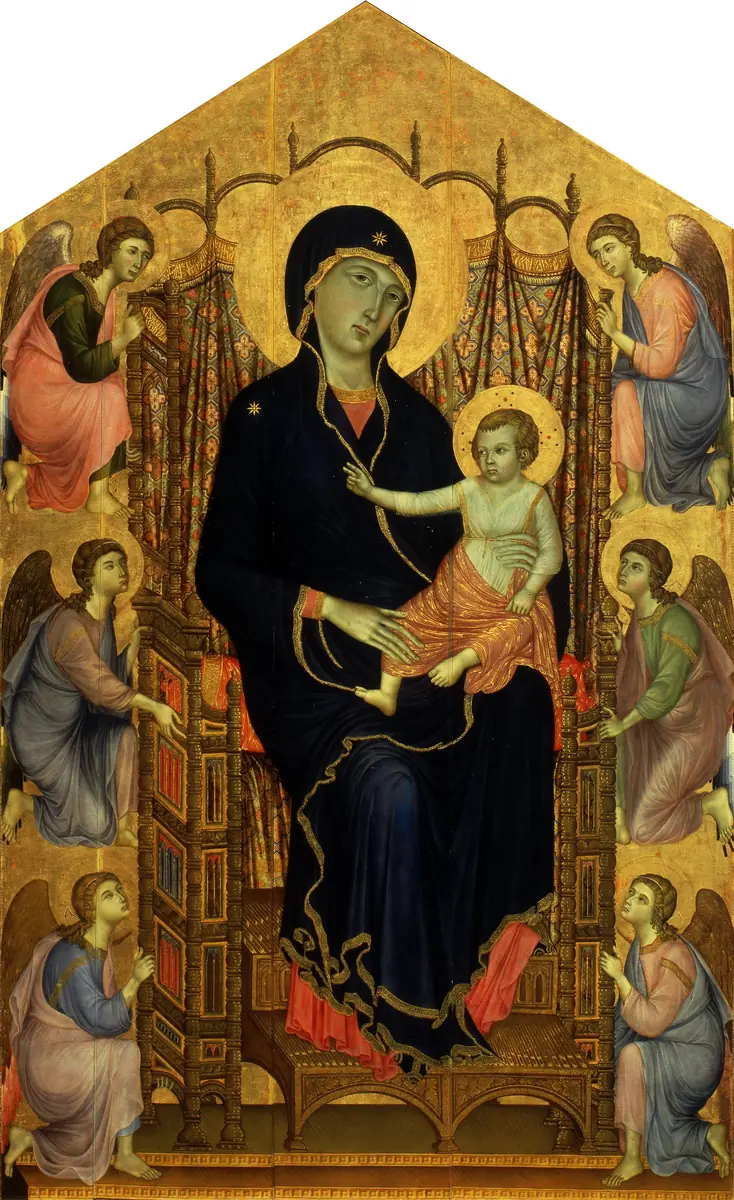
Duccio di Buoninsegna was the leading painter of Siena in the years around 1300, a generation close to Giotto but with a different gift. Where Giotto built solid, staged spaces, Duccio kept a lyrical line, tender faces and colours that seem to shine from within the gold. In 1285 he painted the Rucellai Madonna for a chapel in Florence. His masterpiece is the Maestà, the huge double-sided altarpiece made for the high altar of Siena Cathedral between 1308 and 1311. When it was carried from his workshop to the cathedral, the city walked with it in procession.
The front of the Maestà shows Mary and the Child enthroned among angels and the city's patron saints. The back, and the predella, told the life of Christ in many small scenes, several of which are now in museums far from Siena. Duccio ran a busy workshop and sometimes fell foul of the city's officers, but the Maestà remained Siena's treasure. His gift was storytelling in miniature: he could put a whole Gospel episode into a panel the size of a window, and still leave you room to look at a face.
Key works
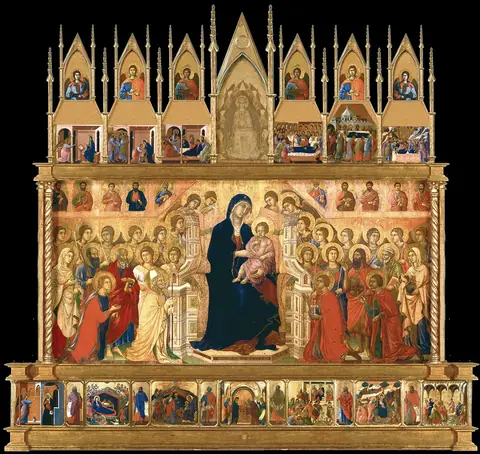
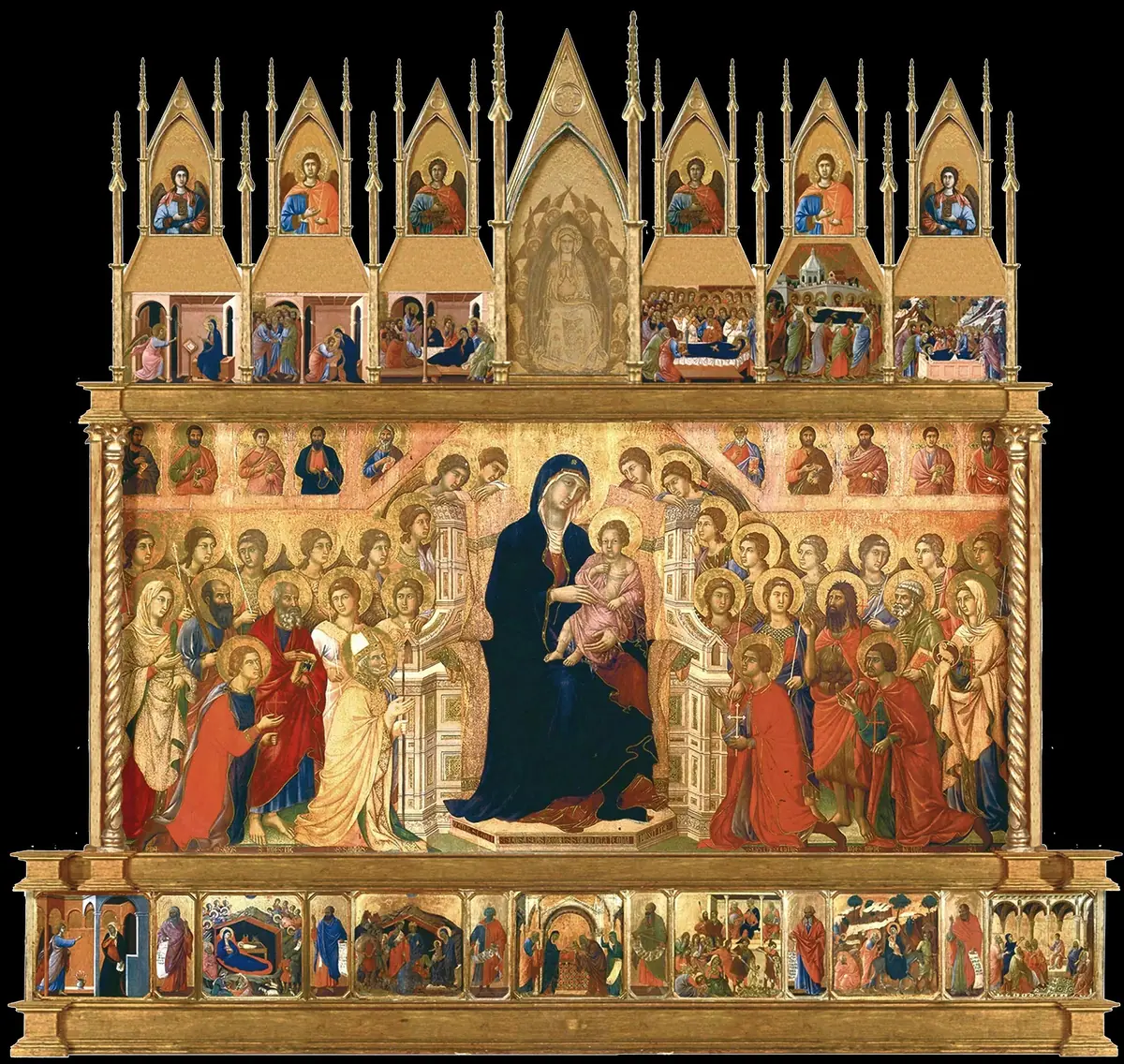
Image: Wikimedia Commons · Public domain (PD-Art) Maestà
Look closely. This image is a reconstruction of the original front, with pinnacles and a predella around the central court of heaven: Mary and the Child on a wide throne, angels in rows, and Siena's patron saints kneeling in front. The altarpiece was made for the cathedral's high altar and later taken apart; the great central assembly is still in Siena, while some small scenes are now in other museums.
In the library: The Bible (KJV) · Mary, mother of Jesus · Jesus Christ · Giotto
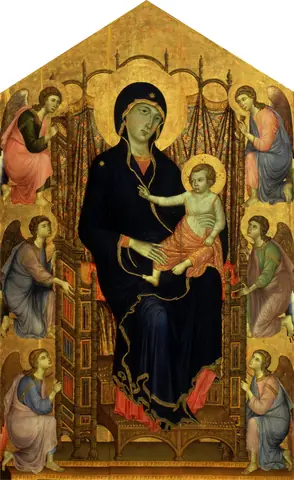
Image: Wikimedia Commons · Public domain (PD-Art) Rucellai Madonna
Look closely. This tall panel was painted for Santa Maria Novella in Florence, a few years after Cimabue's great Madonnas. Six angels hold the throne, three on each side, and the Child's blessing hand is very small and precise. Compare the angels' faces and the fall of Mary's blue cloak with Cimabue's Santa Trinita Maestà in the same gallery.
In the library: The Bible (KJV) · Mary, mother of Jesus · Cimabue
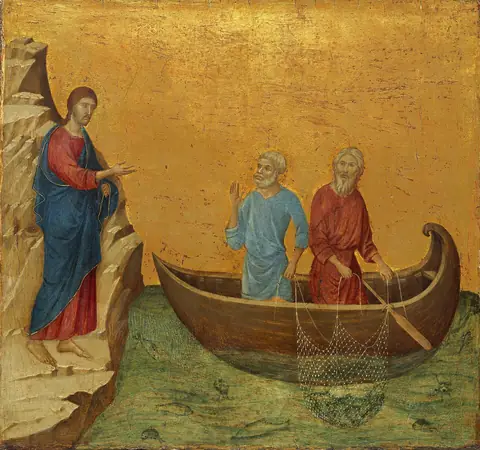
Image: Wikimedia Commons · Public domain (PD-Art) The Calling of the Apostles Peter and Andrew
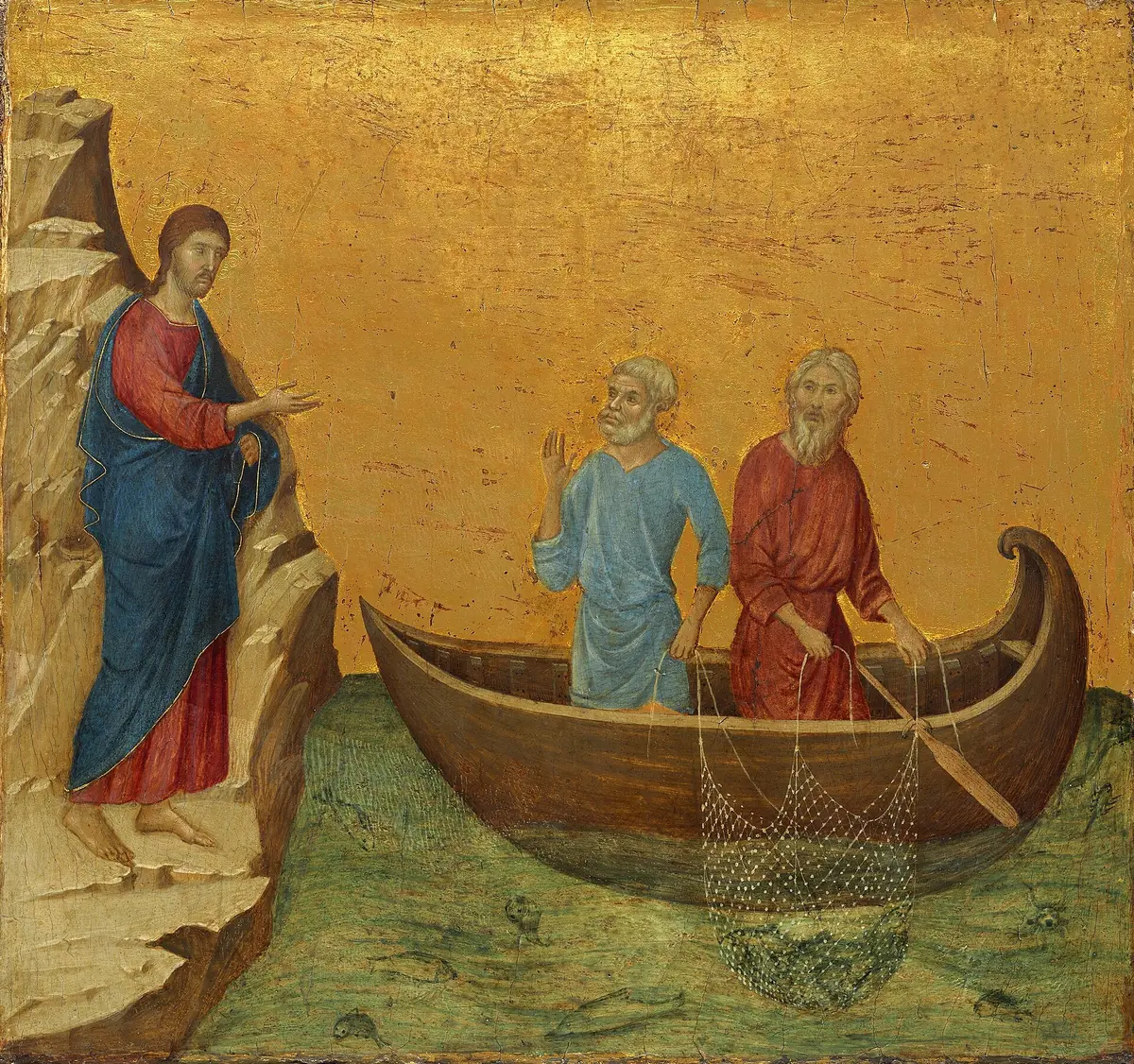
Look closely. From a rock on the shore, Christ calls the two brothers, who are still in their boat with a net full of fish. One already raises his hands; the other is still busy with the catch. The gold sky meets a curly, stylised sea. This was one of the small back panels of the Maestà.
In the library: The Bible (KJV) · Apostle Peter · Jesus Christ
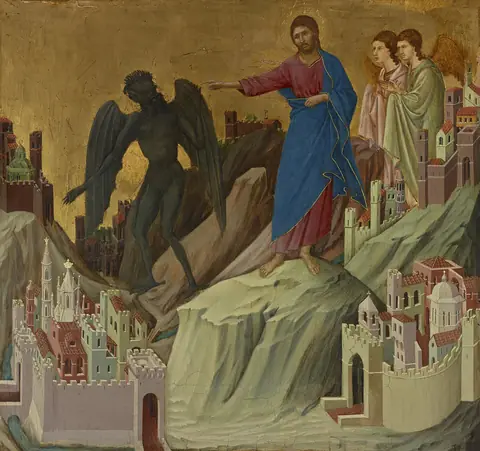
Image: Wikimedia Commons · Public domain (PD-Art) The Temptation of Christ on the Mountain
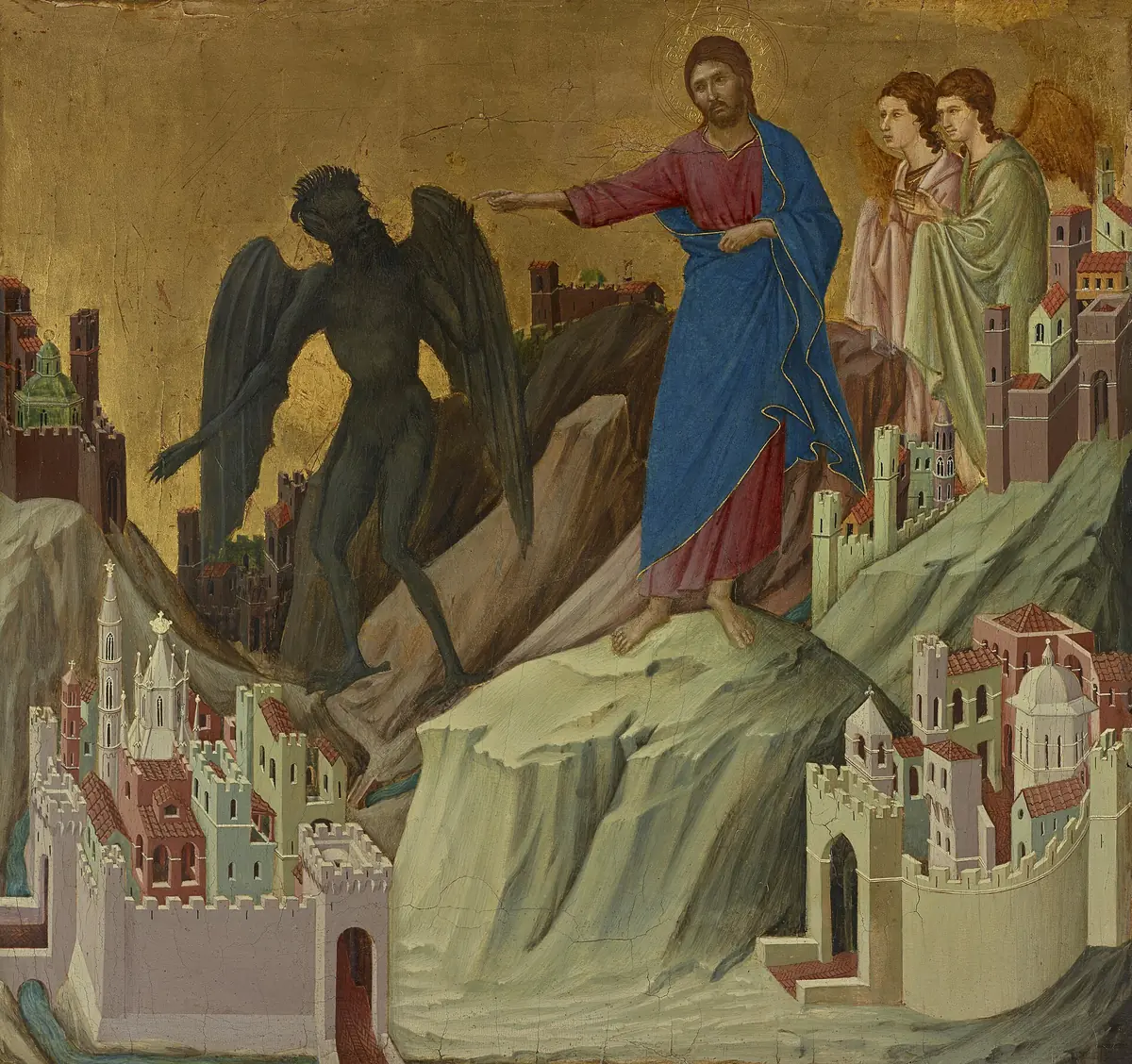
Look closely. The devil, a dark winged figure, offers Christ the kingdoms of the world, which Duccio paints as small coloured cities on the tops of crags. Christ stands firm on the highest rock. After the temptation, angels come in from the side. The panel, once part of the Maestà, is only a little larger than a traveller's book.
In the library: The Bible (KJV) · Jesus Christ
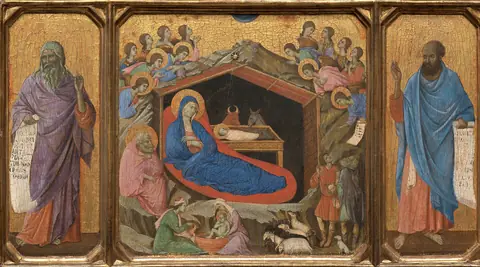
Image: Wikimedia Commons · Public domain (PD-Art) The Nativity with the Prophets Isaiah and Ezekiel
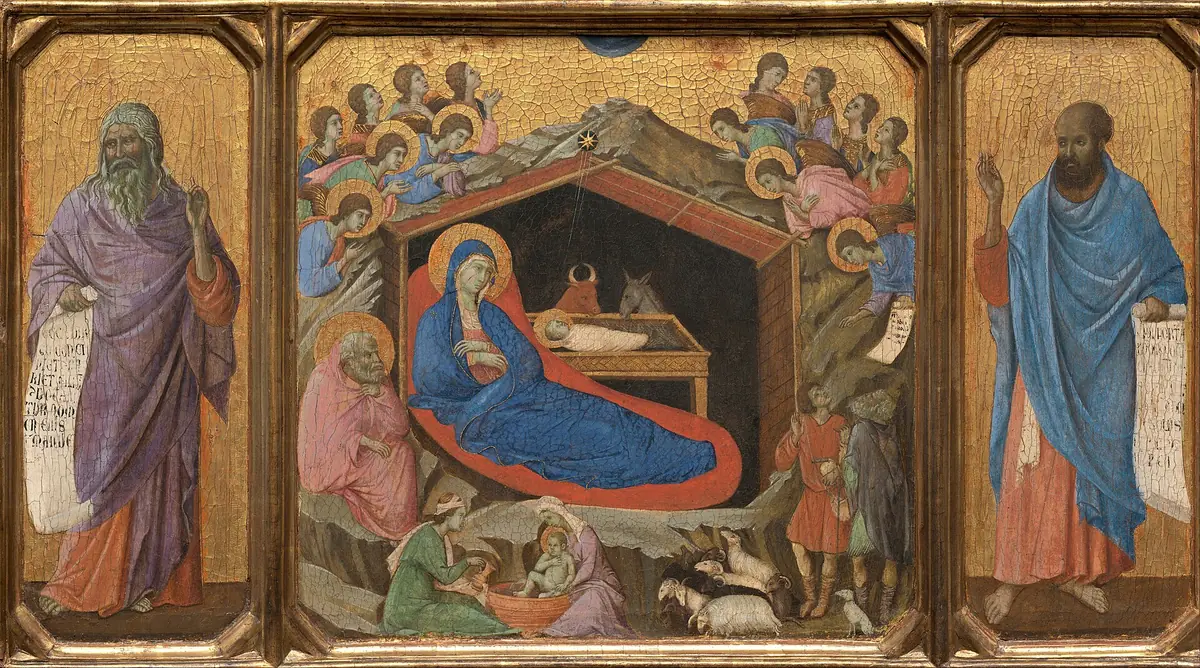
Look closely. The birth itself is packed into the centre: Mary, the Child in the manger, the ox and ass, Joseph seated in thought, and the midwives washing the Child. On either side, in their own panels, the prophets Isaiah and Ezekiel unfurl scrolls that point to this moment. It is a lesson in how the old promises and the Gospel scene were read together.
In the library: The Bible (KJV) · Jesus Christ · Mary, mother of Jesus · Isaiah
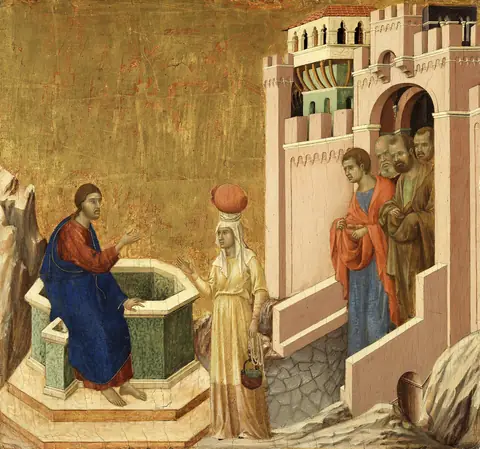
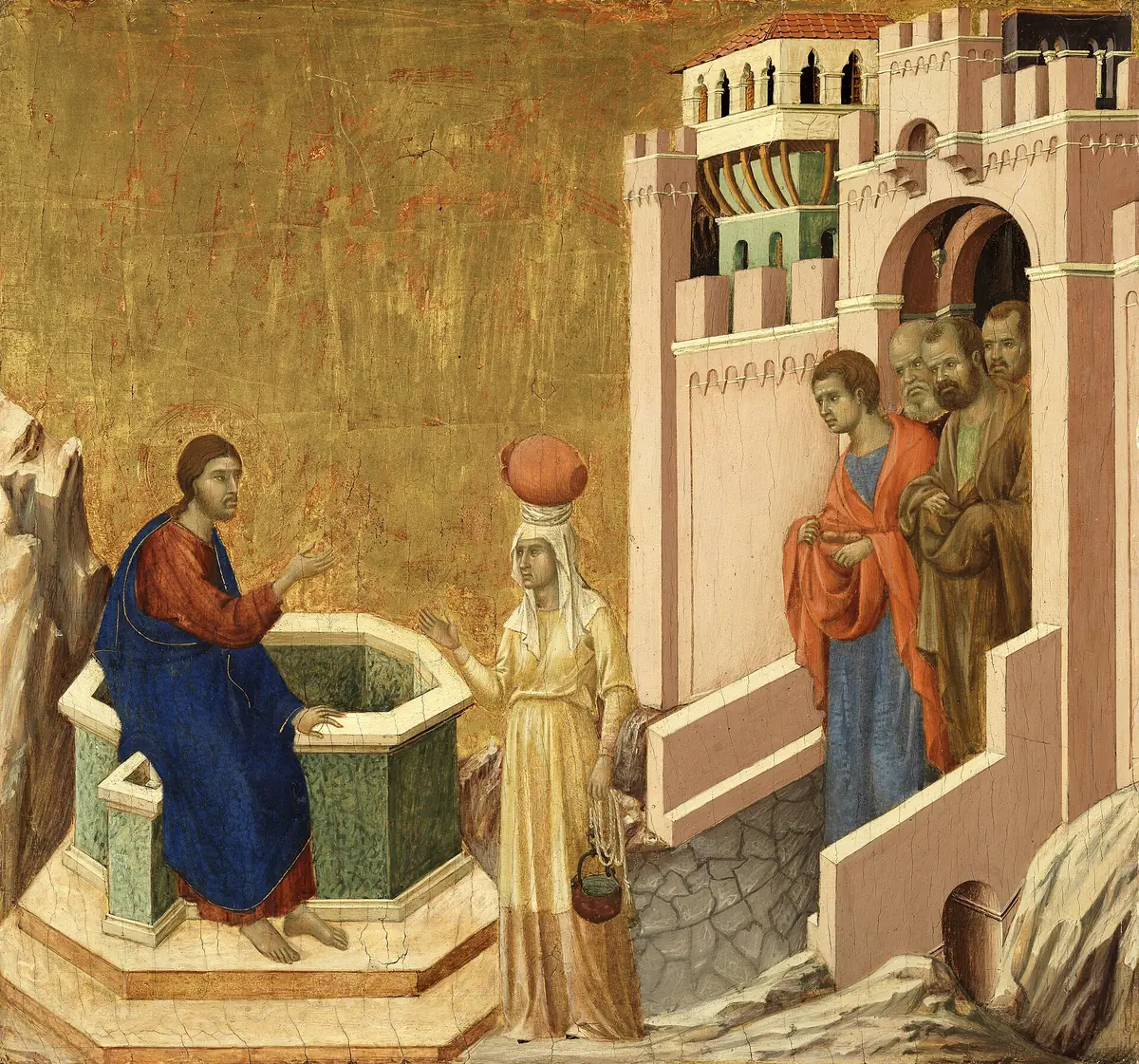
Image: Wikimedia Commons · Public domain (PD-Art) Christ and the Samaritan Woman
Look closely. Christ sits at the well and speaks with the Samaritan woman, who holds her jar and listens. Behind them a little walled town stands for Sychar, and the disciples return along the path. Look at the well-head, a solid stone cylinder, and at how much of the talk is told simply by the turn of the two heads.
In the library: The Bible (KJV) · Jesus Christ
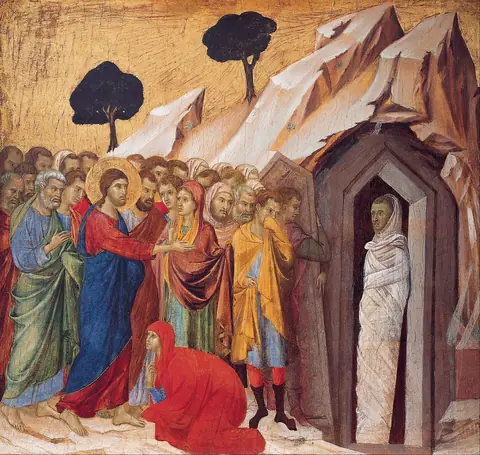
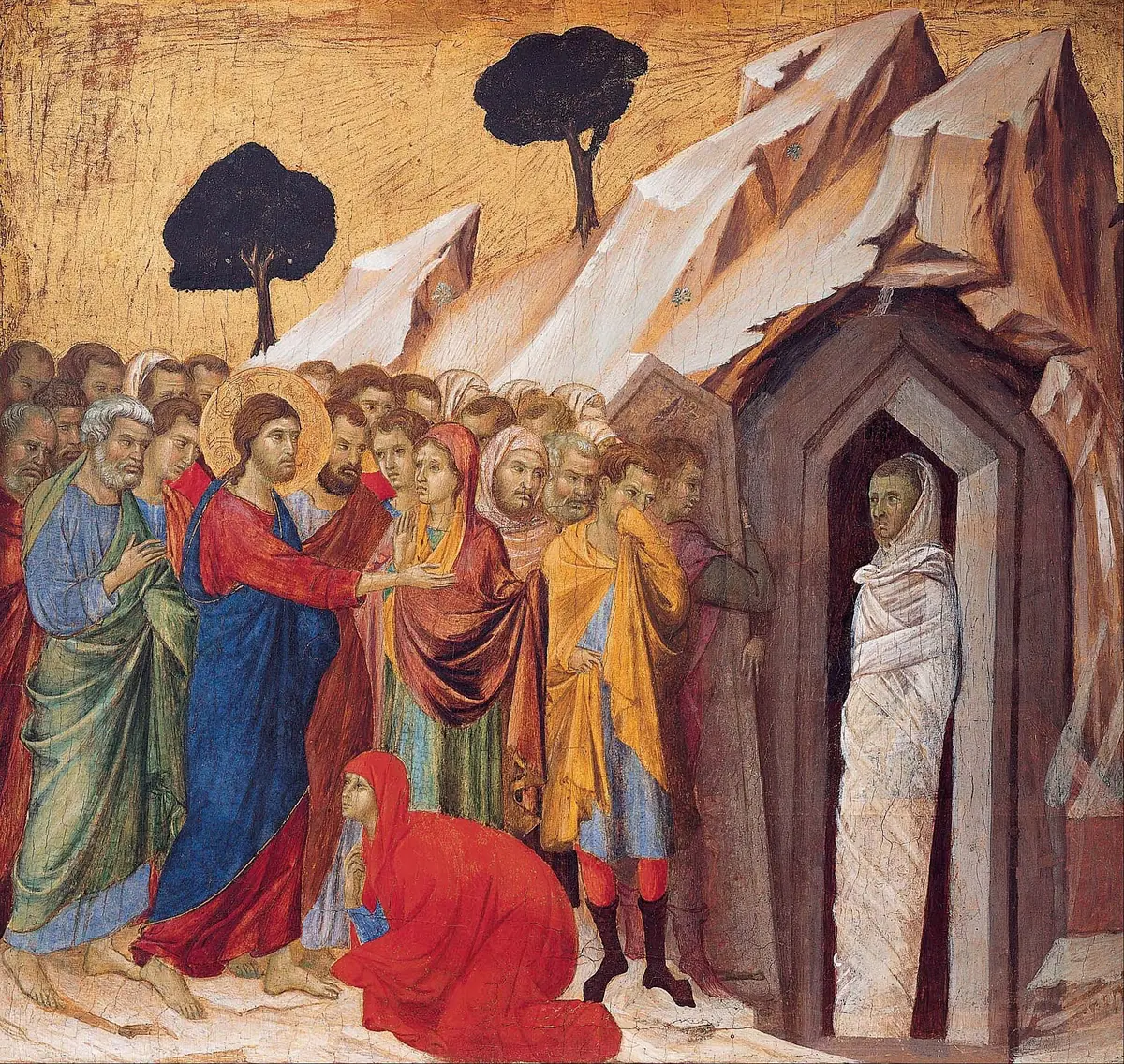
Image: Wikimedia Commons · Public domain (PD-Art) The Raising of Lazarus
Look closely. Lazarus comes out of a stone tomb still wrapped in grave-clothes, while the crowd covers their noses and Mary and Martha plead with Christ. Christ's hand is raised in command. Compare this Maestà panel with Giotto's larger, more dramatic Raising of Lazarus at Padua, painted only a few years earlier.
In the library: The Bible (KJV) · Jesus Christ · Mary and Lazarus of Bethany


What to watch for in Duccio
Look slowly- Many small scenes. The Maestà was a whole Gospel cycle. Ask which moment you are looking at and what comes next.
- Tender faces. Eyes are often slightly elongated, mouths small, grief and wonder shown quietly.
- Gold and deep colour. Ultramarine, red and gold work together; look at how a halo is incised into the gold leaf.
- Architecture like a toy city. Buildings are neatly tiled and angled, more like a precious model than a deep street.
- Siena's saints. On the front of the Maestà, the city's patron saints kneel in the front row, as if presenting their people to Mary.
Dates and collections follow the holding museums and Wikidata. Images of paintings are photographs of public-domain pictures from Wikimedia Commons or museum open-access releases; photographs of sculpture are used only when the photograph itself is Public domain, CC0, or CC BY with a named credit. Each picture links to its source page with full licence details.