Great Art · Northern Renaissance
Albrecht Dürer
The Nuremberg master of the engraved line, who joined northern craft to Italian study and made prints that carried his name across Europe.
Read Albrecht Dürer's Great Life →
His life
Albrecht Dürer was born in Nuremberg in 1471, the son of a goldsmith who had come from Hungary. He learned painting in the shop of Michael Wolgemut, then travelled as a young journeyman and, twice, to Italy, where he studied perspective, proportion and the example of Venetian colour. He settled again in Nuremberg, married Agnes Frey, and ran a busy workshop. He published his own prints, wrote books on measurement and on the human figure, and served as court painter to the emperors Maximilian I and Charles V.
His woodcuts and engravings travelled farther than any altarpiece could: a sheet signed with his famous monogram could hang in a scholar's room a hundred miles away. He looked hard at grass, a hare, a pair of hands, and at his own face, and he used that attention in the service of Scripture as well as of study. He died in Nuremberg in 1528. His gift was a line that could think: every burin stroke has a job to do, and nothing in the plate is idle.
Key works
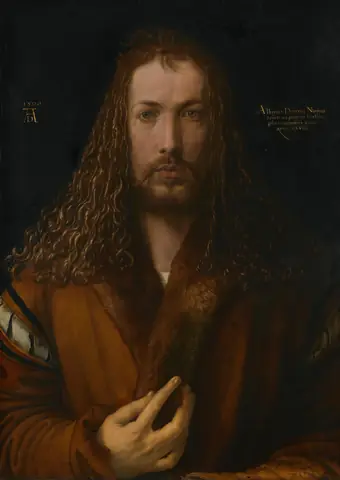
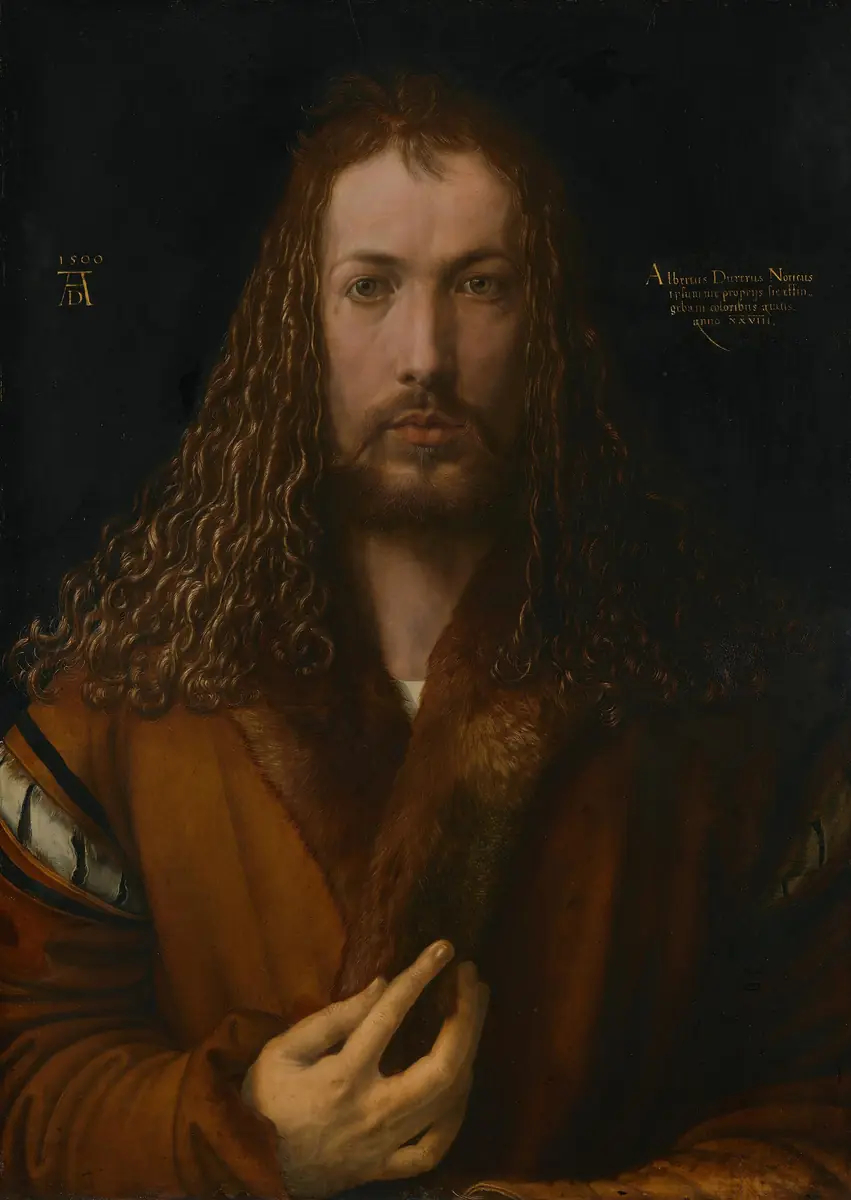
Image: Wikimedia Commons · Public domain (PD-Art) Self-Portrait with a Fur-Trimmed Robe
Look closely. Dürer faces us almost squarely, in a fur-lined coat, his right hand held toward the heart in a grave, frontal pose that later viewers have compared to images of Christ. Look at the long ringlets, at the clear brown eyes, at the inscription that dates the picture to his twenty-eighth year, and at how the dark ground makes the face and the fur stand forward.
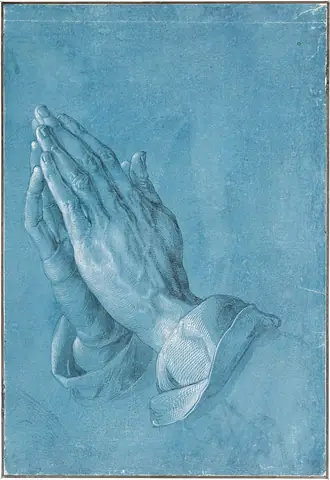
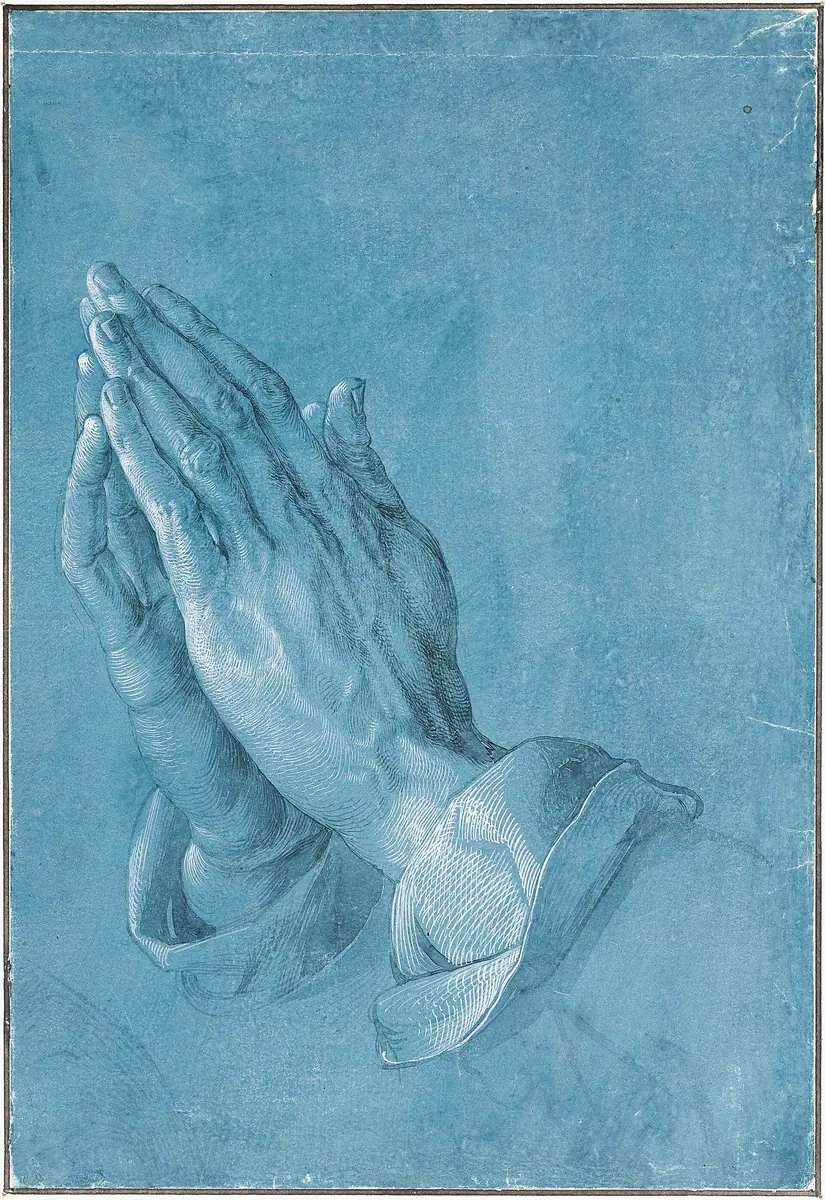
Image: Wikimedia Commons · Public domain (PD-Art) Praying Hands
Look closely. A study in ink and wash, made in preparation for an altarpiece, of two work-worn hands set together in prayer, with a cuff of folded linen at each wrist. Look at the slightly swollen knuckles, at the light along the nails and the tendons, and at how little else is needed: the hands alone become an image of attention before God.
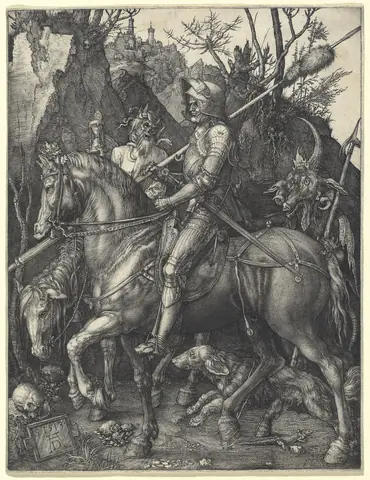
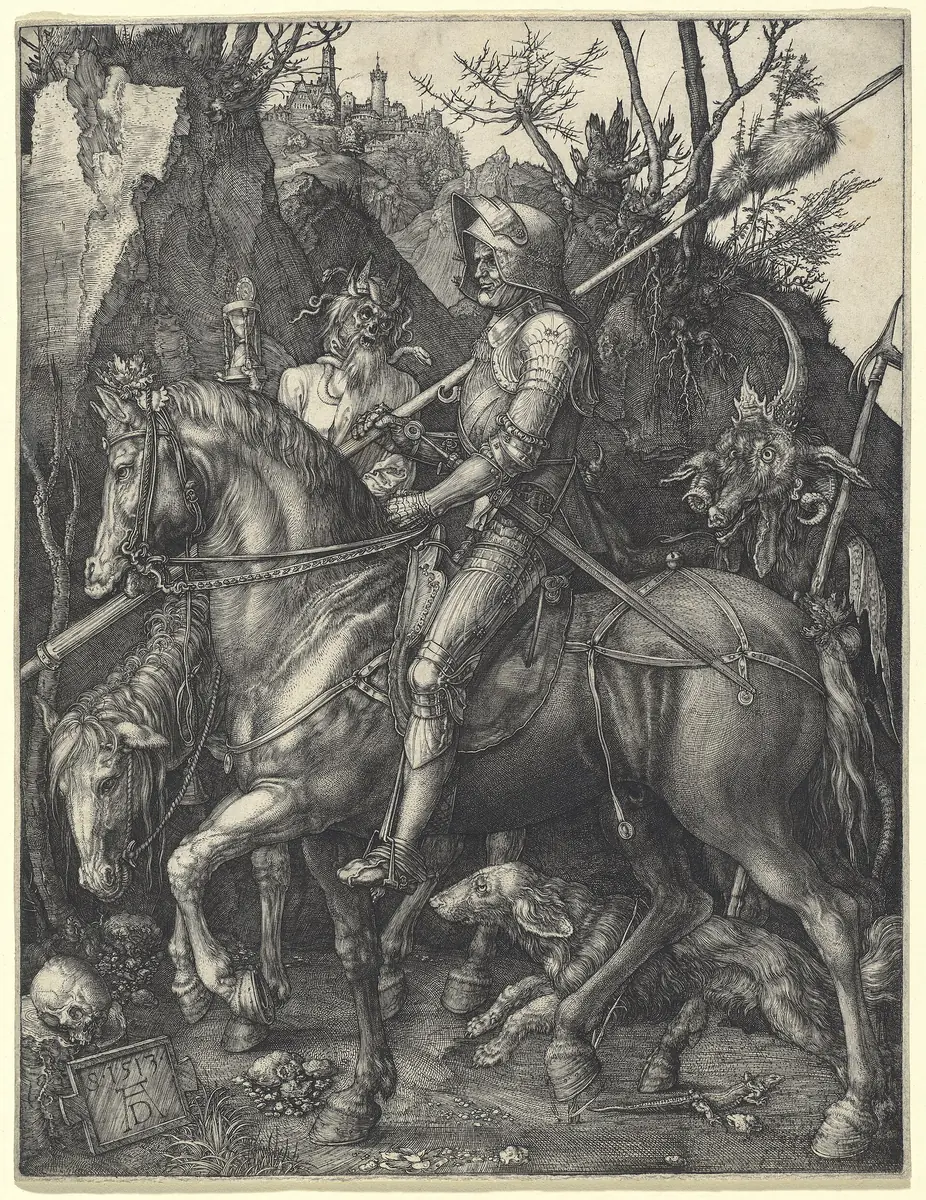
Image: Wikimedia Commons · CC0 (public domain) Knight, Death and the Devil
Look closely. A Christian knight rides through a tight rocky defile; Death holds an hourglass at his side, and a horned devil follows behind. The rider does not turn. Look at the gleam of the armour, at the faithful dog trotting below, at the skull on the path, and at the burin work that turns a copper plate into moss, hair, metal and bone.
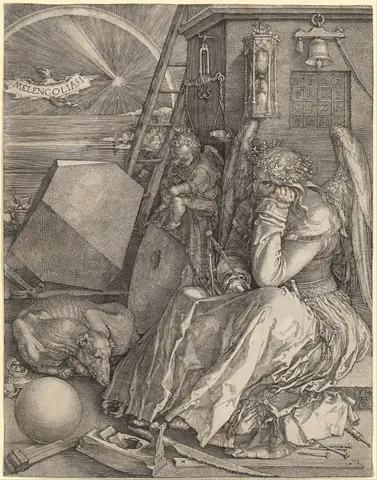
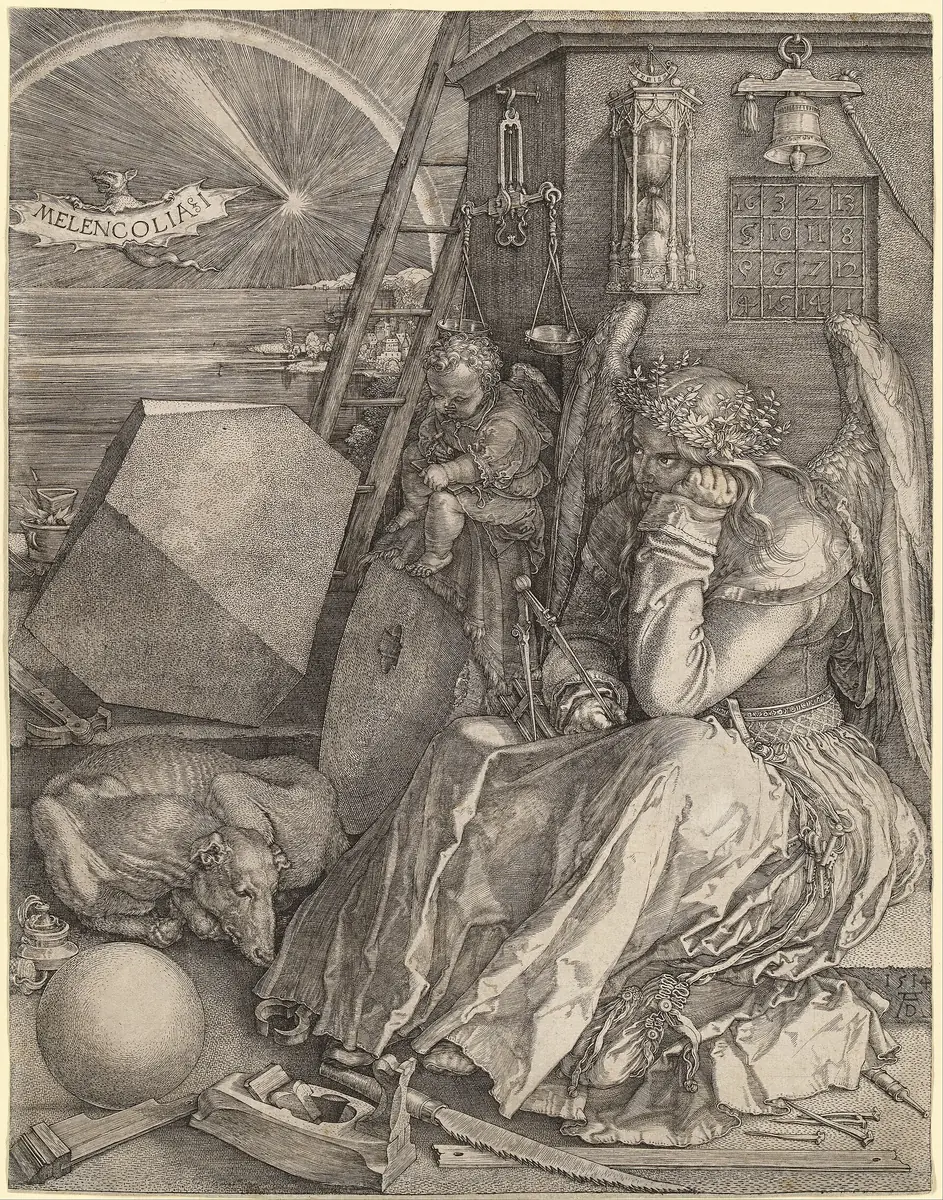
Image: Wikimedia Commons · Public domain (PD-Art) Melencolia I
Look closely. A winged figure sits among the tools of art and building — a saw, a plane, nails, a polyhedron, a sleeping dog — her head on her hand, a compass idle in her lap. A magic square and a comet hang on the wall behind. Look at the heavy wreath, at the unused instruments, and at the stubborn, thinking face: a picture of gifted work that has come, for a moment, to a halt.
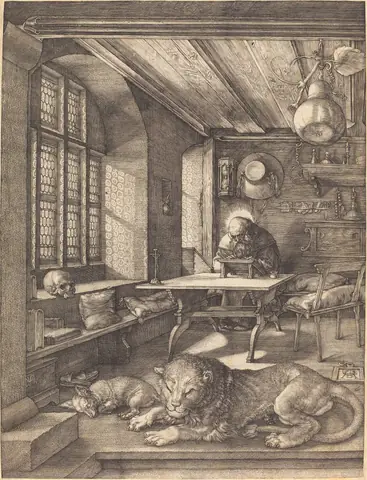
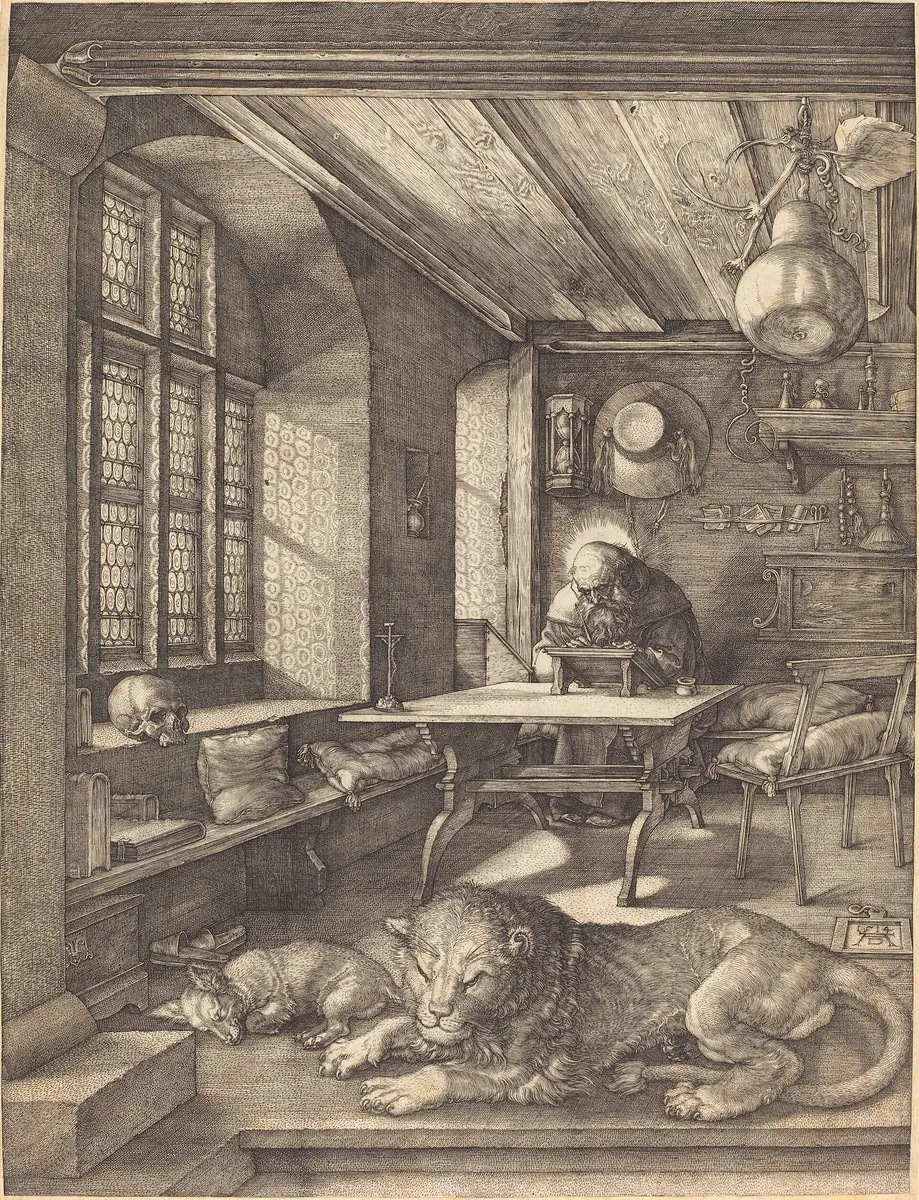
Image: Wikimedia Commons · CC0 (public domain) Saint Jerome in His Study
Look closely. Jerome works at a sunlit desk in a tidy chamber, a lion dozing in the foreground, a skull on the windowsill, slippers under the bench. Light pours through the round panes and lies in patches on the timber floor. Look at the gourd hanging from the ceiling, at the letters on the table, and at the calm of a scholar's room given to the Word.
In the library: The Bible (KJV)
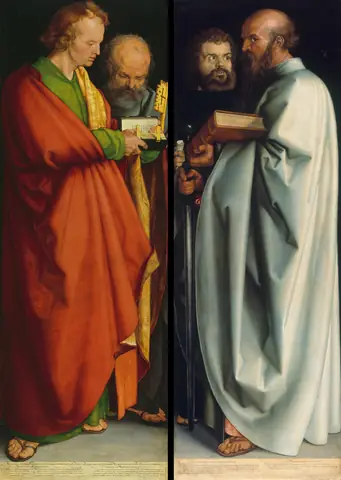
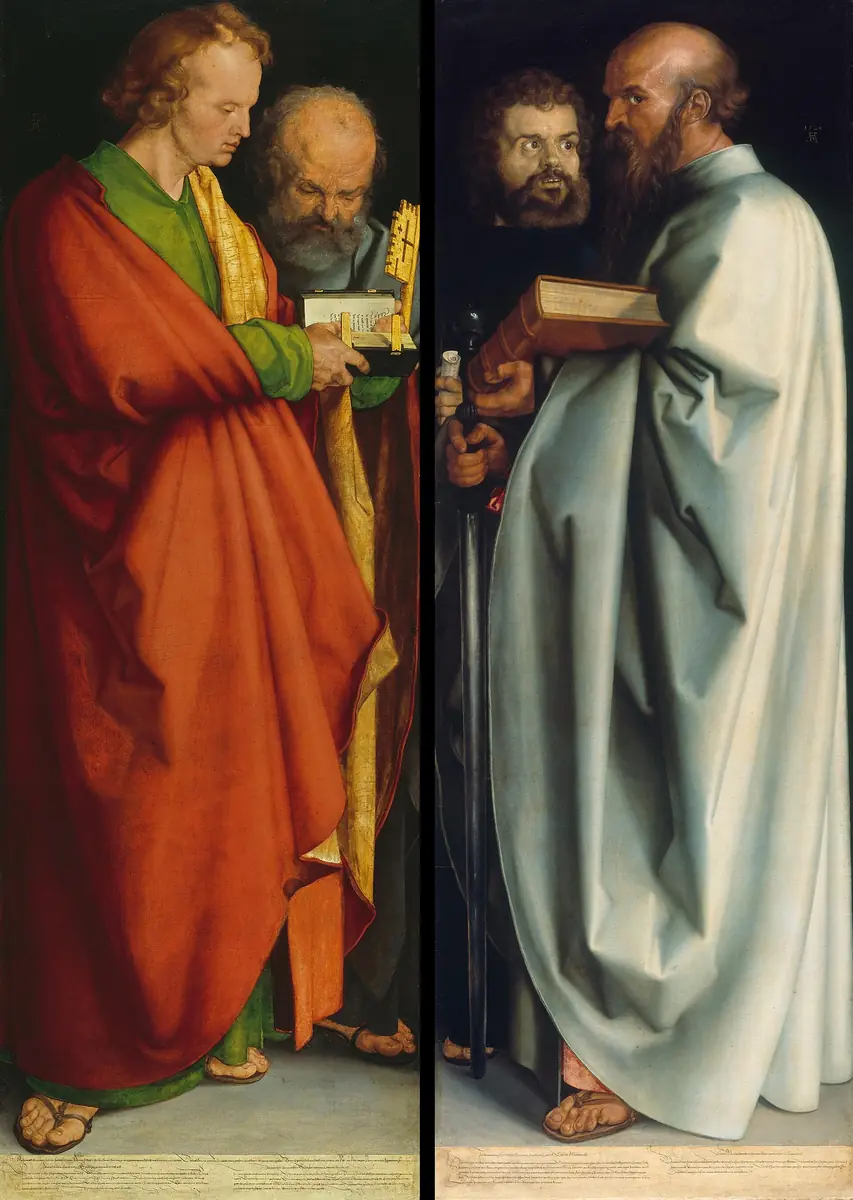
Image: Wikimedia Commons · Public domain (PD-Art) The Four Apostles
Look closely. Two tall panels, given by Dürer to the city of Nuremberg: John and Peter on the left, Mark and Paul on the right, each with a book, standing as if they were living pillars of the faith. Look at John's young face and red mantle, at Peter's keys and the weathered head beside him, at Paul's stern glance and closed Bible, and at the inscriptions Dürer set along the lower edge.
In the library: The Bible (KJV) · John the Apostle · Peter · Paul
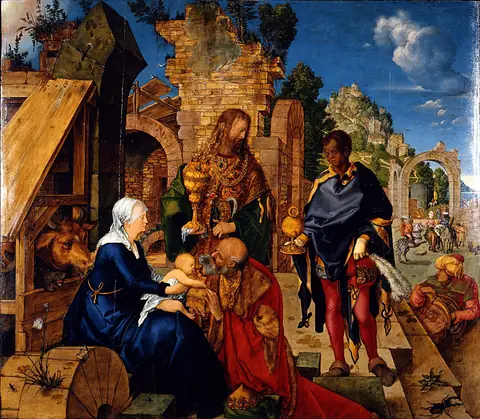
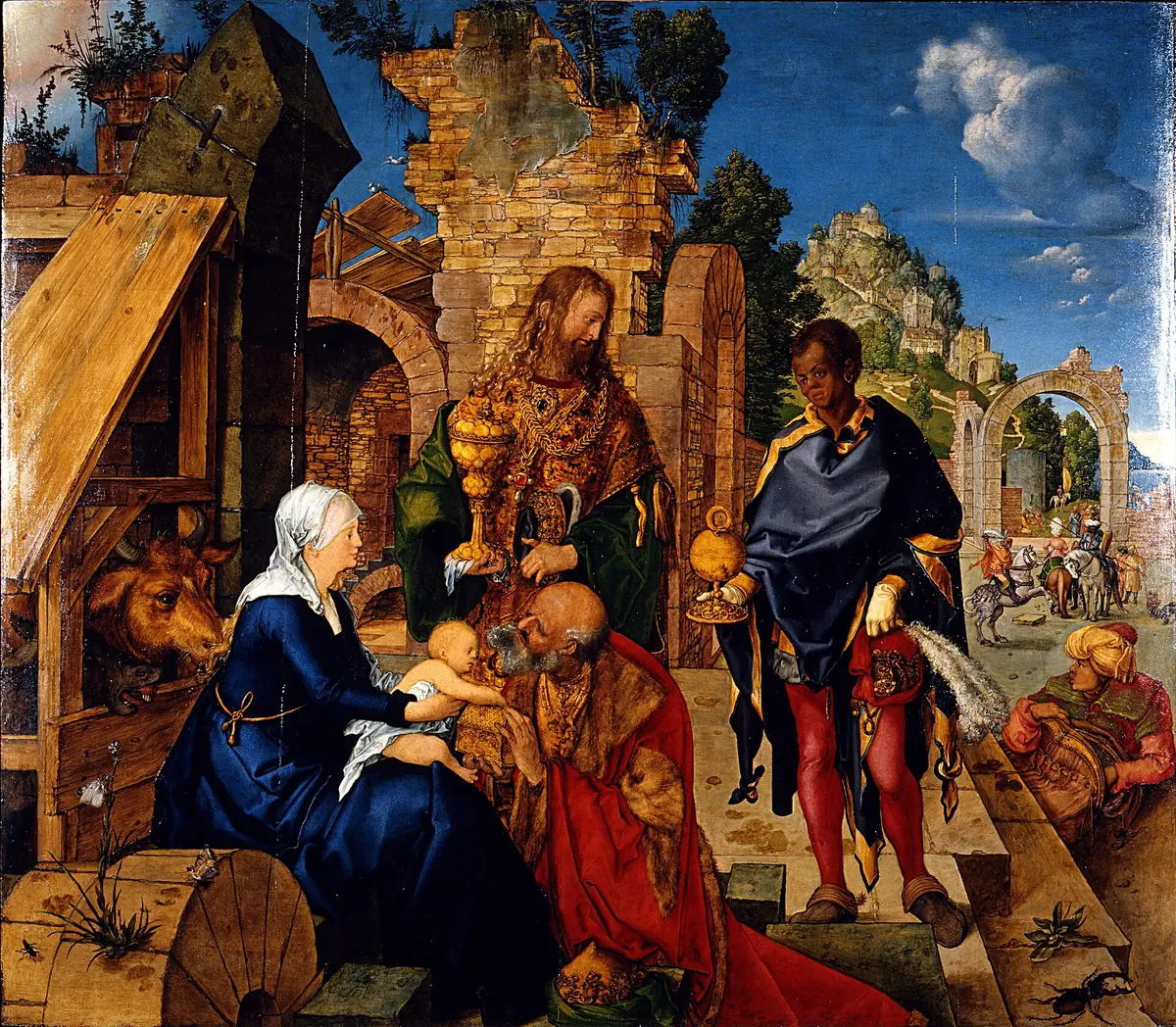
Image: Wikimedia Commons · Public domain (PD-Art) The Adoration of the Magi
Look closely. Mary sits with the Child before a ruined arch; the three kings approach with their gifts, a pale city and a distant mountain behind. Look at the careful still-life of the cups and the chalice, at the horses and the little dog, at the plants in the foreground, and at how the infant reaches toward the gold as if it were a toy as well as a tribute.
In the library: The Bible (KJV) · Jesus Christ · Mary, mother of Jesus


What to watch for in Albrecht Dürer
Look slowly- The monogram. Look for the famous A-over-D; he treated it as a maker's mark and a signature of quality.
- The engraved line. In the copper plates, every stroke of the burin has a direction and a weight; hatching becomes light, fur, grass or armour.
- Northern detail, Italian weight. A blade of turf or a wrinkle can sit beside a figure as solid as a statue.
- Hands. He drew hands as carefully as faces: clasped in prayer, resting on a book, or his own in a self-portrait.
- A print that teaches. Knight, Melencolia and Jerome were made as a set of lessons you can hold in a sheet.
For older students
These famous works include nudity, so they are named here but not shown. Teachers and parents can decide when to look at them together.
- Adam and Eve (engraving, and the Prado panels), 1504 (engraving); 1507 (panels), Impressions in many collections; Museo del Prado, Madrid. Dürer's 1504 engraving and his later painted panels show Adam and Eve unclothed, before the Fall, as studies in ideal proportion. They are named here but not shown.
Dates and collections follow the holding museums and Wikidata. Images of paintings are photographs of public-domain pictures from Wikimedia Commons or museum open-access releases; photographs of sculpture are used only when the photograph itself is Public domain, CC0, or CC BY with a named credit. Each picture links to its source page with full licence details.