Great Art · High Renaissance
Raphael
The painter of harmony, who set philosophy and theology face to face on the walls of the Vatican.
His life
Raphael was the son of a court painter in Urbino and lost both parents while still a boy. He trained in the workshop of Perugino, then moved to Florence, where he studied Leonardo and Michelangelo and painted the gentle Madonnas that made his name. In 1508 Pope Julius II called him to Rome to paint the papal rooms in the Vatican, and he spent the rest of his short life there, running a large workshop, designing tapestries and serving as architect of the new Saint Peter's.
Raphael's gift was for order and grace: crowded scenes in which every figure has room to breathe, and faces of calm sweetness. Contemporaries praised his courtesy as much as his skill. He died in Rome in 1520, at thirty-seven, and his unfinished Transfiguration was set up beside his body. He was buried, at his own wish, in the Pantheon.
Key works
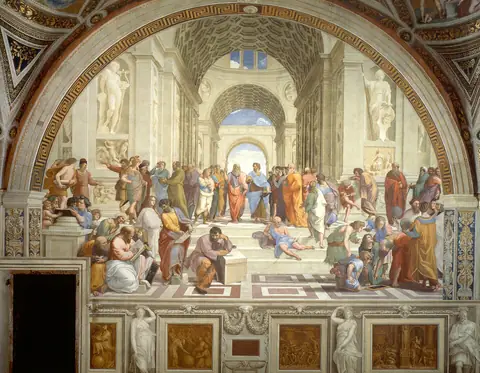
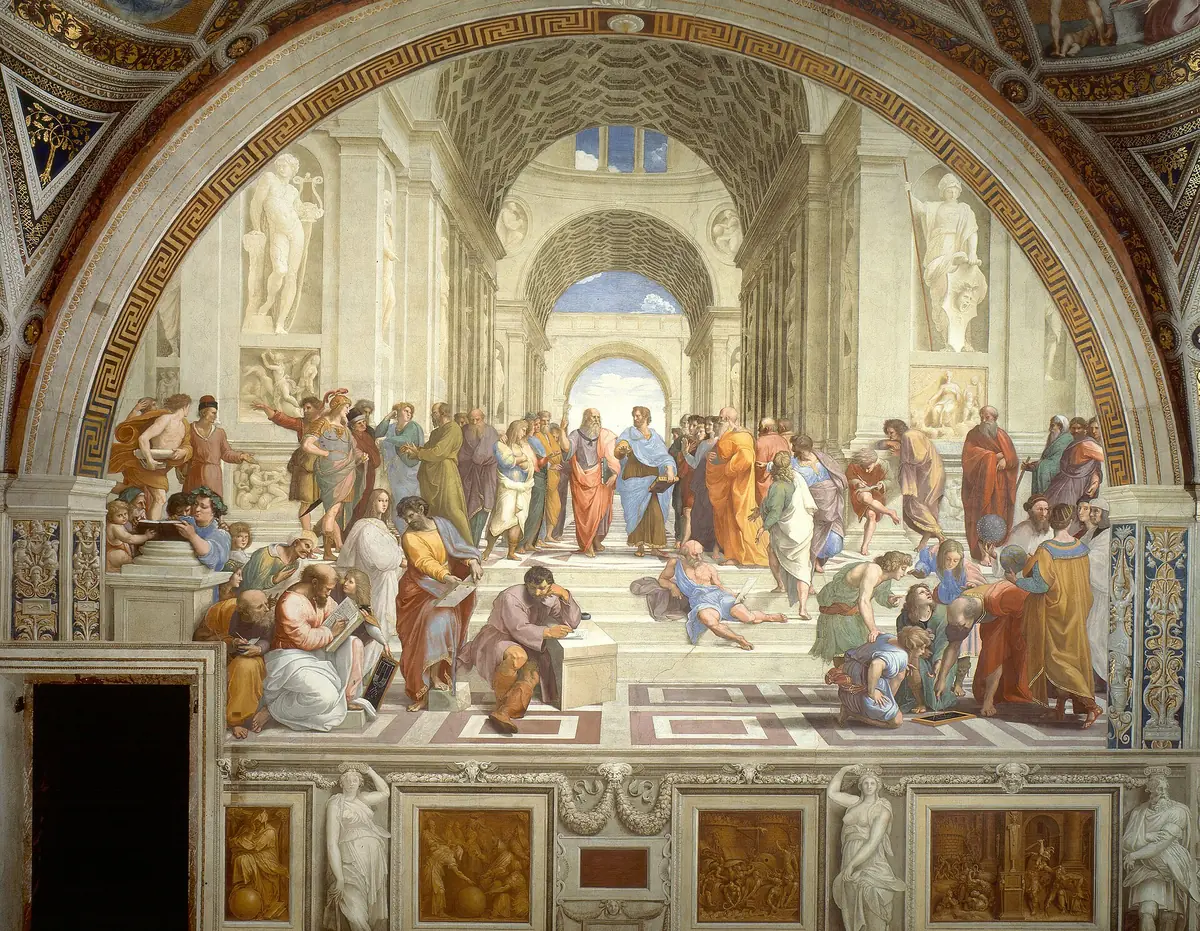
Image: Wikimedia Commons · Public domain (PD-Art) The School of Athens
Look closely. Under the central arch walk Plato, pointing upward and holding his Timaeus, and Aristotle, holding his Ethics and stretching his hand out flat over the earth: two ways of seeking wisdom. Around them the great thinkers argue, teach and write. Find Euclid bending with compasses at the lower right, and Raphael himself looking out at the far right edge.
In the library: Plato · Aristotle · Plato, The Republic · Aristotle, Nicomachean Ethics · Socrates · Euclid · Pythagoras · Heraclitus
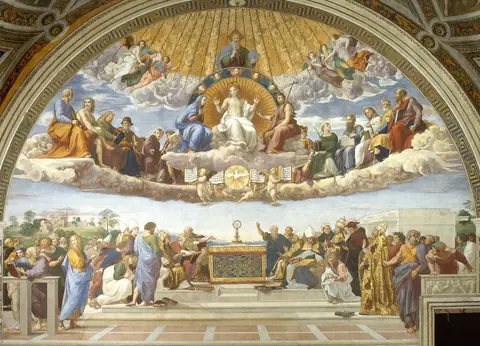
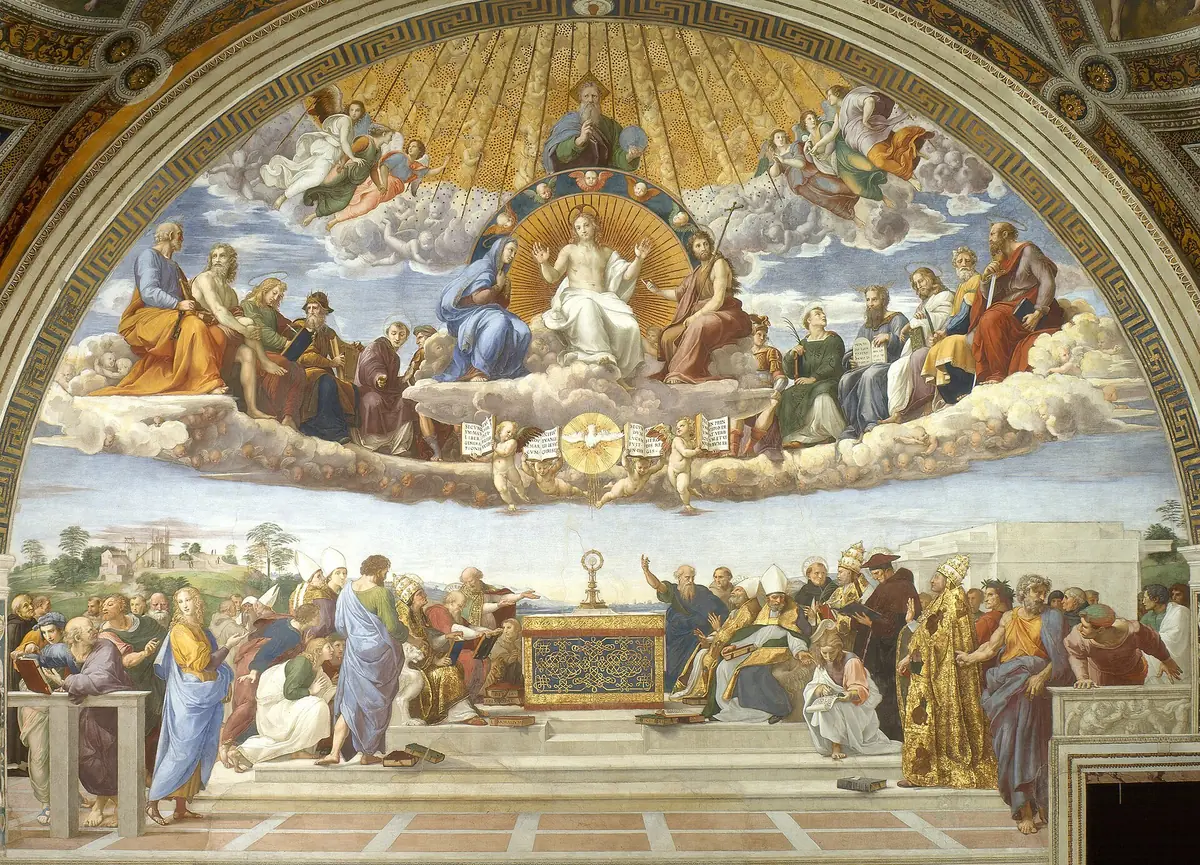
Image: Wikimedia Commons · Public domain (PD-Art) The Disputation of the Holy Sacrament
Look closely. It faces the School of Athens across the same room, so theology answers philosophy. Every line leads to the small white Host on the altar. Above, Christ sits among saints in heaven; below, popes, bishops and teachers discuss the mystery. Look for Dante in a red robe and laurel wreath at the right.
In the library: Thomas Aquinas · Augustine of Hippo · Dante · Aquinas, Summa Theologica · The Divine Comedy
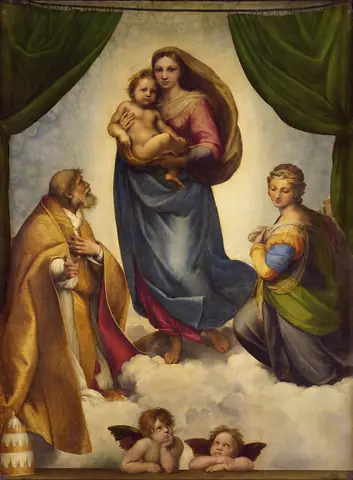
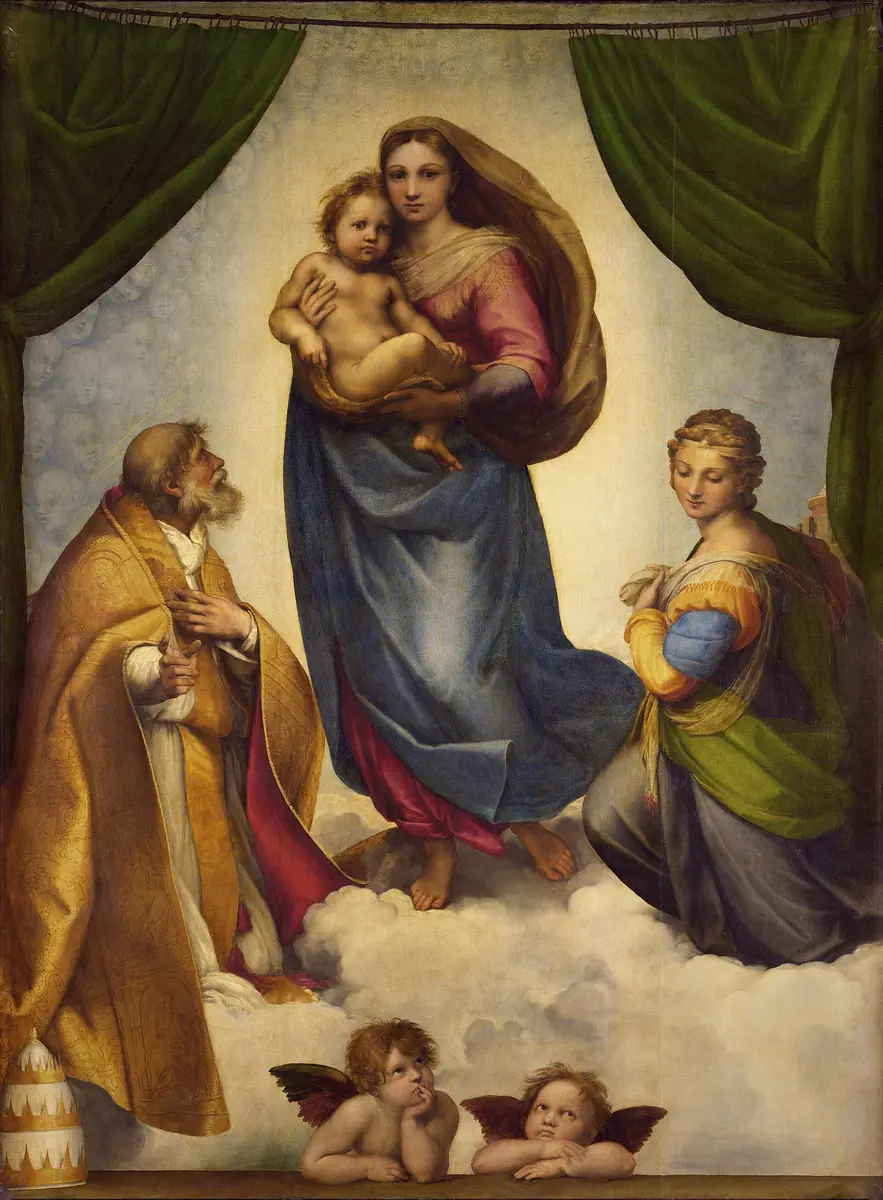
Image: Wikimedia Commons · Public domain (PD-Art) The Sistine Madonna
Look closely. Green curtains have just been drawn back, and Mary steps forward on the clouds toward us with the Child in her arms. Saint Sixtus points out toward the viewer; Saint Barbara looks down. At the bottom rest the two thoughtful little angels that have since become famous on their own.
In the library: Mary, mother of Jesus
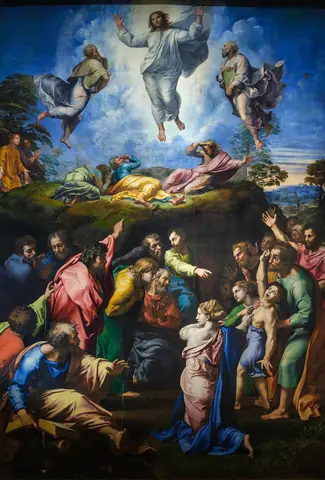
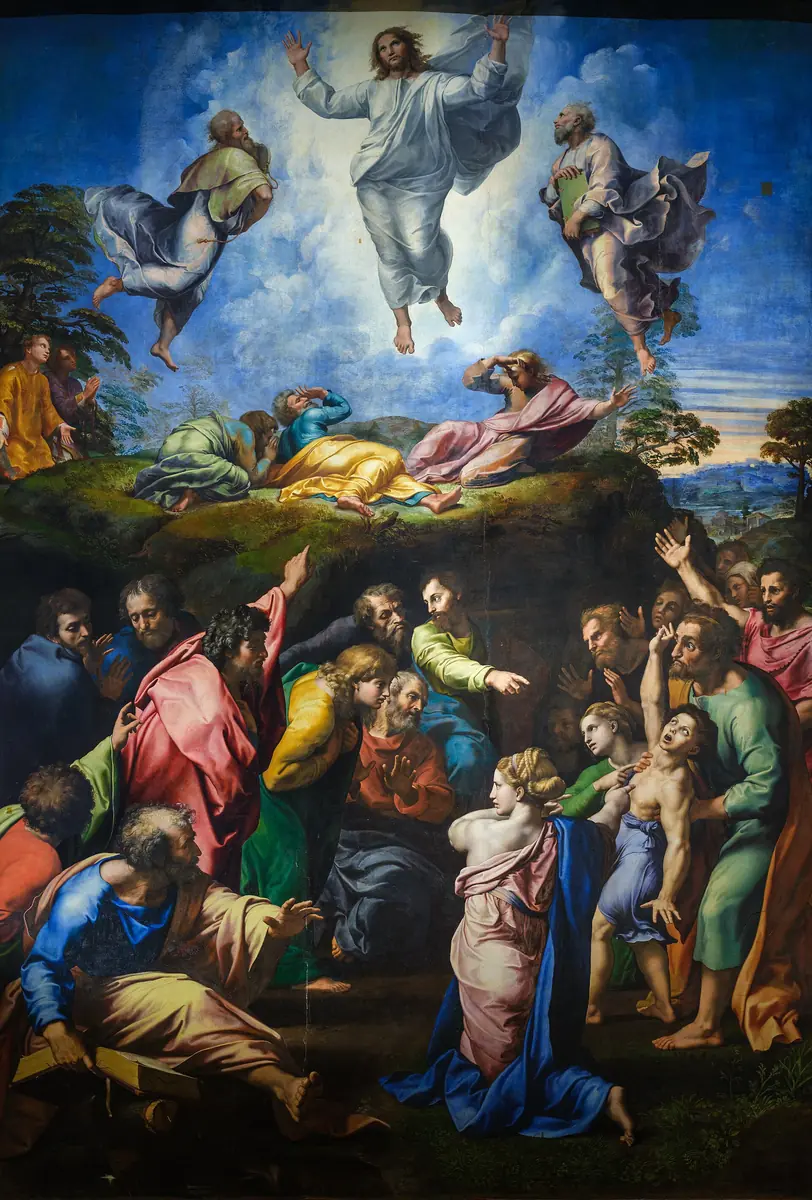
Image: Wikimedia Commons · Public domain (PD-Art) The Transfiguration
Look closely. Two Gospel scenes are stacked. Above, Christ rises in light with Moses and Elijah while the three disciples shield their eyes. Below, the other apostles cannot cure a boy possessed by a spirit, and his family points upward to the only one who can. Raphael's last painting.
In the library: The Bible (KJV) · Jesus Christ · Moses · Elijah · Peter
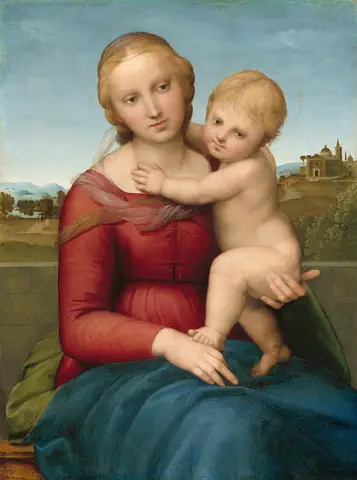
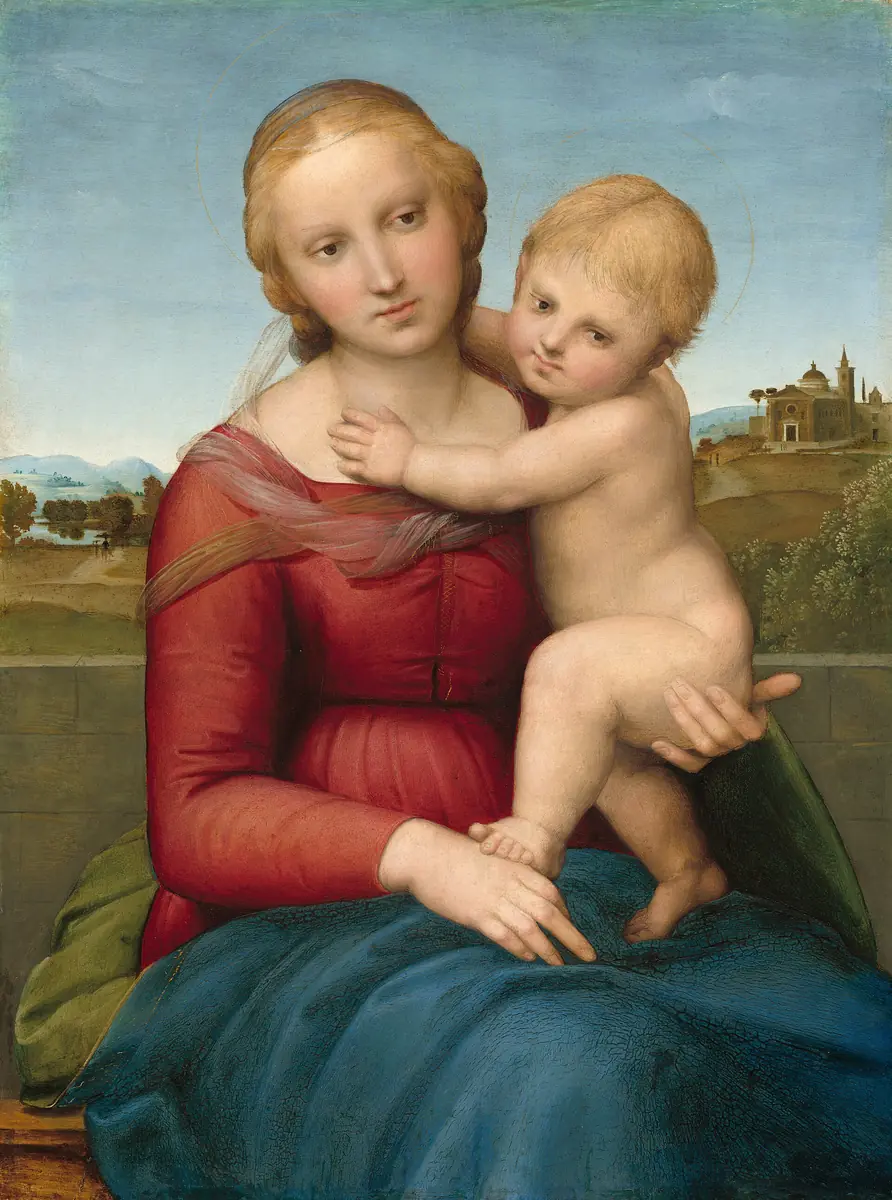
Image: Wikimedia Commons · Public domain (PD-Art) The Small Cowper Madonna
Look closely. A gentle Madonna from Raphael's Florentine years: Mary sits outdoors and the Child clings to her. Look at the domed church on the hill behind them, often identified as a church near Urbino, Raphael's home. The name comes from the Earls Cowper, who once owned it, not from the poet William Cowper.
In the library: Mary, mother of Jesus
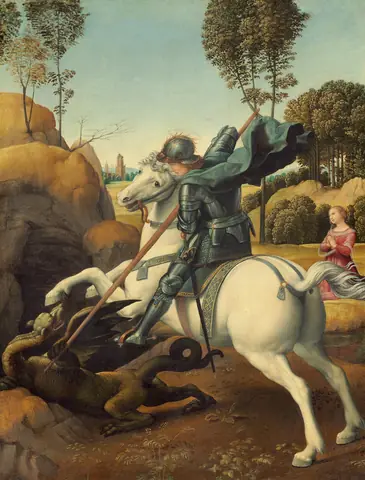
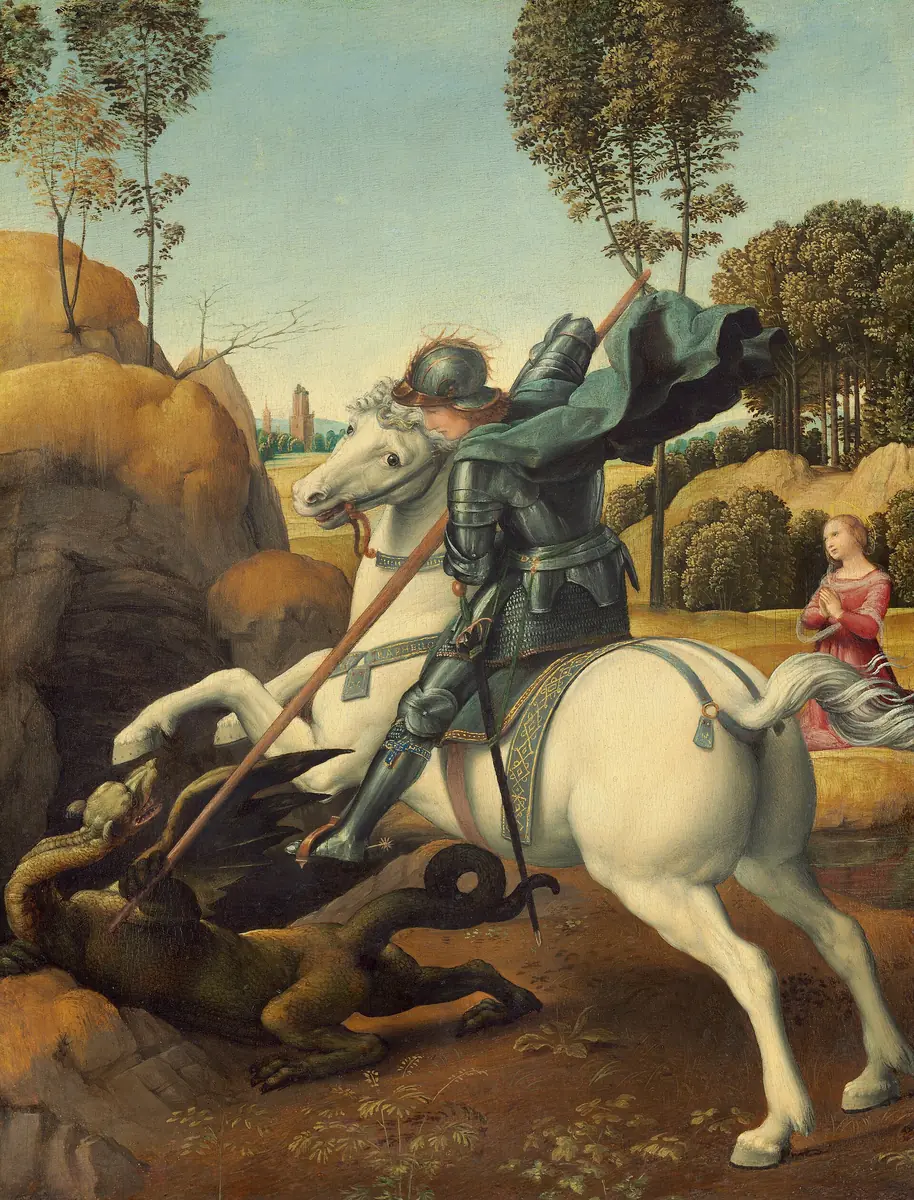
Image: Wikimedia Commons · Public domain (PD-Art) Saint George and the Dragon
Look closely. George drives his lance into the dragon while the princess kneels in prayer at the right. On his left leg he wears the blue Garter of the English Order of the Garter, a sign that the painting was linked to the Duke of Urbino's admission to that order.
In the library: The Golden Legend (Life of S. George)
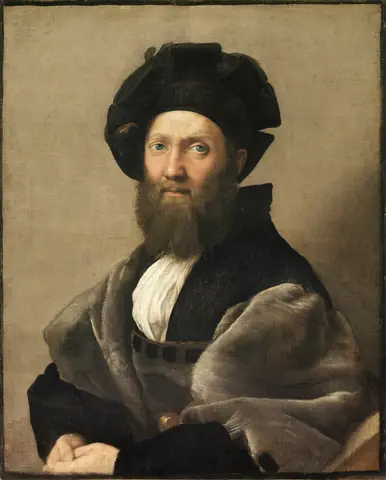
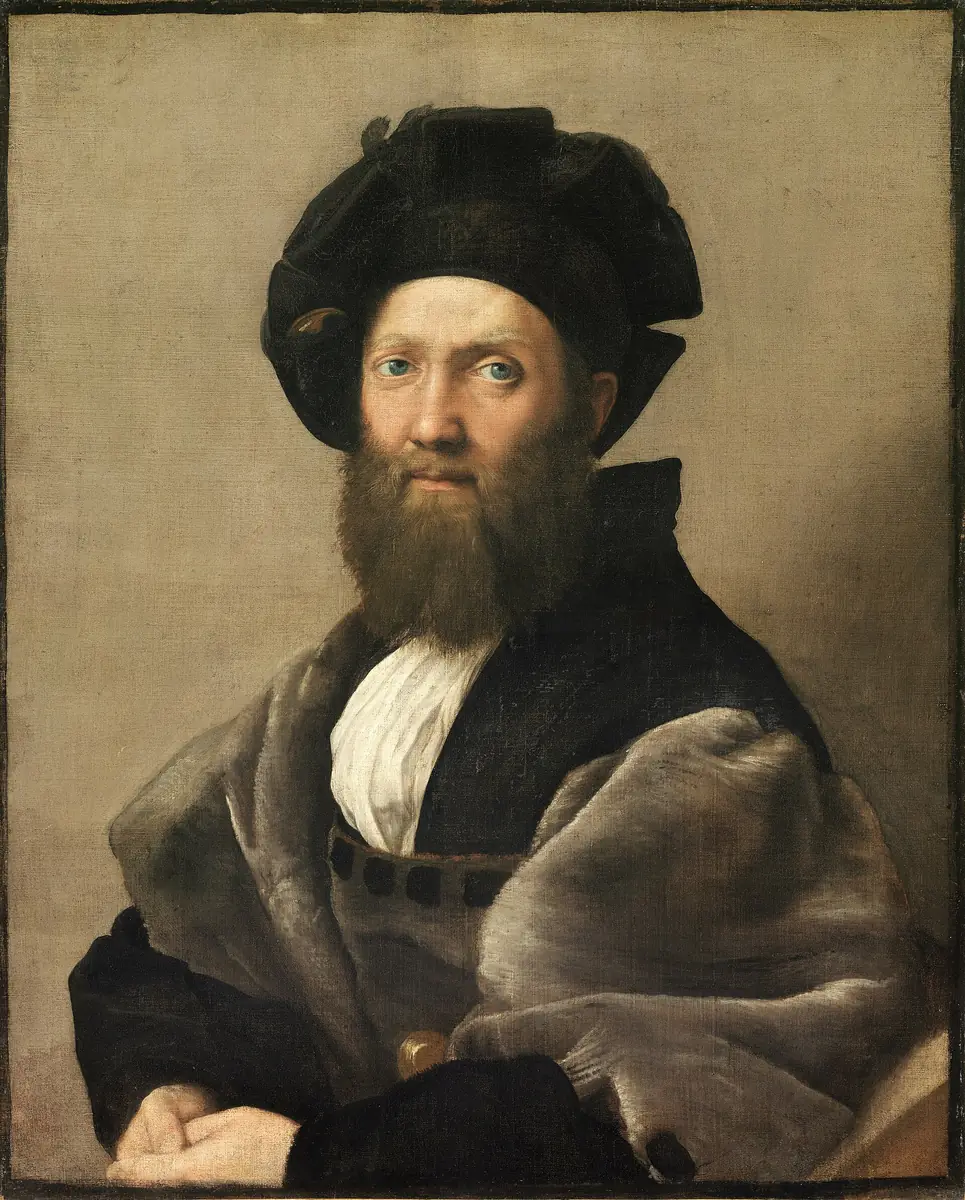
Image: Wikimedia Commons · Public domain (PD-Art) Portrait of Baldassare Castiglione
Look closely. Castiglione wrote The Book of the Courtier, a famous guide to graceful, honourable conduct. Raphael paints his friend in soft greys and blacks, with steady blue eyes. More than a century later Rembrandt sketched this portrait at an Amsterdam auction and borrowed its pose for his own self-portrait.
In the library: Rembrandt (Great Art)


What to watch for in Raphael
Look slowly- Triangles and circles. Raphael builds groups into calm pyramids and arcs; trace them with your finger.
- Faces that answer each other. Glances and gestures pass around a group like a conversation.
- Architecture as frame. Arches and vaults recede to a point that sits right behind the most important figure.
- Two worlds in one picture. Heaven above and earth below, often linked by a single figure or gesture.
- Borrowed ideas, made his own. Look for poses learned from Leonardo and Michelangelo, smoothed into his own style.
Dates and collections follow the holding museums and Wikidata. Images of paintings are photographs of public-domain pictures from Wikimedia Commons or museum open-access releases; photographs of sculpture are used only when the photograph itself is Public domain, CC0, or CC BY with a named credit. Each picture links to its source page with full licence details.