Great Art · Pre-Raphaelite
William Holman Hunt
The Pre-Raphaelite who took a lantern to a weed-grown door, a scapegoat to the Dead Sea, and his easel to the Holy Land.
His life
William Holman Hunt was born in London in 1827 and, with Millais and Dante Gabriel Rossetti, helped found the Pre-Raphaelite Brotherhood in 1848. He kept the Brotherhood's early seriousness longer than most: a conviction that a subject should be painted from close study, with bright colour and a moral or scriptural meaning that could be read in every detail. He travelled more than once to the Holy Land to paint biblical scenes from observed places and light.
He lived into the twentieth century and died in London in 1910. His gift was symbolic exactness. A lantern, a barred door, a red fillet on a goat's horns, or a temple interior can carry a whole teaching, provided you look slowly at what is actually there.
Key works
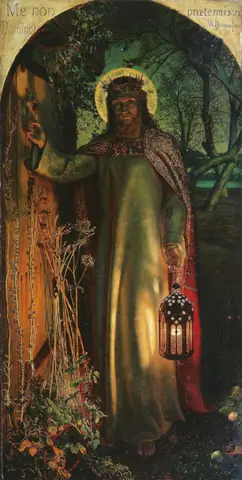
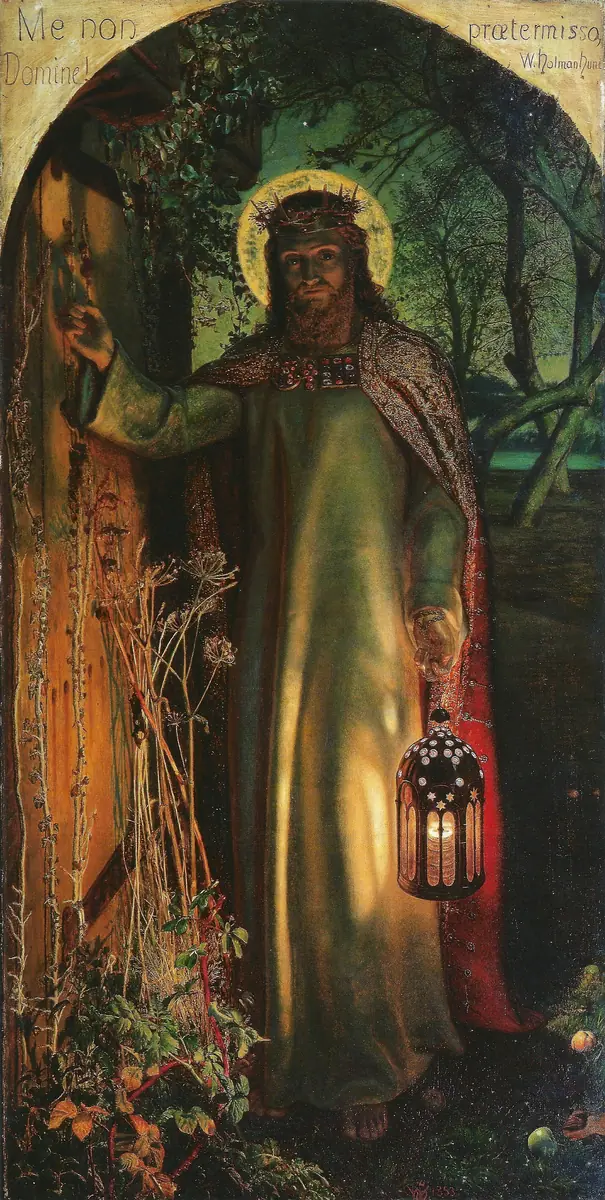
Image: Wikimedia Commons · Public domain (PD-Art) The Light of the World
Look closely. Christ, in a deep green robe and a jeweled cloak, stands at night before a weed-grown door, a lantern in his left hand, his right raised as if to knock; he wears a crown of thorns over a royal crown, and a Latin inscription is painted in the arch. Look at the closed door with no outer handle, at the wild plants grown up against it, at the lantern's pierced pattern, and at the apples or fruit on the ground — a picture of a patient, unanswered visit.
In the library: The Bible (KJV) · Jesus Christ
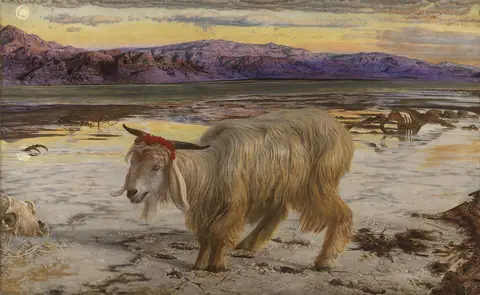
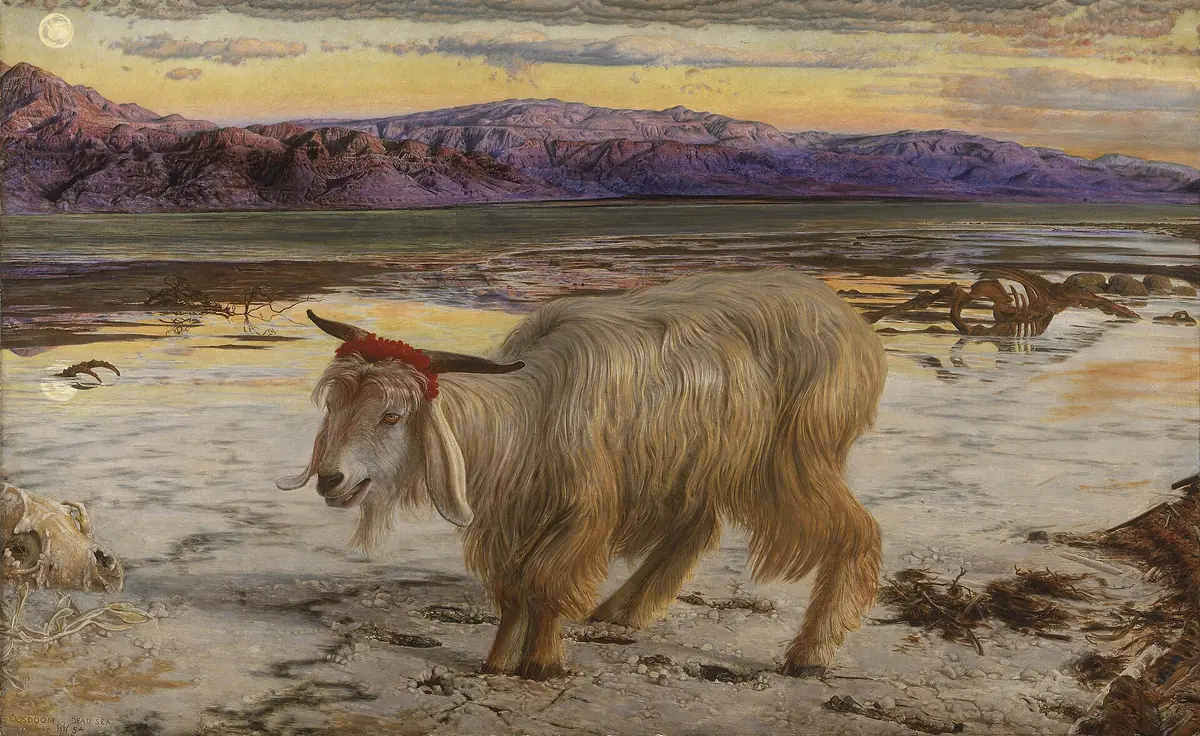
Image: Wikimedia Commons · Public domain (PD-Art) The Scapegoat
Look closely. A white goat with a red fillet around its horns walks across the salt flats of the Dead Sea, under a moon and a band of evening colour, with a skull in the left foreground, bones and a bleached carcass farther out, and purple mountains beyond the water. Look at the cracked ground, at the animal's exhausted mouth, and at the inscription of the place on the picture; Hunt painted the goat in that landscape itself.
In the library: The Bible (KJV)
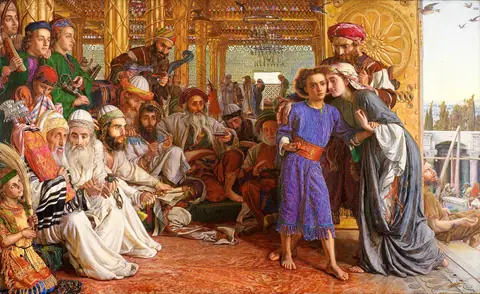
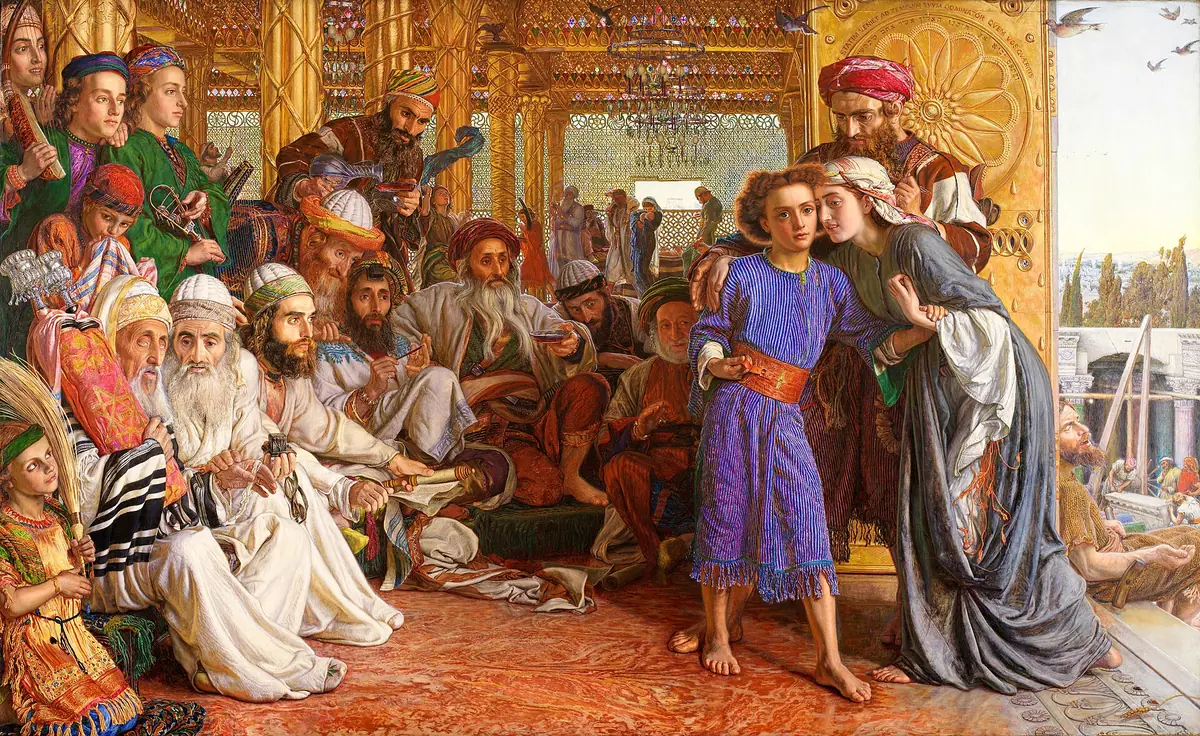
Image: Wikimedia Commons · Public domain (PD-Art) The Finding of the Saviour in the Temple
Look closely. The boy Jesus, in a blue robe with a rust-red sash, stands barefoot in a richly gilded temple court as Mary in grey-blue reaches to embrace him, Joseph close behind her; the doctors of the law sit at the left in white and coloured robes, a child with a fly-whisk in the corner, and a courtyard opens at the far right. Look at Jesus's far-seeing, slightly reluctant face as he is found, at the intent scholars, and at the carefully observed temple ornament and birds.
In the library: The Bible (KJV) · Jesus Christ · Mary, mother of Jesus · Joseph of Nazareth
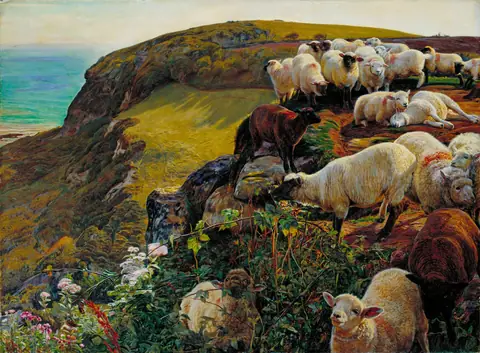
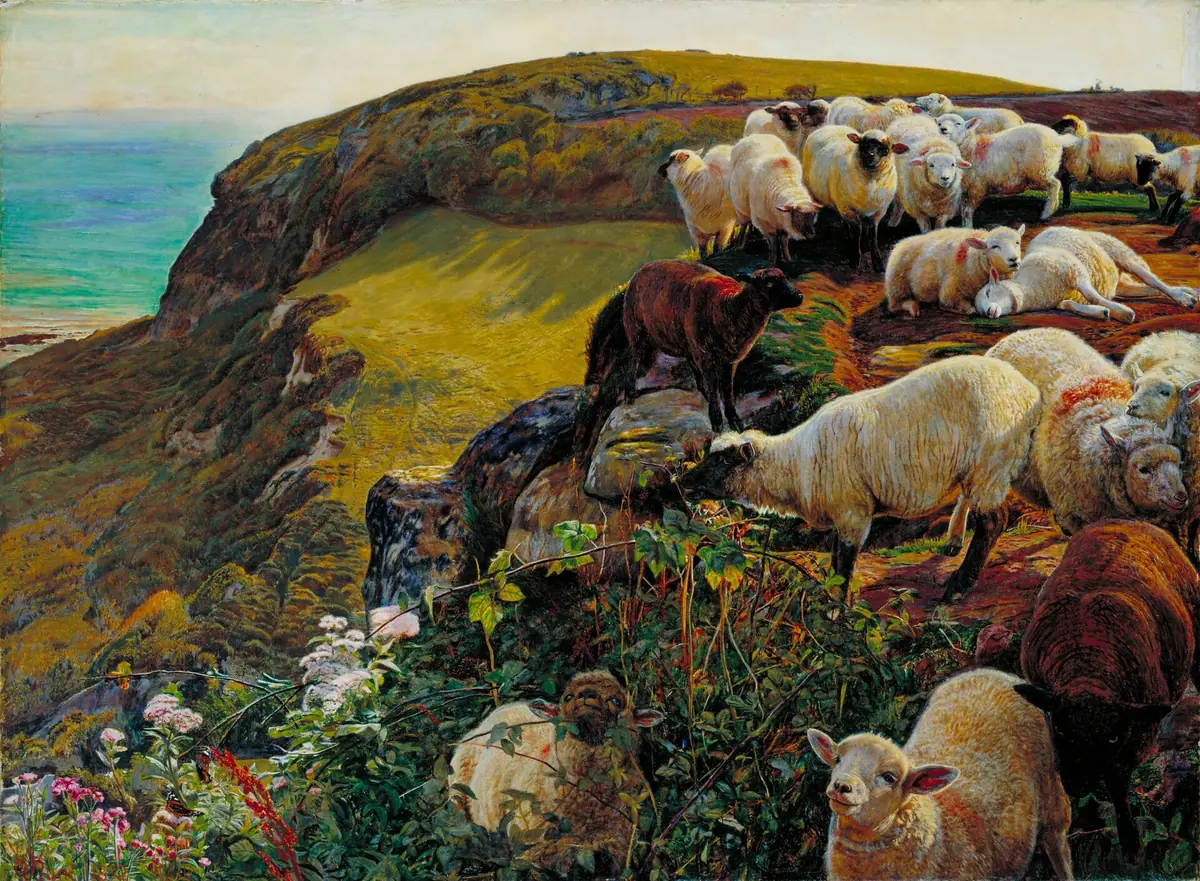
Image: Wikimedia Commons · Public domain (PD-Art) Our English Coasts, 1852 (Strayed Sheep)
Look closely. A flock of sheep is scattered along a sunny, crumbling cliff, with the sea below, butterflies in the air, and no shepherd in sight. Look at the different coats and poses of the sheep, at the edge of the land, and at the title's hint that a flock without a keeper is not only a pretty coastal view.
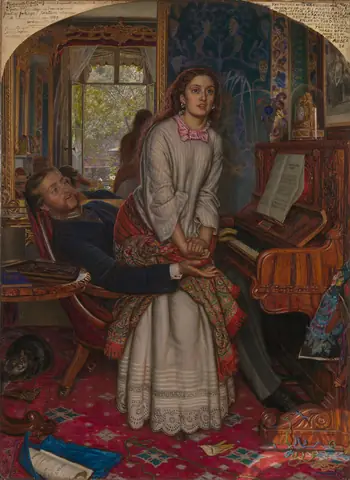
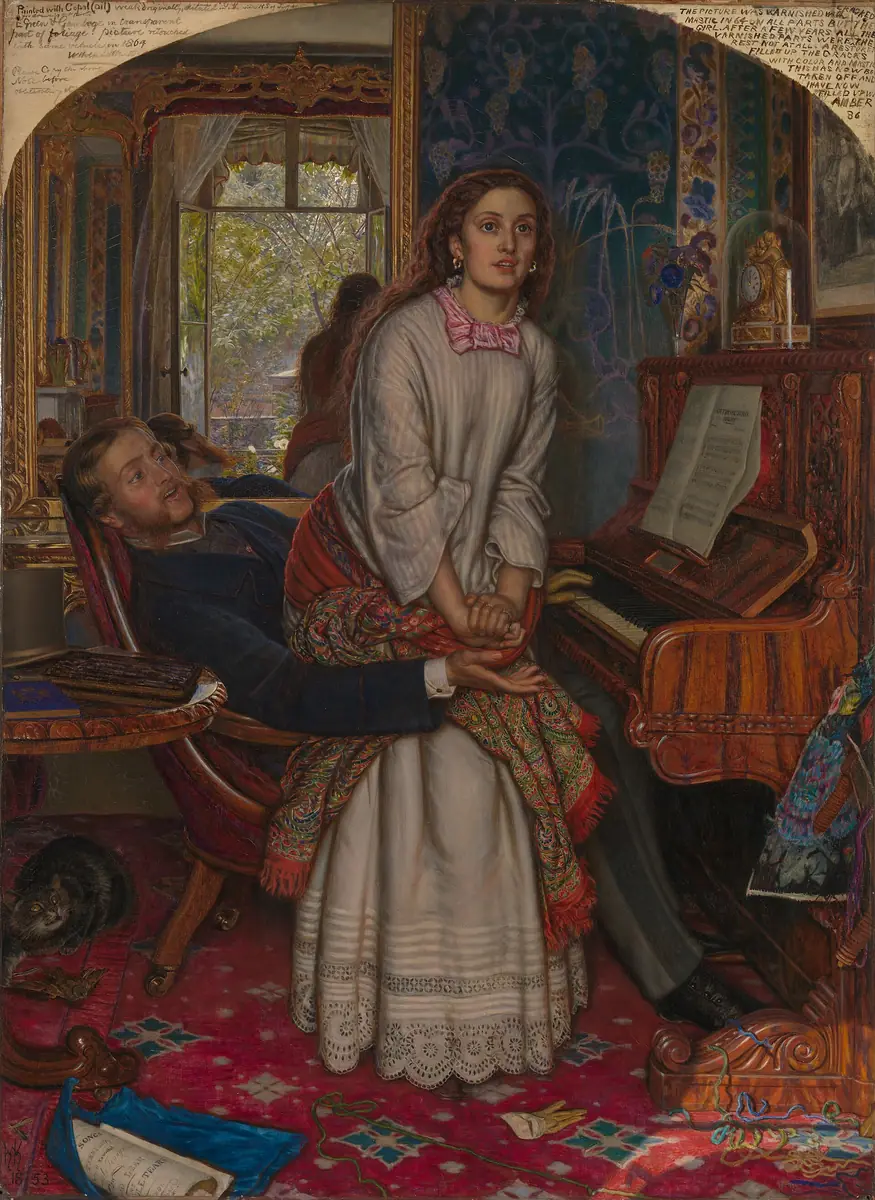
Image: Wikimedia Commons · Public domain (PD-Art) The Awakening Conscience
Look closely. In a cluttered London parlour, a young woman in a white dress starts up from a man's lap, looking up and out as if something has called her; he still leans back in the chair, smiling, a glove in his hand. Look at the bright garden in the mirror and through the window, at the cat under the table, at the music on the piano, and at the unfinished work of a comfortable room that is not a marriage home — a picture of a sudden change of heart, fully clothed, in a modern interior.


What to watch for in William Holman Hunt
Look slowly- Every detail means something. A weed, a lamp, a discarded glove, or a bit of music on a stand may be part of the argument.
- Bright, hard-edged colour. The early pictures reject a brown studio varnish.
- Scripture in a real place. Hunt wanted the Holy Land's light and ground, not only a European studio Palestine.
- A door, a lamp, a path. In The Light of the World, read the closed door and the lantern together.
- A modern moral subject. The Awakening Conscience is a London room, not a Bible scene, and still a picture about a change of heart.
For older students
These famous works include nudity, so they are named here but not shown. Teachers and parents can decide when to look at them together.
- The Shadow of Death, 1870–73, Manchester Art Gallery. Christ as a carpenter stretches in the workshop until his shadow forms a cross on the wall; he is unclothed to the waist. Named for older students and not shown here.
- The Triumph of the Innocents, 1883–84, Tate Britain. The Flight into Egypt, with the spirits of the Holy Innocents accompanying the Holy Family; the children are unclothed. Named for older students and not shown here.
Dates and collections follow the holding museums and Wikidata. Images of paintings are photographs of public-domain pictures from Wikimedia Commons or museum open-access releases; photographs of sculpture are used only when the photograph itself is Public domain, CC0, or CC BY with a named credit. Each picture links to its source page with full licence details.