Great Art · Early Renaissance
Luca della Robbia
The inventor of glazed terracotta sculpture, who set singing boys and the Madonna in white and blue for Florence.
His life
Luca della Robbia began as a marble carver. His first great work, the Cantoria or singing gallery for Florence Cathedral, is a marble celebration of the psalm of praise: children singing, playing and beating time, in panels so lively that you can almost hear them. Later he perfected a way of glazing terracotta in a hard, clean white and a deep blue, sometimes with a little green or yellow, so that a Madonna could stand on an outside wall and keep her color in the rain.
The workshop he founded, carried on by his nephew Andrea and others, filled Tuscany with these durable, quiet devotional images. Luca's own Madonnas have a particular gravity: the Child is held close, the glaze is even, and the blue ground is like a small, solid sky. He spent a long life making praise something a family could look at every day, over a door or in a street tabernacle.
Key sculptures
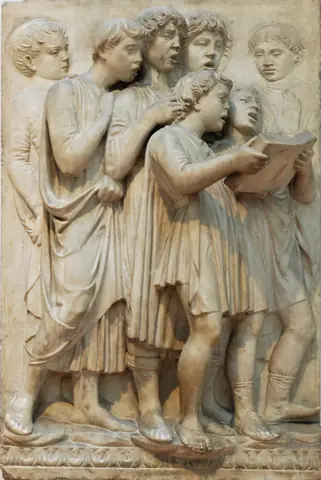
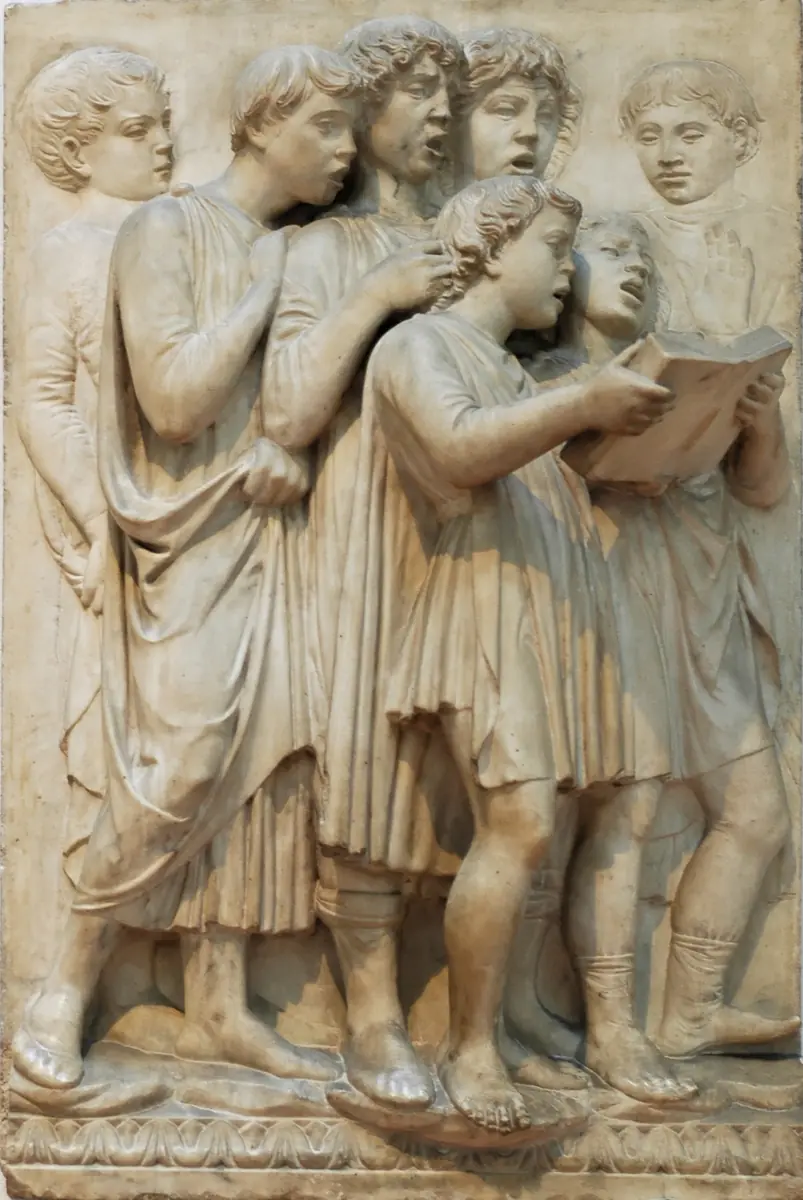
Image: Wikimedia Commons · Public domain Singing children, from the Cantoria
Look closely. A marble relief of boys singing from an open book, packed together, mouths open, some in long tunics and some in shorter ones, their feet overlapping on the carved ground. Look at the hands on the book, the overlapping heads, and the liveliness of a group that has been asked to praise God and has not yet learned to stand still.
In the library: The Bible (KJV)
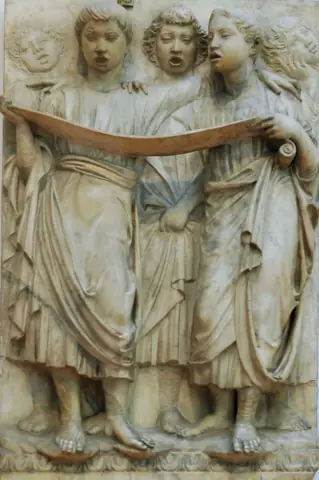
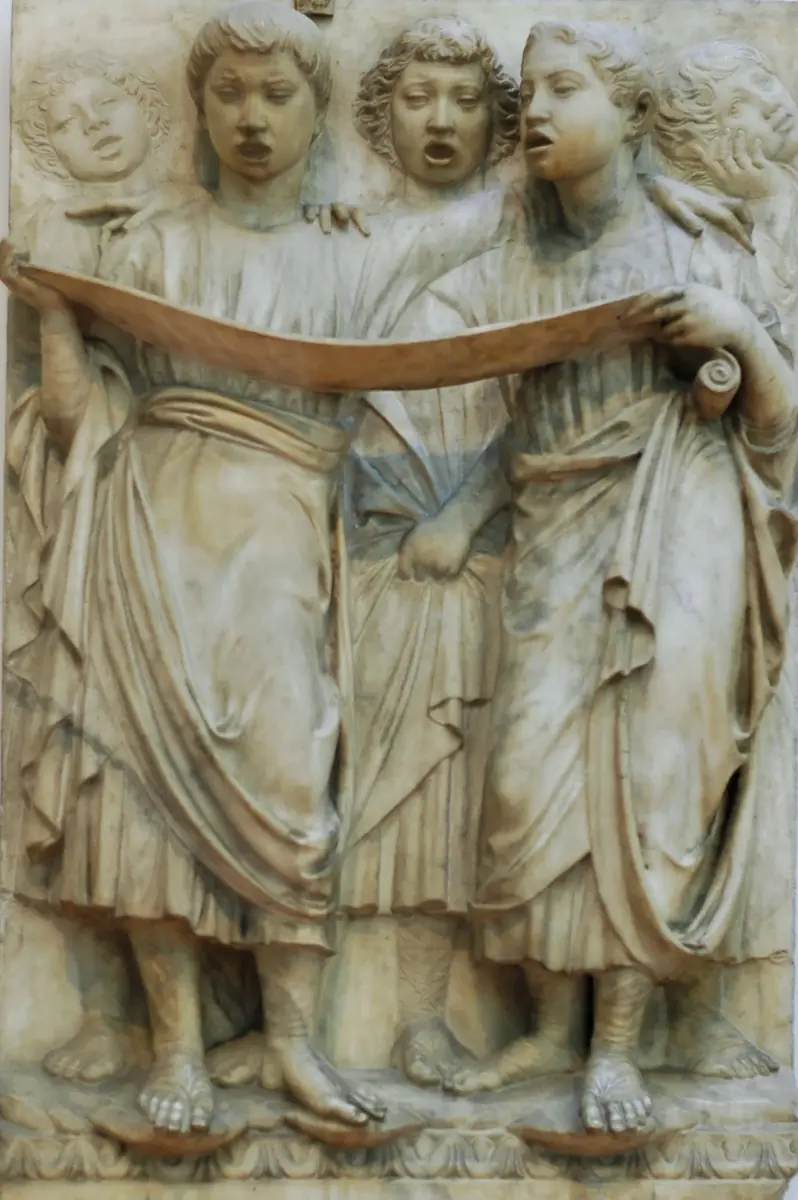
Image: Wikimedia Commons · Public domain Singers with a scroll, from the Cantoria
Look closely. Another panel from the same gallery: children holding a long unrolled scroll of music, singing as they read. Look at the stretch of the parchment across the group, the bare feet on the little carved clouds, and the way Luca makes a choir out of a few figures and one line of text.
In the library: The Bible (KJV)
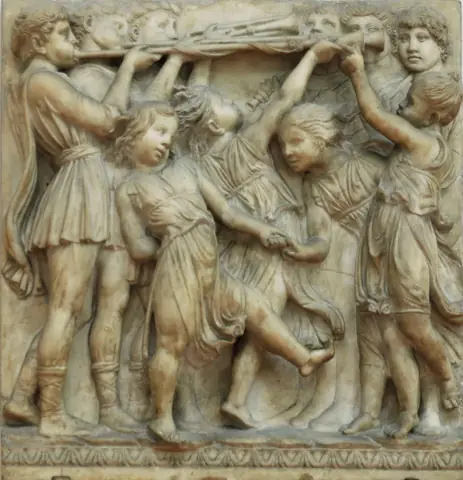
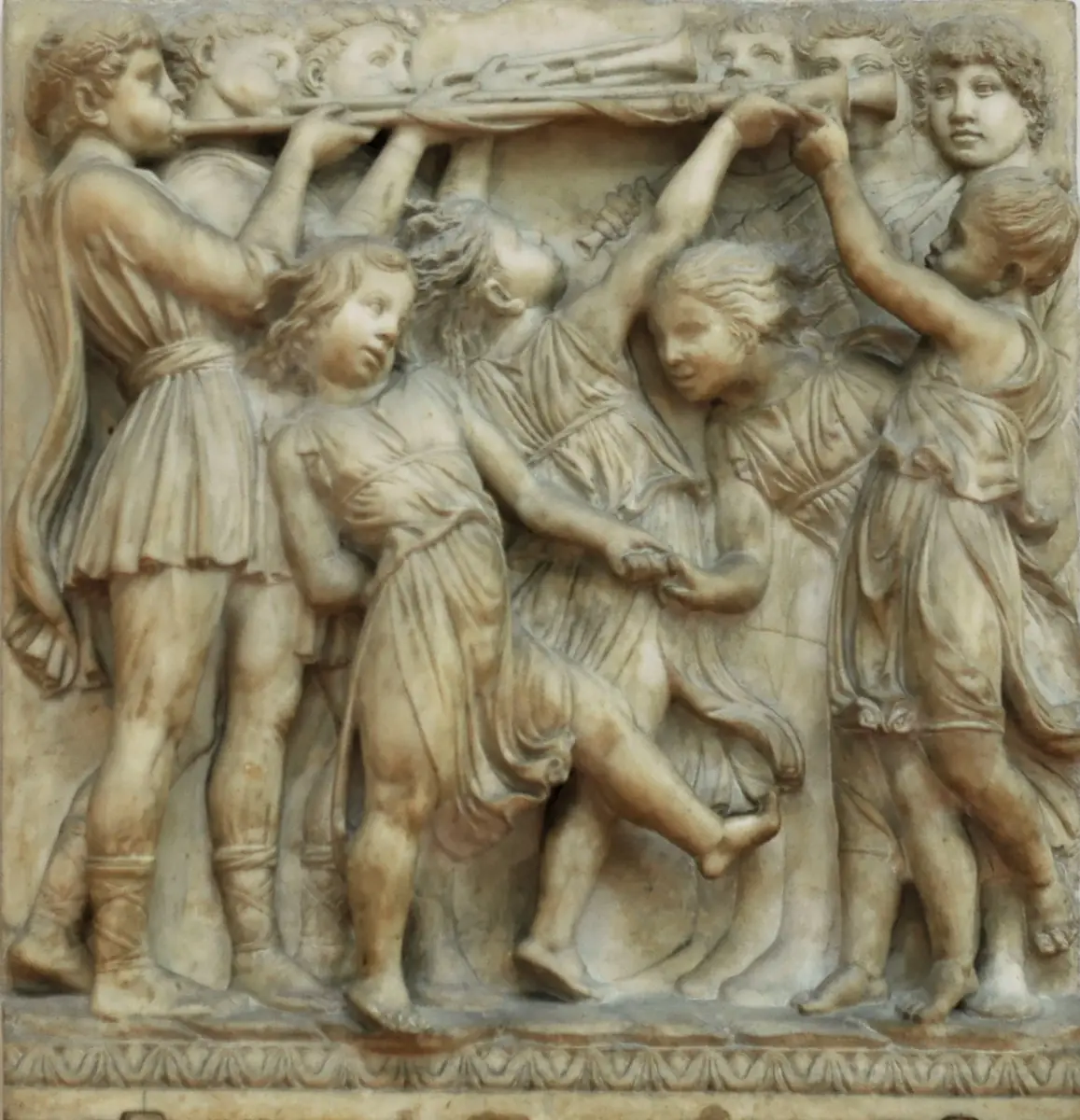
Image: Wikimedia Commons · Public domain Children with trumpets, from the Cantoria
Look closely. Children sounding long trumpets, others dancing in short tunics, from the same singing gallery. Look at the raised instruments, the packed slightly chaotic joy of the group, and the way a psalm of praise has been made into a dance.
In the library: The Bible (KJV)
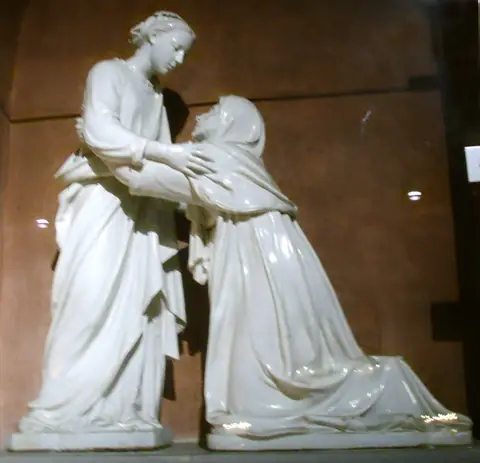
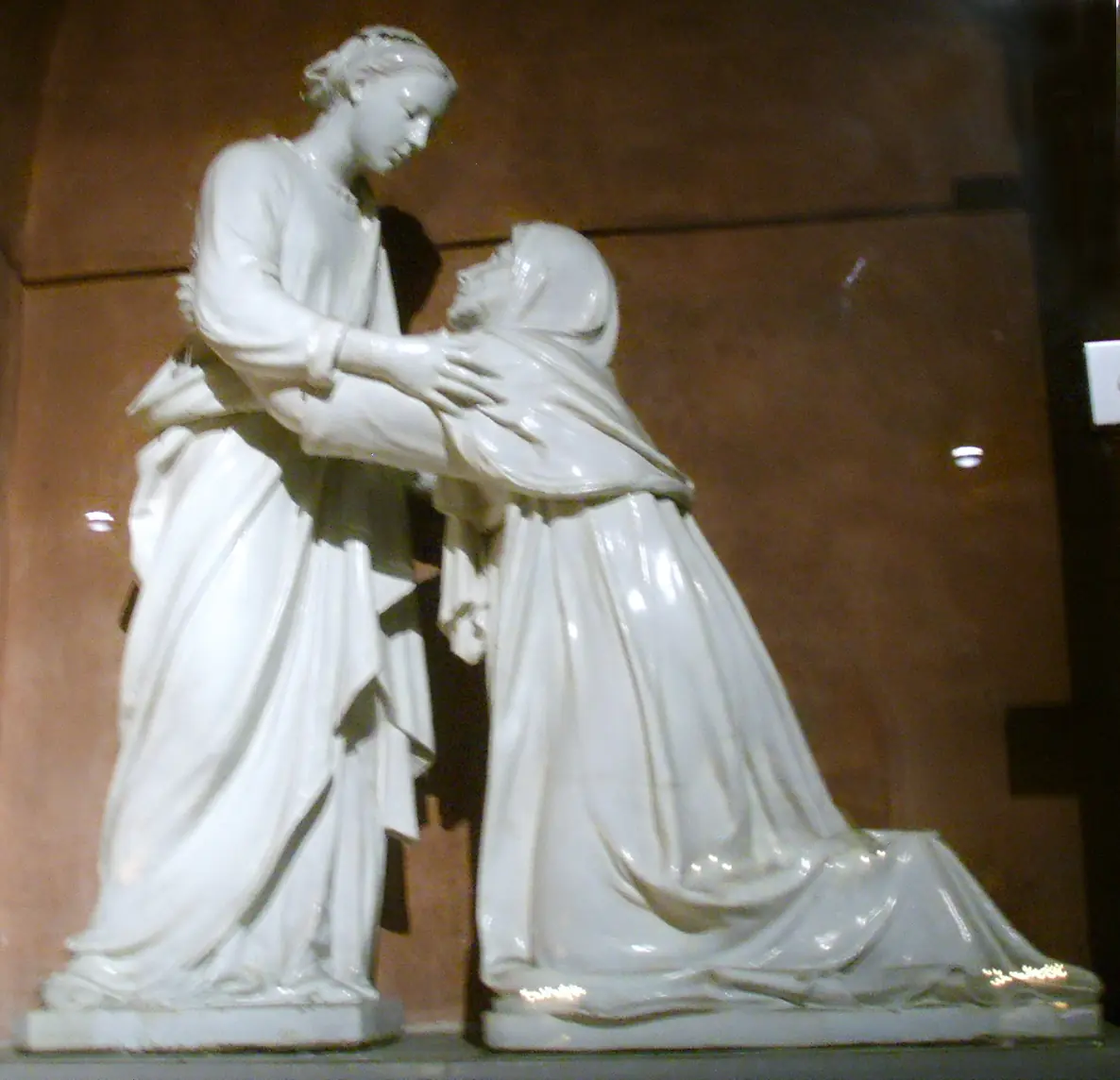
Image: Wikimedia Commons · CC BY 2.5 · Photo: Sailko The Visitation
Look closely. Mary and Elizabeth, two fully draped figures in white glaze, meeting: the younger woman standing, the older kneeling or bending in greeting, their hands at each other's arms. Look at the shine of the terracotta, the long simple folds, and the tenderness of a meeting that needs no other figures.
In the library: The Bible (KJV) · Mary, mother of Jesus
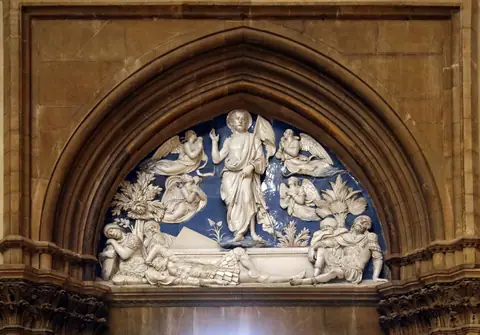
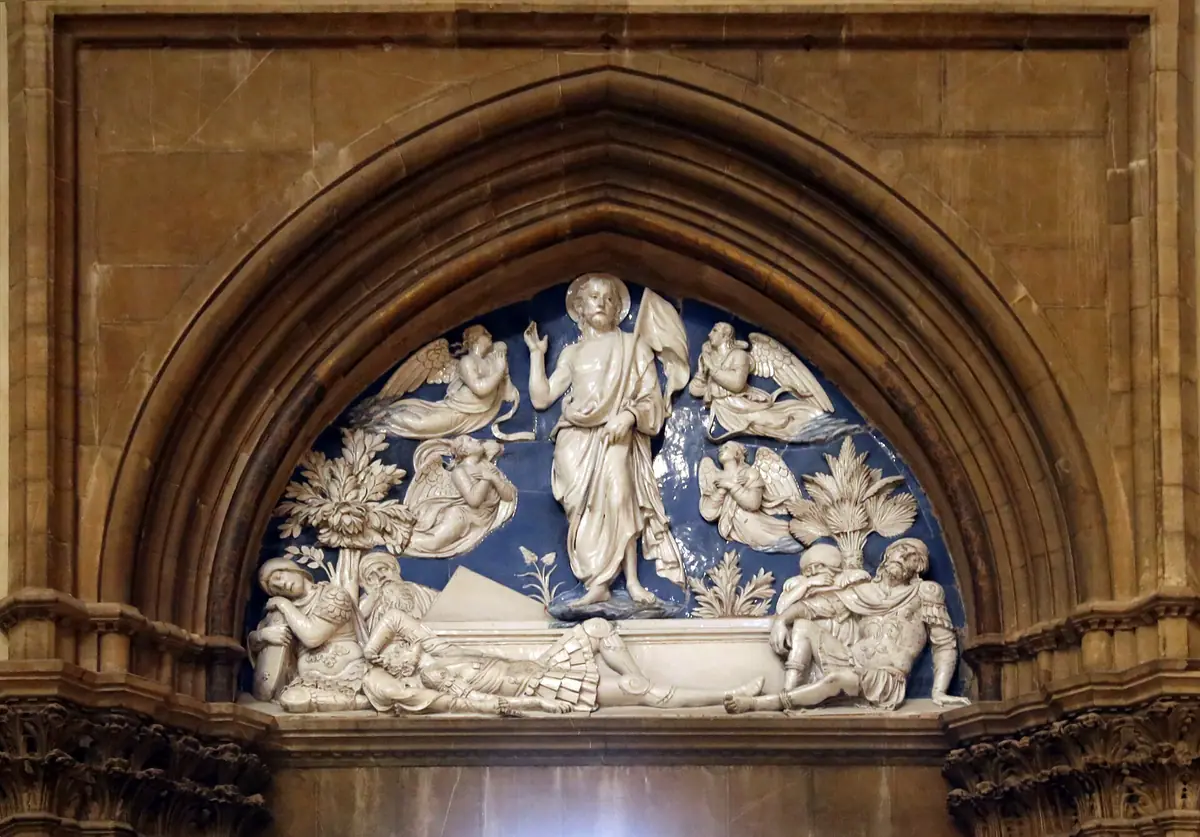
Image: Wikimedia Commons · CC BY 3.0 · Photo: Sailko The Resurrection
Look closely. A glazed lunette over a doorway: Christ steps from the tomb with a banner, soldiers sleep below, angels rest on a deep blue ground. Look at the white figures against that blue, and at the way Luca tells the whole morning in one arch.
In the library: The Bible (KJV) · Jesus Christ


What to watch for in Luca della Robbia
Look slowly- Praise as a subject. The Cantoria is children making music, not a battle or a triumph.
- A glaze that can live outdoors. The white and blue are not paint; they are fired skin.
- White on blue. In the Visitation and the Resurrection, the glaze is a quiet, durable light.
- Hands and music. On the Cantoria, look at how a child holds a scroll, a book, or a trumpet.
- Workshop and master. Later della Robbia work is often Andrea's; the pieces here are Luca's or from his immediate shop.
For older students
These famous works include nudity, so they are named here but not shown. Teachers and parents can decide when to look at them together.
- Madonna and Child with a scroll, c. 1450s, Metropolitan Museum of Art, New York. A glazed terracotta Madonna; the Christ Child is unclothed.
- Virgin and Child in a niche, c. mid-fifteenth century, Metropolitan Museum of Art, New York. A glazed shrine; the Christ Child is unclothed.
- Other Madonna and Child reliefs from Luca's shop, mid-fifteenth century, Various collections. Many of the white-and-blue Madonnas show the Child unclothed.
- Some panels of the Cantoria, 1431–1438, Museo dell'Opera del Duomo, Florence. Several reliefs include unclothed dancing children or putti, and are not shown here.
Dates and collections follow the holding museums and Wikidata. Images of paintings are photographs of public-domain pictures from Wikimedia Commons or museum open-access releases; photographs of sculpture are used only when the photograph itself is Public domain, CC0, or CC BY with a named credit. Each picture links to its source page with full licence details.