Great Art · Early Renaissance
Masaccio
The young Florentine who, in a short life, gave painted figures the weight of sculpture and set them in true perspective.
His life
Masaccio, born Tommaso, was called "Masaccio" — clumsy, hulking Tom — by fellow artists, apparently because he cared more about painting than about manners or dress. He was born in 1401 in the Arno valley and was working in Florence while still very young. In the Brancacci Chapel at Santa Maria del Carmine he painted, with Masolino, scenes from the life of Saint Peter that became a school for later painters. Vasari, writing later, said that every artist of importance went there to study.
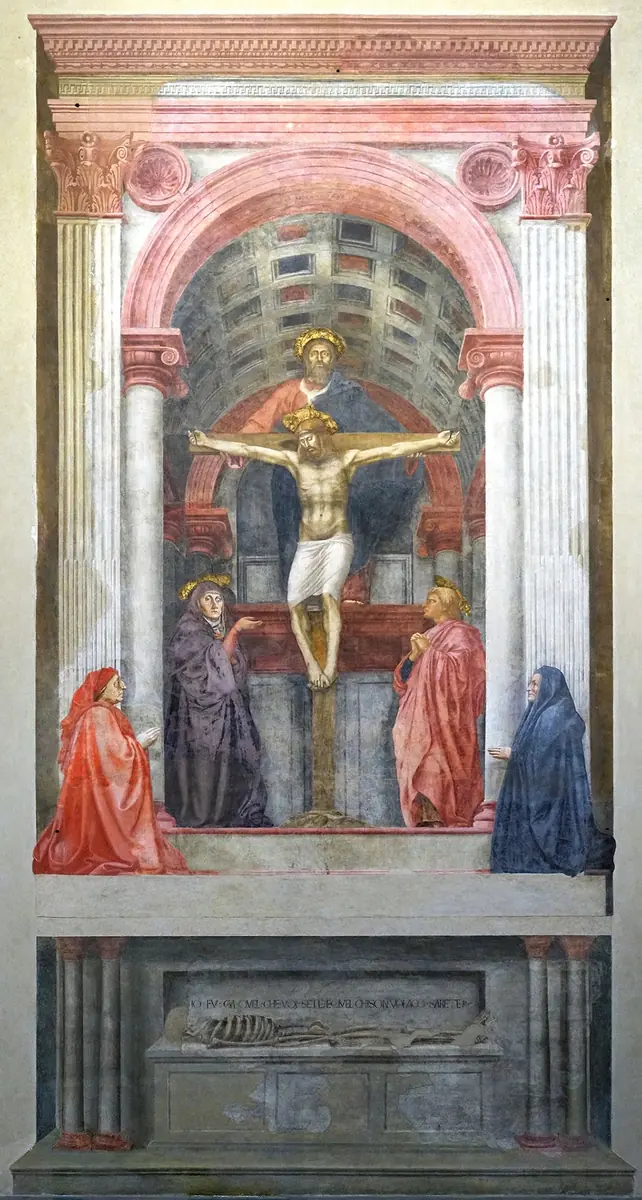
His Holy Trinity in Santa Maria Novella is among the first paintings to use systematic linear perspective, the kind of measured space that the architect Brunelleschi had been working out in Florence. Masaccio died in Rome in 1428, only twenty-six or twenty-seven years old. His gift was gravity: feet that stand on a real floor, bodies that throw shadows, and faces that look as if thought and grief have weight. Later Florentines, including Michelangelo, learned from him.
Key works
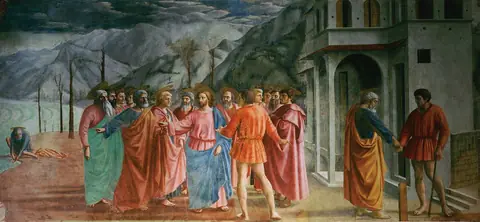
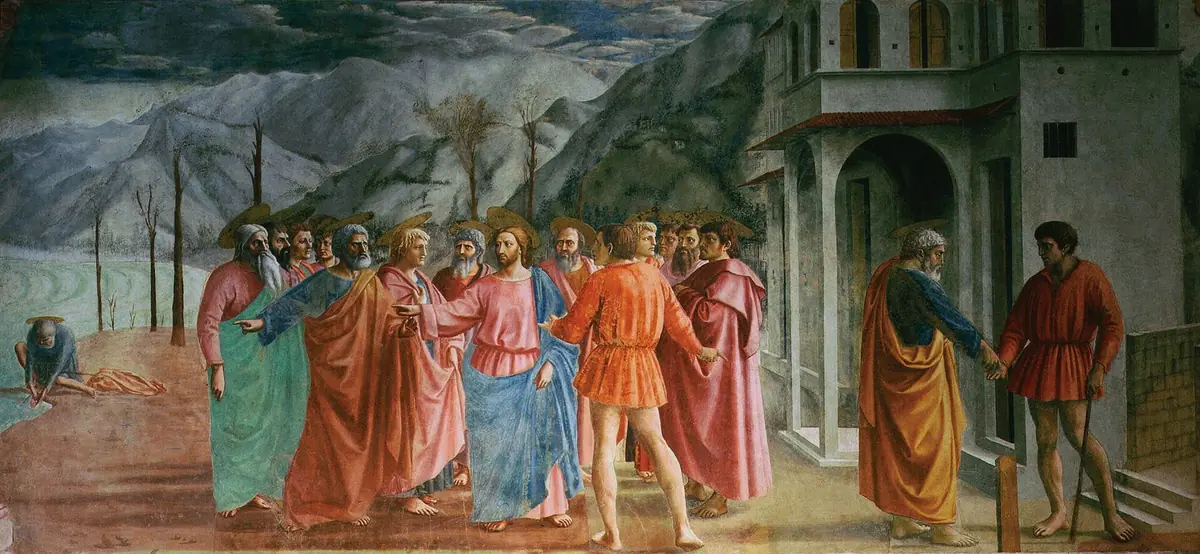
Image: Wikimedia Commons · Public domain (PD-Art) The Tribute Money
Look closely. The story is told in three moments within one landscape. At the centre, a tax collector demands the temple tax and Christ tells Peter what to do; at the left, Peter takes a coin from the mouth of a fish; at the right, he pays the collector. Look at the tax collector from behind, and at how all the apostles stand in a solid ring around Christ.
In the library: The Bible (KJV) · Apostle Peter · Jesus Christ
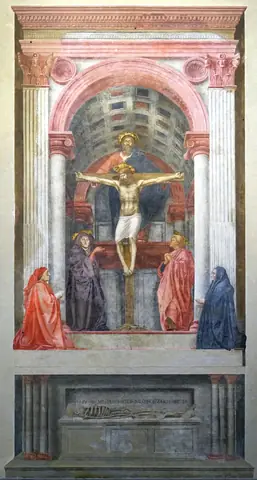
Image: Wikimedia Commons · Public domain (PD-Art) The Holy Trinity
Look closely. God the Father holds the cross of the Son, and the dove of the Spirit is between them, all set in a painted barrel vault so exact that the chapel wall seems to open. Below, a skeleton lies on a tomb. The inscription (in Italian) reminds the living that the dead man was once as they are, and that they will be as he is. Donors kneel on a ledge at the sides, as if they were in the room with you.
In the library: The Bible (KJV) · Jesus Christ · Filippo Brunelleschi
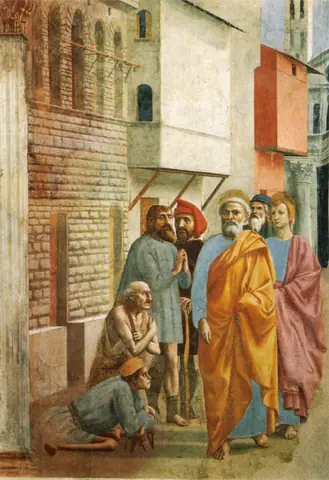
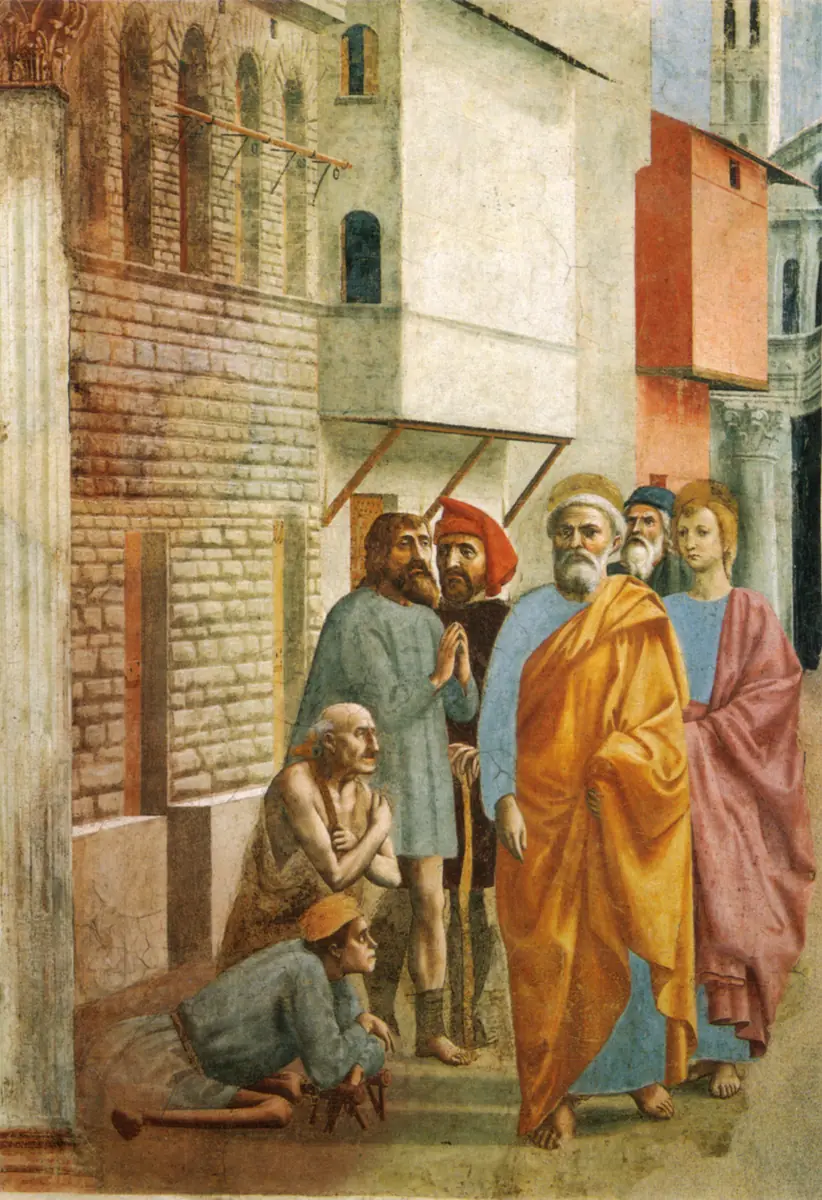
Image: Wikimedia Commons · Public domain (PD-Art) Saint Peter Healing the Sick with His Shadow
Look closely. Peter walks down a Florentine street and the sick wait for his shadow to fall on them. You do not need a gesture of miracle: the story is told by the line of his walk and by the hope on the waiting faces. Look at the plain town houses and at how simply Masaccio paints poverty and healing in the same light.
In the library: The Bible (KJV) · Apostle Peter
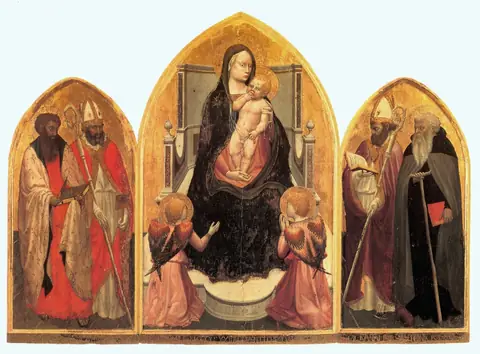
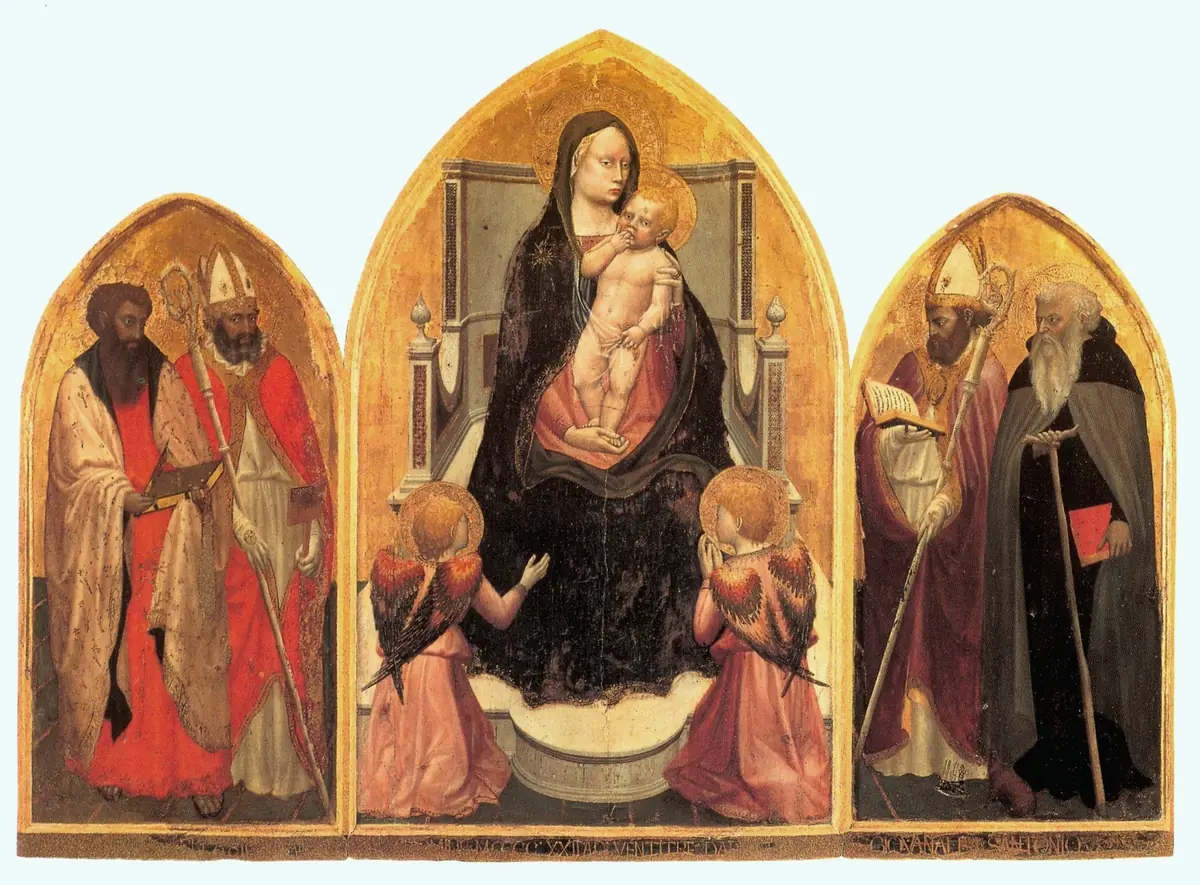
Image: Wikimedia Commons · Public domain (PD-Art) San Giovenale Triptych
Look closely. This is Masaccio's earliest dated work, painted when he was about twenty for a country church. Mary and the Child sit in the centre; saints, including John the Baptist, stand in the wings. The gold ground is still medieval, but the Child already has a real baby's weight, and the throne sits in a shallow, believable space.
In the library: The Bible (KJV) · Mary, mother of Jesus · John the Baptist
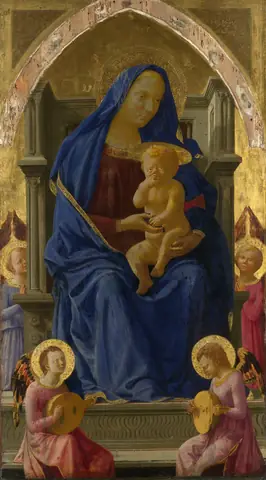
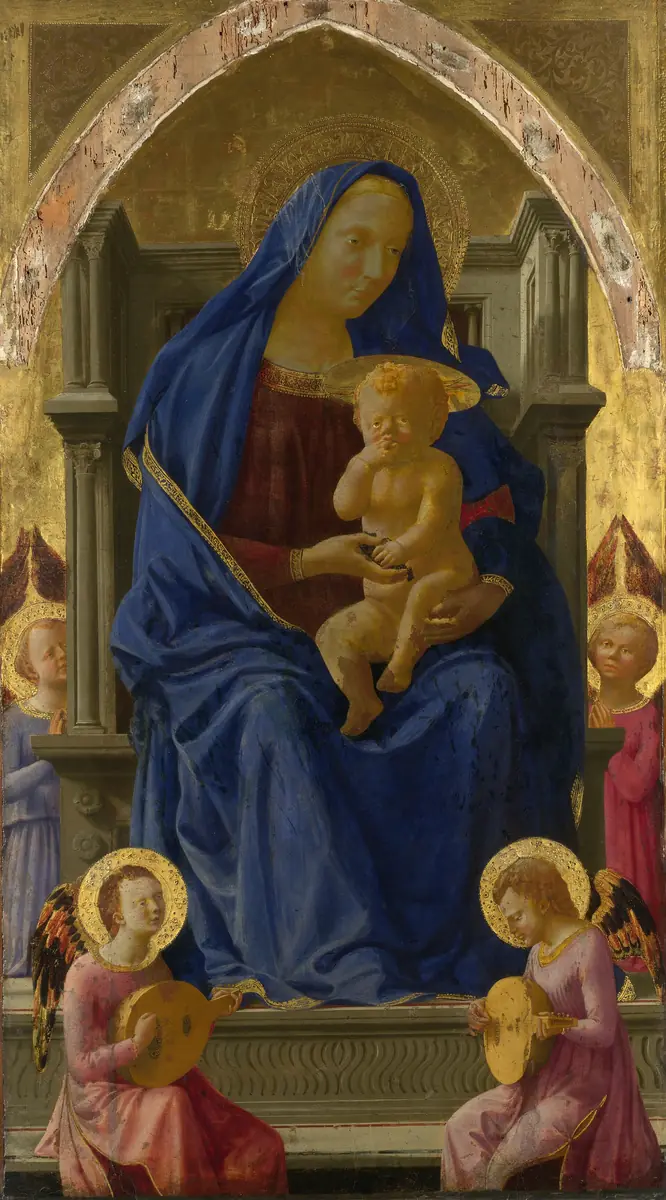
Image: Wikimedia Commons · Public domain (PD-Art) Madonna and Child (from the Pisa Polyptych)
Look closely. Mary sits on a heavy throne eating grapes, and the Child reaches for them — a quiet hint of the wine of the Last Supper and of his coming death. Two angels kneel in front with a lute and a lute-like viol. The panel was the centre of a large altarpiece painted for a chapel in Pisa, later divided among several museums.
In the library: The Bible (KJV) · Mary, mother of Jesus · Jesus Christ
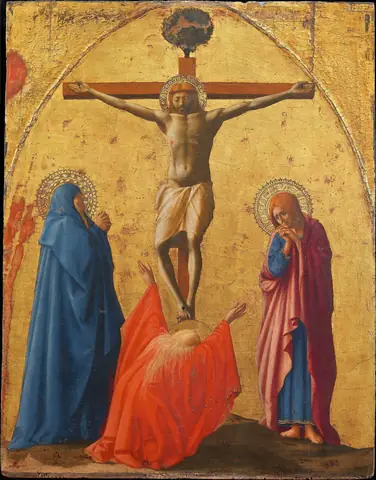
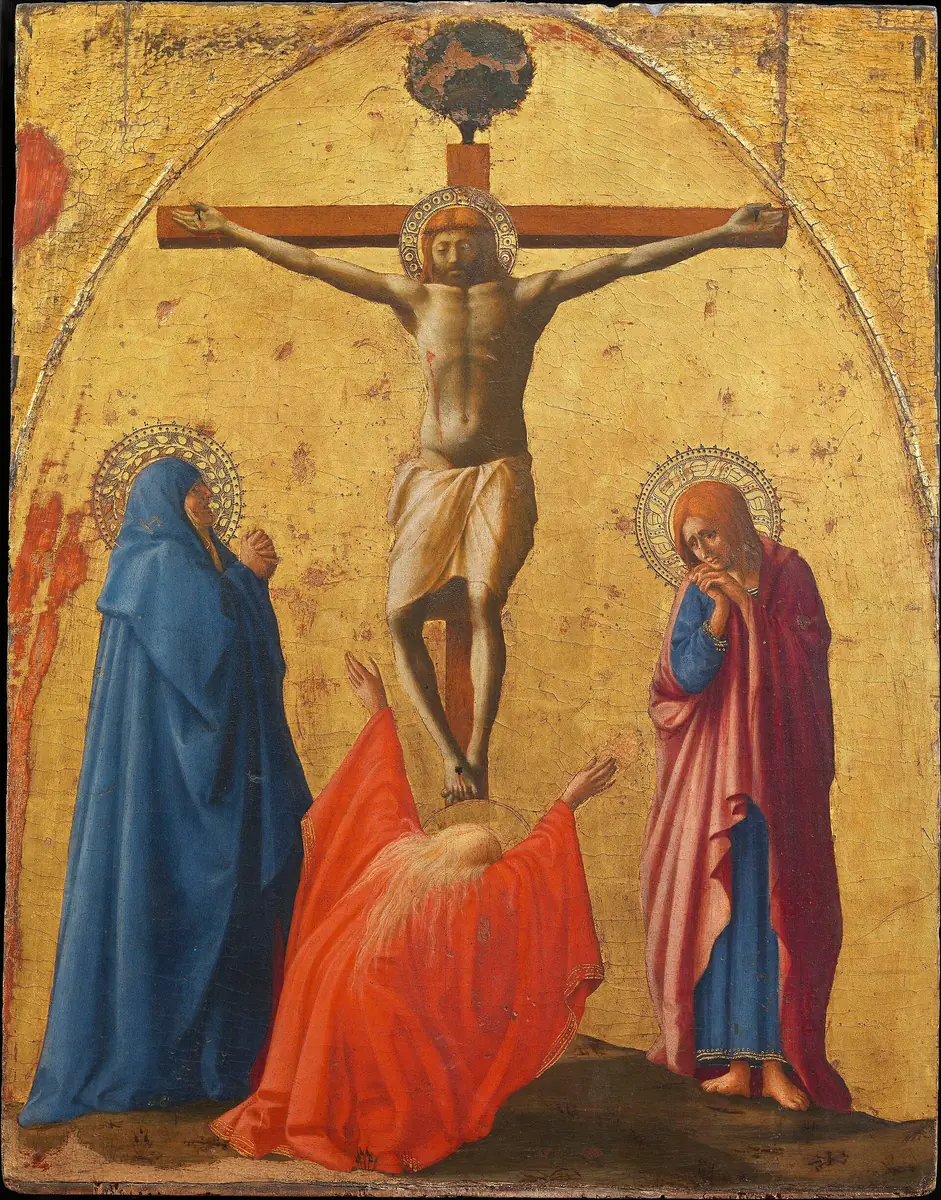
Image: Wikimedia Commons · Public domain (PD-Art) Crucifixion (from the Pisa Polyptych)
Look closely. This pointed panel sat above the Madonna in the same Pisa altarpiece. Mary, in a long blue cloak, faints with grief; John clasps his hands; and at the foot of the cross the Magdalene, in a red cloak, throws her arms up toward Christ. The gold ground is old-fashioned; the bodies and the anguish are new.
In the library: The Bible (KJV) · Jesus Christ · Mary, mother of Jesus · John the Apostle


What to watch for in Masaccio
Look slowly- Feet on the ground. Look where the figures stand: shadows puddle around real heels.
- One light source. In the Brancacci Chapel the light falls as if from the real chapel window.
- Perspective lines. In the Trinity, follow the coffers of the painted vault back to a vanishing point.
- Three moments, one space. In the Tribute Money, the same Peter appears more than once in a single landscape.
- Sculptural faces. Heads look carved, with plain, serious features rather than pretty decoration.
For older students
These famous works include nudity, so they are named here but not shown. Teachers and parents can decide when to look at them together.
- Expulsion from the Garden of Eden, c. 1425, Brancacci Chapel, Santa Maria del Carmine, Florence. Adam and Eve are shown unclothed as they are driven out of Eden. The fresco is famous for their grief, but it is not shown on this page.
- Baptism of the Neophytes, c. 1426, Brancacci Chapel, Santa Maria del Carmine, Florence. New Christians are baptised in a river; some of the figures are unclothed. Teachers may wish to look at it with older students when studying the Brancacci cycle.
Dates and collections follow the holding museums and Wikidata. Images of paintings are photographs of public-domain pictures from Wikimedia Commons or museum open-access releases; photographs of sculpture are used only when the photograph itself is Public domain, CC0, or CC BY with a named credit. Each picture links to its source page with full licence details.