Great Art · Early Renaissance
Piero della Francesca
The Tuscan master of still, mathematical light, who painted the Baptism, the Resurrection, and the Legend of the True Cross.
His life
Piero della Francesca was born in Sansepolcro, a small town in the upper Tiber valley, and trained in Florence, but he spent much of his life working in his native region and at the court of Urbino. He painted a long fresco cycle of the Legend of the True Cross in the church of San Francesco in Arezzo, and he wrote treatises on perspective and on the geometry of regular solids. He was a painter who also thought like a mathematician.
His figures stand in a calm, even light, as if time had slowed. Faces are often shown in profile or in a quiet three-quarter view, and the spaces are measured with a care you can almost count. Late in life his eyesight failed, and he died in Sansepolcro in 1492. His gift was stillness: he could make a baptism, a resurrection, or a pregnant Madonna feel as solid and as considered as a theorem, without losing tenderness.
Key works
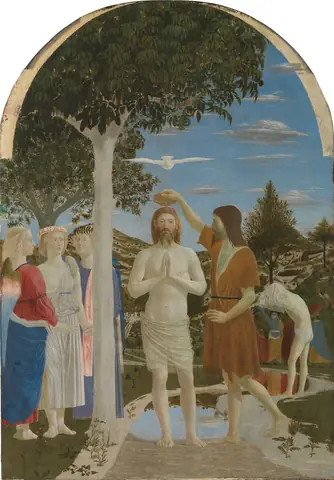
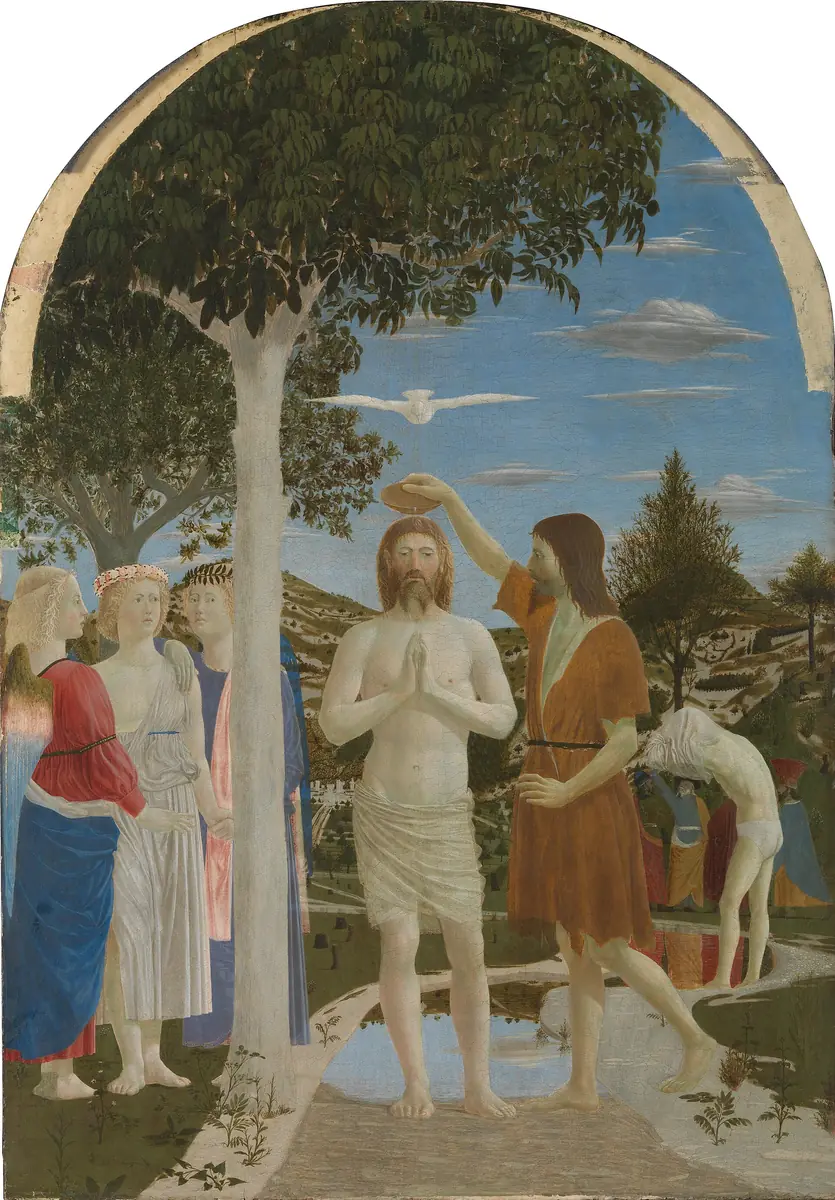
Image: Wikimedia Commons · Public domain (PD-Art) The Baptism of Christ
Look closely. Christ stands in a shallow stream, hands joined, while John pours water over his head and the dove hovers under a small cloud. Three angels on the left hold Christ's garments, and a man behind John pulls off his shirt, ready to be baptised. A walnut tree divides the panel down the middle. Look at the pale, still light and at the little town — Sansepolcro, Piero's home — in the distance.
In the library: The Bible (KJV) · Jesus Christ · John the Baptist
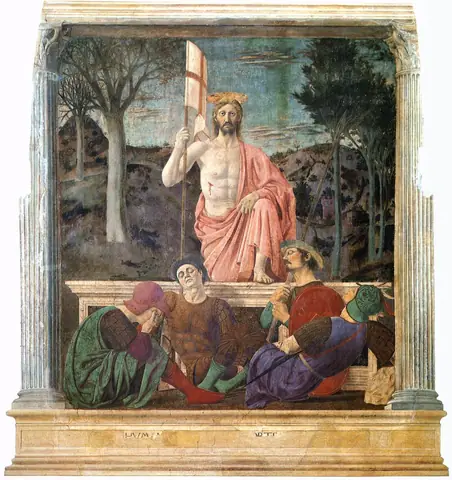
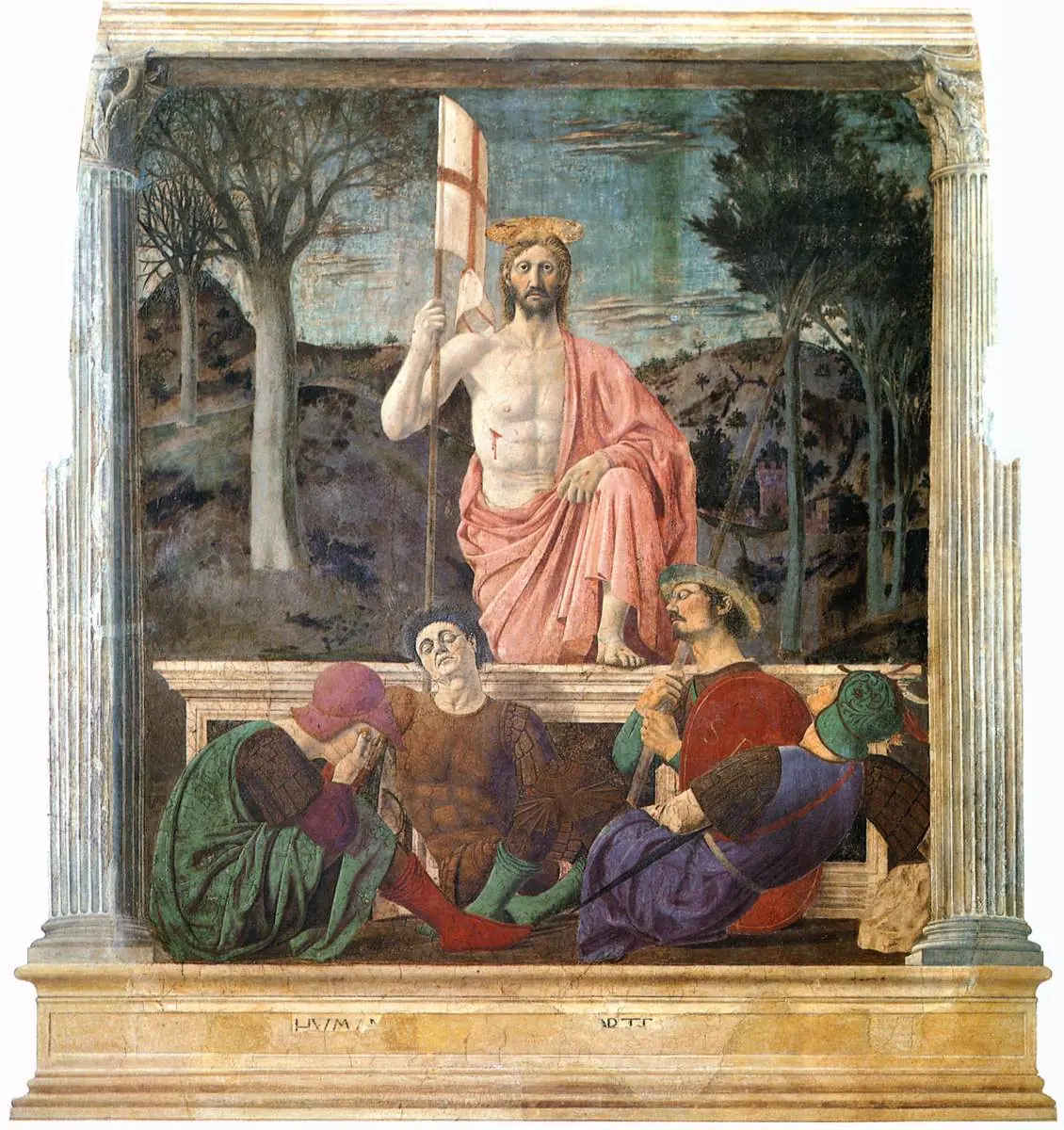
Image: Wikimedia Commons · Public domain (PD-Art) The Resurrection
Look closely. Christ steps out of the tomb at dawn, a banner in his hand, while four soldiers sleep in a heap at the foot of the stone. His body is solid and front-facing, the landscape winter on one side and summer on the other. The fresco was painted for the town hall of Sansepolcro, whose very name means "Holy Sepulchre." Look at the soldier in brown, often thought to be Piero's own face, and at Christ's unblinking gaze.
In the library: The Bible (KJV) · Jesus Christ
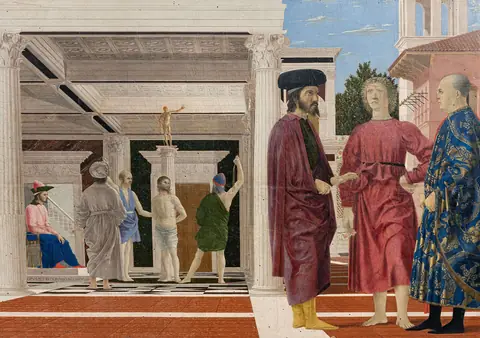
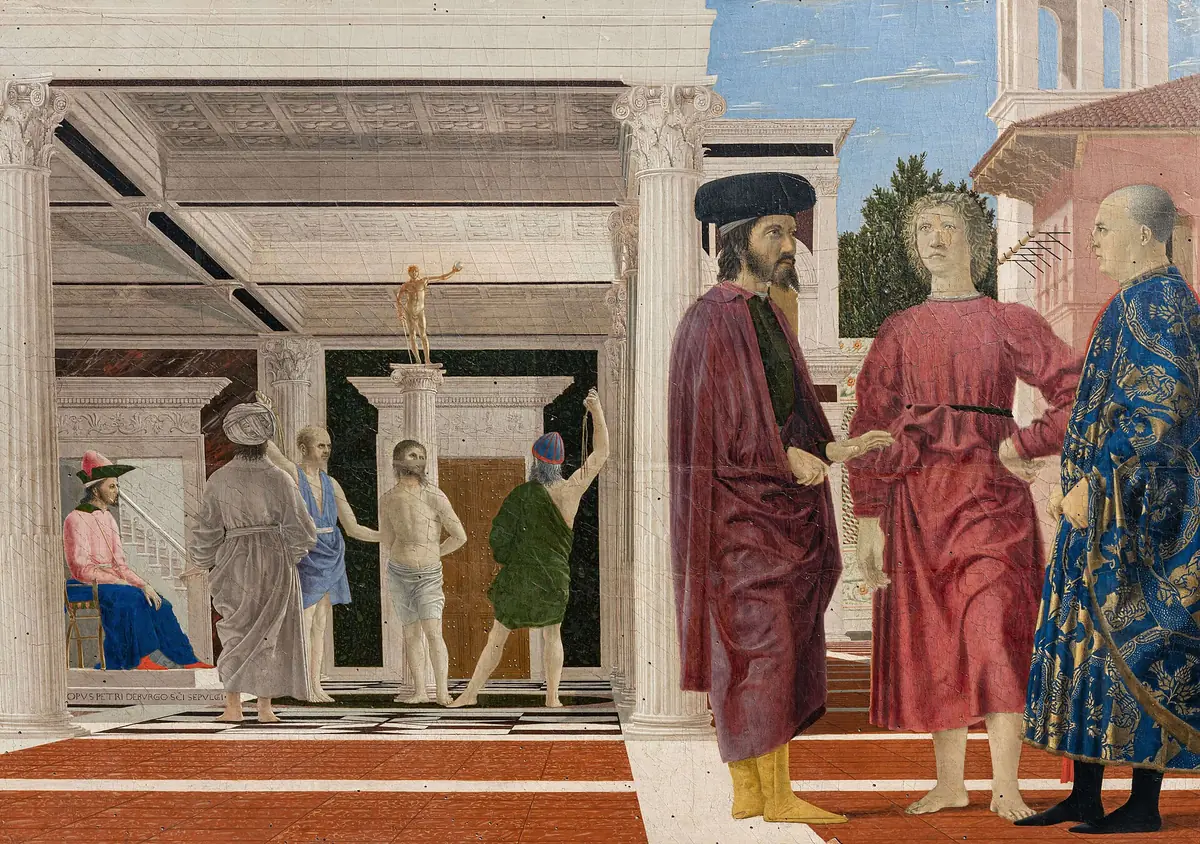
Image: Wikimedia Commons · Public domain (PD-Art) The Flagellation of Christ
Look closely. The picture is split by a puzzle. In a classical courtyard at the left, Christ is beaten at a pillar; in the right foreground, three well-dressed men stand talking, as if they belong to another moment. Scholars still disagree about who they are. Look first at the measured pavement and the calm architecture, then ask why Piero set the suffering of Christ so far back, and the conversation so close to us.
In the library: The Bible (KJV) · Jesus Christ
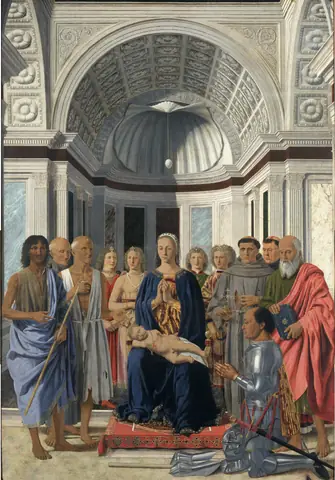
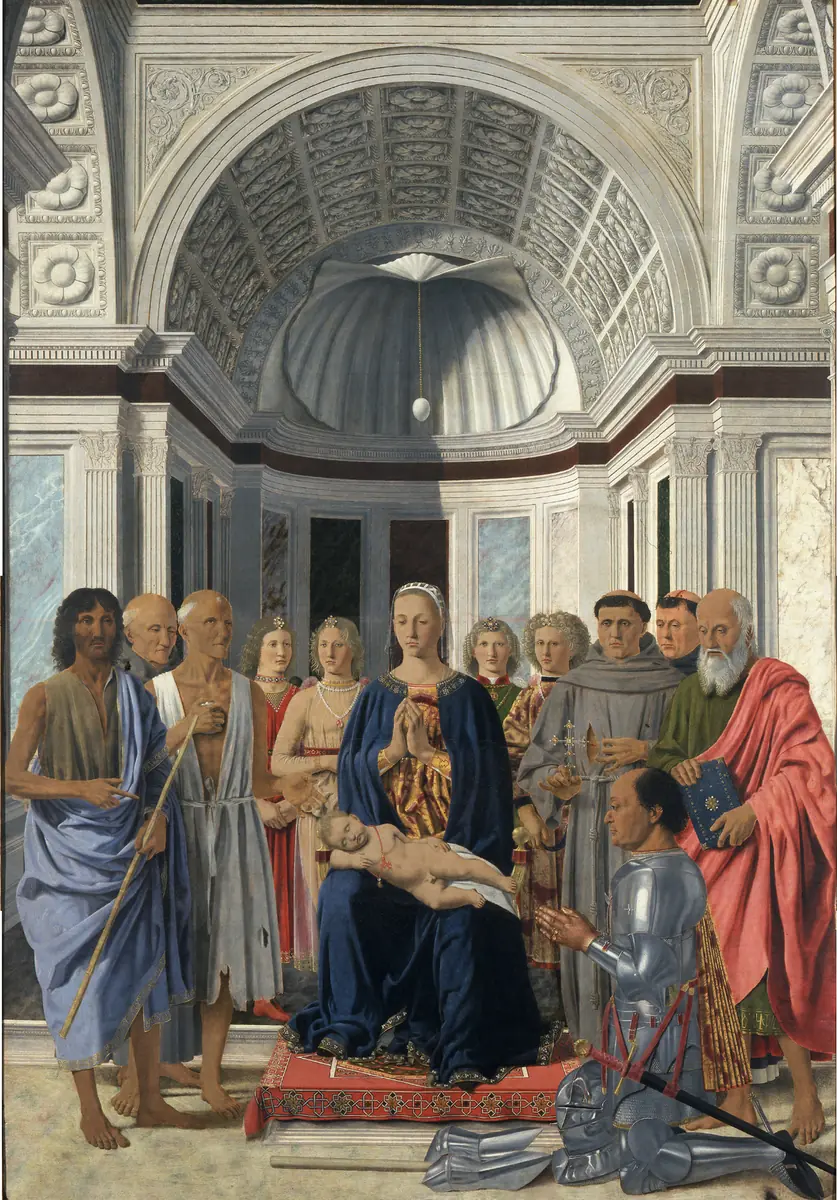
Image: Wikimedia Commons · Public domain (PD-Art) The Brera Madonna (Montefeltro Altarpiece)
Look closely. Mary and the Child sit in a classical apse, among saints and angels, while Federico da Montefeltro, Duke of Urbino, kneels in armour at the right, his helmet on the floor. An ostrich egg hangs from a shell in the coffered vault above them — a sign of miraculous birth and of the court's learning. Look at the silence of the group and at how every figure has room to stand.
In the library: The Bible (KJV) · Mary, mother of Jesus · Jesus Christ
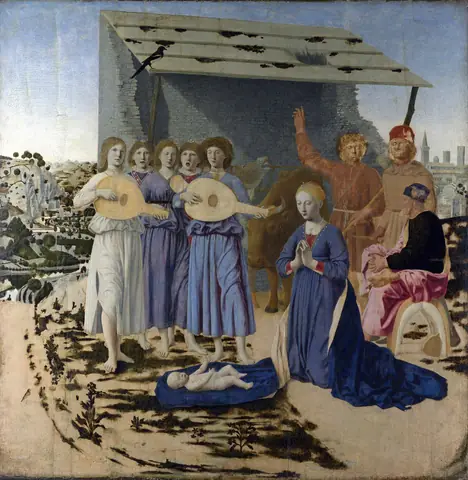
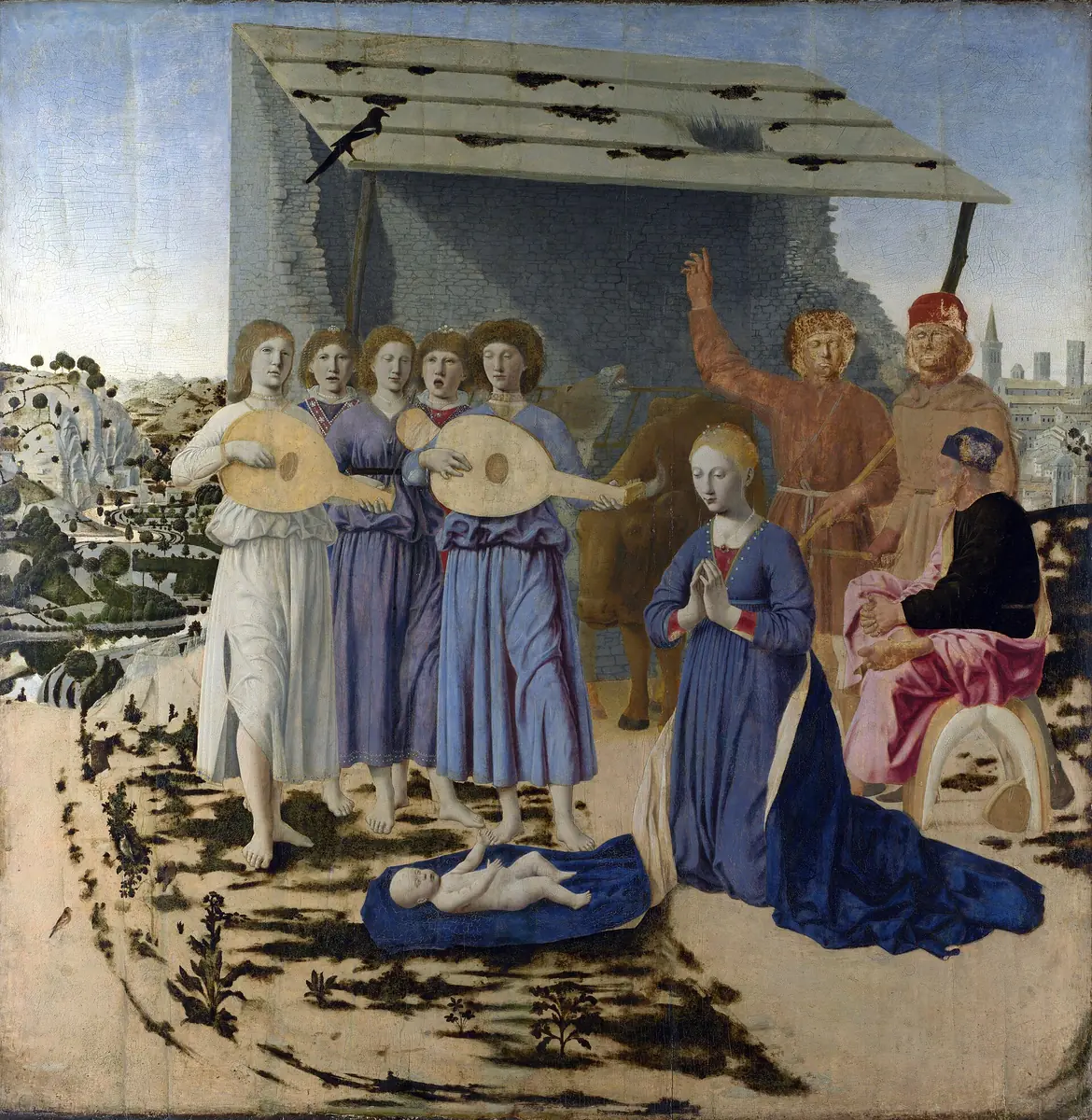
Image: Wikimedia Commons · Public domain (PD-Art) The Nativity
Look closely. Mary kneels on the bare ground before the Child, who lies on her cloak. Five angels sing, some with lutes, and Joseph sits with one bare foot raised to rest it. Shepherds point, and a ruined shed opens onto a wide landscape. The panel may have been left unfinished in places; even so, the stillness of Mary's kneeling is complete.
In the library: The Bible (KJV) · Jesus Christ · Mary, mother of Jesus · Joseph of Nazareth
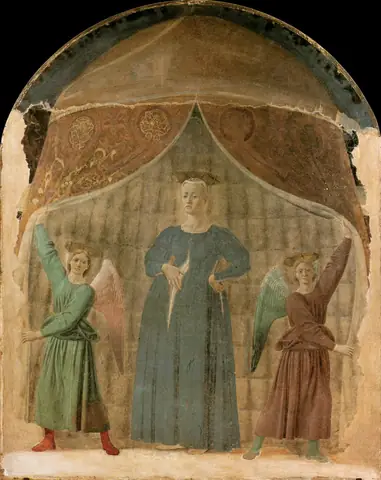
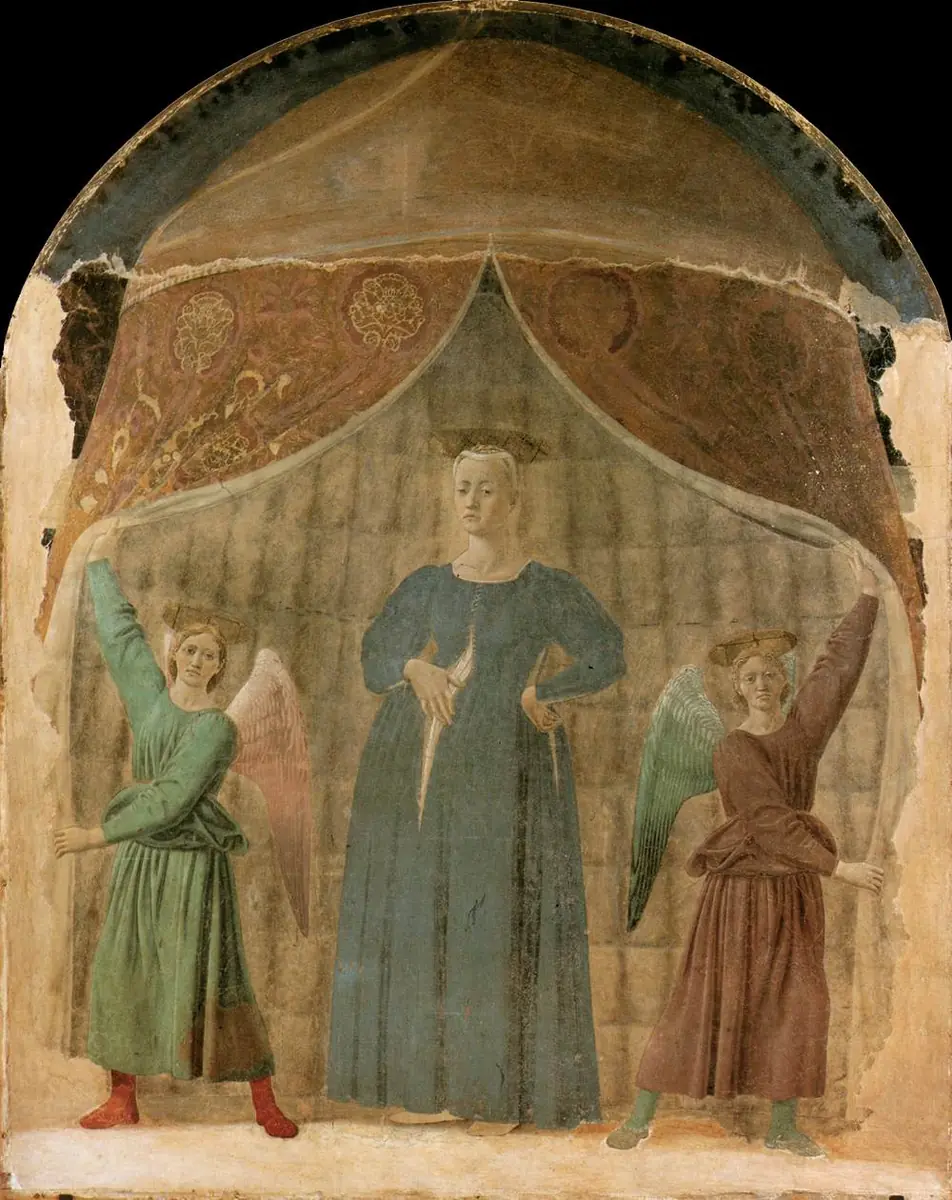
Image: Wikimedia Commons · Public domain (PD-Art) Madonna del Parto
Look closely. Mary stands, clearly with child, in a simple gown, and two angels draw back the flaps of a richly lined tent so that we can see her. One hand rests on her belly, the other at her side. The fresco was painted for a country chapel near Piero's mother's village. It is modest and direct: the Mother of God shown as a pregnant woman, honoured and guarded.
In the library: The Bible (KJV) · Mary, mother of Jesus
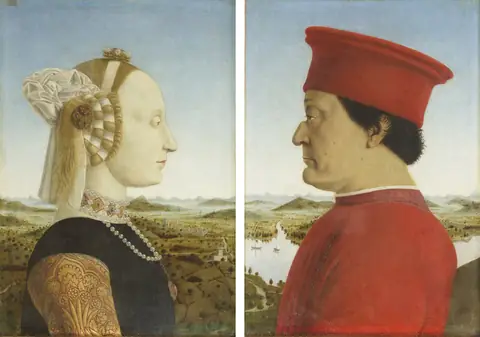
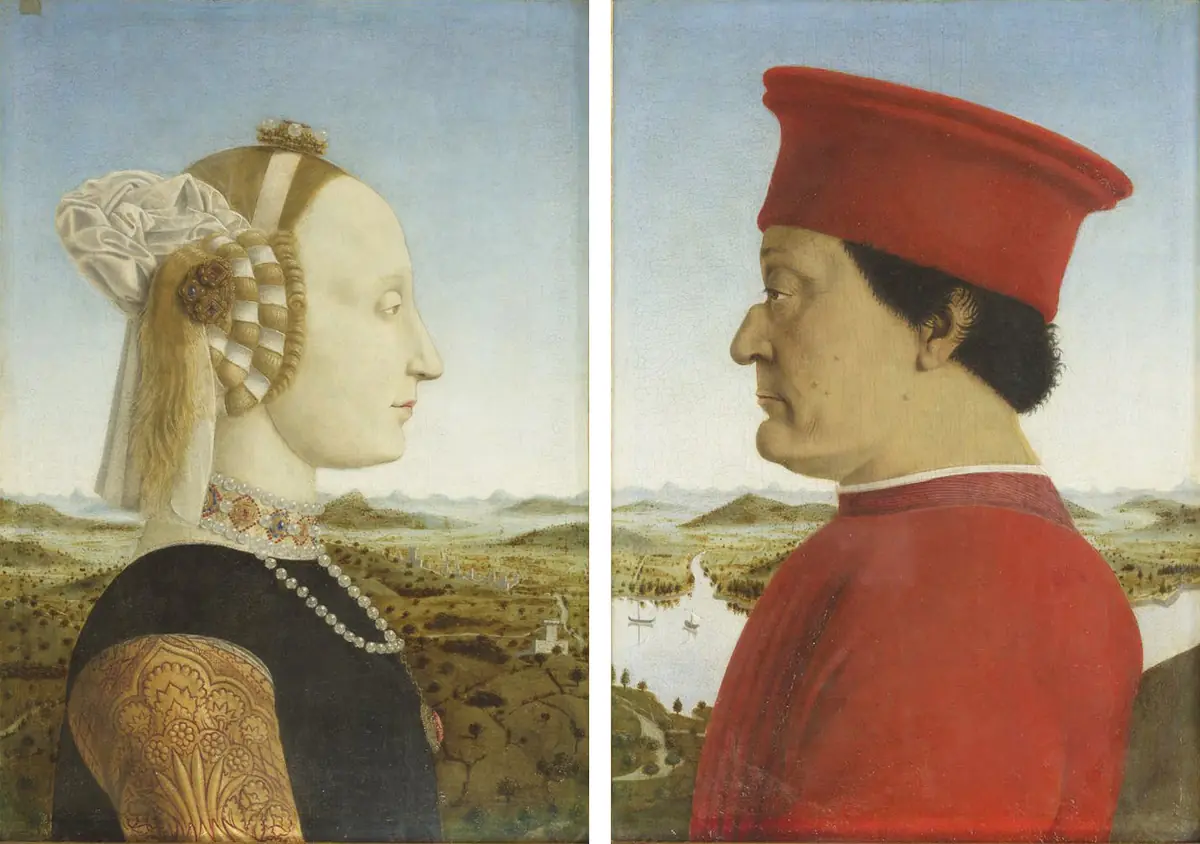
Image: Wikimedia Commons · Public domain (PD-Art) Diptych of Federico da Montefeltro and Battista Sforza
Look closely. The Duke and Duchess of Urbino face each other in strict profile, like a pair of Roman coins, against a high, pale landscape. Federico is shown on his left side, the side uninjured in a tournament that broke his nose. On the reverse of the original panels, each is carried in a triumphal cart. Look at the tiny hills and rivers behind them, and at how much dignity Piero can put into a silhouette.


What to watch for in Piero della Francesca
Look slowly- Even, pale light. There are few heavy shadows; forms are modelled as if by morning air.
- Geometry you can count. Look for circles, repeated intervals, and figures placed on a clear grid.
- Profiles and ovals. Heads are often calm ovals in profile, like medals.
- A landscape like a stage floor. Hills and rivers are clear, pale and far, with little weather.
- Silence. Even battle and miracle are painted without bustle; look at the faces for the story.
Dates and collections follow the holding museums and Wikidata. Images of paintings are photographs of public-domain pictures from Wikimedia Commons or museum open-access releases; photographs of sculpture are used only when the photograph itself is Public domain, CC0, or CC BY with a named credit. Each picture links to its source page with full licence details.