Great Art · Baroque (Classicizing)
Nicolas Poussin
The French master who made Rome his home, and who composed sacred and classical stories with a grave, reasoned order.
His life
Nicolas Poussin was born in 1594 near Les Andelys in Normandy. After a difficult start in France he reached Rome in 1624 and, apart from a short and uneasy spell as first painter to Louis XIII in Paris, he stayed there for the rest of his life. He worked slowly, often for learned private patrons, composing pictures as if they were arguments: every figure has a place, every gesture a reason.
He died in Rome in 1665. His gift was order in the service of feeling. A Biblical rescue, a judgement, or a group of shepherds reading a tomb can be arranged like a relief on a sarcophagus, and still move you. He looked to ancient sculpture and to a clear daylight, and he used them to tell sacred history without theatrical display.
Key works
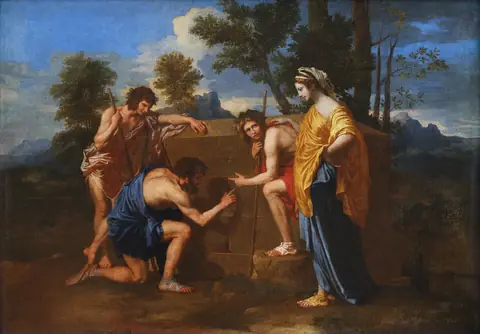
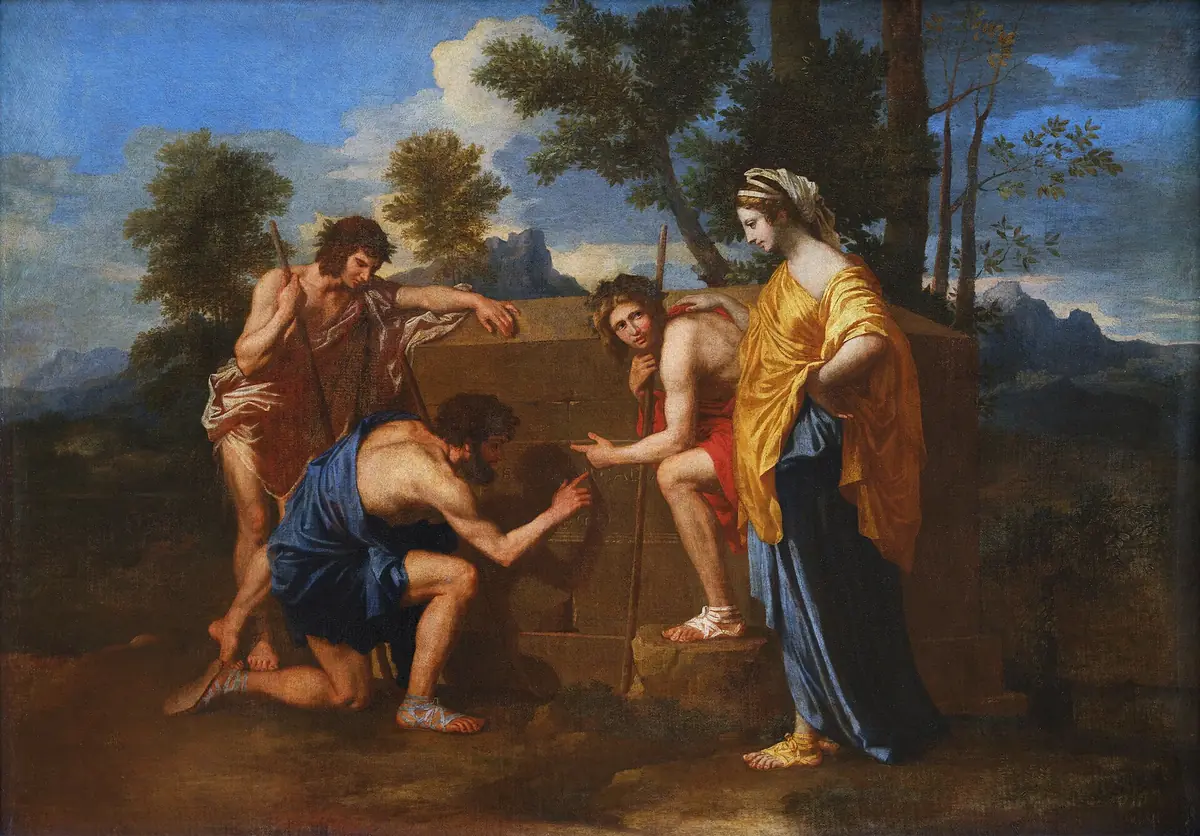
Image: Wikimedia Commons · Public domain (PD-Art) Et in Arcadia ego
Look closely. Four shepherds, in a calm, classical landscape, have stopped at a stone tomb; one traces the carved letters, and a woman stands in a blue-gold drapery and looks on. Look at the settled, almost triangular grouping, at the bare feet and the quiet hands, and at the thought the picture asks you to finish: even in Arcadia, death is present.
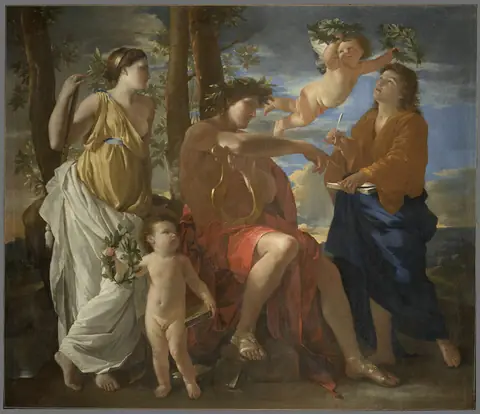
Image: Wikimedia Commons · Public domain (PD-Art) The Inspiration of the Poet
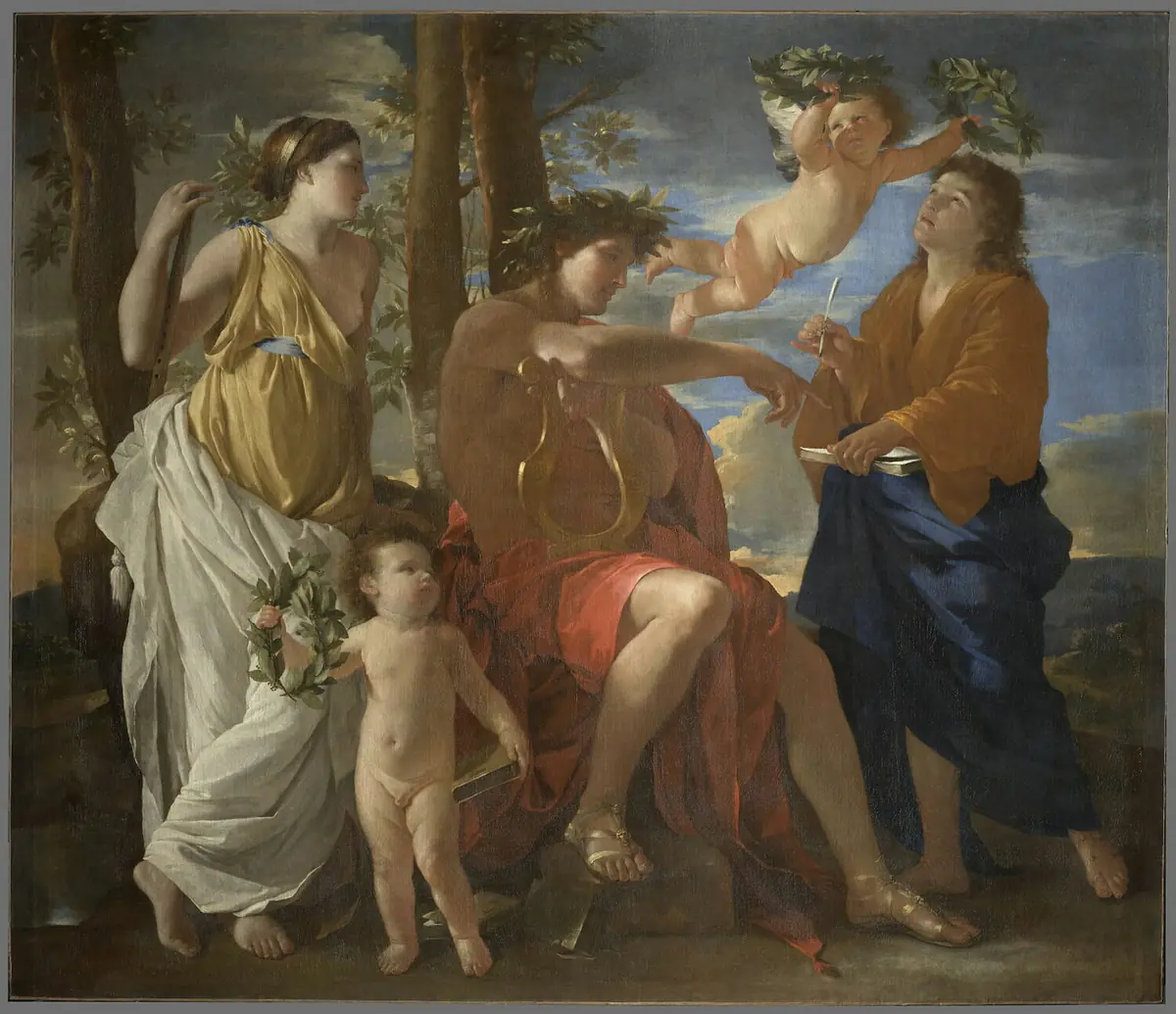
Look closely. Apollo, a golden god with a lyre, sits between a standing poet who writes at his dictation and a muse with a book; putti offer a laurel wreath, and a calm landscape opens at the right. Look at the tall, frieze-like arrangement, at the poet's bare foot and lifted face, and at how inspiration is shown as a grave ceremony, not as a frenzy.
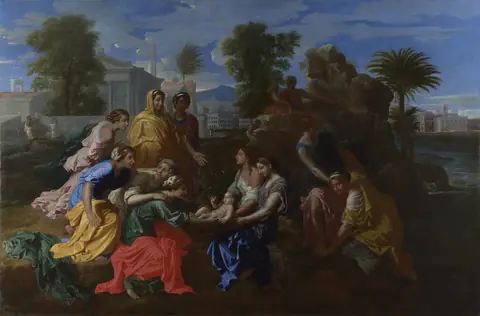
Image: Wikimedia Commons · Public domain (PD-Art) The Finding of Moses
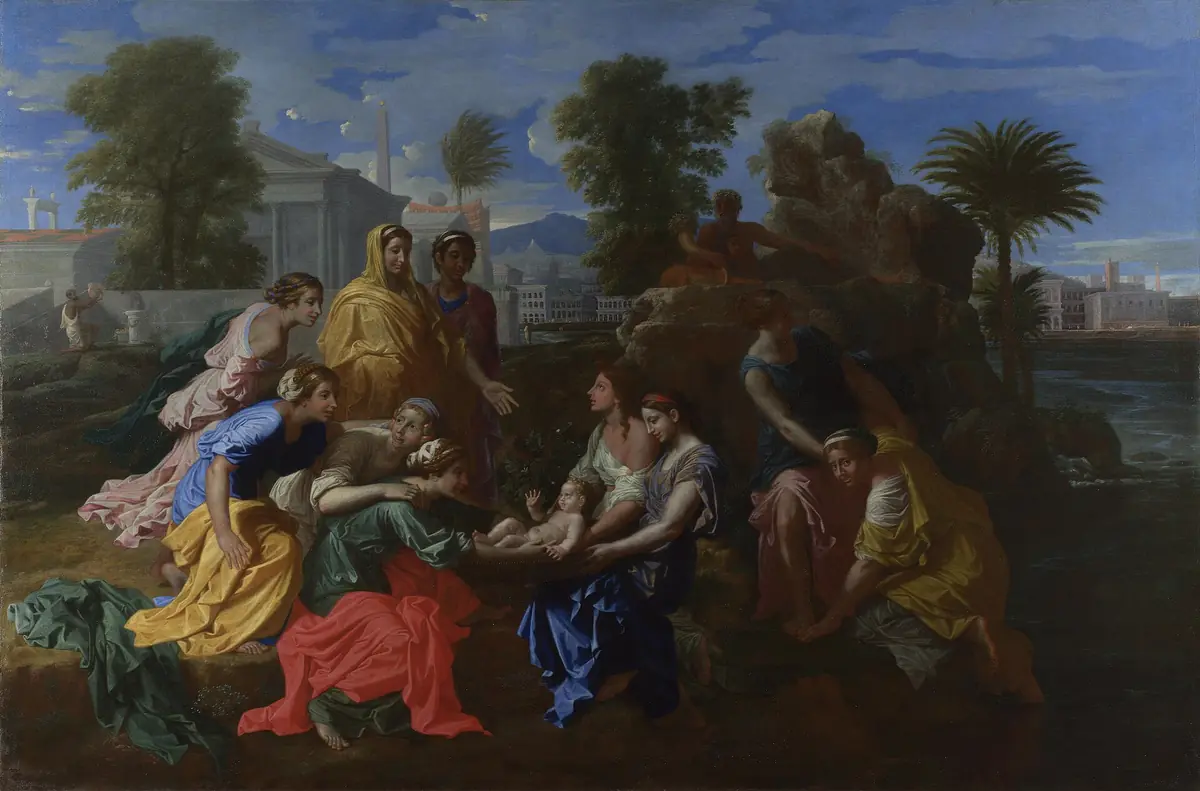
Look closely. Pharaoh's daughter and her attendants have found the infant Moses at the river; the women form a graceful, frieze-like group in a wide Egyptian landscape of river, trees and distant buildings. Look at the pointing hands, at the basket, at the still water, and at the dignity given to a rescue that will change Israel's history. (Jointly owned with National Museum Cardiff.)
In the library: The Bible (KJV) · Moses
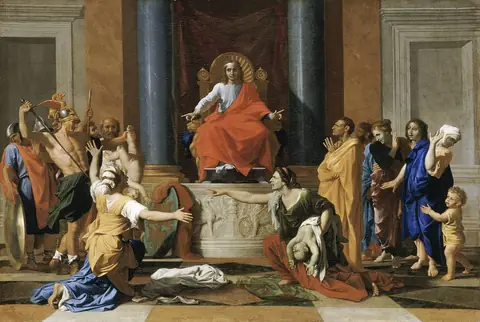
Image: Wikimedia Commons · Public domain (PD-Art) The Judgment of Solomon
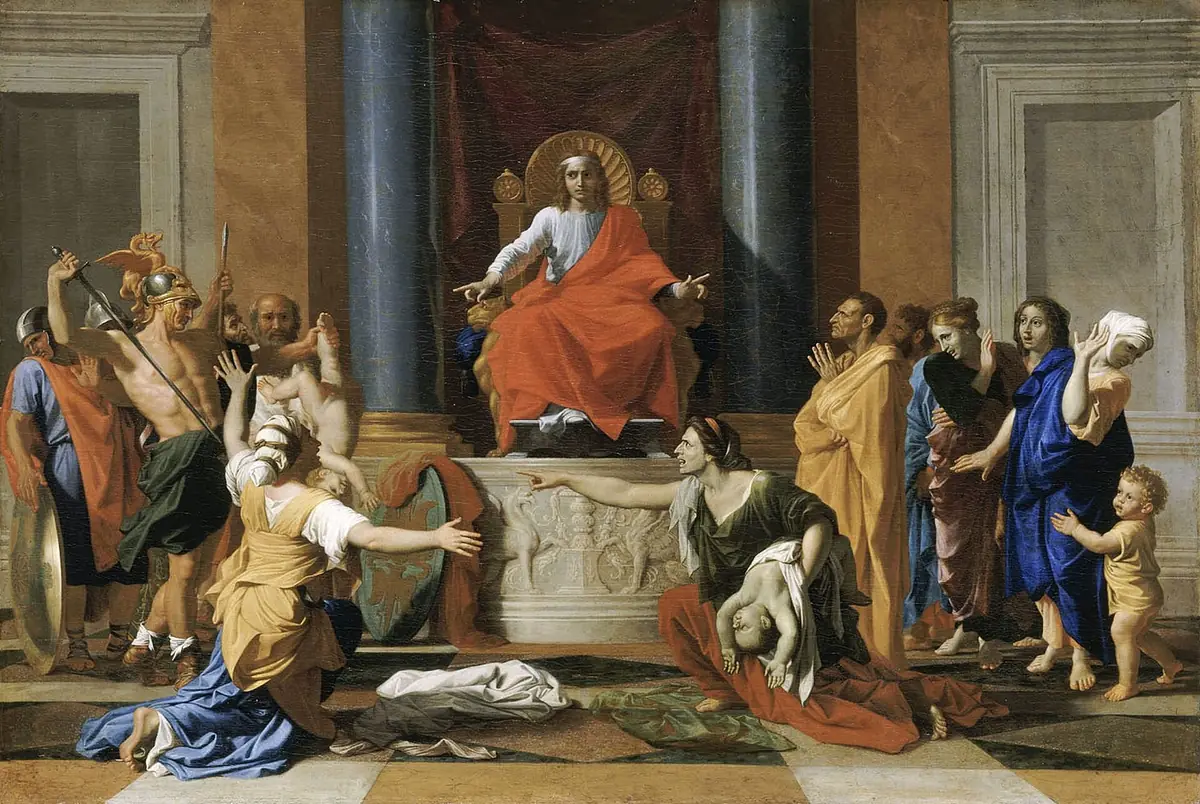
Look closely. Solomon sits high on a throne between columns, pointing his judgement, while one mother kneels in a plea and the other has already turned away; a soldier holds the living child. Look at the clear, almost architectural symmetry of the court, at the contrasting gestures of the two women, and at how a terrible test is staged with order rather than with chaos.
In the library: The Bible (KJV) · Solomon
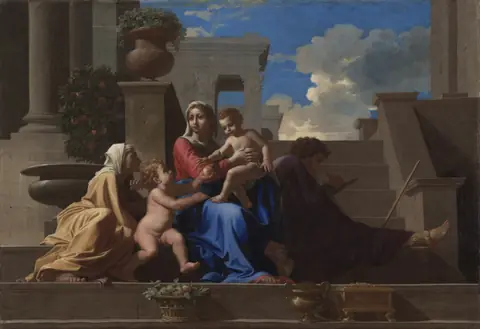
Image: Wikimedia Commons · CC0 (public domain) The Holy Family on the Steps
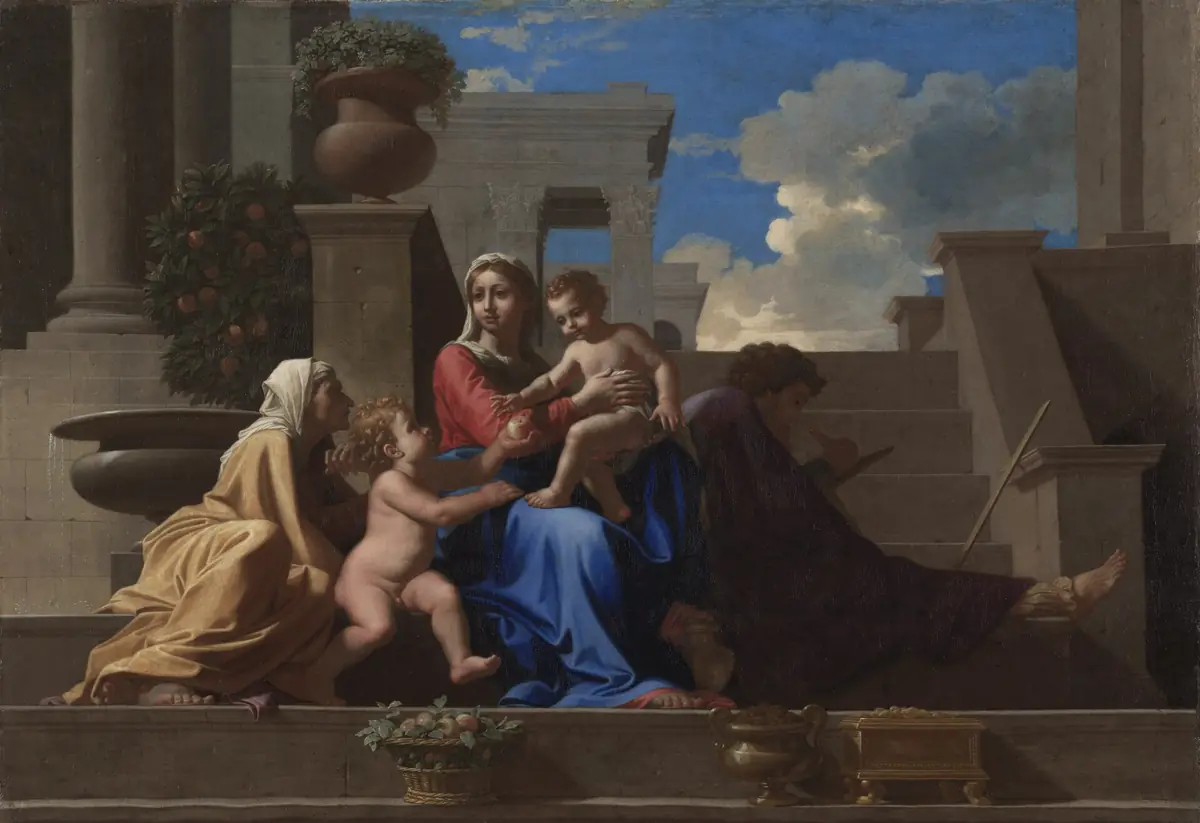
Look closely. Mary, the Child, Saint Anne or Elizabeth, and Joseph are set on a flight of sunlit steps, fruit at their feet, a pale architectural box of walls and sky behind them. Look at the measured geometry of the steps and the figures, at the gift of fruit, and at the quiet, almost mathematical peace of a family picture that is also a sacred conversation.
In the library: The Bible (KJV) · Mary, mother of Jesus · Jesus Christ · Joseph of Nazareth
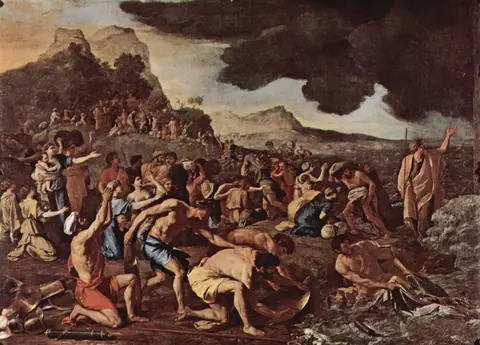
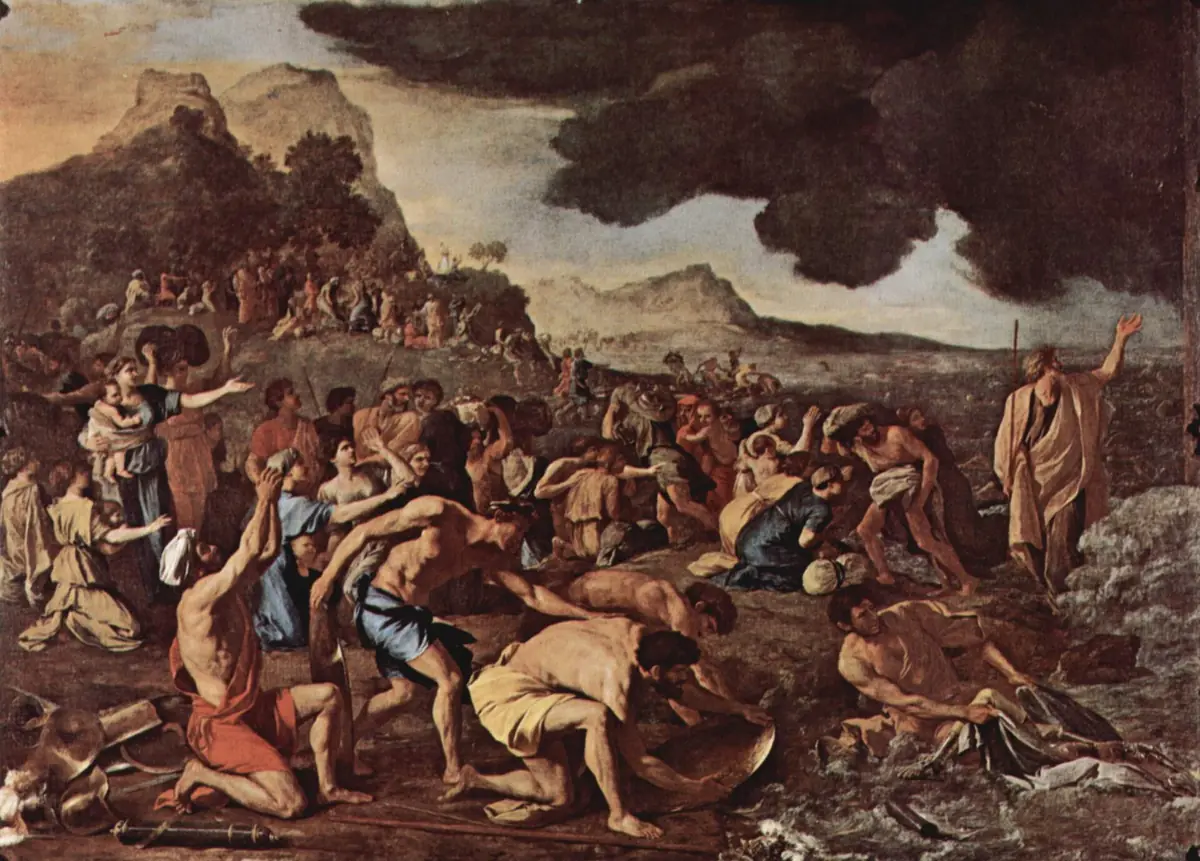
Image: Wikimedia Commons · Public domain (PD-Art) The Crossing of the Red Sea
Look closely. The Israelites come up from the sea; some already stand on the shore with spoils and thanksgiving, others are still among the waves, and the pursuing army is lost in the water behind. Look at the grouping of the rescued, at the lifted hands, at Moses and the rod, and at the wide, almost theatrical weather of the deliverance.
In the library: The Bible (KJV) · Moses
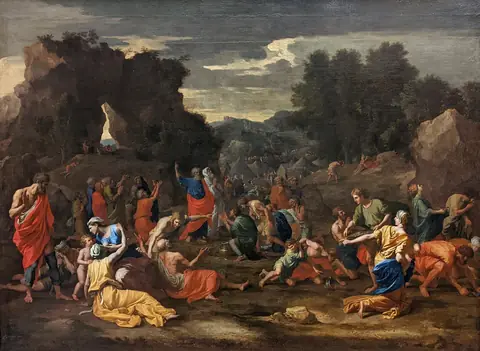
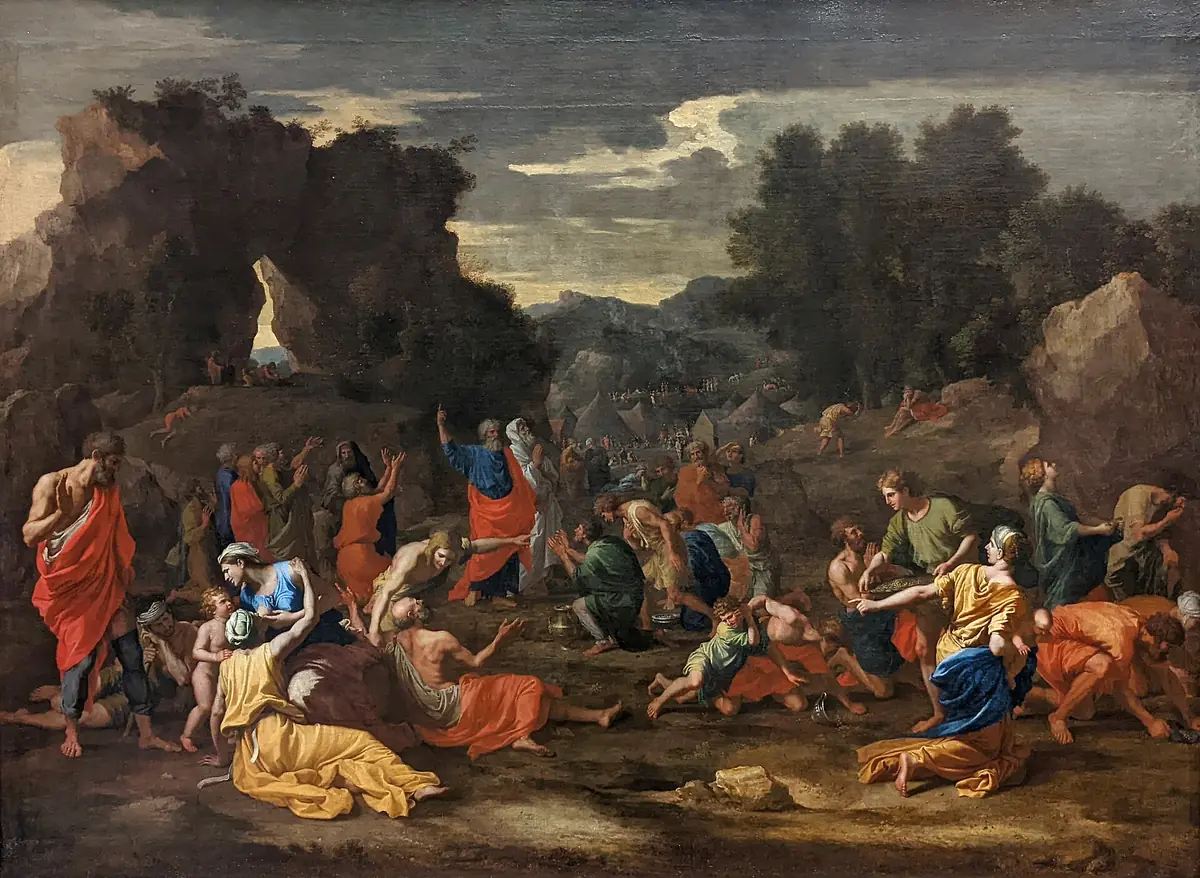
Image: Wikimedia Commons · Public domain (PD-Art) The Israelites Gathering Manna
Look closely. In a rocky desert, people kneel, stoop and reach for the small white food on the ground; Moses and Aaron stand as witnesses, and a grave landscape holds the many little groups together. Look at the variety of poses — hunger, thanks, instruction — and at how a miracle of provision is told as a clear, readable assembly rather than as a blur of wonder.
In the library: The Bible (KJV) · Moses


What to watch for in Nicolas Poussin
Look slowly- A composed stage. Figures often stand on a shallow plane, like a carved relief, with a clear landscape behind.
- Gesture as speech. Hands, pointing fingers and turned heads tell the story as much as faces do.
- A cool, even light. There is rarely a single theatrical spotlight; daylight makes every part readable.
- Architecture and trees as frame. A temple, a step, or a clump of trees will hold the group in place.
- Feeling inside order. Look twice: the geometry is there to carry grief, wonder or judgement, not to replace them.
For older students
These famous works include nudity, so they are named here but not shown. Teachers and parents can decide when to look at them together.
- The Abduction of the Sabine Women, c. 1633–34 and a later version, Metropolitan Museum of Art, New York, and Louvre, Paris. A violent classical subject with struggling, partly unclothed figures. Named here but not shown.
- Spring, or The Earthly Paradise, 1660–64, Louvre, Paris. Part of the Four Seasons; Adam and Eve are shown unclothed in Eden. Named here but not shown.
Dates and collections follow the holding museums and Wikidata. Images of paintings are photographs of public-domain pictures from Wikimedia Commons or museum open-access releases; photographs of sculpture are used only when the photograph itself is Public domain, CC0, or CC BY with a named credit. Each picture links to its source page with full licence details.