Great Art · Northern Renaissance
Hans Holbein the Younger
The portraitist of Erasmus, Thomas More and the court of Henry VIII, who could put a whole mind into a face, a letter, or a stretched skull.
His life
Hans Holbein the Younger was born in Augsburg around 1497, the son of a painter, and came to maturity in Basel, where he worked for printers and for the scholar Erasmus. He designed title pages and typographic ornaments as well as altarpieces and portraits, and he learned to make a face look as if it could speak. In the mid-1520s he travelled to England, was welcomed in the house of Thomas More, and later became painter to Henry VIII.
The English portraits are famous for their calm: a diplomat, a duchess, a scholar at a desk, each set down without fuss and without flattery. He also made a terrifying, unsparing image of the dead Christ, and a great Madonna for a Basel mayor. He died in London in 1543, probably of plague. His gift was truthfulness of look: he would not invent a nobler jaw or a quieter room than the one that was there.
Key works
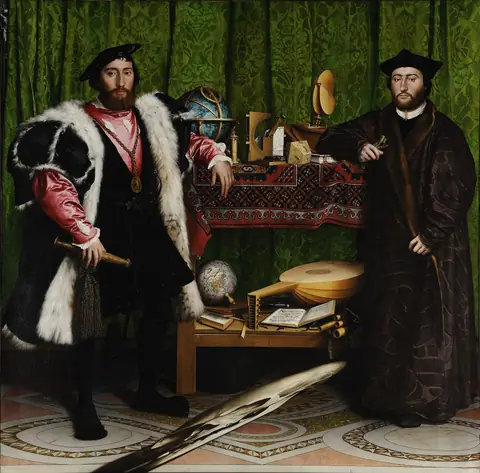
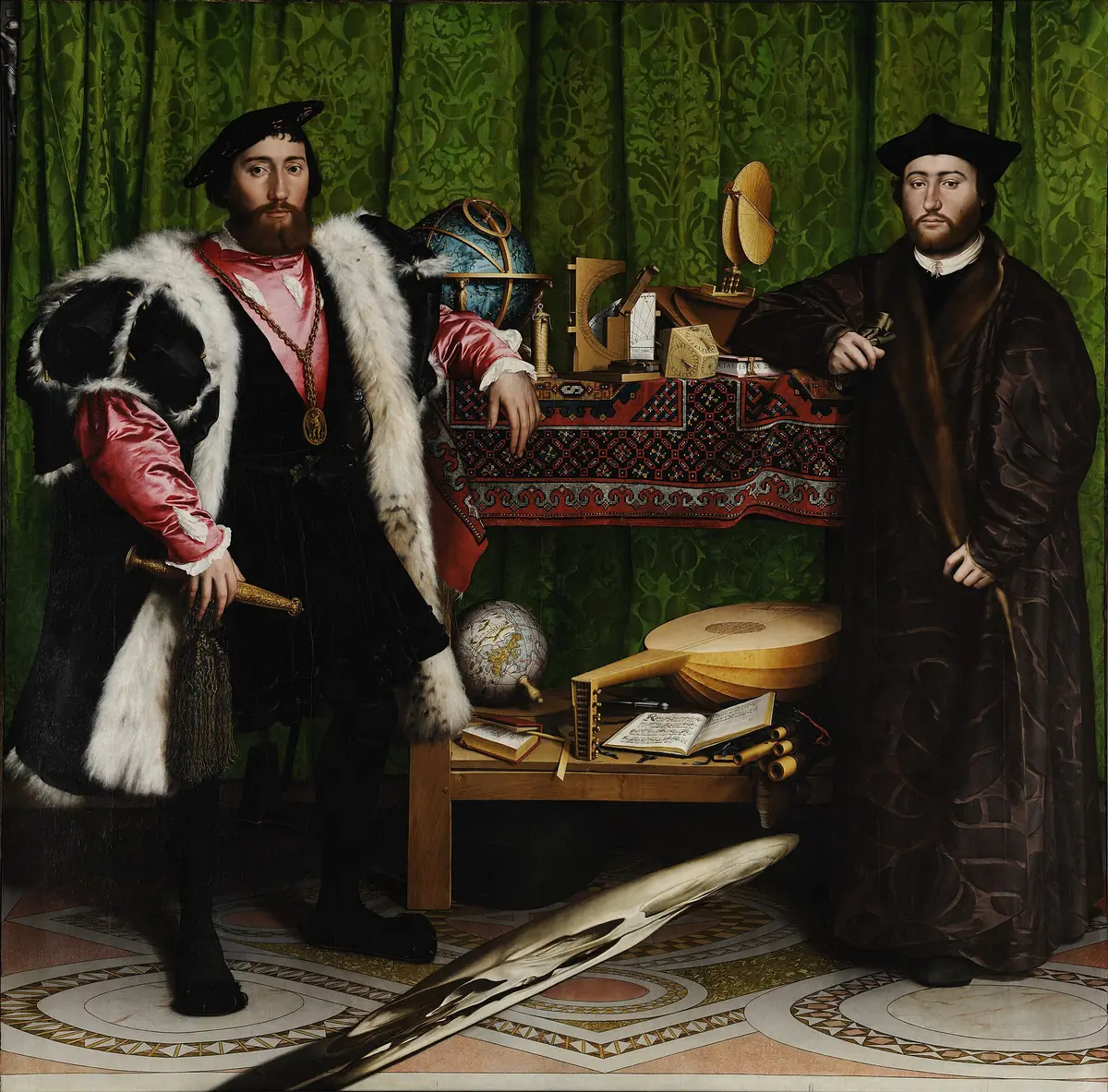
Image: Wikimedia Commons · Public domain (PD-Art) The Ambassadors
Look closely. Two French envoys stand beside a table loaded with books, globes, a lute and scientific instruments; between them, on the floor, a stretched skull can be read only from a sharp angle. Look at the broken lute string, at the hymnbook and the sundials, at the crucifix half hidden at the upper left, and at how a portrait of worldly skill is also a reminder of death.
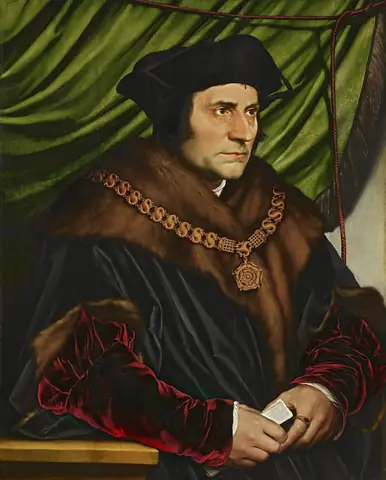
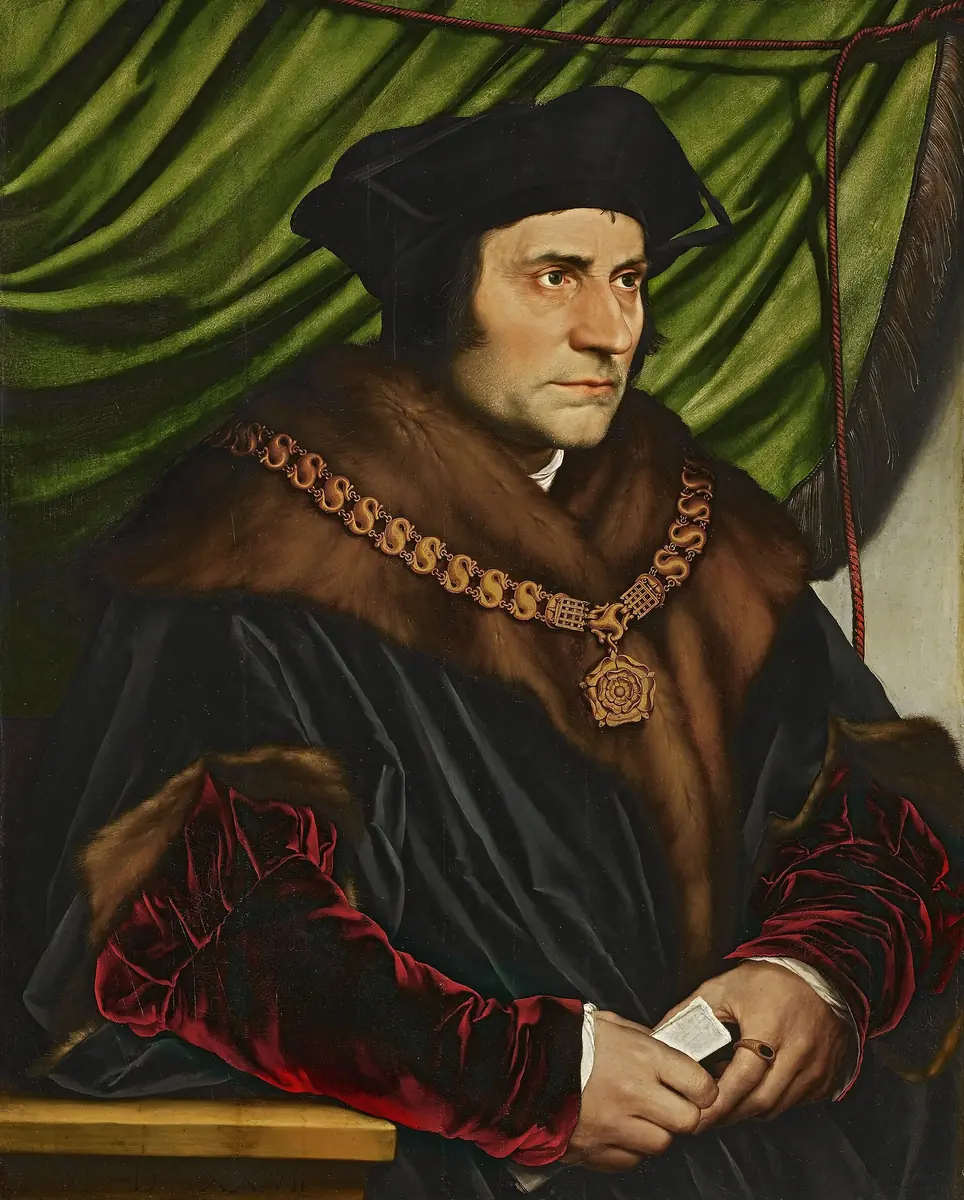
Image: Wikimedia Commons · Public domain (PD-Art) Portrait of Sir Thomas More
Look closely. More sits in a furred coat and a gold chain of office, a paper in one hand, a watchful, tired kindness in the face. Look at the stubble of the beard, at the red-velvet sleeve, at the writing on the paper, and at the plainness of the setting: a mind and a conscience, not a palace, are what the painter came to record.
In the library: Thomas More · Utopia · Henry VIII
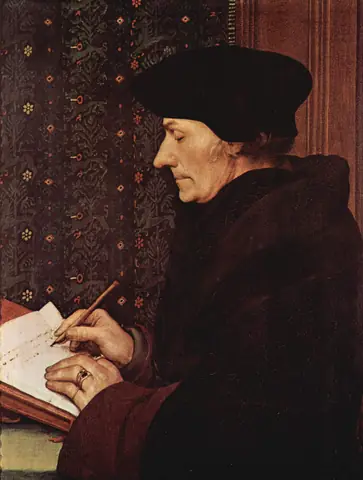
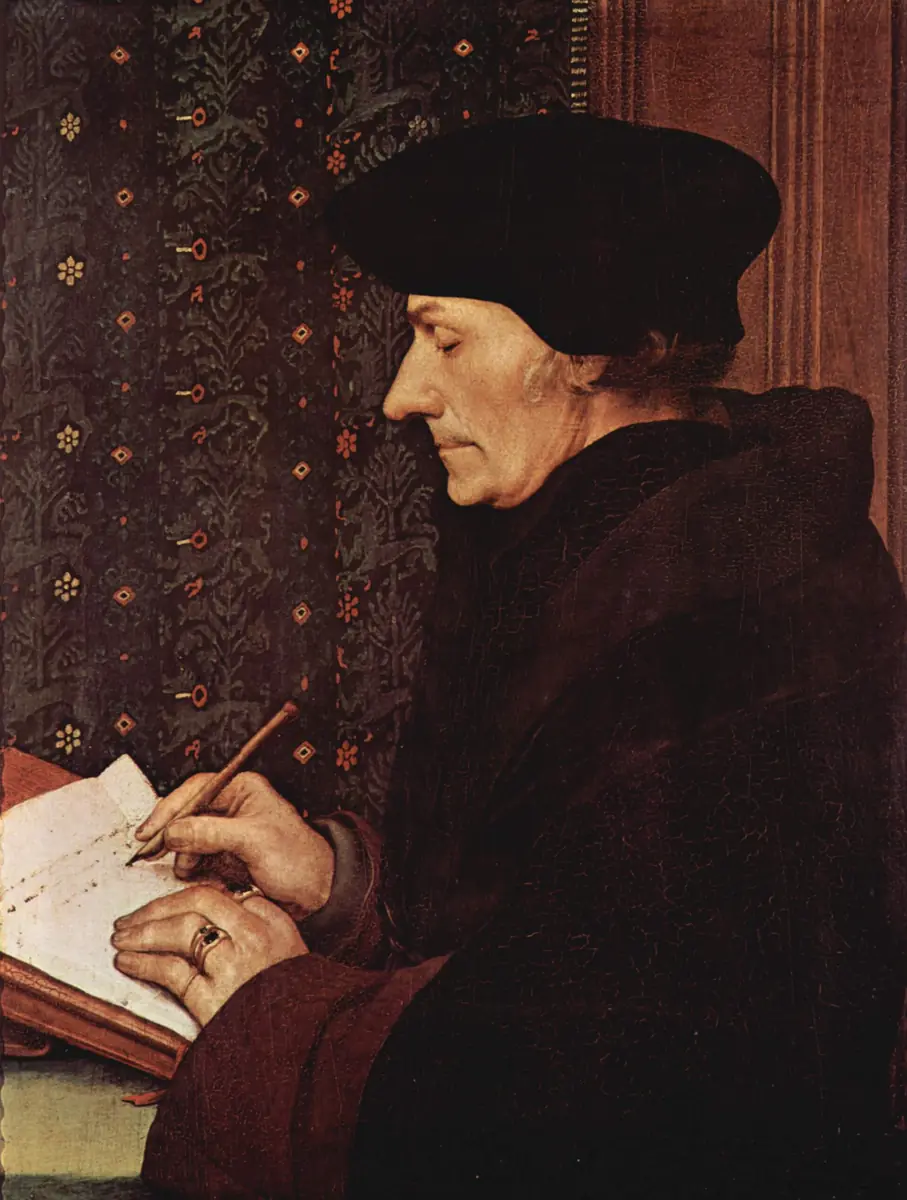
Image: Wikimedia Commons · Public domain (PD-Art) Portrait of Erasmus writing
Look closely. Erasmus sits in profile at a desk, already at work, the point of the pen on the page, a few books in a shelf behind. Look at the fur of the gown, at the quiet mouth, at the downcast eye, and at how little ceremony is needed: the scholar is simply doing the day's labour that made his name.
In the library: Erasmus · The Praise of Folly

Image: Wikimedia Commons · CC0 (public domain) The Body of the Dead Christ in the Tomb
Look closely. Christ lies in a long, shallow tomb, almost at eye level, the flesh already showing the marks of death: sunken eyes, a tight mouth, wounds in the hand, the side and the feet, a thin loincloth the only covering. Look at the hair falling back, at the greenish tone of the skin, and at how nothing is softened. Teachers of younger children may wish to look at the picture first; it is unsparing on purpose.
In the library: The Bible (KJV) · Jesus Christ
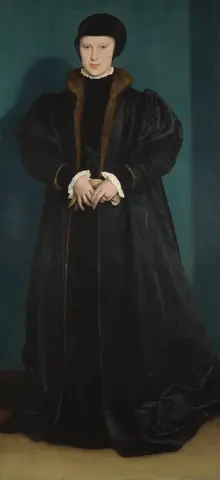
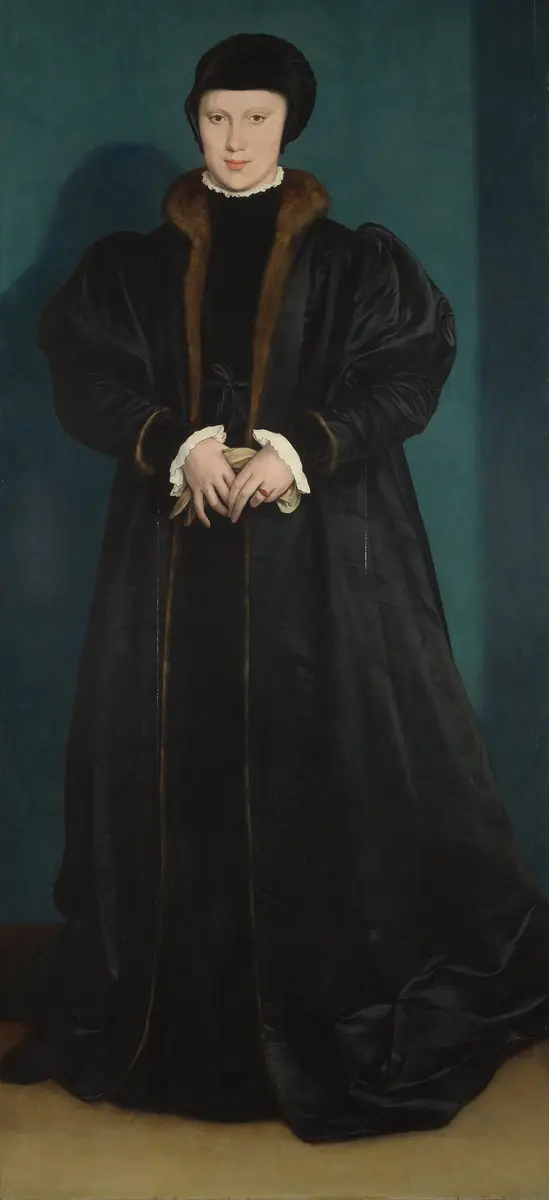
Image: Wikimedia Commons · Public domain (PD-Art) Christina of Denmark, Duchess of Milan
Look closely. A young widow, painted in three-quarter length for Henry VIII to consider as a possible wife, stands in a dark coat and gloves against a teal ground, a little smile at the mouth. Look at the width of the skirt, at the still hands, at the shadowed face, and at how much presence Holbein gets from so little setting. The marriage did not take place.
In the library: Henry VIII
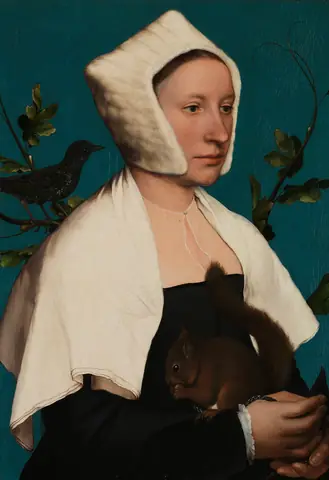
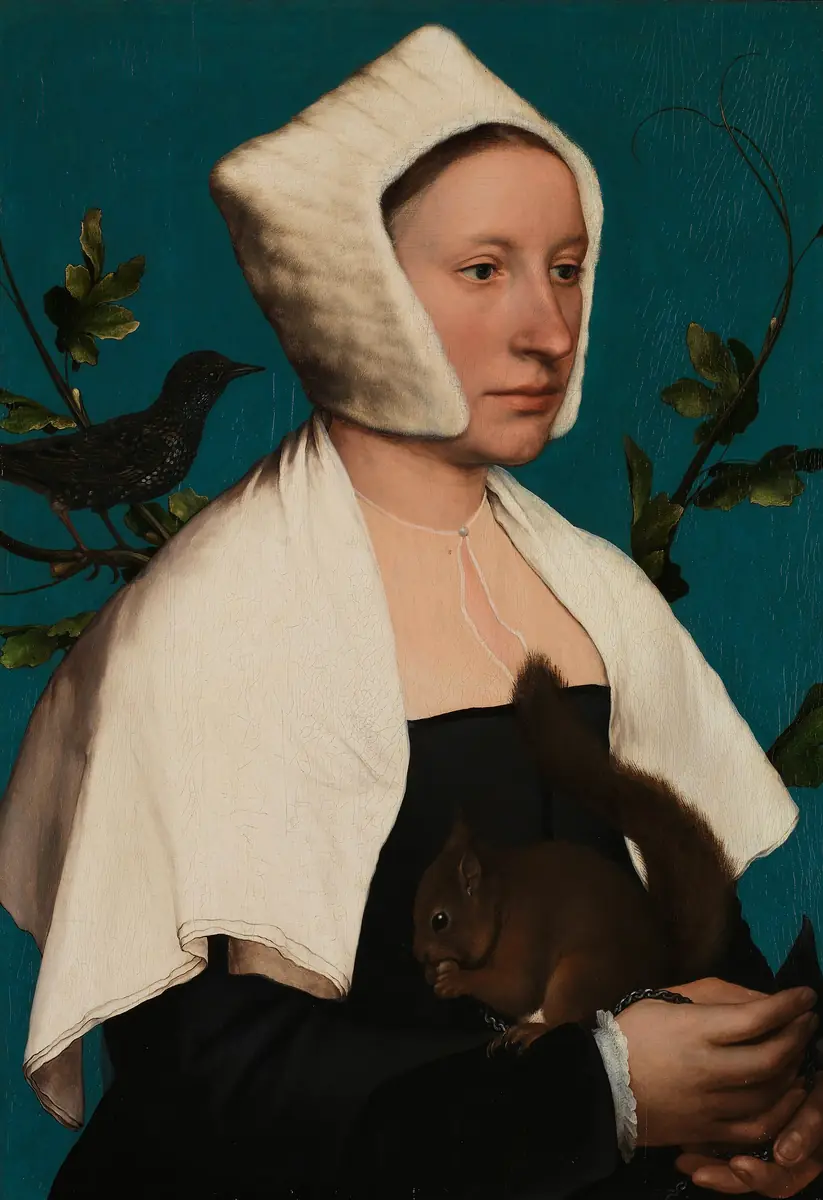
Image: Wikimedia Commons · Public domain (PD-Art) A Lady with a Squirrel and a Starling (Anne Lovell?)
Look closely. A young English woman sits in a white fur cap and a yellow-red dress, a squirrel in her lap and a starling at her shoulder. Look at the chain of white beads, at the small animal's chain and nut, at the vine on the hedge behind, and at the calm, slightly sidelong glance. The creatures are probably a play on her family name or arms.
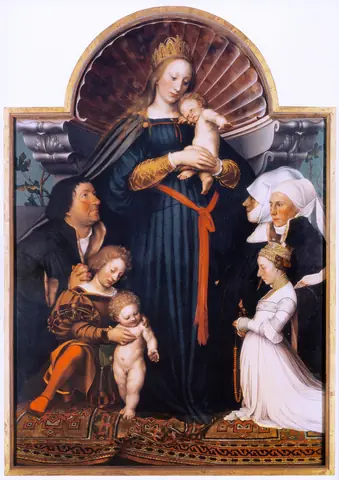
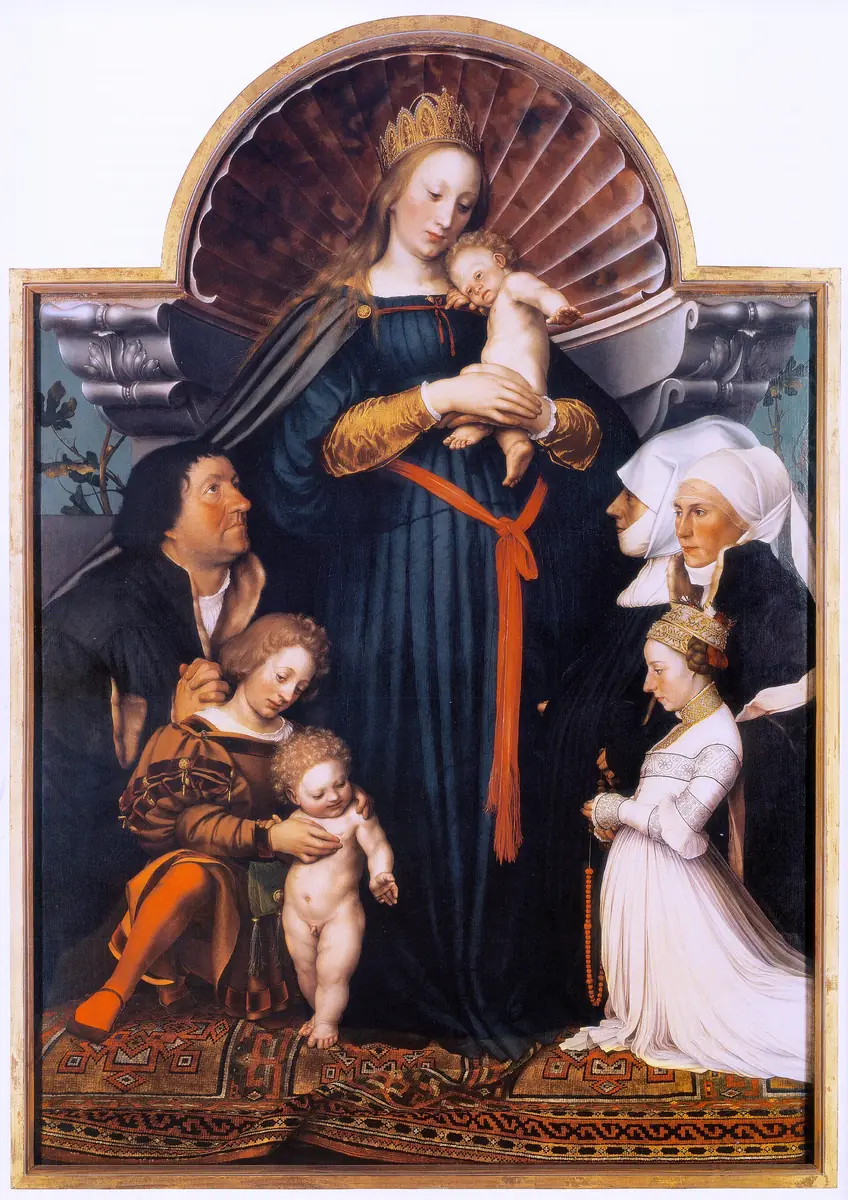
Image: Wikimedia Commons · Public domain (PD-Art) The Darmstadt Madonna (Madonna of Jakob Meyer)
Look closely. Mary stands in a niche with the Child, a carved shell above, while the Basel mayor Jakob Meyer, his family and a kneeling boy gather at her feet. Look at the carefully described carpets and costumes, at the infant's reaching arms, and at the grave, almost sculptural fold of Mary's mantle, which fills the upper half like a carved canopy.
In the library: The Bible (KJV) · Mary, mother of Jesus · Jesus Christ



What to watch for in Hans Holbein the Younger
Look slowly- A face that thinks. Look at the mouth and the eyes before the clothes; Holbein lets a mind show in a very still head.
- Objects as biography. Books, globes, letters, a squirrel, a crucifix — the things on a shelf or a table are part of the likeness.
- Latin and lettering. Inscriptions, papers and books are painted so that they can almost be read.
- The English calm. Court portraits often stand against a plain ground, with almost no furniture to hide in.
- An unsparing sacred picture. The Dead Christ is as closely looked-at as any ambassador, and much harder to face.
Dates and collections follow the holding museums and Wikidata. Images of paintings are photographs of public-domain pictures from Wikimedia Commons or museum open-access releases; photographs of sculpture are used only when the photograph itself is Public domain, CC0, or CC BY with a named credit. Each picture links to its source page with full licence details.