Great Art · Early Netherlandish
Jan van Eyck
Court painter to the Duke of Burgundy, who used oil paint to make jewels, cloth, windows and distant towns look close enough to touch.
His life
Jan van Eyck worked as court painter to Philip the Good, Duke of Burgundy, and lived mainly in Bruges. He was already a trusted servant as well as an artist: the duke sent him on embassies, including a journey to Portugal in 1428–29 in connection with a marriage alliance. He signed and dated pictures in a careful, learned way, and he used a motto that means, in his Netherlandish, "as I can" — a humble claim that he had done his utmost.
He did not invent oil painting, but he used oil with a new depth, building thin layers so that light seems to sit inside a jewel, a glass, or a fold of velvet. The great Ghent Altarpiece, begun with his brother Hubert and finished by Jan in 1432, is still in St Bavo's Cathedral. His gift was attention of a rare kind: he could paint a single candle, a convex mirror, or the New Jerusalem in a tiny landscape, and make you believe the world was worth that much looking.
Key works
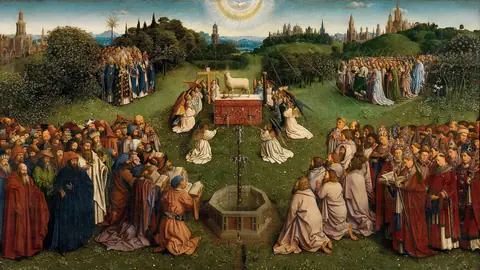
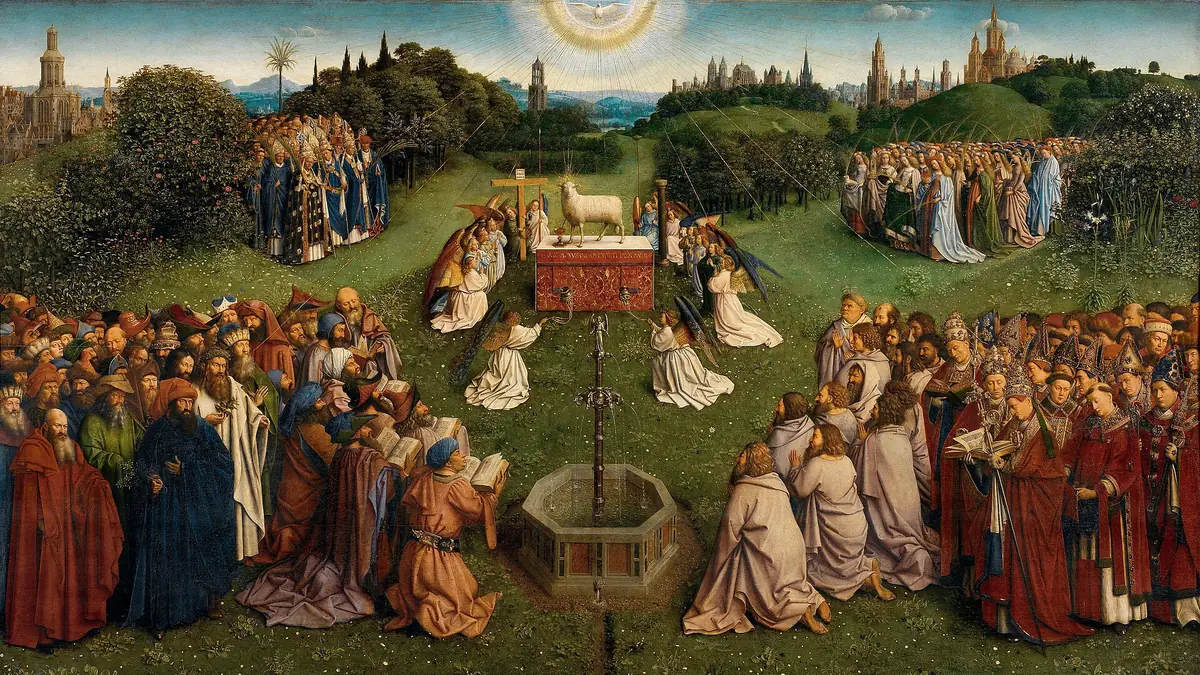
Image: Wikimedia Commons · Public domain (PD-Art) The Adoration of the Mystic Lamb (central panel of the Ghent Altarpiece)
Look closely. In a green meadow the Lamb stands on an altar, blood flowing into a chalice, while a fountain of life plays in front and processions of saints, prophets, pilgrims and martyrs draw in from every side. A dove of the Spirit hangs in a disc of light above. This is the heart of the huge Ghent Altarpiece; the figures of Adam and Eve on the shutters are named for older students, not shown here.
In the library: The Bible (KJV) · Jesus Christ · John the Apostle
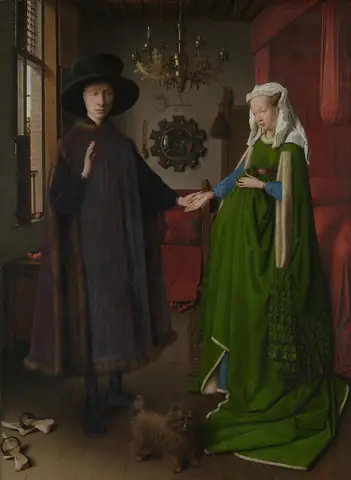
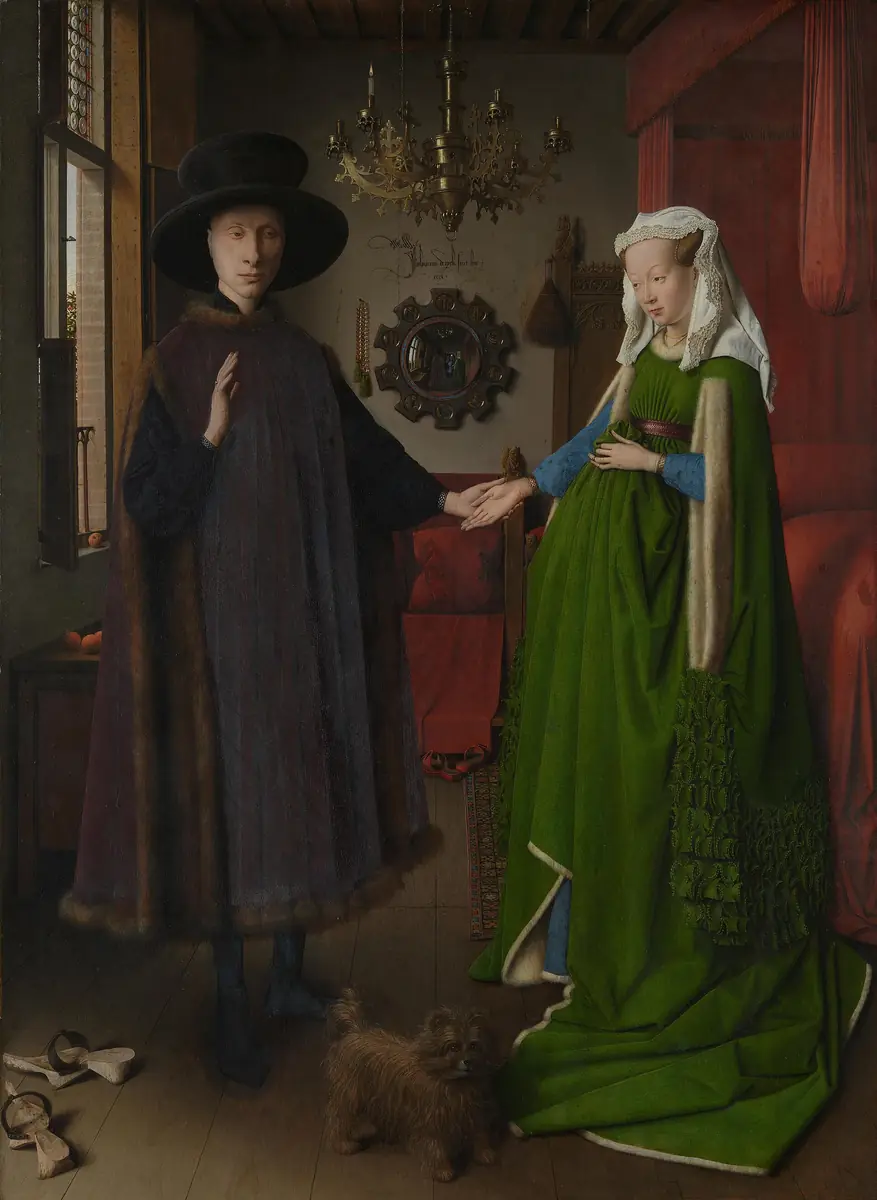
Image: Wikimedia Commons · Public domain (PD-Art) The Arnolfini Portrait
Look closely. A man and a woman stand in a small upper room, their hands meeting, a little dog at their feet. Look at the convex mirror on the back wall, which reflects two more figures in the doorway; at the single candle in the chandelier; at the discarded clogs and the oranges on the chest. The painter's signature is written, as if in an official hand, on the wall above the mirror.
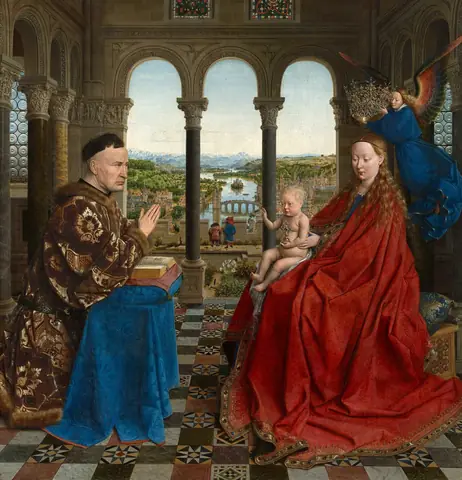
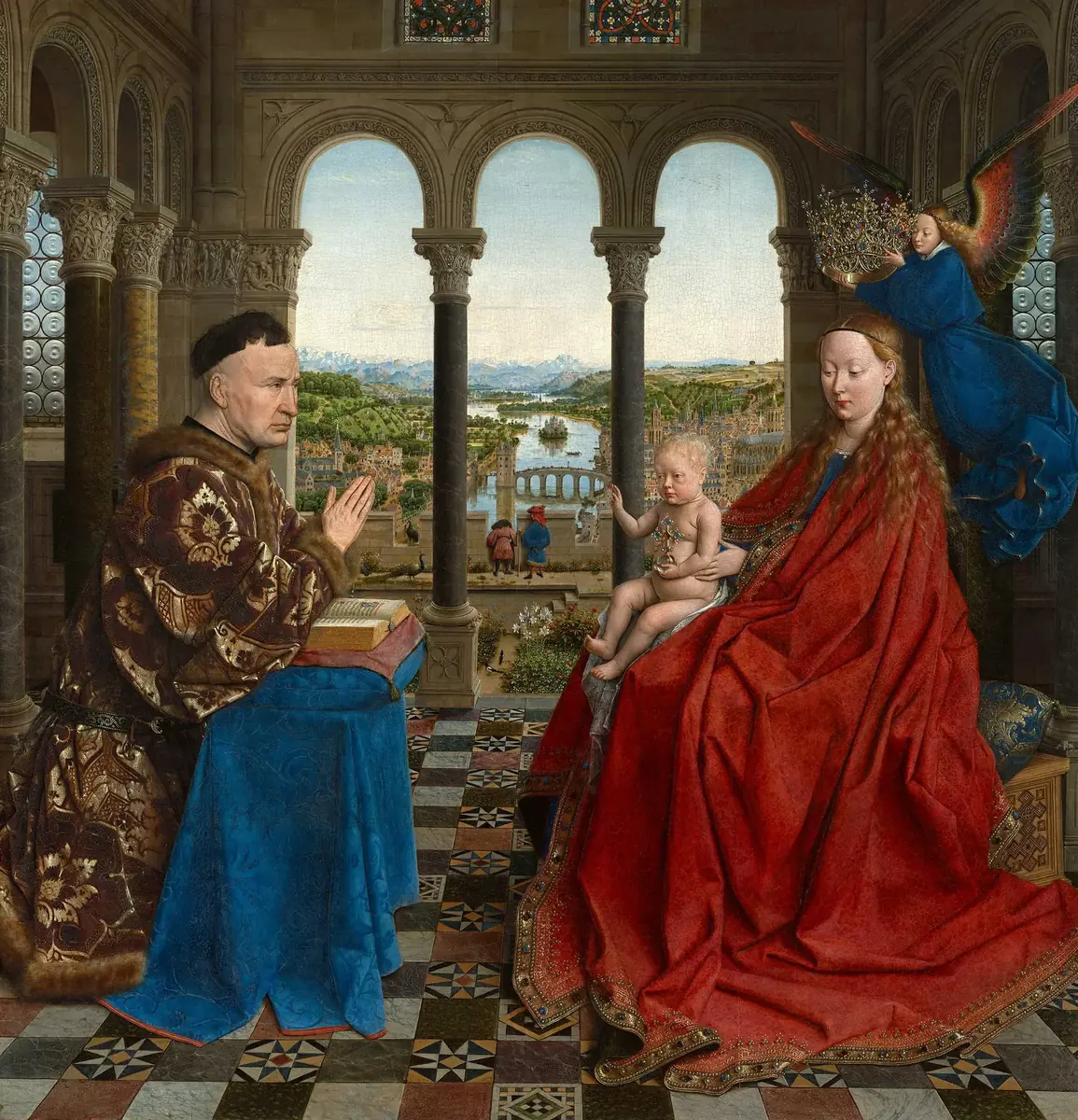
Image: Wikimedia Commons · Public domain (PD-Art) The Madonna of Chancellor Rolin
Look closely. Nicolas Rolin, chancellor of Burgundy, kneels in a stone loggia as the Child raises a hand toward him and Mary sits crowned opposite. Between them the floor tiles run out to a garden and then to a whole river city, painted as if seen from a high window. Look at the carved capitals above Rolin's head, and at the two tiny figures standing on the parapet, looking out.
In the library: The Bible (KJV) · Mary, mother of Jesus · Jesus Christ
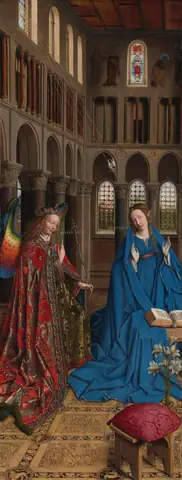
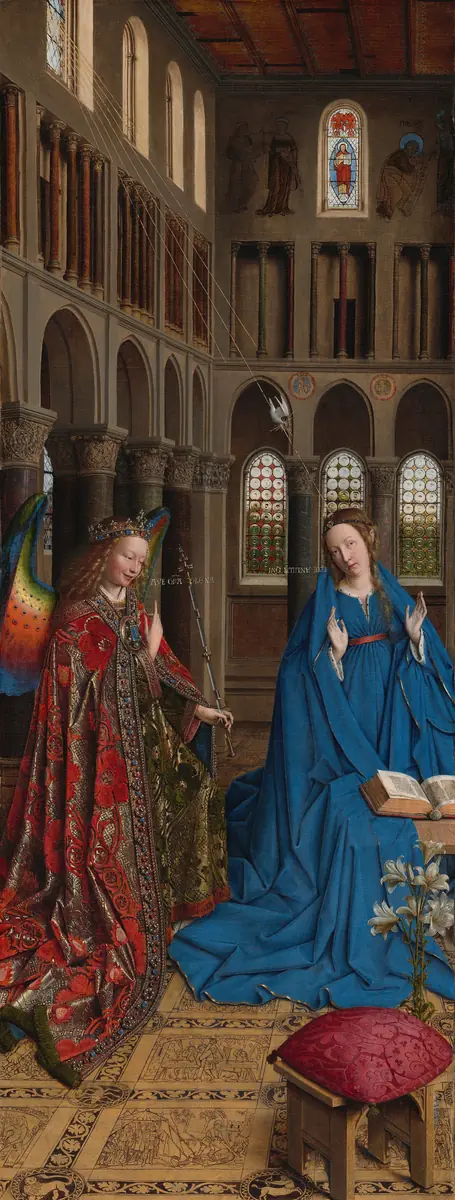
Image: Wikimedia Commons · Public domain (PD-Art) The Annunciation
Look closely. The panel is tall and narrow, like a church window. Gabriel greets Mary in a richly decorated church interior, and the Holy Spirit comes down as a dove on a ray of gold. Look up at the upper windows, which show scenes from the life of Israel, and down at the colourful floor tiles. Mary's answer is painted, in gold letters that run upside down toward God, as if rising from her book.
In the library: The Bible (KJV) · Mary, mother of Jesus
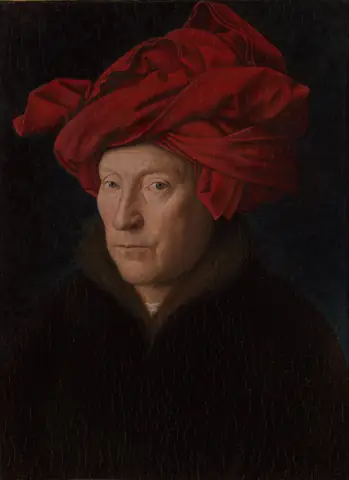
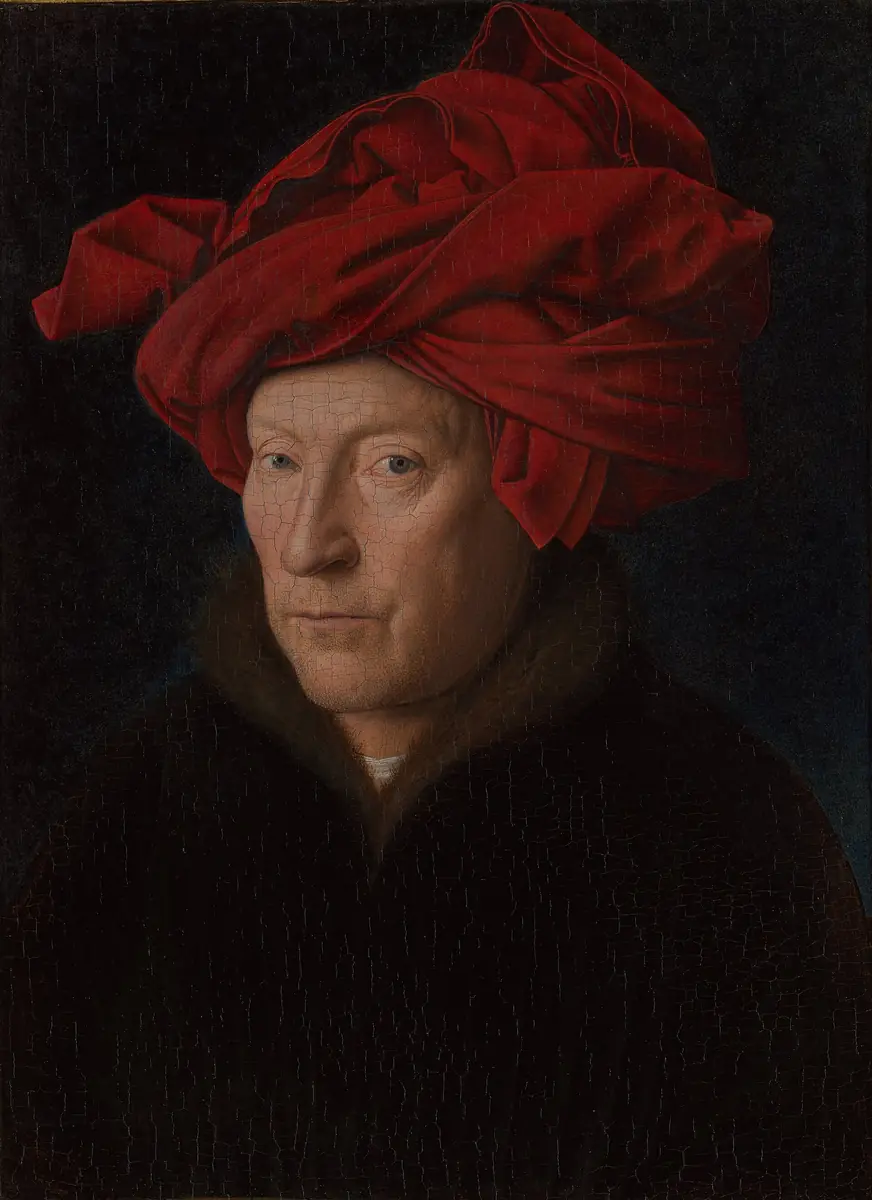
Image: Wikimedia Commons · Public domain (PD-Art) Portrait of a Man (Self-Portrait?)
Look closely. A man in a vast red chaperon looks slightly to the side, the light picking out the stubble on his chin and the veins in his left eye. The frame is painted to look like stone and bears van Eyck's motto and the date. Many historians think this is the painter himself; whether or not it is, it is a study in looking back at the looker.
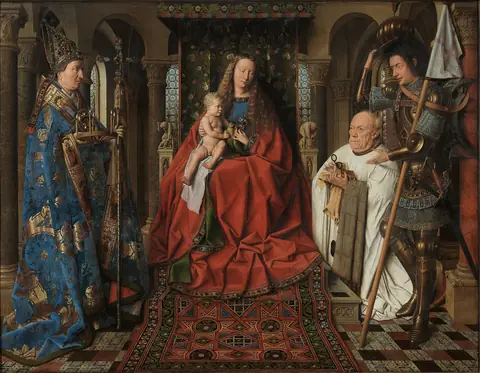
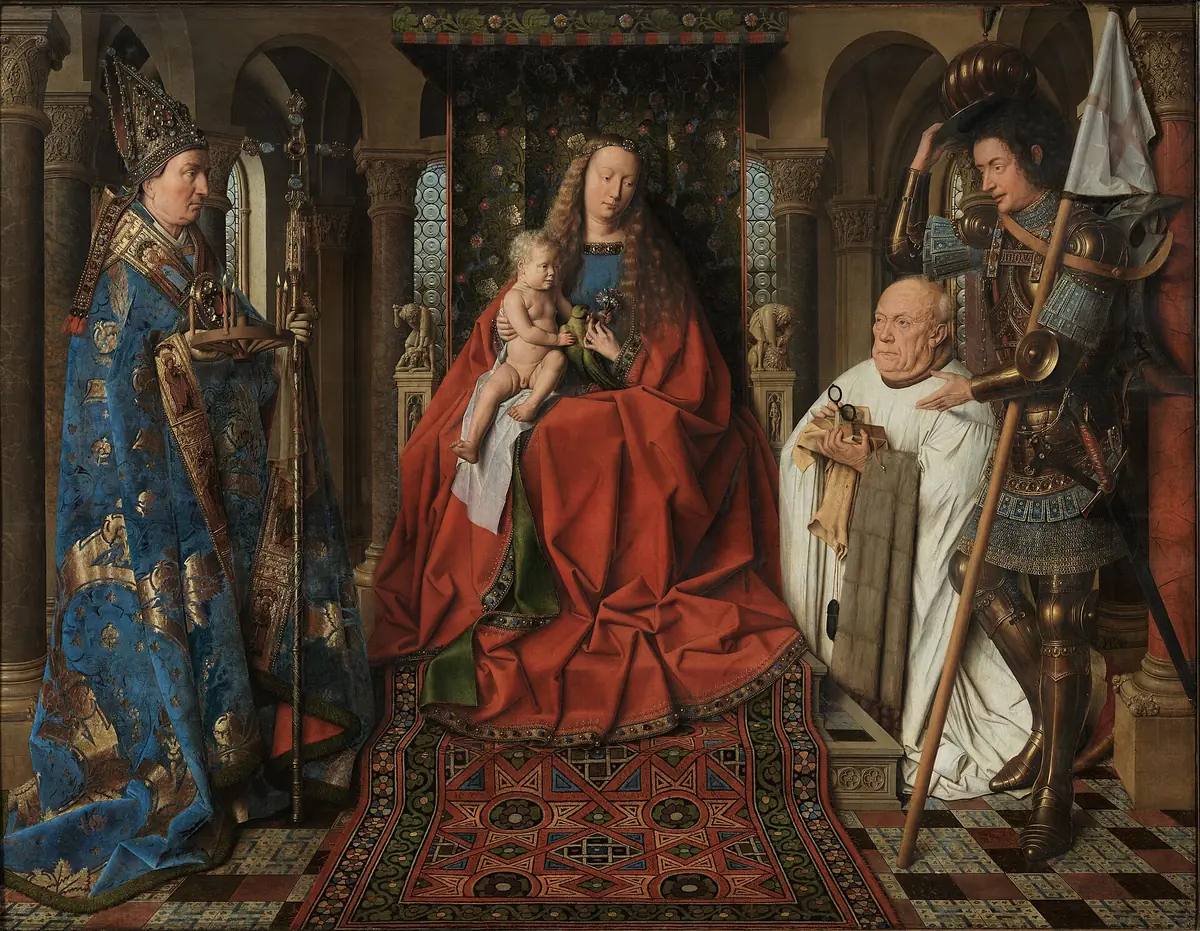
Image: Wikimedia Commons · Public domain (PD-Art) Madonna with Canon Joris van der Paele
Look closely. The elderly canon kneels, having taken off his spectacles, as Saint George in shining armour presents him to Mary and the Child. Saint Donatian stands on the other side in a blue and gold cope. Look at the canon's weathered face, at the reflection of a window in Saint George's shield, and at the oriental carpet under Mary's feet.
In the library: The Bible (KJV) · Mary, mother of Jesus · Jesus Christ
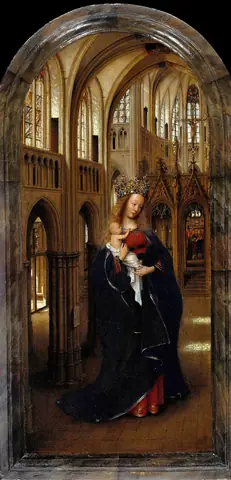
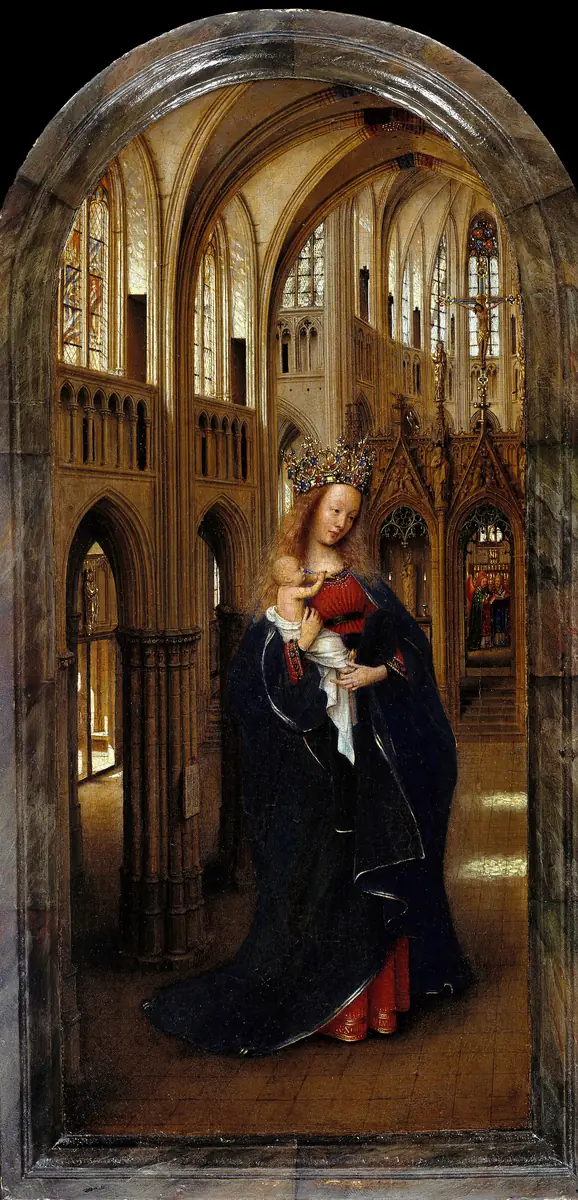
Image: Wikimedia Commons · Public domain (PD-Art) The Madonna in the Church
Look closely. Mary is painted as a tall figure, almost as high as the Gothic nave in which she stands, to show that she herself is the house of God. The Child lies in her arms, and two angels sing at a high altar in the distance. Look at the coloured light from the windows on the floor, and at how large she is in the church — a theological idea made visible.
In the library: The Bible (KJV) · Mary, mother of Jesus


What to watch for in Jan van Eyck
Look slowly- Light in oil. Look for light caught inside jewels, glass, a single bead, or the glaze on an orange.
- Tiny worlds in the distance. A window or a gap in a colonnade often opens onto a whole town.
- Words painted as if carved. Van Eyck often painted inscriptions on frames or walls; they are part of the picture.
- Textures side by side. Fur, metal, tile, skin and fabric meet in one glance.
- A humble motto. He marked work with words that mean "as I can" — a craftsman's claim, not a boast.
For older students
These famous works include nudity, so they are named here but not shown. Teachers and parents can decide when to look at them together.
- Adam and Eve (Ghent Altarpiece, shutters), 1432, St Bavo's Cathedral, Ghent. The inner shutters of the Ghent Altarpiece show Adam and Eve unclothed, after the Fall. They are named here but not shown; the central Adoration of the Lamb is on this page.
Dates and collections follow the holding museums and Wikidata. Images of paintings are photographs of public-domain pictures from Wikimedia Commons or museum open-access releases; photographs of sculpture are used only when the photograph itself is Public domain, CC0, or CC BY with a named credit. Each picture links to its source page with full licence details.