Great Art · American Realism
Winslow Homer
The American painter of boys at play, of fishermen in a dory, and of a man alone on a dismasted boat.
His life
Winslow Homer was born in Boston in 1836 and began as a lithographer and a Civil War illustrator before teaching himself to paint. After the war he painted ordinary American life — schoolboys, veterans, women at the shore — and then, especially after a stay in England and his move to Prouts Neck, Maine, the sea: fishermen, wrecks, and the force of water on rock. He was a private, working man, not a school founder, and he died at Prouts Neck in 1910.
His gift was concentration. A boy in a field, a dory in fog, or a single figure in a boat can hold a whole picture because he leaves out almost everything that does not belong to the essential action and the weather.
Key works
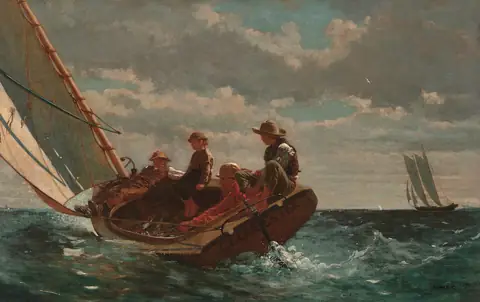
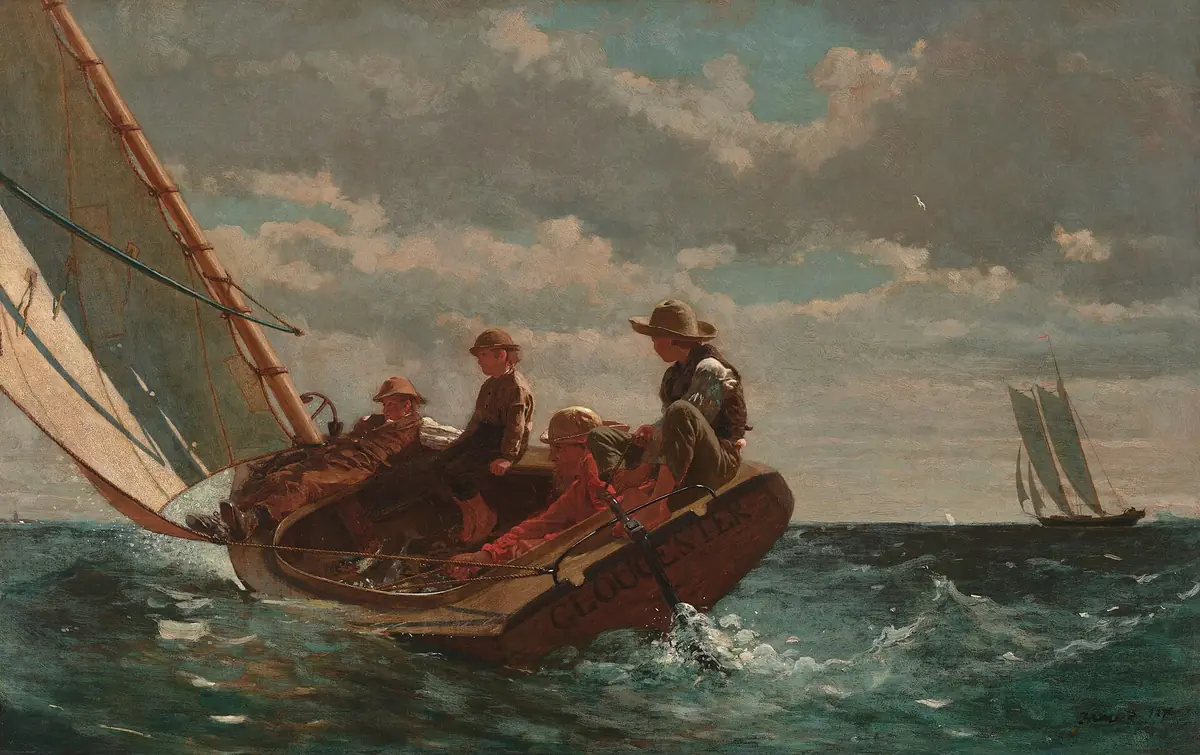
Image: Wikimedia Commons · Public domain (PD-Art) Breezing Up (A Fair Wind)
Look closely. A catboat heels in a choppy afternoon sea, a man at the tiller and three boys in the boat, the sail full, a ship on the horizon. Look at the boys' different seats in the spray, at the weight of the skipper, and at the sense of a fair wind that is still work, not only pleasure.
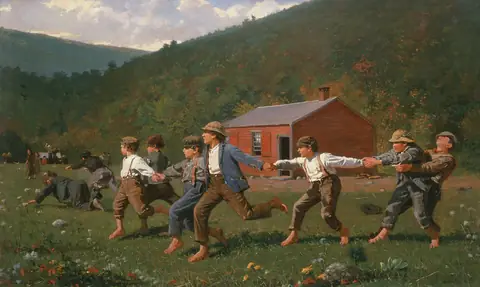
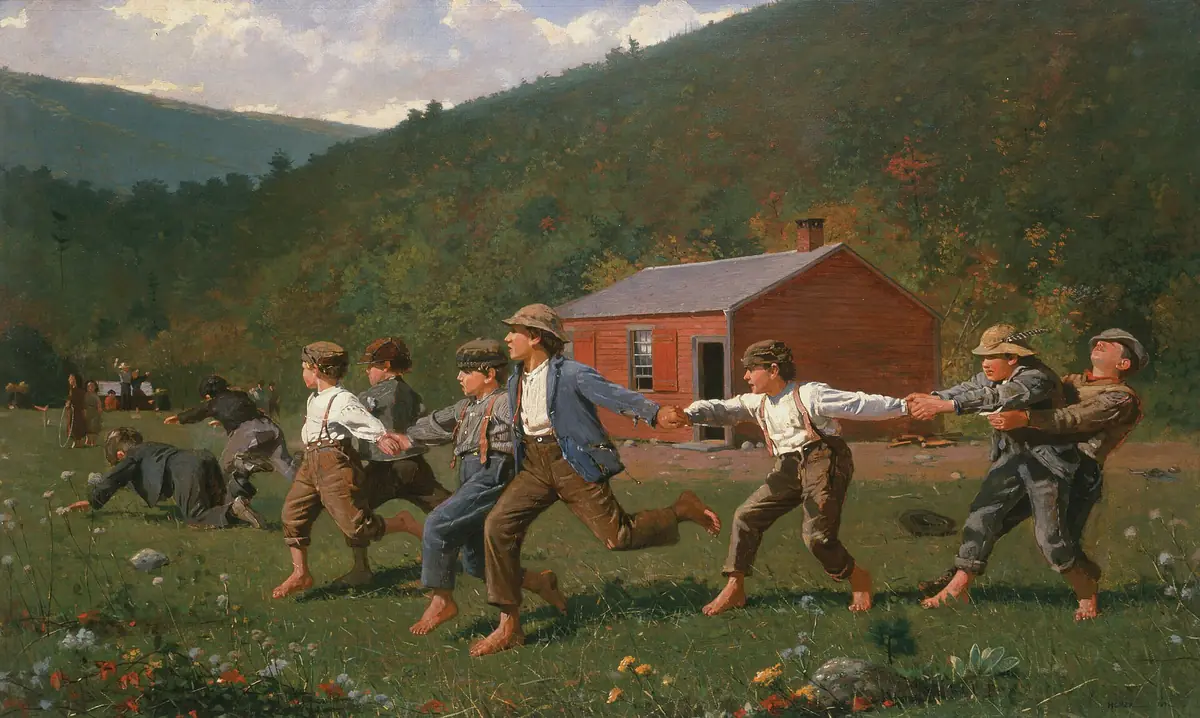
Image: Wikimedia Commons · Public domain (PD-Art) Snap the Whip
Look closely. Barefoot boys in a field join hands in a running line, the end of the chain already losing its footing, with a red schoolhouse and a clear sky behind them. Look at the stretch of the arms, at the boy who has gone down, and at how a simple game is painted with the seriousness of a real fall and a real afternoon.
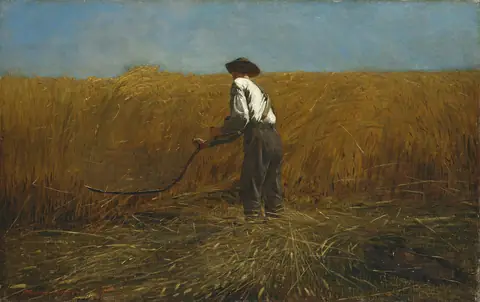
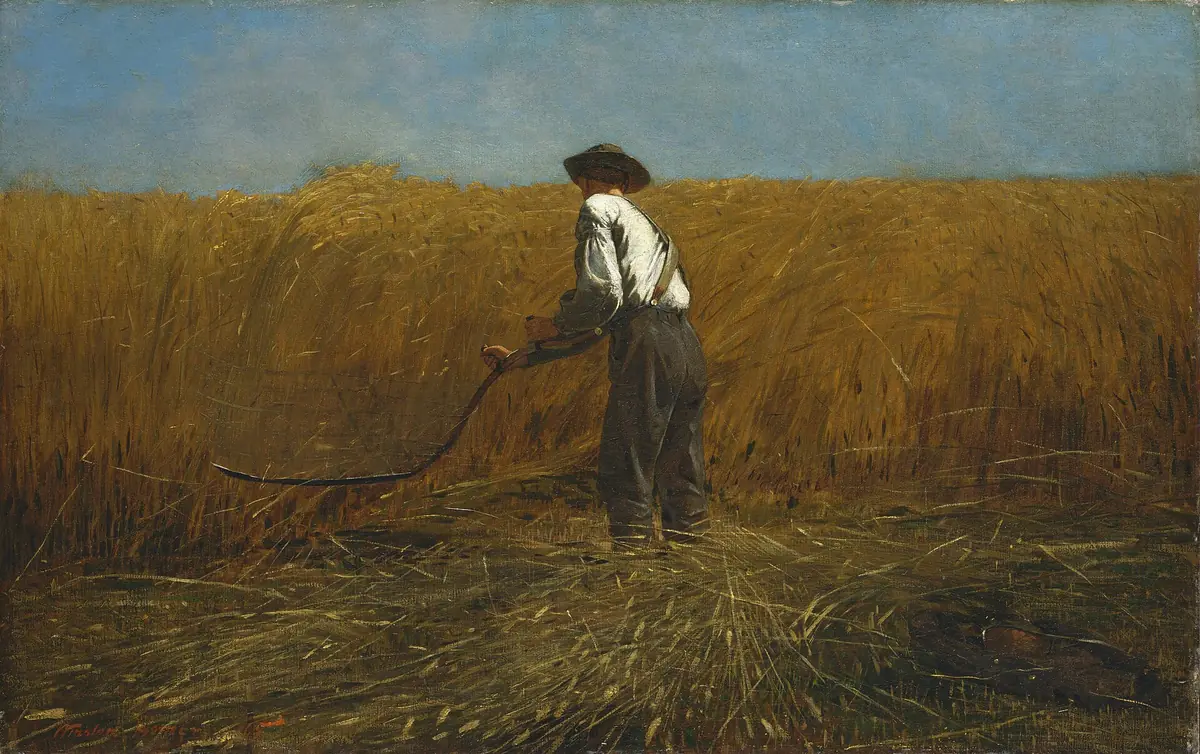
Image: Wikimedia Commons · Public domain (PD-Art) The Veteran in a New Field
Look closely. A Union veteran, seen from behind, reaps a tall field of wheat with a single-handed scythe; his discarded canteen and jacket lie in the lower right. Look at the wall of ripe grain, at the old soldier's stoop, and at how a harvest just after the Civil War can feel both peaceful and costly.
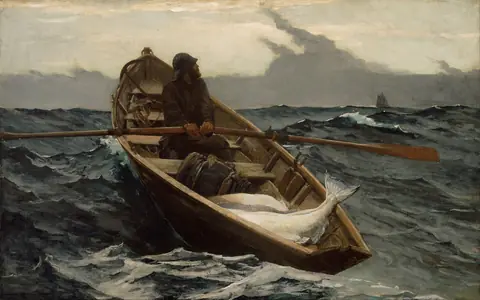
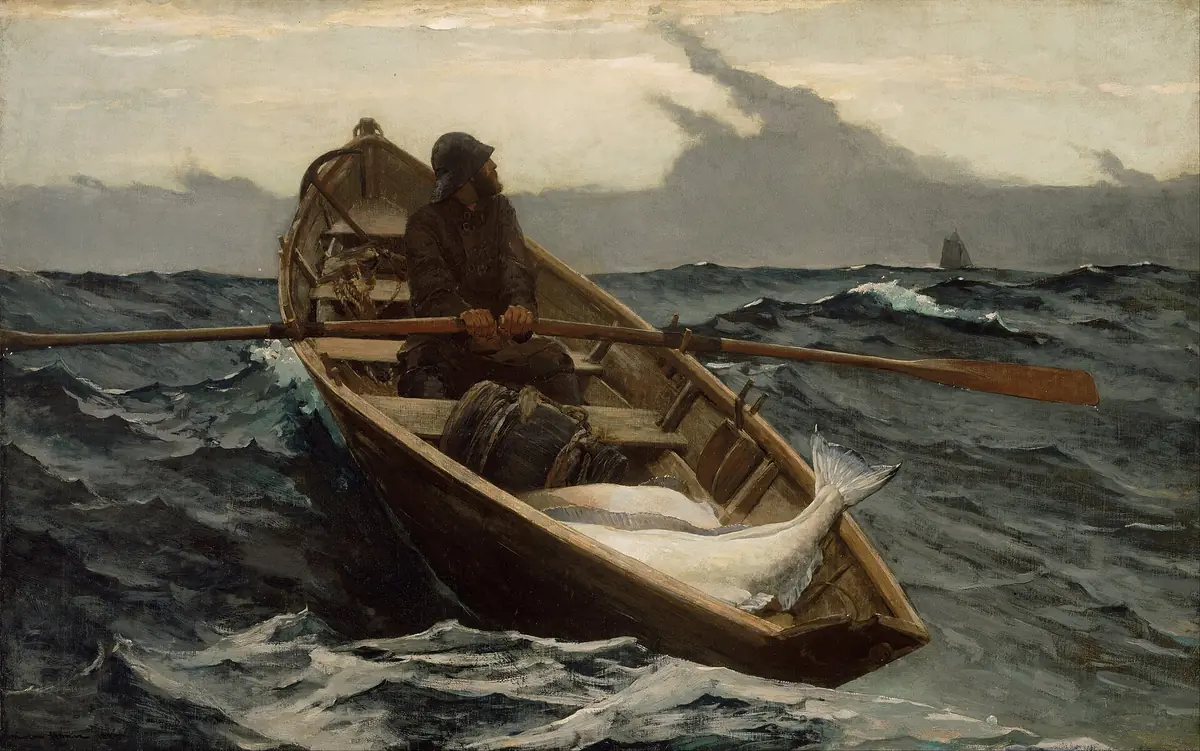
Image: Wikimedia Commons · Public domain (PD-Art) The Fog Warning
Look closely. A lone fisherman in a dory, two great fish in the boat, turns to look over his shoulder at the mother ship, while a bank of fog is already closing in on the horizon. Look at the twist of his body, at the distance to the ship, and at the still, dangerous beauty of the water he has to cross before the weather shuts down.
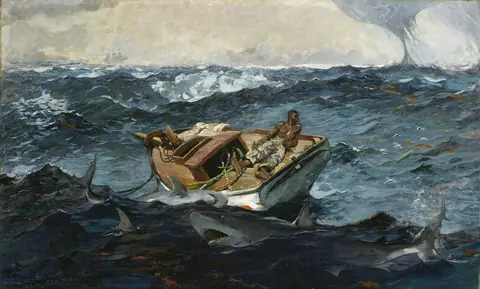
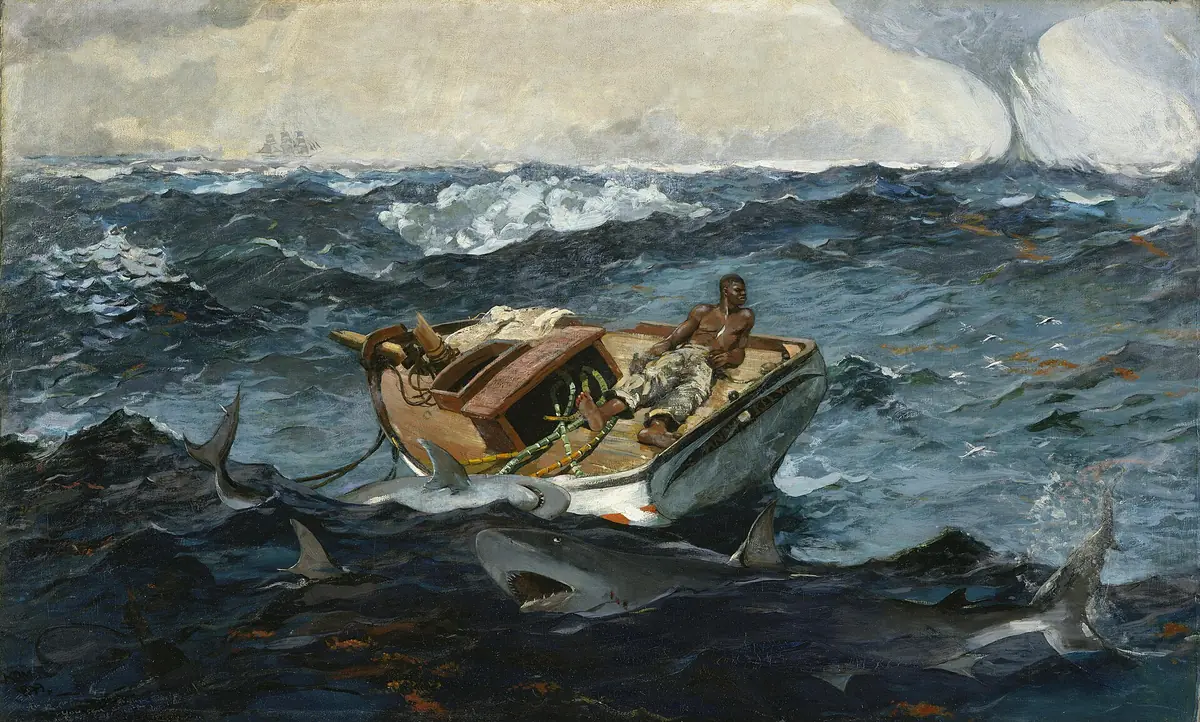
Image: Wikimedia Commons · Public domain (PD-Art) The Gulf Stream
Look closely. A bare-chested man in trousers lies in a dismasted, listing boat, sharks in the water around him, a waterspout at the right, and a ship far off on the horizon that may or may not have seen him. Look at his absorbed, almost waiting face, at the broken mast and the sugar-cane in the bow, and at the gap between the nearby danger and the distant, indifferent sail. (Teachers of younger children may wish to look first: the scene is one of real peril.)
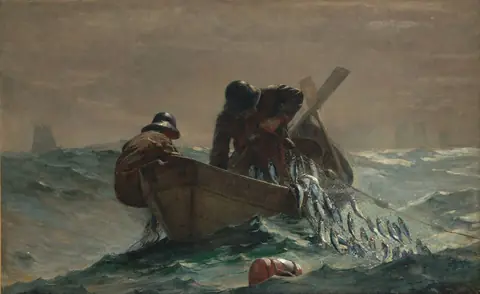
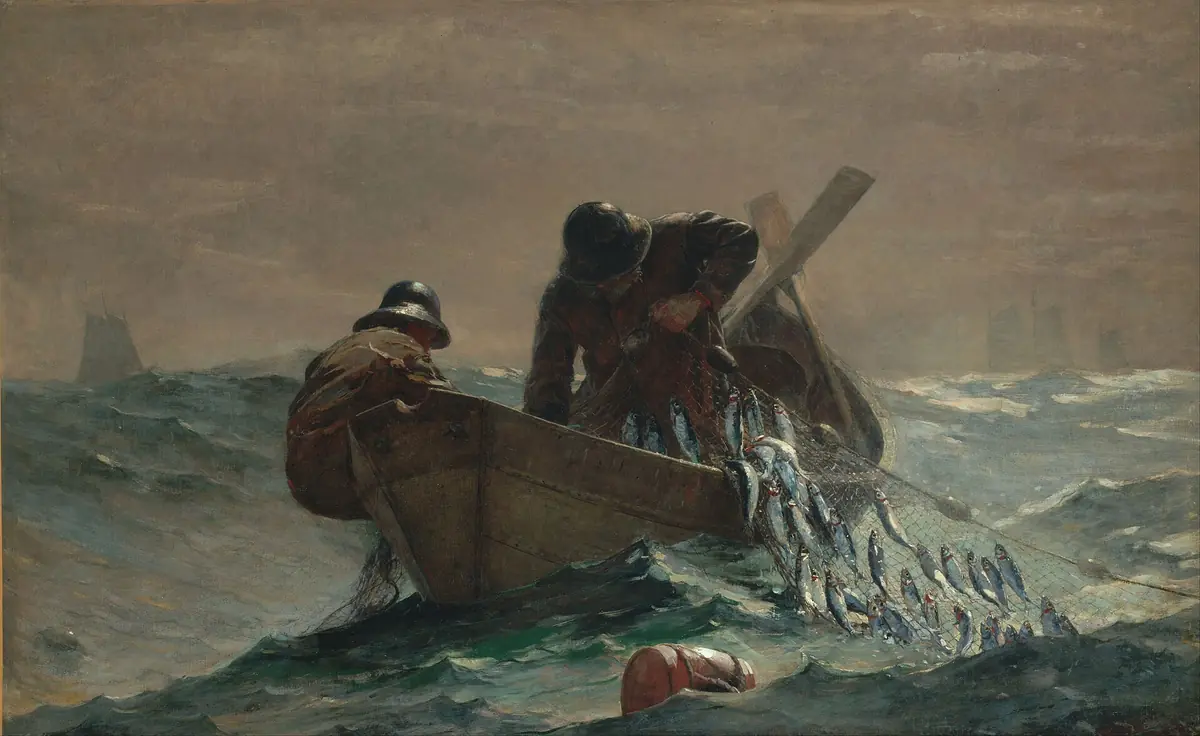
Image: Wikimedia Commons · Public domain (PD-Art) The Herring Net
Look closely. Two fishermen in a dory haul a heavy, glittering net of herring, their backs rounded to the work, the sea and fog almost the same pale tone around them. Look at the weight in the net, at the two different tasks in the same boat, and at how little of the horizon is allowed to comfort the labour.
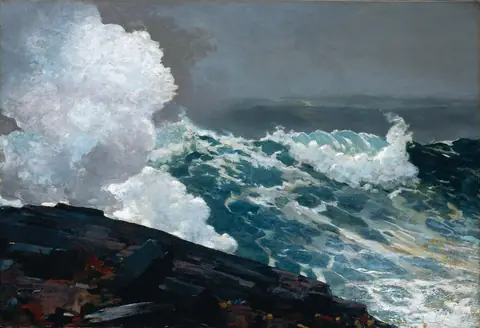
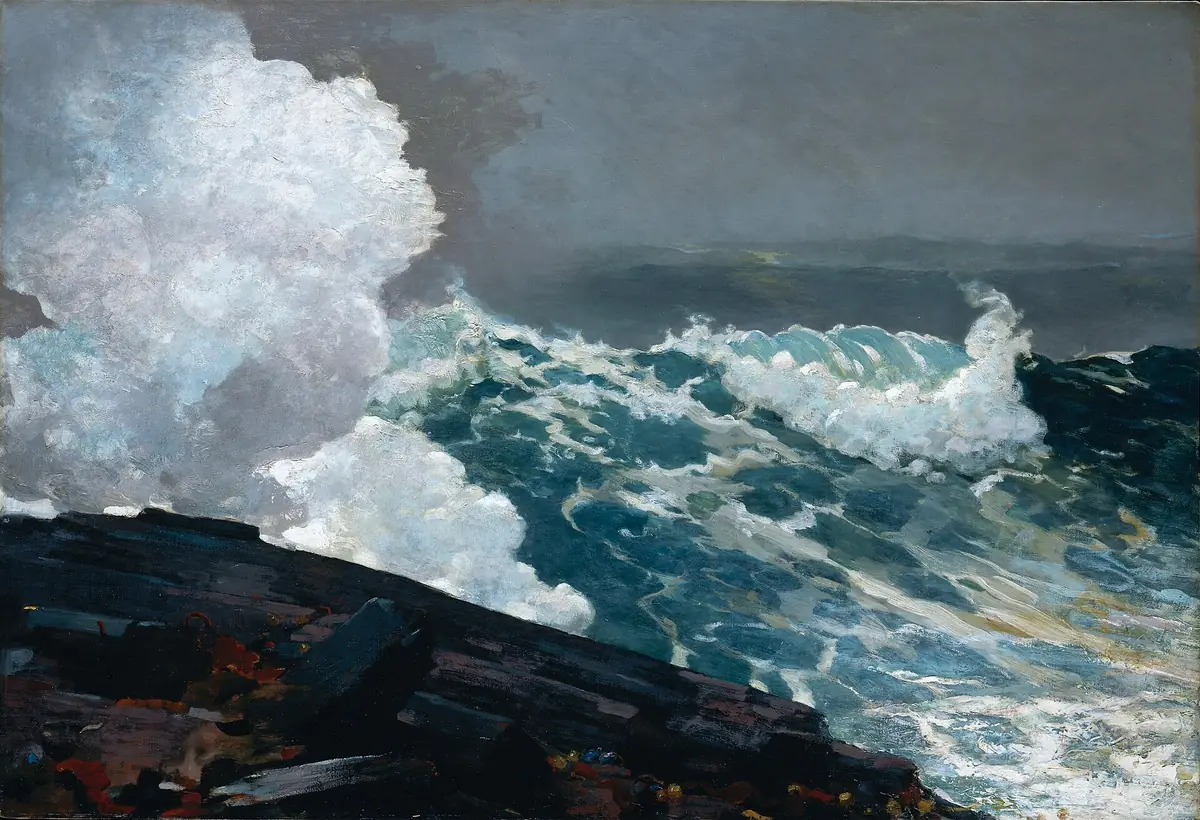
Image: Wikimedia Commons · Public domain (PD-Art) Northeaster
Look closely. A heavy sea breaks on a dark rocky shore; there are no figures, only water, foam and stone. Look at the force of the incoming wave, at the spray thrown up against the dull sky, and at how complete the picture is without a boat or a watcher.


What to watch for in Winslow Homer
Look slowly- Weather as danger or play. Ask whether the sea is a workplace, a threat, or a day out.
- A few figures, clearly doing something. Homer is not a painter of crowds for their own sake.
- The Civil War's afterlife. A veteran in a wheat field still carries the war in a canteen or a discarded coat.
- Light on water. Look at how a fog, a chop, or a breaking wave is built from spare, sure marks.
- No wasted corner. A basket, a mast, or a schoolhouse is there because it is needed.
Dates and collections follow the holding museums and Wikidata. Images of paintings are photographs of public-domain pictures from Wikimedia Commons or museum open-access releases; photographs of sculpture are used only when the photograph itself is Public domain, CC0, or CC BY with a named credit. Each picture links to its source page with full licence details.