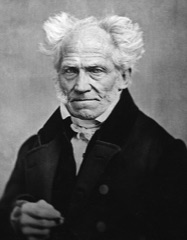
Arthur Schopenhauer
1788–1860 · German philosopher, author of The World as Will and Representation, known for his pessimism and his influence on artists and later thinkers.
Arthur Schopenhauer was born in 1788 in Danzig (now Gdańsk, Poland), the son of a wealthy merchant. His father hoped he would become a merchant too, and Arthur traveled through Europe with his parents as a boy. After his father's death in 1805 he turned to study, attending the universities of Göttingen and Berlin and earning a doctorate at Jena in 1813. His mother, Johanna Schopenhauer, became a well-known novelist in Weimar, where Arthur met Goethe. His main work, The World as Will and Representation (1818), drew on Plato, Kant and Indian philosophy, describing the world as the expression of a blind, striving will that causes suffering, which art, compassion and self-denial can relieve. He lectured briefly at Berlin, scheduling his classes at the same hour as Hegel's, but few students came. He lived quietly in Frankfurt from 1833, and his essays, Parerga and Paralipomena (1851), finally brought him fame. He died in Frankfurt in 1860.
Arthur Schopenhauer is also an author in the library: author page and works.
Faith: His philosophy drew on Buddhist thought. Source: Stanford Encyclopedia of Philosophy
Further reading
- Schopenhauer: A Very Short Introduction by Christopher Janaway (Oxford University Press, 2002), ISBN 9780192802590

Key dates
- 1788 Born in Danzig
- 1813 Doctorate from the University of Jena
- 1818 The World as Will and Representation published
- 1833 Settles in Frankfurt
- 1851 Parerga and Paralipomena published
- 1860 Dies in Frankfurt
Fun facts
- He started playing the flute as a boy and kept playing it all his life. (Source: Arthur Schopenhauer (Wikipedia))
Read about them
Grades 9–12
- The World as Will and Representation · In the library
- Essays and Aphorisms · In the library
More lives
Frédéric Bastiat · Eugen von Böhm-Bawerk · Thomas Carlyle · Carl von Clausewitz · Samuel Taylor Coleridge · John Dewey