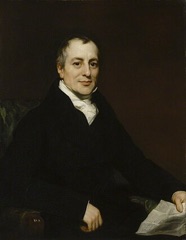
David Ricardo
1772–1823 · English economist of the classical school, known for comparative advantage, the theory of rent and the labour theory of value.
David Ricardo was born in London in 1772, the third child of a Sephardic Jewish family that had come from the Netherlands. At fourteen he joined his father's business on the London Stock Exchange. At twenty-one he married Priscilla Anne Wilkinson, a Quaker, which led to a break with his parents; he later became a Unitarian. Working on his own account, he became one of the richest men in England, partly through government loans during the Napoleonic Wars. Reading Adam Smith's Wealth of Nations in 1799 drew him to economics. His pamphlets on paper money (1810) and on the corn laws (1815) led to his major work, On the Principles of Political Economy and Taxation (1817), which set out the theory of comparative advantage. He retired to Gatcombe Park in Gloucestershire, sat in Parliament from 1819 and was a close friend and critic of Thomas Malthus. He died in 1823, aged fifty-one.
David Ricardo is also an author in the library: author page and works.
Faith: Born into a Sephardic Jewish family; by 21 he had broken with his father over religion, become a Unitarian and married a Quaker. Source: Encyclopaedia Britannica
See also: Adam Smith · John Stuart Mill

Key dates
- 1772 Born in London
- 1793 Marries Priscilla Anne Wilkinson
- 1799 Reads The Wealth of Nations
- 1810 The High Price of Bullion published
- 1817 Principles of Political Economy and Taxation published
- 1819 Enters Parliament for Portarlington
- 1823 Dies at Gatcombe Park
Read about them
Grades 9–12
- On the Principles of Political Economy and Taxation · In the library
More lives
Frédéric Bastiat · Eugen von Böhm-Bawerk · Thomas Carlyle · Carl von Clausewitz · Samuel Taylor Coleridge · John Dewey