G. K. Chesterton
1874–1936 · English writer of the Father Brown stories, Orthodoxy and witty essays.
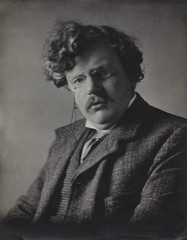
Gilbert Keith Chesterton was born in London, the son of a real estate agent, and studied art at the Slade School. He became a journalist and one of the most famous writers of his day, producing about a hundred books and thousands of newspaper essays. A huge man who wore a cape and a broad hat, he was known for his cheerful humor and his love of paradox, turning ideas upside down to show their truth. He debated friendly opponents such as George Bernard Shaw and H. G. Wells. In Orthodoxy, published in 1908, he explained how he had come to Christian belief, describing it as finding that the truth was stranger and more exciting than any heresy. He created Father Brown, a quiet Catholic priest who solves crimes through his understanding of human nature, and wrote novels, poems such as Lepanto, and biographies of Francis of Assisi, Thomas Aquinas and Charles Dickens. In 1922 he entered the Catholic Church. His book The Everlasting Man helped lead C. S. Lewis toward Christianity. He died in 1936 at his home in Beaconsfield.
G. K. Chesterton is also an author in the library: author page and works.
Faith: A Christian from his youth who moved from Anglicanism to the Catholic Church in 1922. Source: Wikipedia

Key dates
- 1874 Born in London
- 1908 Orthodoxy
- 1911 The Innocence of Father Brown; Lepanto
- 1922 Enters the Catholic Church
- 1925 The Everlasting Man
- 1936 Dies at Beaconsfield
Fun facts
- He usually wore a cape and a crumpled hat and carried a swordstick, and he loved friendly public debates with men such as George Bernard Shaw. (Source: G. K. Chesterton (Wikipedia))
- According to his autobiography, he and Shaw once played cowboys in a silent film that was never released. (Source: G. K. Chesterton (Wikipedia))
In their words
“I did try to found a heresy of my own; and when I had put the last touches to it, I discovered that it was orthodoxy.”
“Tradition means giving votes to the most obscure of all classes, our ancestors. It is the democracy of the dead.”
Read about them
Grades 6–8
- Lepanto · In the library
Grades 9–12
- The Innocence of Father Brown · In the library
- Orthodoxy · In the library