Gregor Mendel
1822–1884 · Augustinian friar whose pea-plant experiments founded genetics.
Johann Mendel was born to a farming family in Heinzendorf, in Austrian Silesia, now the Czech Republic. Bright but poor, he struggled to pay for his education, and in 1843 he joined the Augustinian abbey of St. Thomas in Brno, taking the name Gregor. The abbey sent him to the University of Vienna to study physics, mathematics and natural science, and he then taught at a local school. Between 1856 and 1863, in the abbey garden, he grew and crossed about 28,000 pea plants, tracking seven traits such as tall or short stems, round or wrinkled seeds, and flower color. Counting the results carefully, he found regular ratios, such as three to one, and concluded that traits are passed on as separate units, now called genes, one from each parent, with some dominant and others recessive. He presented his work in 1865 and published it in 1866, but its importance was not recognized. In 1868 he was elected abbot, and administrative duties took up his later years. He died in 1884. In 1900 three scientists independently rediscovered his laws.
Gregor Mendel is also an author in the library: author page and works.
Faith: Augustinian friar and Catholic priest who later became abbot of St Thomas's Abbey in Brno. Source: Wikipedia
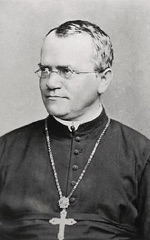
Key dates
- 1843 Enters the abbey at Brno
- 1856–1863 Pea-plant experiments
- 1866 Publishes his results
- 1868 Elected abbot
- 1884 Dies in Brno
- 1900 His work rediscovered
Fun facts
- Mount Mendel in New Zealand was named after him in 1970. (Source: Gregor Mendel (Wikipedia))
Watch


Videos load from YouTube in privacy-enhanced mode only when you press play.
In their words
“The value and utility of any experiment are determined by the fitness of the material to the purpose for which it is used”
Read about them
Grades 9–12
More lives
Edwin A. Abbott · Charles Babbage · Claude Bernard · George Boole · Josef Breuer · Lewis Carroll