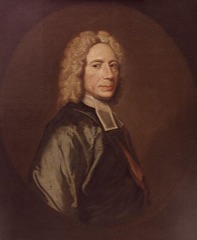
Isaac Watts
1674–1748 · English Congregationalist minister and hymn writer, often called the father of English hymnody, author of Joy to the World.
Isaac Watts was born in Southampton in 1674, the eldest son of a Nonconformist schoolmaster who had been imprisoned for his beliefs. Because Dissenters were barred from Oxford and Cambridge, he studied at a Dissenting academy in Stoke Newington. Finding the metrical psalms sung in churches dull, he began writing new hymns, and in 1702 became pastor of the Independent congregation at Mark Lane in London. Poor health later limited his preaching, and he spent his last thirty-six years as a guest of Sir Thomas Abney and his family at Theobalds and Stoke Newington. His Hymns and Spiritual Songs (1707) and The Psalms of David Imitated in the Language of the New Testament (1719) changed congregational singing in English, and include When I Survey the Wondrous Cross, Our God, Our Help in Ages Past and Joy to the World. He also wrote Divine Songs for children, a widely used textbook on logic and works of theology. He died in 1748 and is buried at Bunhill Fields in London. Congregations around the world still sing his hymns in worship.
Isaac Watts is also an author in the library: author page and works.
Faith: English minister and pastor of an independent (Nonconformist) congregation; a hymn writer. Source: Dictionary of National Biography (1885–1900) (via Wikisource)
See also: Charles Wesley
Key dates
- 1674 Born in Southampton
- 1702 Pastor at Mark Lane, London
- 1707 Hymns and Spiritual Songs published
- 1715 Divine Songs for children
- 1719 The Psalms of David Imitated
- 1748 Dies at Stoke Newington
Watch


Videos load from YouTube in privacy-enhanced mode only when you press play.
Read about them
Grades 9–12
- Hymns and Spiritual Songs · In the library
More lives
Richard Allen · George Berkeley · William Blake · James Boswell · Robert Burns · William Cowper