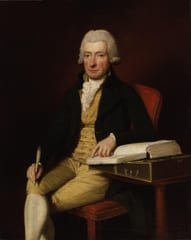
William Cowper
1731–1800 · Evangelical poet of The Task, John Gilpin and the Olney Hymns, and an early poetic voice against the slave trade.
William Cowper was born on 26 November 1731 at Great Berkhamsted, Hertfordshire, where his father was rector. His mother died when he was six. After Westminster School he trained as a lawyer, but in 1763, facing an examination for a clerkship in the House of Lords, he suffered a breakdown and attempted suicide. At Dr Nathaniel Cotton's asylum in St Albans he recovered and underwent an evangelical conversion. He lived afterwards with the Unwin family, settling at Olney with Mary Unwin in 1767, where John Newton was curate; together they wrote the Olney Hymns (1779). Recurring depression, including the conviction that he was damned, troubled him for the rest of his life, yet he wrote cheerful letters, the comic John Gilpin and the long poem The Task (1785). He translated Homer and spoke out against slavery. He died at East Dereham, Norfolk, on 25 April 1800.
William Cowper is also an author in the library: author page and works.
Faith: An evangelical Anglican converted in 1764 at St Albans, Cowper co-wrote the Olney Hymns with John Newton, though recurrent depression left him long convinced he was excluded from grace. Source: Encyclopaedia Britannica
See also: John Newton · William Wilberforce · Oliver Goldsmith · William Wordsworth · Samuel Taylor Coleridge

Key dates
- 1731 Born at Great Berkhamsted, 26 November
- 1763 Breakdown; confined at St Albans, where he is converted
- 1767 Settles at Olney with Mary Unwin; meets John Newton
- 1779 Olney Hymns published with Newton
- 1785 The Task and John Gilpin published
- 1800 Dies at East Dereham, 25 April
In their words
“God made the country, and man made the town.”
“I was a stricken deer that left the herd Long since;”
Read about them
Grades 3–5
- The Diverting History of John Gilpin · In the library
Grades 9–12
- Olney Hymns · In the library
- The Task · In the library
More lives
William Blake · James Boswell · Robert Burns · John Dickinson · Denis Diderot · Robert Fergusson