Johannes Kepler
1571–1630 · German astronomer who discovered that planets move in ellipses.
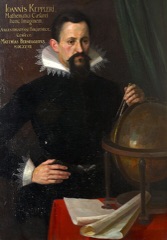
Johannes Kepler was born in Weil der Stadt, Germany, to a poor family. Smallpox in childhood left him with weak eyesight. He studied theology at Tübingen, intending to become a Lutheran minister, but a teacher there introduced him to the idea of Copernicus that the planets circle the Sun, and he became a mathematics teacher in Graz. In 1600 he went to Prague to work with the Danish astronomer Tycho Brahe, who had made the most accurate observations of the planets ever recorded. After Tycho died in 1601, Kepler became imperial mathematician and spent years working on the orbit of Mars. He found that the planets move in ellipses, not perfect circles, and move faster when closer to the Sun, published in his New Astronomy in 1609; a third law, relating a planet's period to its distance, followed in 1619. He believed he was thinking God's thoughts after him. His life was hard: his first wife and several children died, and he spent years defending his mother against a charge of witchcraft. He died in 1630.
Johannes Kepler is also an author in the library: author page and works.
Faith: Born to Lutheran parents and trained at a Lutheran seminary; he remained a Lutheran. Source: Wikipedia
Key dates
- 1571 Born in Weil der Stadt
- 1600 Joins Tycho Brahe in Prague
- 1609 Publishes New Astronomy with his first two laws
- 1619 Publishes Harmony of the World with his third law
- 1630 Dies at Regensburg
Record-breaker
Firsts and records, worded as the sources give them ("first known", "at the time").
- Neuroscientists generally consider him the first to recognise that the eye projects images onto the retina upside down and reversed. (Source: Johannes Kepler (Wikipedia))
Watch


Videos load from YouTube in privacy-enhanced mode only when you press play.
Read about them
Grades 9–12
- New Astronomy and The Harmony of the World · In the library
- Epitome of Copernican Astronomy · In the library
More lives
Francis Bacon · Robert Boyle · Nicolaus Copernicus · René Descartes · Galileo Galilei · William Gilbert